Author: koreainsideout

  • Autumn in Korea: Where to See Fall Foliage, Seasonal Foods & More

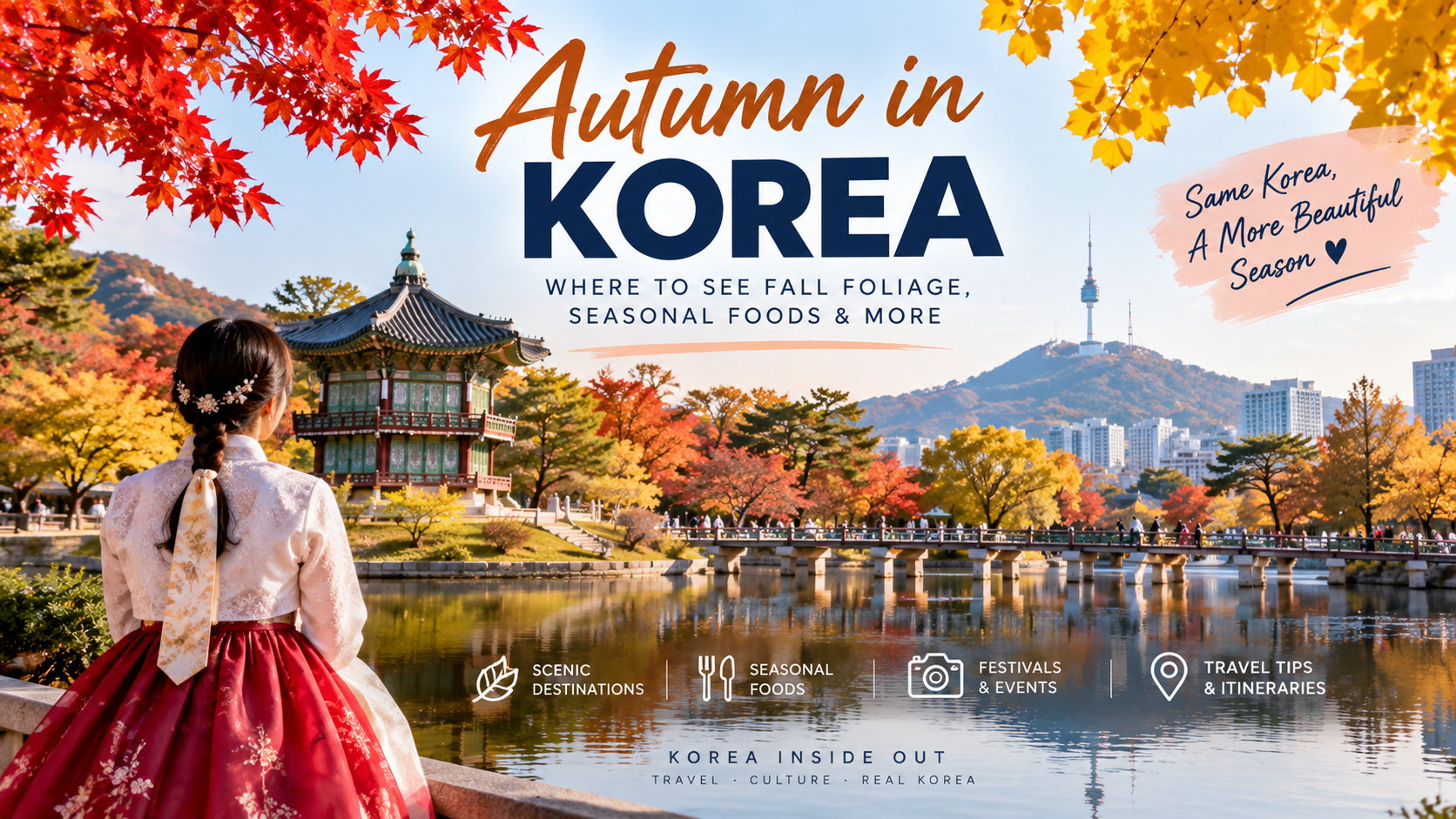
    Autumn in Korea: Where to See Fall Foliage, Seasonal Foods & More

    A Local’s Guide to Experiencing Korea in Fall

    If you’ve ever seen photos of Korea in autumn, you probably understand why this is one of the most beautiful times of year to visit.

    Golden ginkgo trees line city streets.

    Maple leaves turn brilliant shades of red and orange.

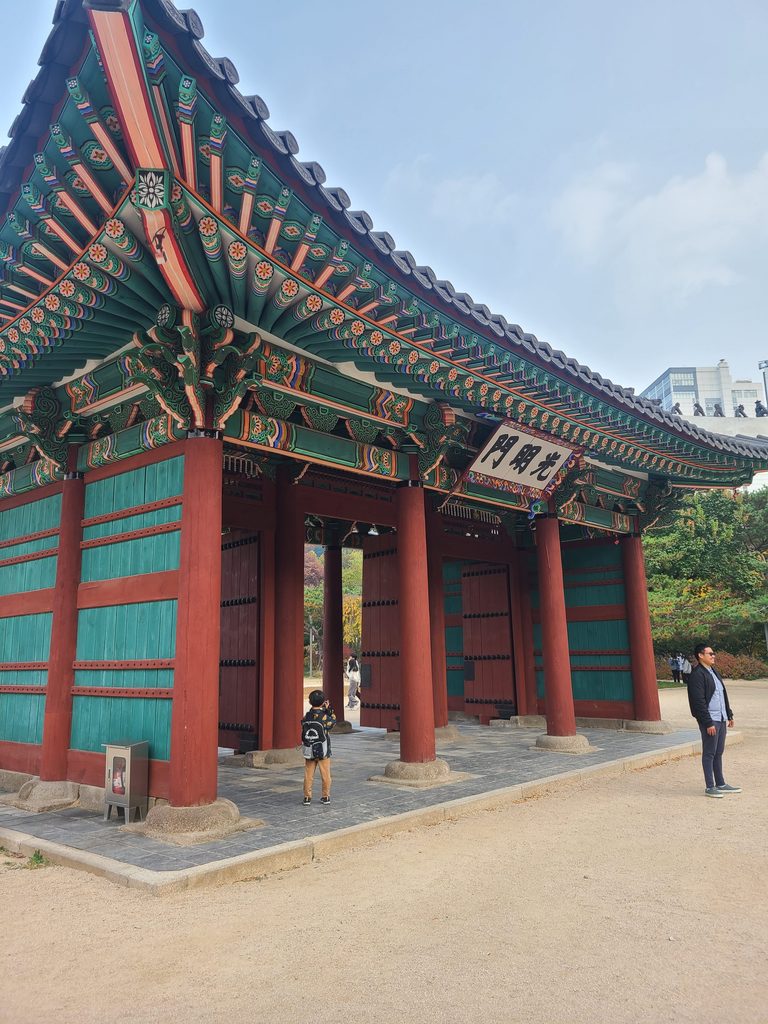
    Palaces become surrounded by autumn colors.

    Mountain trails transform into spectacular landscapes.

    And then there are the seasonal foods, festivals, outdoor markets and cool evenings that make autumn feel completely different from summer in Korea.

    If you’re planning a trip to South Korea between September and November, here’s our practical guide to experiencing autumn like a local.
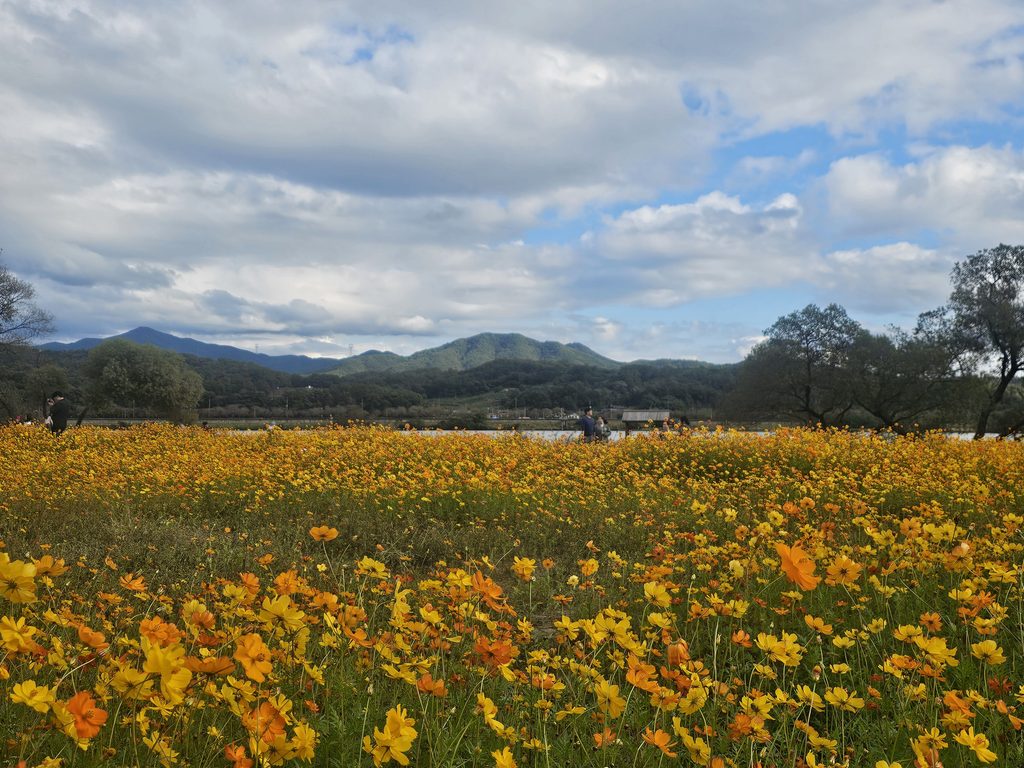

    🍂 When Is Autumn in Korea?

    Autumn generally arrives in Korea from September through November, but the timing of fall foliage varies considerably depending on where you are.

    The first autumn colors usually appear in the northern and mountainous areas before gradually moving south.

    In general:

    Late September–early October
    → First fall colors in higher elevations, especially around Seoraksan

    Mid–late October
    → Beautiful autumn scenery across much of Korea

    Late October–early November
    → Often the best period for Seoul and many central regions

    Early–mid November
    → Southern Korea and some lower-elevation areas can still have beautiful foliage

    These are general patterns rather than guaranteed dates. Weather conditions can shift the foliage season from year to year. The official 2025 forecast, for example, placed peak foliage at Seoraksan in late October and Bukhansan in early November.

    So if you’re planning a trip specifically for autumn colors, don’t choose your destination based on a single date.

    Choose a region that matches the time of your trip.


    🍁 1. Seoul — Autumn Without Leaving the City

    You don’t need to leave Seoul to enjoy fall foliage.

    In fact, some of the best autumn scenery in Korea can be found right in the middle of the capital.

    Gyeongbokgung Palace
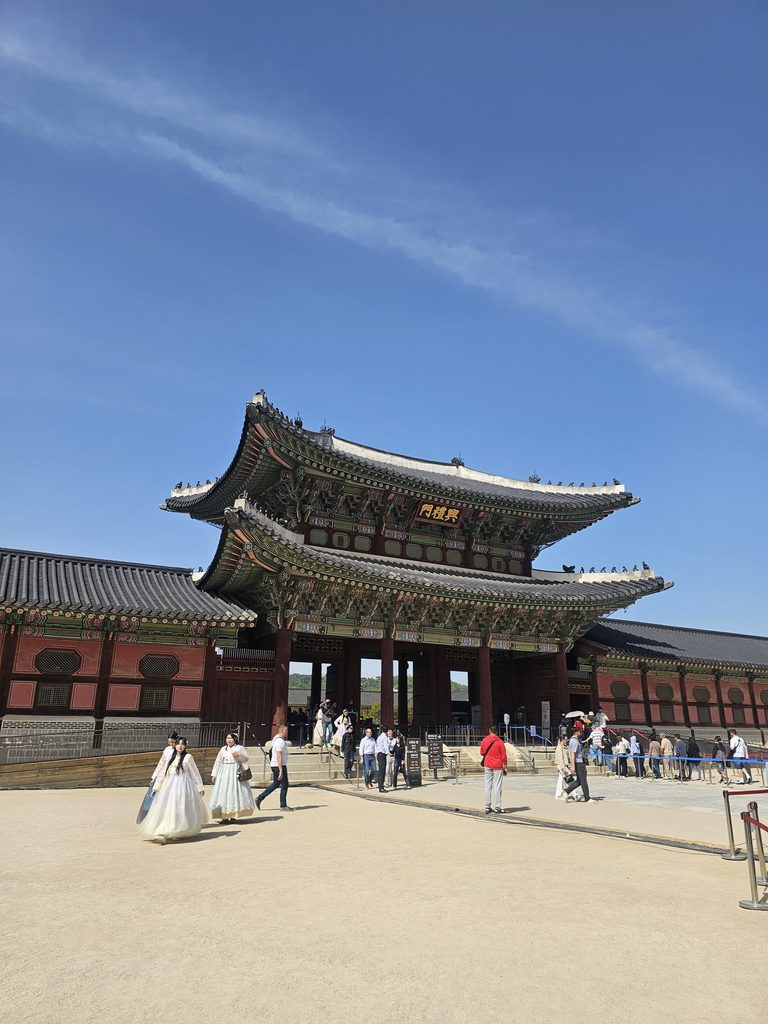
    One of the most iconic combinations is simple:

    Korean palace + traditional architecture + autumn leaves.

    Visit Gyeongbokgung in the morning, when the palace grounds are relatively peaceful, and walk around the surrounding areas afterward.

    Renting a hanbok can make the experience even more memorable — and visitors wearing traditional Korean clothing can enter many palace areas without paying the standard admission fee.


    Deoksugung Stone Wall Road

    If you want an easy autumn walk in central Seoul, don’t overlook Deoksugung’s Stone Wall Road.
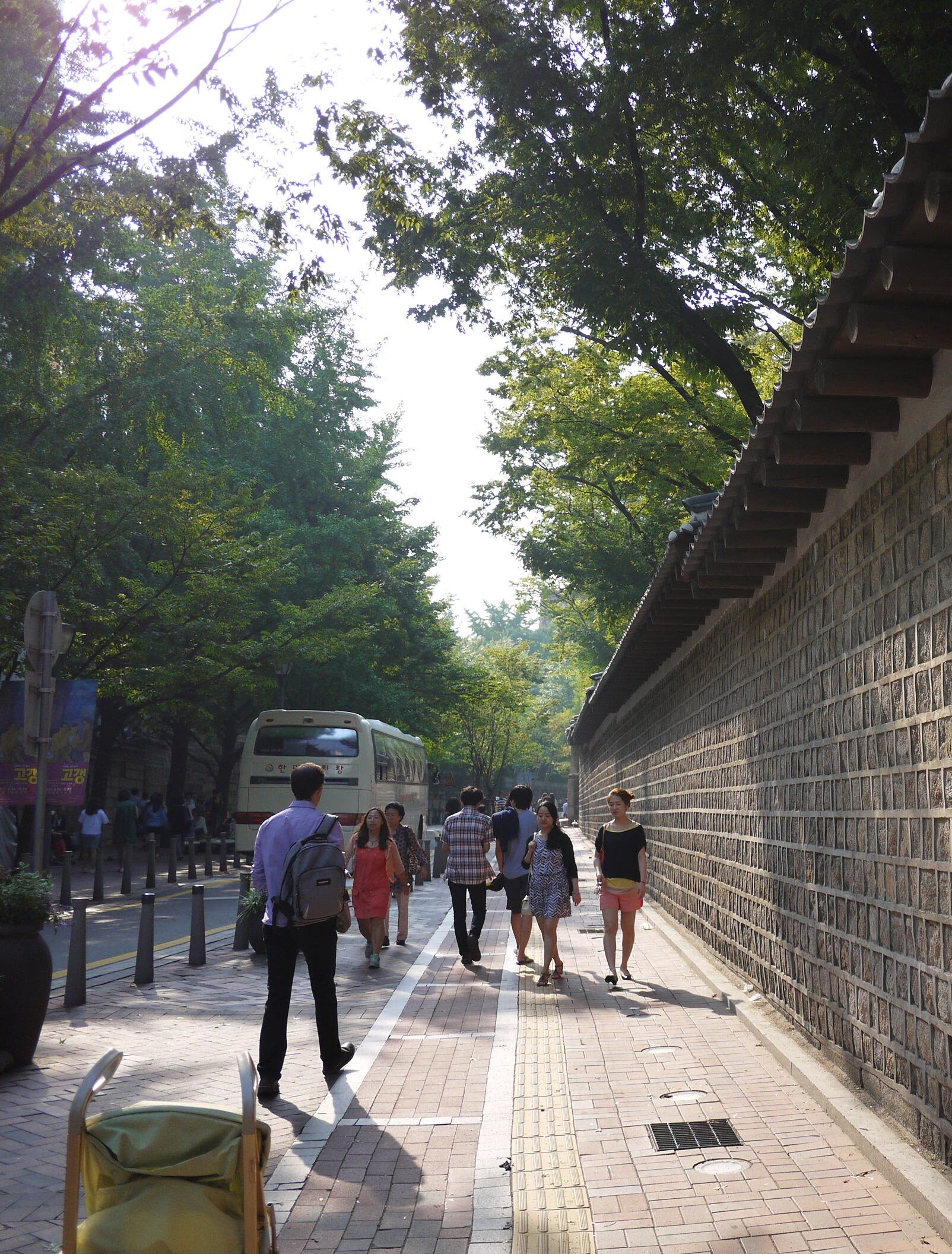
    The road is particularly beautiful when the ginkgo trees turn golden.

    It’s also convenient because you’re right in the middle of Seoul, close to City Hall, museums, cafés and historic attractions.

    This is one of those places where you don’t need to dedicate an entire day.

    An hour-long autumn walk can be enough.


    Seoul Forest

    Want something more relaxed?

    Head to Seoul Forest.

    Located near Seongsu, Seoul Forest combines walking paths, trees, open lawns and seasonal scenery with one of Seoul’s trendiest neighborhoods.

    You can spend the afternoon walking through the park and then head into Seongsu for cafés, restaurants and shopping.

    It’s a particularly good combination for travelers who want to mix nature and modern Seoul.

    The Korea Tourism Organization also lists Seoul Forest among Seoul’s recommended autumn forest destinations.


    🏔️ 2. Seoraksan — For the Classic Korean Autumn Experience

    If your main goal is spectacular mountain scenery, Seoraksan National Park should be high on your list.

    Located near Sokcho in Gangwon State, Seoraksan is one of Korea’s most famous autumn destinations.

    The combination of:

    • 🍁 Red and yellow foliage
    • ⛰️ Dramatic mountain peaks
    • 🌲 Forest trails
    • 🏯 Temples
    • 🌊 Nearby East Sea beaches

    makes the area ideal for a short autumn getaway.

    It’s also one of the first major areas in Korea to show autumn colors because of its elevation.

    Our tip

    Don’t try to squeeze Seoraksan into a few hours from Seoul.

    If you have time, stay overnight in Sokcho.

    You can enjoy the mountain during the day and seafood and the beach in the evening.

    That gives you a much more relaxed experience.


    🌳 3. Hwadam Botanic Garden — One of the Best Day Trips from Seoul

    Looking for autumn scenery without traveling all the way to a national park?

    Consider Hwadam Botanic Garden in Gwangju, Gyeonggi-do.

    The garden is designed around a forested landscape with thousands of plant species, walking paths and a monorail.

    In autumn, the trees become a spectacular mix of red, orange and yellow.

    It’s about 1.5 hours from Seoul by public transportation, making it possible as a day trip.

    One important thing to know

    Hwadam Botanic Garden is extremely popular during peak foliage season.

    Tickets can sell out, and online reservations are required.

    Don’t simply show up expecting to buy a ticket at the entrance.

    Check the official reservation information before making the trip.


    🌿 4. Nami Island — Easy, Scenic & Tourist-Friendly

    If you’re looking for an easy autumn day trip from Seoul, Nami Island is another popular choice.

    The island is famous for its tree-lined roads, walking paths and seasonal scenery.

    It’s particularly photogenic in autumn, when the long rows of trees turn yellow and orange.

    The advantage for international visitors is that Nami Island is relatively easy to navigate and has plenty of facilities, restaurants and activities.

    It’s more touristy than some of the other destinations on this list.

    But sometimes that’s exactly what you want.

    Easy transportation + beautiful scenery + plenty of things to do.


    🍂 5. Bulguksa Temple in Gyeongju

    Want to combine autumn foliage with Korean history?

    Go to Gyeongju.

    The ancient city was once the capital of the Silla Kingdom and is filled with historical sites.

    One of the most beautiful autumn combinations is Bulguksa Temple surrounded by fall colors.

    The temple is a UNESCO World Heritage site, and its traditional architecture looks particularly beautiful against the autumn landscape.

    Gyeongju is also easy to combine with:

    • Donggung Palace & Wolji Pond
    • Daereungwon Tomb Complex
    • Cheomseongdae
    • Hwangnidan-gil
    • Traditional cafés
    • Historic neighborhoods

    If you have several days in Korea, Seoul + Gyeongju + Busan makes an excellent autumn itinerary.


    🌊 6. Busan — Autumn by the Ocean

    Busan isn’t usually the first city people think about when they hear “fall foliage.”

    But autumn is actually a wonderful time to visit.

    The weather becomes cooler while the beaches remain beautiful.

    You can walk along Gwangalli or Haeundae without the intense summer heat, explore cafés, hike coastal trails and enjoy Busan’s growing nighttime culture.

    And autumn brings some of Busan’s biggest annual events.

    🎬 Busan International Film Festival

    The Busan International Film Festival takes place in October and is one of Asia’s most important international film festivals.

    The 2026 festival is scheduled for October 6–15 in Haeundae.

    🎸 Busan International Rock Festival

    If music is more your thing, the Busan International Rock Festival takes place October 2–4, 2026, at Samnak Eco Park.

    So if you’re visiting Korea in October, Busan offers something different:

    Autumn without giving up the ocean.


    🍵 What Should You Eat in Korea in Autumn?

    Autumn isn’t just about scenery.

    It’s also one of the best seasons for Korean food.

    Here are a few things worth trying.

    🍠 Roasted Sweet Potatoes

    You may see roasted sweet potatoes being sold at street stalls or seasonal vendors as the weather gets cooler.

    They’re simple, inexpensive and very Korean.


    🌰 Roasted Chestnuts

    Chestnuts are another classic autumn snack.

    You’ll find them at markets, seasonal stalls and sometimes convenience stores.


    🦀 Korean Autumn Seafood

    Autumn is an excellent season for seafood.

    Depending on where you’re traveling, look for seasonal dishes featuring:

    • Blue crab
    • Shrimp
    • Mackerel
    • Oysters
    • Squid
    • Various local shellfish

    Busan is particularly good if seafood is one of your priorities.


    🍐 Korean Pears

    Korean pears are particularly good in autumn.

    They’re much larger and juicier than many varieties found elsewhere and are often served as a dessert or eaten fresh.

    Look for Korean pear (배 / bae) at supermarkets and markets.


    🎉 Autumn Is Festival Season in Korea

    One of the best things about visiting Korea in autumn is the sheer number of festivals.

    The official Korea Tourism Organization’s 2026 autumn festival guide includes events covering traditional culture, food, music, fireworks and nighttime experiences.

    Some highlights include:

    🏮 Andong Maskdance Festival

    September 24 – October 4, 2026

    A great choice for travelers interested in traditional Korean performance and culture.

    🏯 Suwon Hwaseong Festival

    October 4–11, 2026

    Held around the UNESCO-listed Hwaseong Fortress, with traditional performances and a recreation of a Joseon-era royal procession.

    🏮 Jinju Namgang Yudeung Festival

    October 3–18, 2026

    Thousands of lanterns illuminate the Namgang River, creating one of Korea’s most spectacular nighttime autumn scenes.

    ☕ Gangneung Coffee Festival

    October 21–25, 2026

    Perfect if you’re interested in Korea’s rapidly growing specialty coffee culture.

    🍙 Gimcheon Gimbap Festival

    October 23–25, 2026

    Yes, Korea actually has a festival dedicated to gimbap.

    And it’s exactly as fun as it sounds.

    The 2026 official autumn festival lineup includes many more regional events, so it’s worth checking what’s happening near your destination before you travel.


    📸 Best Places for Autumn Photos

    If you’re mainly looking for beautiful photographs, these are some of our favorite types of locations:

    For traditional Korea

    Gyeongbokgung Palace
    Bulguksa Temple
    Namsangol Hanok Village

    For city scenery

    Seoul Forest
    Seokchon Lake
    Olympic Park

    For dramatic nature

    Seoraksan
    Naejangsan
    Juwangsan

    For a day trip

    Nami Island
    Hwadam Botanic Garden
    Garden of Morning Calm

    The Korea Tourism Organization also recommends locations including Namsan, Namhansanseong, Hwadam Botanic Garden, Nami Island, Seoraksan, Naejangsan and Bulguksa for autumn foliage.


    👟 What Should You Wear in Autumn?

    This is where many first-time visitors make a mistake.

    Korean autumn weather can change quickly.

    Early autumn can still feel like summer during the day.

    By November, evenings can be surprisingly cold.

    Instead of bringing one heavy jacket, layers are your friend.

    A good combination is:

    • T-shirt or light top
    • Light jacket or cardigan
    • Comfortable walking shoes
    • Lightweight scarf for later in the season

    If you’re hiking in the mountains, bring warmer layers.

    And don’t forget comfortable shoes.

    Autumn in Korea is a walking season.


    🗓️ How Long Should You Stay?

    If autumn scenery is one of the main reasons you’re visiting Korea, here’s a simple itinerary idea.

    🍁 5 Days

    Seoul → Seoul → Day trip → Seoul → Seoul

    Focus on palace areas, parks, cafés and one foliage day trip.

    🍂 7 Days

    Seoul → Seoul → Nami Island/Hwadam → Gyeongju → Gyeongju → Busan → Busan

    A good balance of history, nature and cities.

    🏔️ 10–14 Days

    You can add:

    Seoraksan + Sokcho

    or

    Jeonju + Jeongeup/Naejangsan

    and spend more time in the countryside.

    The longer you stay, the easier it becomes to follow the foliage south as autumn progresses.


    🍁 The Best Thing About Autumn in Korea

    There is something different about autumn in Korea.

    Summer is energetic.

    Winter is quiet.

    Spring is colorful.

    But autumn feels comfortable.

    People spend more time outdoors.

    Cafés open their terraces.

    Parks fill with people.

    Mountain trails become busy.

    And in the evening, the air becomes cool enough for a light jacket.

    You can spend the morning exploring a palace, have lunch at a local restaurant, drink coffee in a neighborhood café and finish the day walking beneath golden trees.

    You don’t need an elaborate itinerary.

    Sometimes autumn in Korea is best experienced simply by walking.


    🍂 Our Quick Guide to Autumn in Korea

    If you want…Go to…
    🏯 Traditional Korea + foliageGyeongbokgung
    🌳 An easy Seoul nature escapeSeoul Forest
    🏔️ Dramatic mountain scenerySeoraksan
    🚆 Easy day trip from SeoulNami Island
    🍁 Beautiful managed gardensHwadam Botanic Garden
    🏮 History + autumnGyeongju
    🌊 Autumn by the oceanBusan
    📸 Golden ginkgo treesSeoul & regional ginkgo groves
    🎉 Autumn festivalsAcross Korea
    ☕ Coffee + autumnGangneung

    🍁 Planning Your Autumn Trip to Korea?

    Autumn is one of the busiest travel seasons in Korea, particularly around peak foliage weekends.

    If you’re traveling specifically to see fall colors, don’t wait until the leaves are already changing to start planning.

    Choose your region based on your travel dates, check the foliage forecast closer to your trip, and make reservations for popular destinations such as Hwadam Botanic Garden in advance.

    And don’t forget that autumn in Korea isn’t just about leaves.

    It’s about food, festivals, hiking, cafés, night markets, traditional culture and simply spending more time outside.

    That’s what makes it such a great season to visit.

    Same Korea.
    A completely different season.


    More Korea Inside Out Guides

    Planning your first trip to Korea?

    Start with our practical guides:

    We’ll continue adding practical guides to help you see Korea like a local.
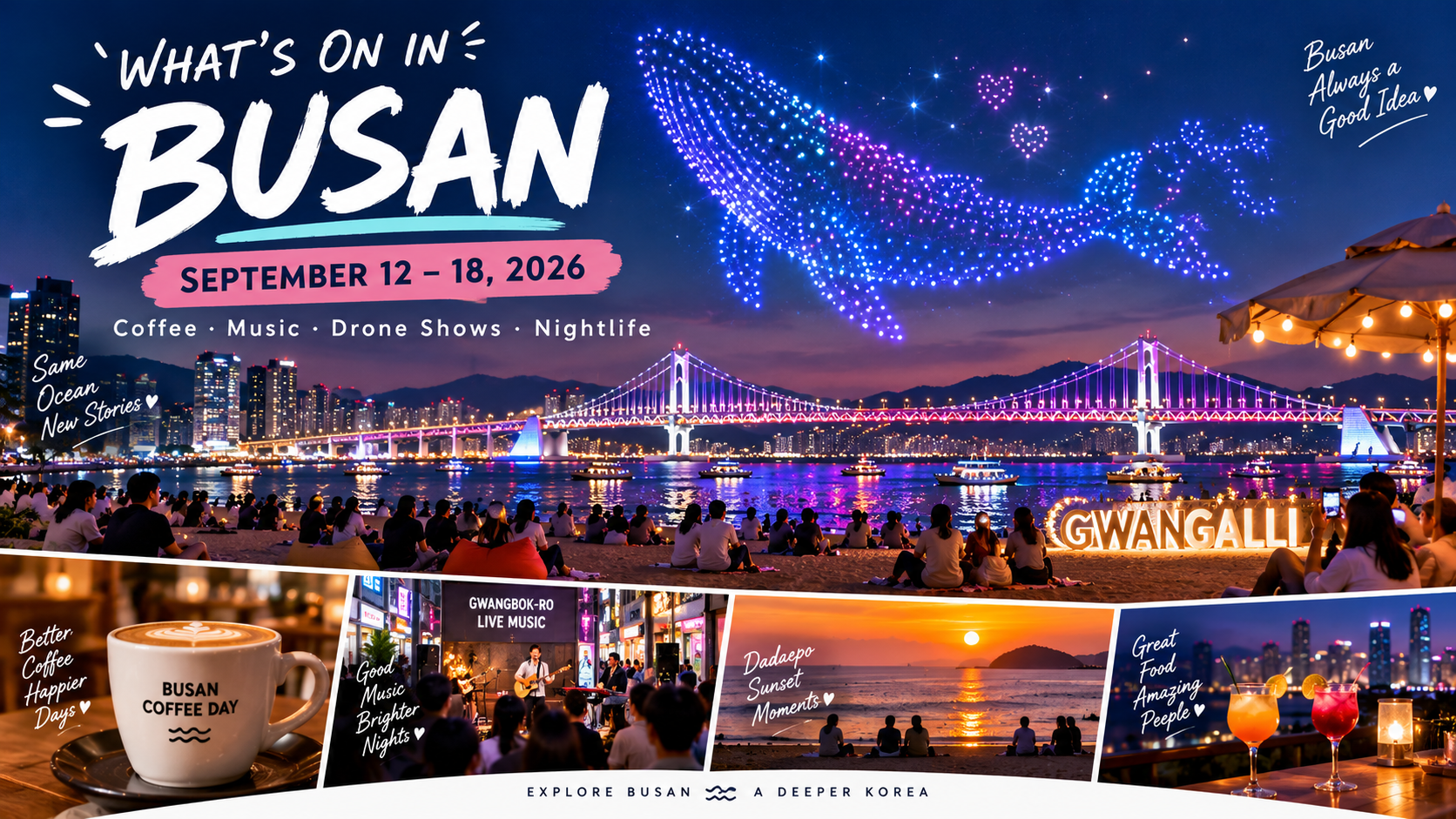
  • What’s On in Busan This Week: September 12–18, 2026

    What’s On in Busan This Week: September 12–18, 2026

    Coffee, Music, Drone Shows & More

    Planning to visit Busan this week?

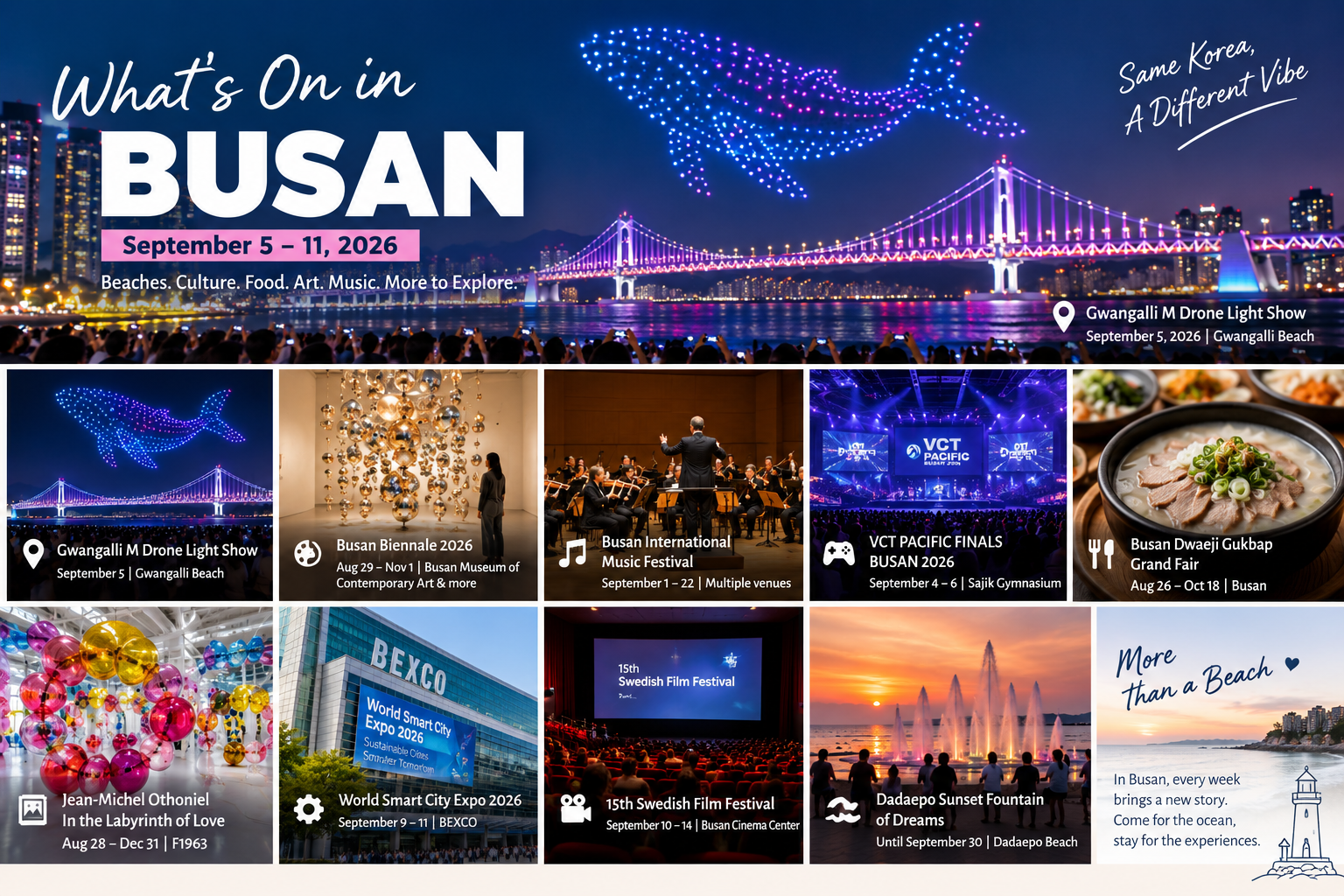
    From a coffee festival by the waterfront to a spectacular drone show at Gwangalli Beach, Busan has plenty happening from September 12 to 18, 2026.

    Here are some of the best events and experiences to add to your itinerary this week.


    ☕ 1. Busan Coffee Day

    📍 Millac the Market Plaza
    📅 Saturday, September 12

    If you love coffee, this is one event worth checking out.

    Busan Coffee Day 2026 takes place at Millac the Market Plaza, a waterfront destination near Gwangalli.

    Busan has developed a strong coffee culture in recent years, with independent cafés, specialty roasters and ocean-view coffee shops spread throughout the city.

    This event is a chance to experience that café culture in one place while enjoying the waterfront atmosphere.

    And if you have never tried Busan’s café scene before, September is a great time to start.


    🐋 2. Gwangalli M Drone Light Show

    📍 Gwangalli Beach
    📅 Saturday, September 12
    ⏰ 8:00 PM & 10:00 PM
    💰 Free

    The Gwangalli M Drone Light Show is back this Saturday.

    More than 1,000 drones create enormous images above Gwangalli Beach, with the illuminated Gwangan Bridge providing one of the most spectacular backdrops in Korea.

    This week’s theme is:

    🎮 “2026 LCK with Gwangalli”

    The show celebrates the world of Korean esports and the LCK.

    There are two performances on September 12, at 8:00 PM and 10:00 PM.

    If you’re visiting Busan for the first time, this is one of the easiest free experiences to recommend.

    Our tip: Get to Gwangalli before sunset, have dinner or coffee near the beach, and stay for the show.

    You get the sunset, the beach, the bridge and the drones — all in one evening.


    🎶 3. Gwangbok-ro Balcony Music Show

    📍 Gwangbok-ro, Jung-gu
    📅 Saturday, September 12
    ⏰ 7:00–9:00 PM
    💰 Free

    Want to experience Busan’s old downtown after dark?

    Head to Gwangbok-ro in Nampo-dong for the September edition of the Balcony Music Show.

    The street becomes an outdoor stage, with live performances combining contemporary music and Korean cultural elements.

    The September 12 lineup includes Jo Tae-jun & Busan Groove and Band Tandanji.

    It’s a particularly good option if you’re staying around Nampo-dong, Jagalchi or Busan Station.

    And because it’s free, you can simply stop by while exploring the neighborhood.


    🌅 4. Starry Night Busan: Night Music Campnic

    📍 Dadaepo Beach Park
    📅 September 11–12 & September 18–19
    ⏰ 5:00–10:00 PM

    This might be one of our favorite recommendations this week.

    Starry Night Busan: Night Music Campnic combines sunset, food, live music and a relaxed picnic atmosphere at Dadaepo Beach.

    The program includes:

    • 🌅 Sunset Eatnic — outdoor food and sunset views
    • 🎵 Night Music Campnic — live music under the stars
    • 🐕 Play Meongnic — a special experience for visitors with dogs
    • 🧘 Wellness programs

    The September 11–12 session is followed by another session on September 18–19.

    Dadaepo is on the western side of Busan and feels quite different from the busy atmosphere of Haeundae or Gwangalli.

    If you’ve already seen the famous beaches, this is a great way to discover another side of Busan.


    🎬 5. Swedish Film Festival

    📍 Busan Cinema Center
    📅 September 10–14

    The 15th Swedish Film Festival continues through September 14 at Busan Cinema Center.

    If you enjoy independent and international cinema, this is an interesting alternative to the usual Busan sightseeing itinerary.

    The festival is also a great excuse to visit Centum City, where you can combine a movie with shopping, restaurants and the nearby waterfront.


    🌱 6. ENTECH 2026 & World Climate Industry Expo

    📍 BEXCO
    📅 September 16–18

    Busan’s event calendar isn’t just about beaches and entertainment.

    Two major international exhibitions take place at BEXCO this week:

    • Environment & Energy Tech 2026 (ENTECH)
    • World Climate Industry EXPO 2026

    Both run from September 16–18.

    For visitors interested in sustainability, climate technology, energy or future cities, these events offer a very different perspective on Busan.

    It’s another reminder that Busan is not simply a beach destination — it is also one of Korea’s major international business and technology hubs.


    🎭 7. Doodle POP: A Family-Friendly Magic Drawing Show

    📍 Busan Citizens Hall
    📅 September 17–18

    Traveling with children?

    The Doodle POP magic drawing show comes to Busan Citizens Hall on September 17–18.

    It’s a family-friendly performance that combines drawing, visual effects and theater.

    If you’ve spent the week exploring beaches and markets, this can be a fun indoor option — especially if the weather isn’t cooperating.


    🎨 8. New Exhibitions at Busan Museum of Art

    📍 Busan Museum of Art
    📅 From September 17

    September 17 brings several new exhibitions to the Busan Museum of Art, including:

    • Future Museology
    • Still We Are Borne on These Waves: 1945–1953
    • Dear All The Yesterdays
    • Safe Base

    These exhibitions continue into 2027, so you don’t need to visit during this particular week.

    But if you’re in Busan from September 17 onward, it’s a good opportunity to see what’s new in the city’s contemporary art scene.


    📅 Busan This Week at a Glance

    EventDateLocationBest For
    ☕ Busan Coffee DaySep. 12Millac the MarketCoffee lovers
    🐋 Gwangalli Drone ShowSep. 12Gwangalli BeachNight views
    🎶 Gwangbok-ro Music ShowSep. 12Gwangbok-roLive music
    🌅 Night Music CampnicSep. 11–12, 18–19DadaepoSunset & music
    🎬 Swedish Film FestivalSep. 10–14Busan Cinema CenterFilm
    🌱 ENTECH 2026Sep. 16–18BEXCOTechnology
    🌍 World Climate Industry ExpoSep. 16–18BEXCOClimate & energy
    🎭 Doodle POPSep. 17–18Busan Citizens HallFamilies
    🎨 New BMA ExhibitionsFrom Sep. 17Busan Museum of ArtArt

    🌊 Our Pick: A Perfect Saturday in Busan

    If you only have one Saturday in Busan, here’s an easy itinerary:

    ☕ Afternoon

    Start with coffee around Millac the Market and enjoy the ocean view.

    🌅 Sunset

    Head toward Gwangalli Beach and watch the sky change over Gwangan Bridge.

    🍽️ Dinner

    Choose one of the many restaurants around Gwangalli.

    🐋 8:00 PM

    Watch the Gwangalli M Drone Light Show.

    🌙 9:00 PM

    Walk along the beach, grab a drink or dessert, and enjoy the nighttime view.

    And if you still have energy…

    🐋 10:00 PM

    Watch the second drone performance.


    💙 Why We Love Busan at Night

    There’s a reason Busan has been investing so heavily in nighttime tourism.

    During the day, the city is all about beaches, seafood, mountains and markets.

    But after sunset, Busan changes.

    The bridges light up.

    Music fills the streets.

    People gather along the beach.

    And the night sky becomes part of the entertainment.

    Busan isn’t just a city to visit during the day.

    It’s a city that really comes alive after dark.


    📌 Planning a Trip to Busan?

    We’ll keep updating this series every week with the latest festivals, exhibitions, performances, markets and seasonal events.

    Check back next week for What’s On in Busan: September 19–25, 2026.

  • What to Know Before Your First Trip to Korea: 12 Things Tourists Often Get Wrong

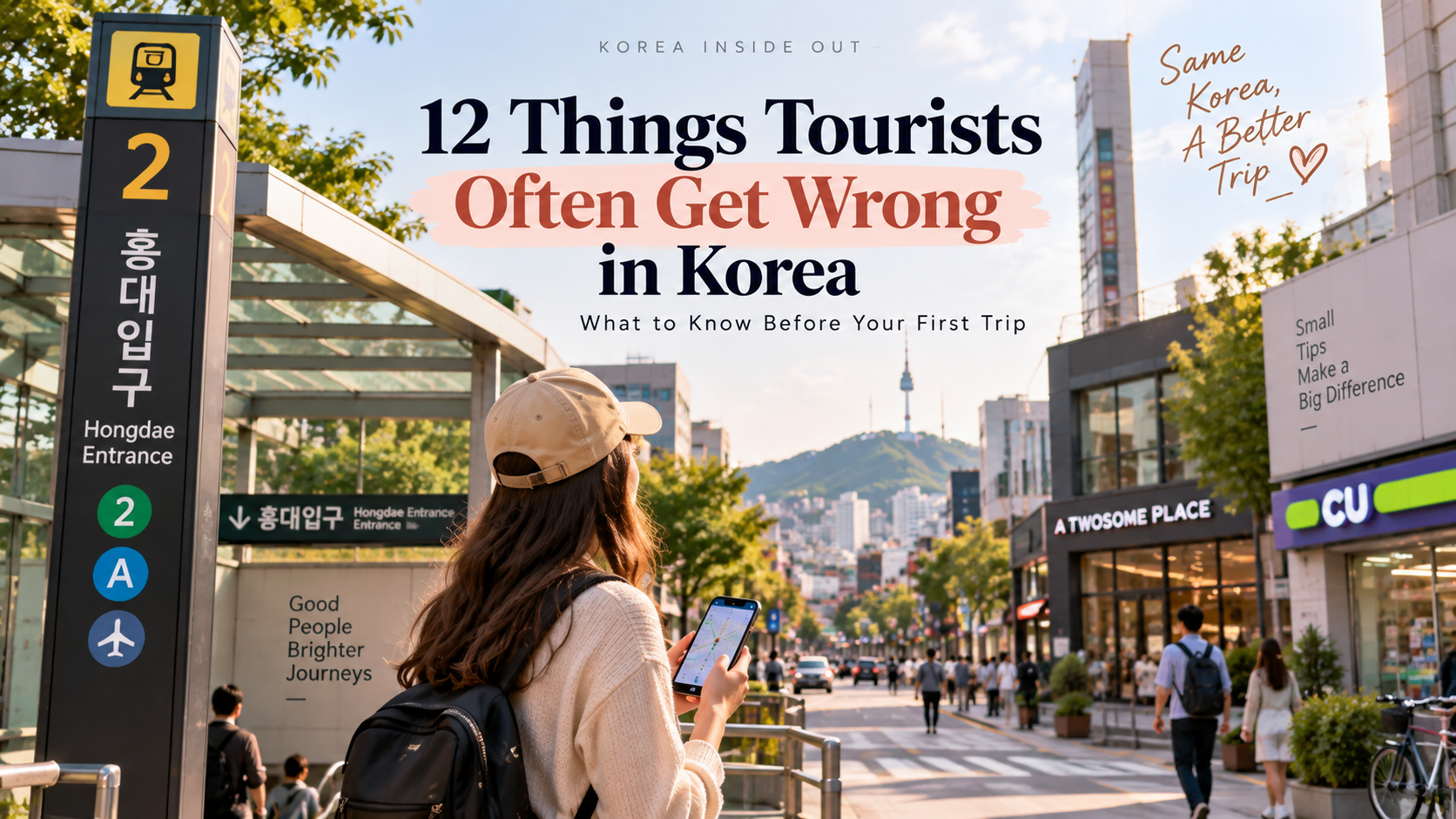
    What to Know Before Your First Trip to Korea: 12 Things Tourists Often Get Wrong

    Planning your first trip to Korea?

    You’ve probably already researched where to stay, what to eat, and what to see in Seoul.

    But some of the things that surprise visitors have nothing to do with the major tourist attractions.

    It’s the small things.

    Why can’t I find a trash can?

    Why doesn’t Google Maps work the way I expected?

    Do I need to tip?

    Why is everyone using their phone on the subway?

    Why did the restaurant staff leave my water on the table?

    Why did the café give me a buzzer?

    Korea is easy to travel around once you understand a few local habits, but knowing them beforehand can make your first few days much smoother.

    Here are 12 things I wish every first-time visitor knew before coming to Korea.


    1. Google Maps Isn’t Always the Best Map for Korea

    This is probably one of the biggest surprises for first-time visitors.

    You may arrive in Korea assuming you’ll use Google Maps for everything, just as you would in many other countries.

    But navigation in Korea can work differently.

    For detailed local navigation, many travelers find Naver Map or KakaoMap more useful, particularly for walking routes, local businesses, public transportation, and Korean addresses.

    That doesn’t mean you need to abandon Google Maps completely.

    Use it for familiar places, saved locations, reviews, and general planning if you like.

    But before your trip, it’s a good idea to install at least one Korean mapping app and become familiar with it.

    A simple strategy

    Use:

    Google Maps → general trip planning

    Naver Map or KakaoMap → detailed navigation in Korea

    You’ll thank yourself when you’re standing outside a subway station trying to find a tiny restaurant hidden down a side street.


    2. Korean Addresses Can Look Very Different From What You’re Used To

    Finding an address in Korea can initially feel confusing.

    You may see an address written in English, Korean, or a combination of both.

    Some places also have names that are easier to find in Korean than in English.

    This is especially common with:

    • Small restaurants
    • Independent cafés
    • Apartment buildings
    • Local shops
    • Businesses inside larger buildings

    The easiest solution

    Save the location on your map before leaving your hotel.

    Don’t rely only on remembering the name.

    If possible, save:

    • The Korean name
    • The English name
    • The map location
    • The building name
    • The nearest subway station

    This becomes especially useful when you’re visiting a small restaurant that doesn’t have an obvious English sign.


    3. Don’t Expect Trash Cans on Every Street

    This surprises many visitors.

    You can walk around a busy Seoul neighborhood for quite a while without seeing a public trash can.

    That doesn’t mean Seoul is dirty.

    Quite the opposite.

    You’ll often notice that streets are remarkably clean despite the relatively limited number of public bins.

    So what should you do with your empty coffee cup or snack wrapper?

    Keep it with you for a while.

    You can usually find disposal points at:

    • Convenience stores
    • Subway stations
    • Shopping malls
    • Tourist facilities
    • Public buildings

    But don’t assume there’s going to be a trash can on the next street corner.

    If you’re spending the day sightseeing, carrying a small bag for your trash is surprisingly useful.


    4. Tipping Isn’t a Normal Part of Everyday Dining

    If you’re coming from the United States or another country where tipping is expected, this is important.

    You generally don’t need to add a percentage tip to an ordinary Korean restaurant bill.

    In most everyday situations, you simply pay the amount shown on the bill.

    That doesn’t mean every business in Korea has exactly the same policy, especially in hotels, luxury services, or businesses catering to international visitors.

    But you should not assume that a 15–20% restaurant tip is expected.

    If you’re unsure, check the bill or ask.

    For most ordinary meals:

    Pay the bill. Say thank you. You’re done.


    5. Restaurant Service Can Feel Different

    A Korean restaurant may not operate exactly like a restaurant you’re used to at home.

    For example, staff may not come to your table repeatedly to ask whether everything is okay.

    That’s normal.

    If you need something, you may need to get the staff’s attention.

    You may also encounter:

    • Water that you pour yourself
    • Side dishes that are refilled
    • Self-service areas
    • A button on the table to call staff
    • Digital ordering systems
    • Payment at the table or near the entrance

    Don’t interpret a less-interactive style of service as unfriendly.

    It’s simply a different restaurant culture.

    A useful Korean phrase

    “Excuse me.”

    저기요 (Jeogiyo)

    This is commonly used to get someone’s attention.


    6. Don’t Be Surprised If You Have to Take Your Shoes Off

    In Korea, taking your shoes off indoors is normal in many situations.

    You’ll most obviously encounter this at:

    • Traditional Korean homes
    • Some restaurants
    • Certain cafés
    • Guesthouses
    • Some traditional accommodations
    • Homes of Korean friends

    If you see a raised floor or a clear shoe-removal area, look around before walking inside with your shoes on.

    When in doubt, follow what everyone else is doing.

    A simple rule

    If there’s a shoe rack near the entrance, pay attention.

    You probably aren’t supposed to walk inside wearing your outdoor shoes.


    7. Personal Space and Public Behavior Can Feel Different

    Seoul is a huge, busy city.

    The subway can be crowded.

    Restaurants can be packed.

    Shopping districts can feel overwhelming.

    You may notice that people move quickly, especially around busy transportation hubs.

    But there is also a strong expectation that people should avoid disturbing others in public spaces.

    For example, you’ll often notice relatively quiet behavior on public transportation.

    This doesn’t mean everyone is silent.

    People talk, laugh, and use their phones.

    But extremely loud conversations, speakerphone calls, or disruptive behavior may attract unwanted attention.

    On public transportation

    A good rule is:

    Keep your voice down and be aware of the people around you.

    It’s simple, and it will make your journey much more comfortable.


    8. Don’t Block the Subway Doors

    This sounds obvious.

    But when you’re visiting a new country, it’s easy to become distracted while looking at your phone or checking your map.

    When the subway arrives, let people get off before you get on.

    Once you’re inside, move away from the doorway when possible.

    And if the train is crowded, don’t stop immediately inside the doors.

    Move in.

    It makes things easier for everyone.

    If you’re still nervous about using the Seoul subway, our complete beginner’s guide explains the basics:

    How to Use the Seoul Subway: A First-Time Visitor’s Guide


    9. Convenience Stores Are More Useful Than You Might Expect

    Korean convenience stores aren’t just places to buy snacks.

    They can be surprisingly useful during a trip.

    You can find things such as:

    • Drinks
    • Snacks
    • Breakfast items
    • Ready-to-eat meals
    • Coffee
    • Desserts
    • Basic toiletries
    • Chargers and small travel items
    • Sometimes ATMs and other services

    Some convenience stores also have seating areas where you can eat.

    This makes them particularly useful when you arrive late at night, need a quick breakfast, or simply want something inexpensive between sightseeing stops.

    But one important point

    Don’t assume every convenience store is open 24 hours.

    Many are, but opening hours can vary.

    Check the specific location if you need one late at night.


    10. Cafés Are Part of Seoul’s Everyday Culture

    Seoul has an enormous café culture.

    You’ll find cafés everywhere:

    • Near subway stations
    • In shopping districts
    • Inside department stores
    • Along residential streets
    • In converted traditional buildings
    • In trendy neighborhoods

    And cafés aren’t necessarily just places to grab a coffee and leave.

    People often sit for quite a while working, studying, talking, or simply relaxing.

    That’s why café hopping can be a fun activity in itself.

    But don’t underestimate the choice

    A café in Seoul might be:

    tiny and traditional

    or

    huge and ultra-modern

    or

    a themed café with an elaborate interior

    or

    a quiet neighborhood coffee shop

    Don’t feel like you have to visit only the famous Instagram cafés.

    Sometimes the small café around the corner is the more memorable one.


    11. Korean Public Bathrooms May Work Differently

    Don’t panic if you enter a public bathroom and don’t immediately see a trash bin next to the toilet.

    In many Korean bathrooms, toilet paper is designed to be flushed.

    However, older or specific facilities may have different instructions.

    The best rule

    Follow the signs in the bathroom.

    If there is a notice telling you to put toilet paper in a bin rather than flush it, follow that instruction.

    You may also encounter:

    • Bidet toilet seats
    • Electronic controls
    • Heated seats
    • Automatic flushing
    • Squat-style toilets in some older facilities

    Modern Korean bathrooms can be surprisingly high-tech.

    If you don’t know what a button does, don’t press everything just to find out.


    12. You Don’t Need to Speak Korean — But a Few Words Help

    You can absolutely travel around Seoul without speaking Korean.

    English signs are common in major tourist areas, transportation hubs, and many hotels.

    But learning a few simple Korean phrases can make everyday interactions easier.

    Hello

    안녕하세요

    Annyeonghaseyo

    Thank you

    감사합니다

    Gamsahamnida

    This one, please

    이거 주세요

    Igeo juseyo

    How much is it?

    얼마예요?

    Eolmayeyo?

    Is it spicy?

    매워요?

    Maewoyo?

    You don’t need perfect pronunciation.

    A friendly attempt is usually enough to show that you’re trying.

    And if communication gets difficult, a translation app can help bridge the gap.


    5 More Small Things That Make Korea Easier

    The 12 points above are the big ones, but these smaller observations can also make your trip smoother.

    Water Is Usually Easy to Get

    Many restaurants provide water automatically or have a water dispenser.

    You may not always have someone bring a bottle of water to your table.

    Look around before asking.

    You may discover a self-service water station nearby.


    Recycling Can Be More Complicated Than Expected

    Korea has detailed recycling systems, and you’ll encounter different disposal categories in public places and buildings.

    Don’t worry if you don’t understand everything immediately.

    When you’re unsure, follow the labels or ask someone nearby.

    The rules can differ depending on the location.


    Restaurants May Have Waiting Systems

    Popular Korean restaurants can have queues.

    You may encounter:

    • A paper waiting list
    • A digital queue
    • A number system
    • A staff member taking names

    Don’t assume that standing outside the restaurant means you simply wait for someone to wave you in.

    Look for a sign, ticket machine, or waiting list.


    Many Buildings Have Businesses on Several Floors

    A restaurant might not be on the ground floor.

    You may see signs such as:

    B1

    2F

    3F

    5F

    This is particularly common in Seoul’s dense commercial neighborhoods.

    Always check the floor number when you’re searching for a restaurant or café.

    A tiny sign next to an elevator may be the only indication that your destination is upstairs.


    Seoul Can Feel Bigger Than It Looks on a Map

    When planning your itinerary, don’t assume that two attractions that look close together are automatically convenient to visit one after another.

    Seoul is huge.

    Walking between neighborhoods can take much longer than expected, and hills can make a short-looking route surprisingly tiring.

    That’s why grouping nearby attractions together is one of the simplest ways to improve your itinerary.

    If you’re still deciding how long to stay, our guide compares 3, 5, and 7 days in Seoul:

    How Many Days Do You Need in Seoul? 3, 5, or 7 Days


    What About Cash?

    You don’t need to arrive in Korea carrying a huge amount of Korean won.

    Cards are widely useful, but keeping some cash as a backup is sensible.

    A combination of:

    Card + some Korean won + transportation card

    works well for many visitors.

    If you want the full explanation of ATMs, cards, cash, and T-money, see:

    Do You Need Cash in Korea? Cards, ATMs & T-money Explained


    What About Safety?

    For most visitors, ordinary travel in Seoul is straightforward.

    But you should still use the same basic awareness you would anywhere else.

    Keep an eye on your belongings in crowded places.

    Be careful when crossing roads.

    Pay attention when walking near traffic.

    And don’t let the city’s reputation for being convenient make you careless.

    If something serious happens, Korea’s emergency numbers are:

    112 — Police

    119 — Fire and ambulance

    The Korea Tourism Organization also provides travel assistance for international visitors.


    What About Travel Requirements?

    Don’t leave visa or entry requirements until the day before your flight.

    Requirements can depend on:

    • Your nationality
    • Passport type
    • Length of stay
    • Purpose of travel
    • Current Korean immigration policy

    And these rules can change.

    Always check the current official Korean immigration or tourism information for your own passport before departure.

    Don’t rely on a blog post from two years ago — including this one — for your final immigration decision.


    The Biggest Mistake First-Time Visitors Make

    It’s not using the wrong map.

    It’s not forgetting cash.

    It’s not even ordering the wrong food.

    It’s trying to make Seoul work exactly like the city they’re used to.

    Korea has its own rhythm.

    Restaurants work differently.

    Navigation works differently.

    Public transportation has its own etiquette.

    Shopping works differently.

    Even something as simple as throwing away a coffee cup can be different.

    Once you stop comparing everything to home, those differences become part of the fun.


    A Simple First-Day Checklist

    If you’re arriving in Korea for the first time, here’s what I’d do.

    Before leaving home

    • Install a Korean map app
    • Save your hotel location
    • Download a translation app
    • Check your entry requirements
    • Save your accommodation address in English and Korean
    • Have one backup payment method

    At the airport

    • Get connected to mobile data
    • Have your hotel address ready
    • Decide how you’ll get to Seoul
    • Get your transportation setup sorted

    Once you’re in Seoul

    • Learn your nearest subway station
    • Save your hotel on your map
    • Try a convenience store
    • Don’t worry if you make a small cultural mistake
    • Observe what locals do
    • Ask questions when you’re unsure

    You don’t have to understand everything on your first day.

    You’ll learn surprisingly quickly.


    Final Thoughts

    Korea is one of those destinations where a little preparation can make a big difference.

    You don’t need to memorize Korean etiquette.

    You don’t need to learn the entire subway system.

    You don’t need to understand every Korean custom before stepping off the plane.

    Just know a few basics.

    Use a good map.

    Keep some backup cash.

    Respect shared spaces.

    Watch what locals do.

    Learn a handful of Korean phrases.

    And most importantly, don’t be afraid of getting something slightly wrong.

    People know you’re a visitor.

    A smile, a little patience, and a willingness to learn will take you a long way.

    That’s also the best way to experience Korea.

    Not as someone trying to perfectly follow a tourist checklist, but as a curious visitor learning how everyday life works.

    What Surprised You Most About Korea?

    If you’ve already visited Korea, what was the one thing that surprised you when you first arrived?

    And if you’re planning your first trip, what are you most unsure about?

    Leave a comment — your experience might help another first-time visitor.


    Planning Your First Trip to Seoul?

    You may also find these Korea Inside Out guides useful:

    Is Seoul Expensive? A Realistic Seoul Travel Budget for 2026

    Where to Stay in Seoul: 7 Best Areas for First-Time Visitors

    How to Use the Seoul Subway: A First-Time Visitor’s Guide

    How Much Does Food Cost in Seoul? A Realistic 2026 Guide

    Do You Need Cash in Korea? Cards, ATMs & T-money Explained

    How Many Days Do You Need in Seoul? 3, 5, or 7 Days

  • What’s On Along the Han River This September

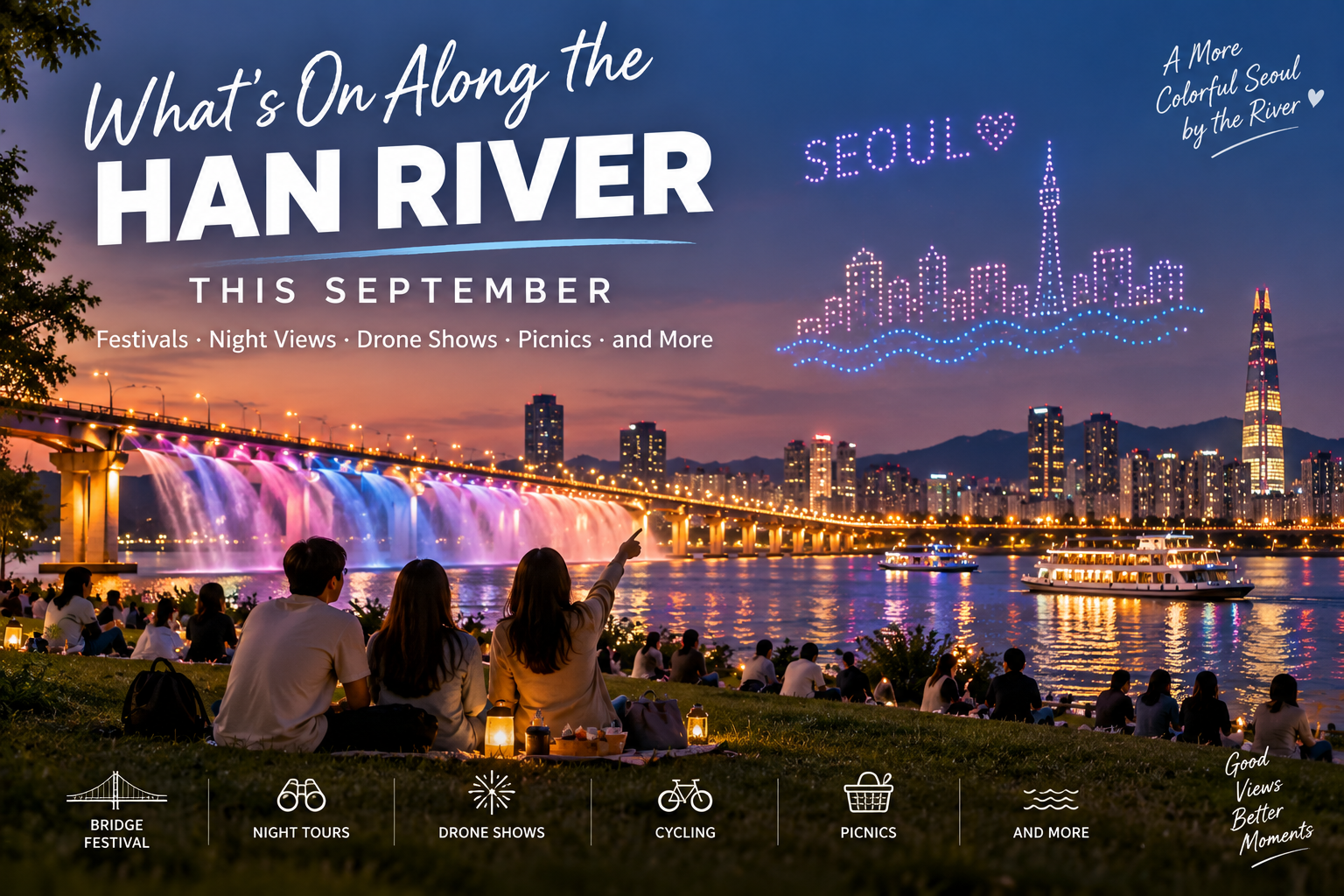
    What’s On Along the Han River This September

    Night Views, Festivals, Drone Shows & More

    If you’re visiting Seoul, there’s one place you shouldn’t overlook:

    the Han River.

    The Han River runs through the heart of Seoul, but it’s much more than a beautiful backdrop for photos. Throughout the year, the riverside parks host festivals, outdoor performances, night tours, markets, sports activities and special events.

    And September is a particularly good time to visit.

    The summer heat is beginning to fade, the evenings are getting cooler, and Seoul’s Han River comes alive after sunset.

    Here are some of the best things happening along the Han River this September.


    🌉 1. Walk Across the Car-Free Jamsugyo Bridge

    📍 Banpo Hangang Park & Jamsugyo Bridge
    📅 September 6 – October 25, 2026
    🕑 Every Sunday, 2:00 PM–10:00 PM
    💰 Free

    One of the most interesting ways to experience the Han River this autumn is the Car-Free Jamsugyo Bridge Festival.

    Every Sunday, Jamsugyo Bridge is closed to cars, turning the bridge into a pedestrian-friendly riverside festival.

    You can walk across the bridge, enjoy street performances, browse small markets, grab something from food trucks and take in the view of the river.

    This autumn season also runs later into the evening, until 10 PM, making it a great option for experiencing Seoul after dark.

    There’s an extra reason to visit this year:

    This is the final season of the festival in its current “car-free bridge” format.

    Jamsugyo is scheduled to become a fully pedestrian bridge from 2027, so this year’s festival is a chance to experience the bridge before that transformation.

    Why we recommend it

    If you’ve already visited the major tourist attractions in Seoul, this is a great way to see how locals enjoy the city.

    It’s casual, inexpensive and very Korean.


    ✨ 2. Take a Han River Night View Tour

    📍 Banpo & Yeouido Hangang Parks
    📅 August 28 – October 3, 2026
    🗓️ Fridays & Saturdays
    🕖 7:00 PM–8:30 PM
    🎟️ Advance reservation required

    Want to experience the Han River after sunset?

    The Han River Night View Tour offers guided evening walks around two of Seoul’s most scenic riverside areas.

    🌙 Banpo Moonlight Road

    The Banpo course takes you along:

    Banpo Information Center → Seoraeseom Island → Sebitseom → Moonlight Rainbow Fountain → Jamsugyo Bridge

    You’ll see the illuminated islands, the river at night and the famous Banpo Bridge Moonlight Rainbow Fountain.

    ✨ Yeouido Starlight Road

    The Yeouido course includes outdoor art installations, the Han River Bus terminal, Water Light Stage and riverside night views.

    For visitors who want to understand Seoul beyond the usual palaces and shopping districts, this is a particularly interesting experience.


    🌈 3. See the Moonlight Rainbow Fountain

    📍 Banpo Hangang Park
    📅 September
    💰 Free

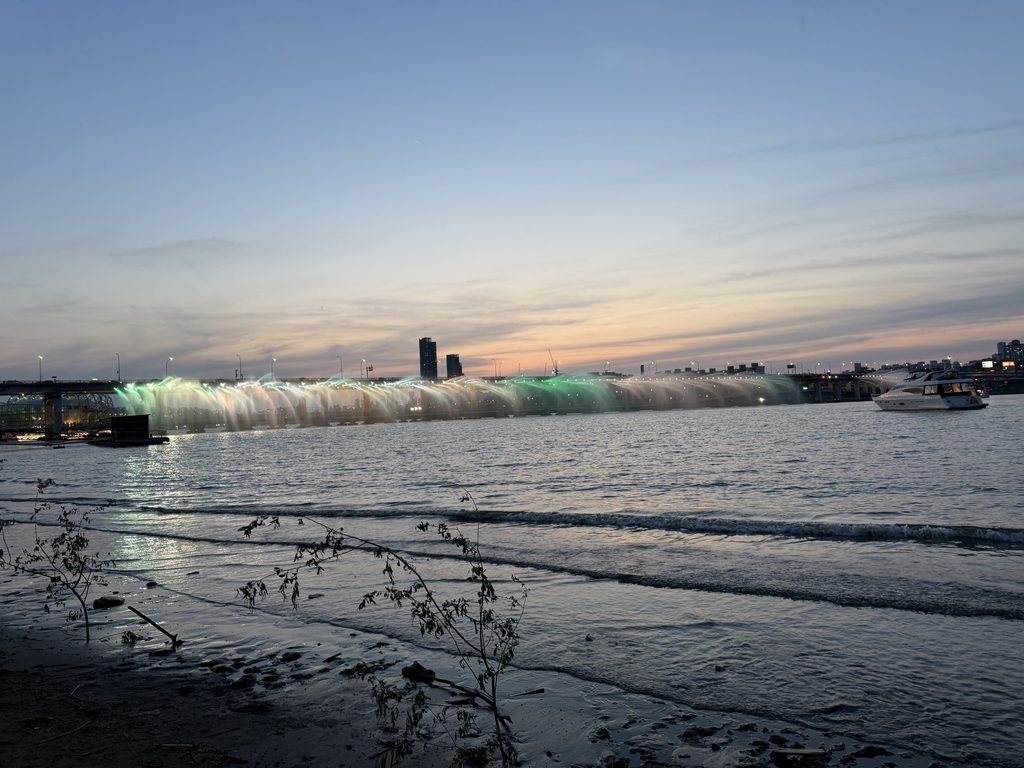
    One of Seoul’s most famous nighttime attractions is the Banpo Bridge Moonlight Rainbow Fountain.

    Water shoots from the bridge while lights and music create a colorful nighttime show over the Han River.

    During June–September, regular fountain performances are scheduled throughout the evening, although the schedule can change because of weather and river conditions.

    The easiest way to enjoy it?

    Come to Banpo Hangang Park around sunset, have a picnic by the river and stay until the fountain starts.


    🚁 4. Han River Drone Light Show Returns

    📍 Ttukseom Hangang Park
    📅 September 12 – October 31, 2026
    🗓️ Saturdays
    💰 Free

    One of Seoul’s most spectacular free nighttime events returns this fall.

    The Han River Light Show uses drones equipped with LED lights — along with other special effects depending on the program — to create large-scale images and stories in the night sky.

    The show takes place at Ttukseom Hangang Park and runs from September 12 through October 31.

    If you’ve never seen a Korean drone light show before, this is definitely worth adding to your Seoul itinerary.

    Tip: Arrive early. Popular Han River events can attract very large crowds.


    🚲 5. Explore the Han River by Bicycle

    One of the best ways to experience the Han River isn’t an organized event at all.

    It’s simply cycling along the river.

    Seoul has an extensive riverside cycling network, with routes connecting many of the major Hangang parks.

    You can rent a bicycle and ride along the river, stopping whenever you find a nice view, café or convenience store.

    For first-time visitors, a route around Yeouido, Mangwon or Ttukseom is an easy way to experience the river without committing to a full-day activity.

    And yes, stopping at a Korean convenience store for ramen or snacks is part of the experience.


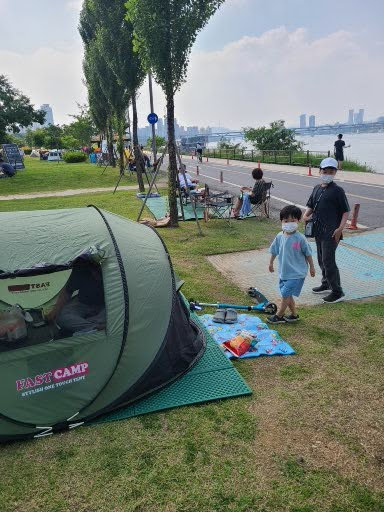
    🧺 6. Have a Han River Picnic

    Sometimes the best Han River activity is doing absolutely nothing.

    Buy some snacks, drinks and Korean convenience-store food, find a spot on the grass and watch Seoul’s skyline change as the sun goes down.

    You don’t need an expensive restaurant or rooftop bar to enjoy one of the best views in Seoul.

    The river is the view.


    📅 What’s Happening at the Han River in September?

    ExperienceDatesLocationCost
    🚶 Car-Free Jamsugyo FestivalSep. 6–Oct. 25BanpoFree
    🌙 Han River Night View TourAug. 28–Oct. 3Banpo & YeouidoReservation
    🌈 Moonlight Rainbow FountainSeptemberBanpoFree
    🚁 Han River Drone Light ShowSep. 12–Oct. 31TtukseomFree
    🚲 Riverside CyclingYear-roundMultiple parksRental fee
    🧺 Han River PicnicYear-roundMultiple parksFree

    🌃 The Han River After Dark

    There’s something special about the Han River at night.

    During the day, you’ll see people cycling, exercising, having picnics and relaxing by the water.

    After sunset, the atmosphere changes.

    The bridges light up.

    The Seoul skyline reflects on the river.

    Music and performances appear along the waterfront.

    And on certain nights, the sky itself becomes part of the show.

    That’s why we think the Han River deserves more than a quick photo stop.

    Give it an evening.

    Bring some snacks, find a spot by the water and stay until the city lights come on.

    You may discover a completely different side of Seoul.


    📌 Planning a Seoul Trip?

    If you’re visiting Seoul in September, keep an eye on this page.

    We’ll continue updating it with new Han River festivals, drone shows, markets, outdoor performances and seasonal events.

    The Han River isn’t just something you see in Seoul.
    It’s somewhere you experience Seoul.

  • 10 Korean Foods You Should Try on Your First Trip to Seoul

    10 Korean Foods You Should Try on Your First Trip to Seoul

    Planning your first trip to Seoul and wondering what Korean food you should try?

    You could spend weeks eating your way through Seoul and still discover something new.

    Korean food is much more than kimchi and Korean barbecue. Depending on where you go, you can find comforting soups, sizzling grilled meat, handmade noodles, crispy fried chicken, spicy street food, traditional rice dishes, and some surprisingly delicious desserts.

    The challenge for a first-time visitor isn’t finding Korean food.

    It’s deciding what to try first.

    So I’ve put together 10 Korean dishes that I think are especially worth trying on your first trip to Seoul.

    Some are famous internationally. Others are dishes you may not have tried before.

    And you don’t need to visit expensive restaurants to enjoy most of them.


    What Korean Food Should You Try First?

    If you only have a few days in Seoul, I’d prioritize these 10 dishes:

    1. Korean BBQ
    2. Bibimbap
    3. Kimchi jjigae
    4. Gimbap
    5. Tteokbokki
    6. Korean fried chicken
    7. Naengmyeon
    8. Kalguksu
    9. Bulgogi
    10. Mandu

    They represent very different parts of Korean food culture.

    Some are spicy, some are mild, some are hearty, and some are perfect as a quick snack.

    The best part is that you can find many of them at ordinary restaurants throughout Seoul.


    1. Korean BBQ

    Let’s start with one of the foods most visitors associate with Korea.

    Korean barbecue is more than just grilled meat.

    The experience of cooking meat at the table, eating it with different side dishes, wrapping it in lettuce, and sharing everything with friends or family is part of what makes Korean BBQ special.

    Popular choices include:

    • Samgyeopsal (pork belly)
    • Galbi (beef short ribs)
    • Bulgogi
    • Various cuts of pork and beef
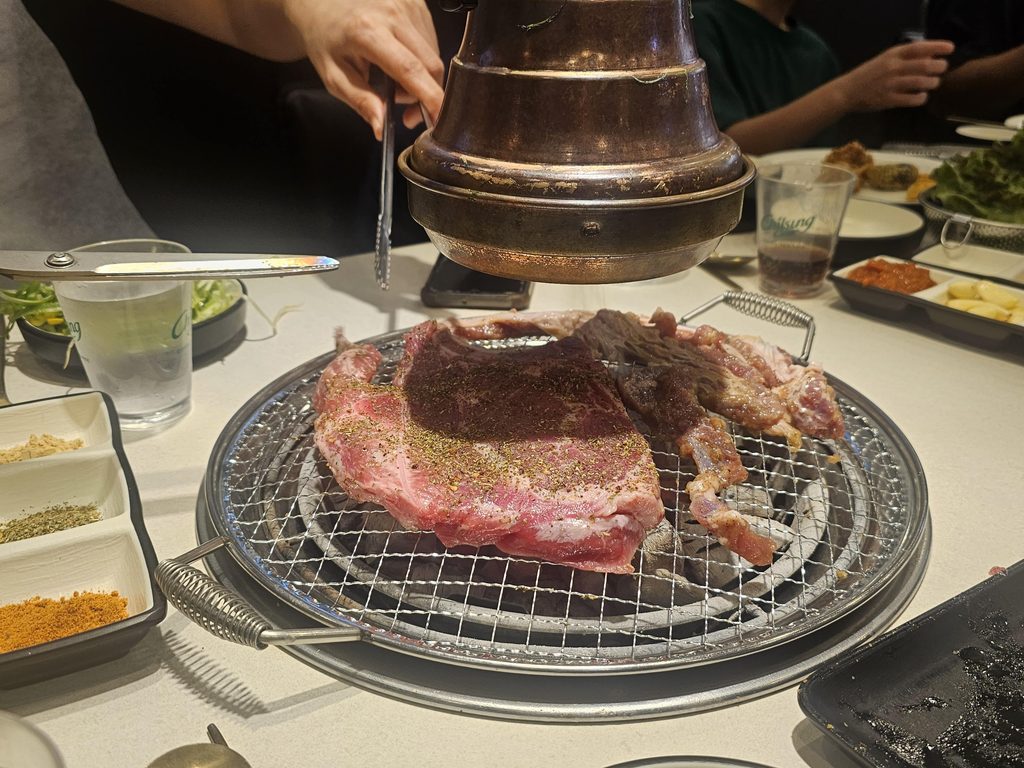
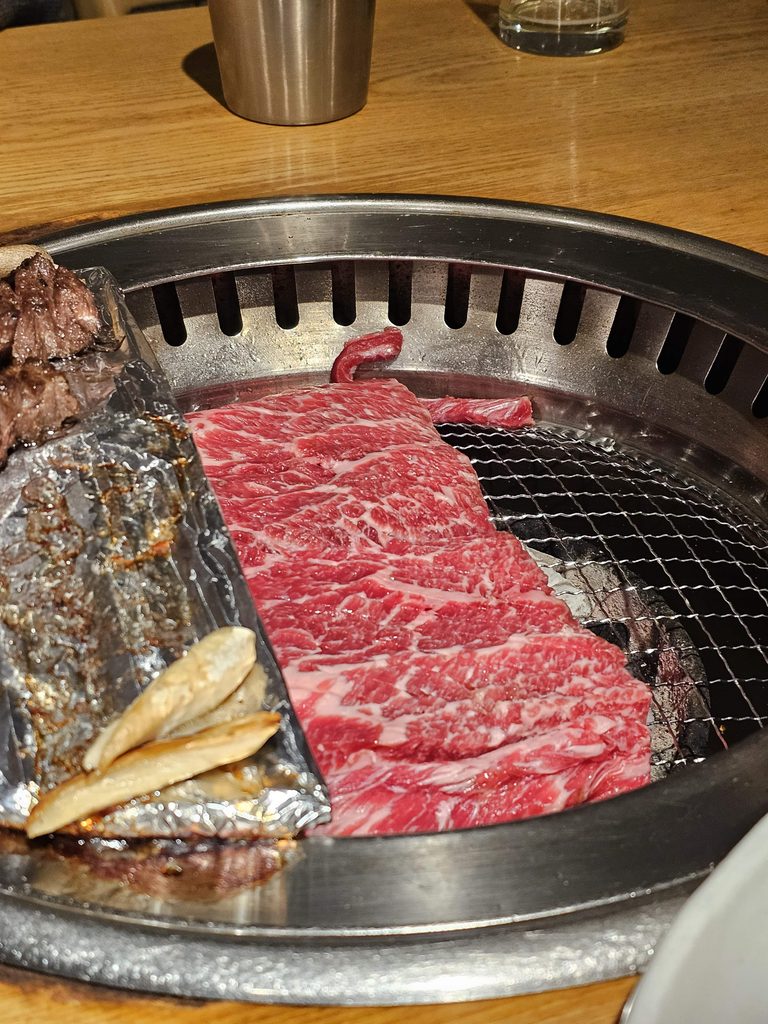
    Korean barbecue grilling at a restaurant in Seoul

    How Do You Eat Korean BBQ?

    Depending on the restaurant, you’ll typically receive various side dishes called banchan.

    You can eat the grilled meat with rice, lettuce wraps, sauces, garlic, kimchi, and other side dishes.

    Don’t worry if you don’t know exactly what to do.

    Watch what other diners are doing, or simply ask the staff.

    Is Korean BBQ Expensive?

    It can be.

    Korean BBQ generally costs more than a simple bowl of noodles or soup, particularly if you’re ordering premium beef.

    For a realistic breakdown of Seoul food prices, see:

    How Much Does Food Cost in Seoul? A Realistic 2026 Guide


    2. Bibimbap

    If you want something that feels distinctly Korean but is relatively easy for first-time visitors to understand, try bibimbap.

    Bibimbap literally combines rice with various ingredients.

    A typical bowl may include:

    • Rice
    • Vegetables
    • Egg
    • Meat
    • Sesame oil
    • Gochujang

    You mix everything together before eating.

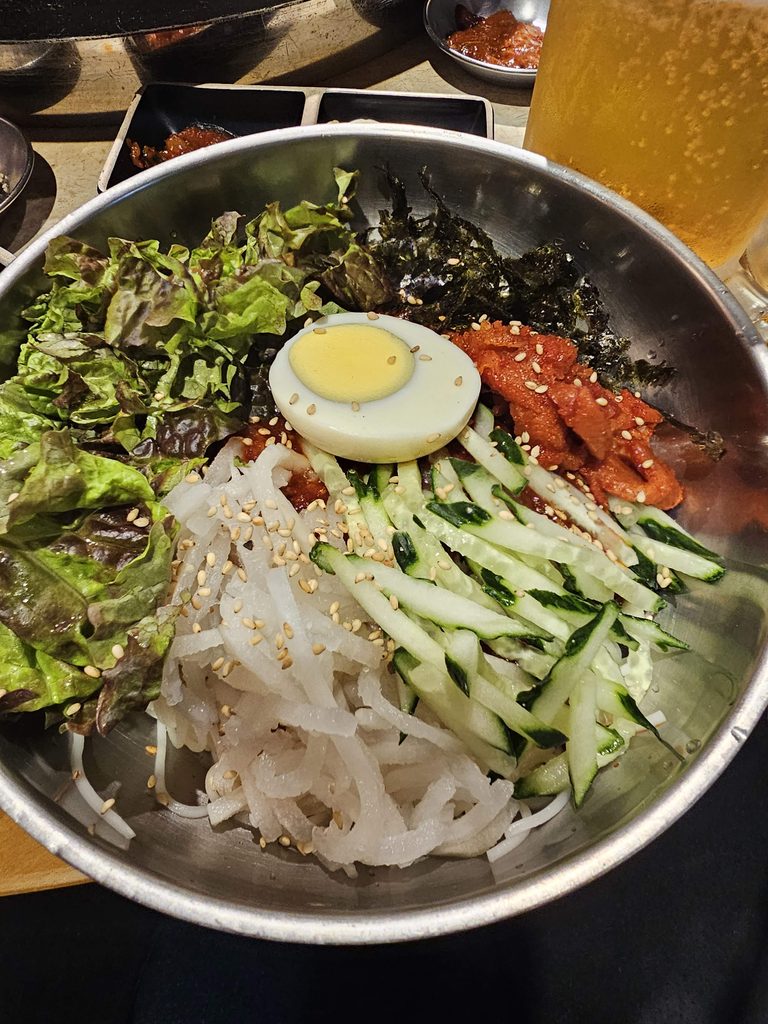
    Traditional Korean bibimbap served in Seoul

    Why Try Bibimbap?

    It’s colorful, filling, and customizable.

    If you’re worried about trying unfamiliar Korean dishes, bibimbap is a good place to start.

    You can also find different versions depending on the restaurant.

    One popular variation is dolsot bibimbap, served in a hot stone bowl.

    The rice at the bottom becomes crispy as it cooks against the hot bowl.

    If you like crispy rice, definitely try this version.


    3. Kimchi Jjigae

    If you want to experience everyday Korean comfort food, try kimchi jjigae.

    Jjigae means stew, and kimchi jjigae is a spicy stew made with kimchi and other ingredients.

    Depending on the restaurant, it may include:

    • Pork
    • Tofu
    • Onions
    • Green onions
    • Kimchi

    It is usually served hot and accompanied by rice and side dishes.

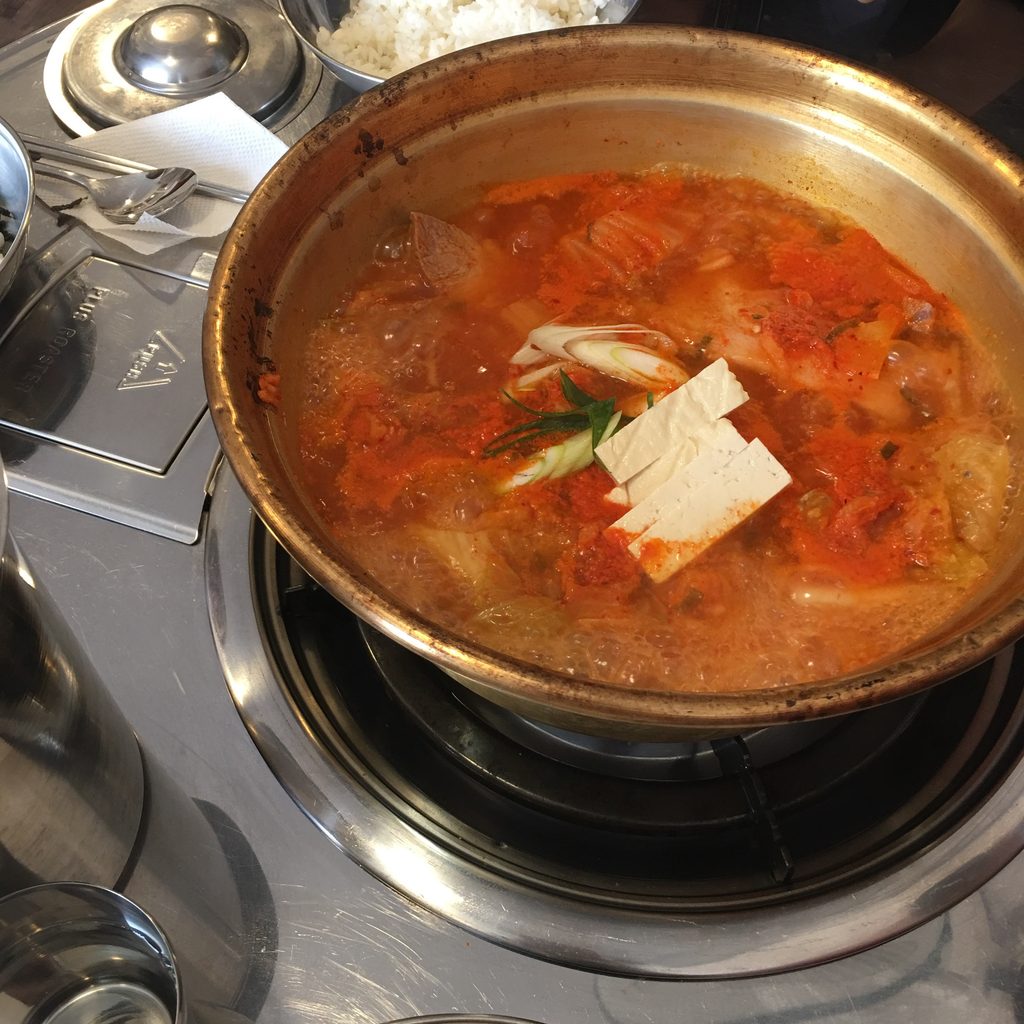
    Hot kimchi jjigae stew served in Seoul

    Is Kimchi Jjigae Very Spicy?

    It can be.

    The level of heat varies depending on the restaurant and recipe.

    If you don’t normally eat spicy food, ask the restaurant about the spice level before ordering.

    Even if you love spicy food, remember that Korean dishes can use different types of chili and fermented ingredients, so the flavor can be quite different from spicy food you’re familiar with at home.


    4. Gimbap

    Gimbap is one of the easiest Korean foods for a first-time visitor to try.

    It consists of rice and various fillings wrapped in dried seaweed and sliced into bite-sized pieces.

    Common fillings include:

    • Vegetables
    • Egg
    • Pickled radish
    • Fish cake
    • Beef
    • Tuna
    • Cheese

    There are countless variations.

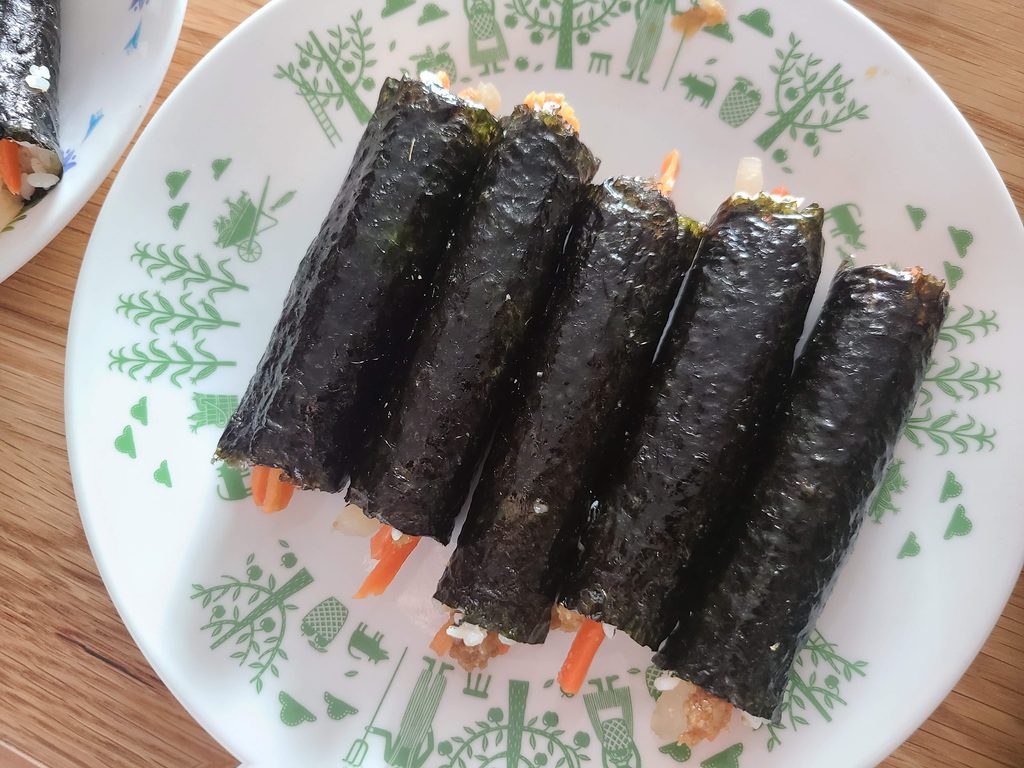
    Fresh Korean gimbap rolls in Seoul

    Why I Recommend Gimbap

    It’s inexpensive, portable, and easy to share.

    You can eat it for breakfast, lunch, a snack, or even as part of a picnic.

    It’s also one of the easiest foods to pick up from a casual neighborhood restaurant or convenience store.

    If you’re traveling on a budget, gimbap can be particularly useful.


    5. Tteokbokki

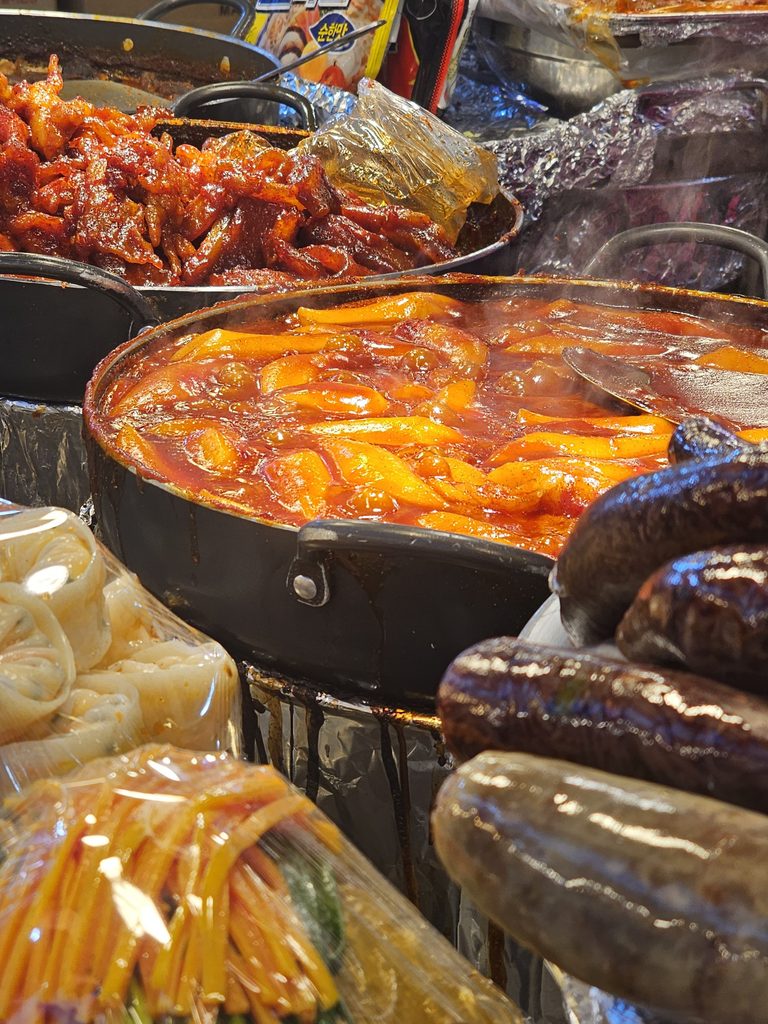
    If you walk around a Korean market or street-food area, there’s a good chance you’ll see tteokbokki.

    These chewy rice cakes are usually cooked in a sweet and spicy red sauce.

    It’s one of Korea’s most recognizable street foods.

    Korean street food vendor at a traditional market in Seoul

    Is Tteokbokki Spicy?

    Often, yes.

    But the level of spiciness varies.

    If you’re sensitive to spicy food, start with a small portion.

    The texture is also part of the experience.

    The rice cakes are soft and chewy rather than crispy, so the dish may feel quite different from foods you’re used to eating.

    What Goes Well With Tteokbokki?

    You’ll often see other street foods alongside it, such as:

    • Eomuk (fish cake)
    • Twigim (fried snacks)
    • Mandu
    • Korean-style fried food

    Trying several small dishes together can be a fun way to explore Korean street food.


    6. Korean Fried Chicken

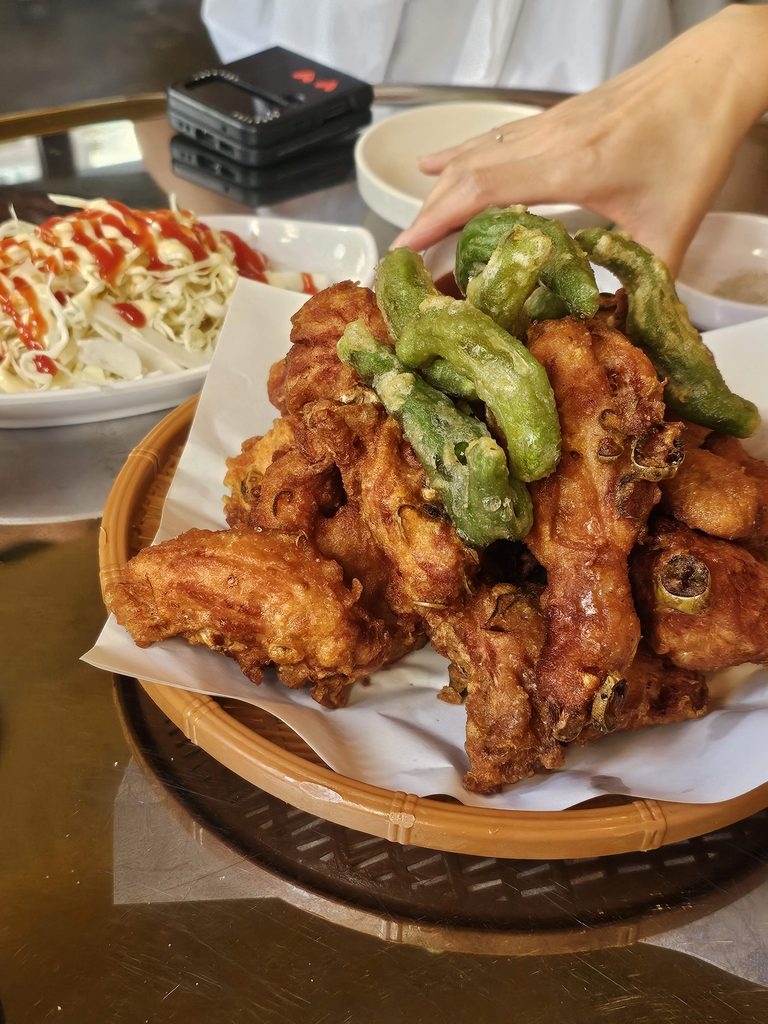
    Korean fried chicken deserves its own category.

    The chicken is often fried until extremely crisp and then coated with different sauces or seasonings.

    Popular flavors include:

    • Soy garlic
    • Spicy sauce
    • Original crispy chicken
    • Honey or sweet flavors
    Crispy Korean fried chicken in Seoul

    Why Is Korean Fried Chicken So Popular?

    The texture.

    Korean fried chicken is known for its crispy exterior, and many restaurants serve it with beer or other drinks.

    You don’t necessarily need to order it as a late-night meal.

    It can be a fun dinner to share with friends or family.

    How Many People Should Share?

    A typical order can be quite large.

    If you’re traveling with two or three people, sharing one order can be a good option.


    7. Naengmyeon

    Naengmyeon is a great dish to try if you’re visiting Seoul during warmer weather.

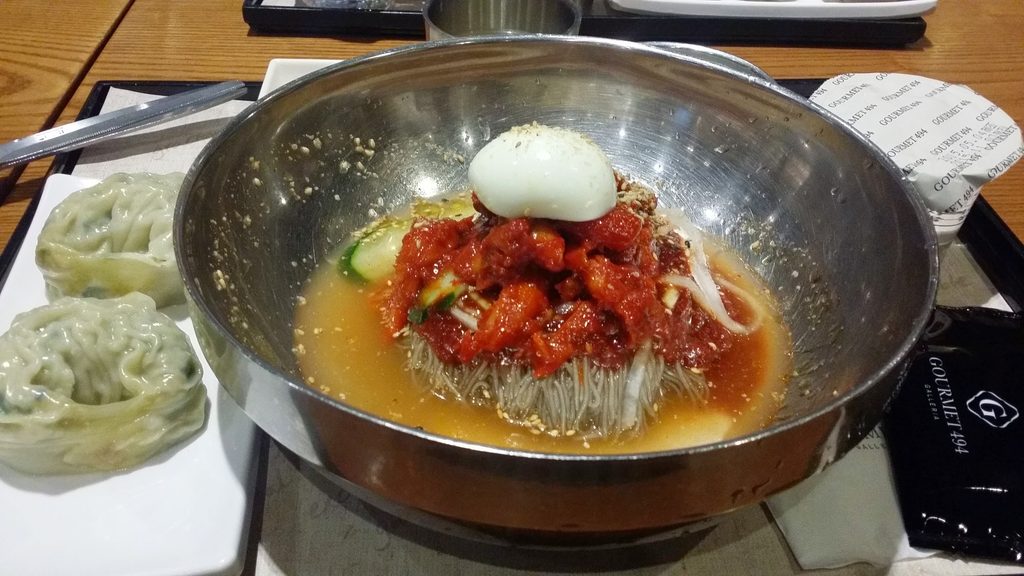
    The name literally refers to cold noodles.

    The noodles are served cold, often in a chilled broth or with a spicy sauce, depending on the variety.

    Two common styles are:

    • Mul naengmyeon — noodles in a chilled broth
    • Bibim naengmyeon — noodles mixed with a spicy sauce
    Korean cold noodles naengmyeon served in Seoul

    Why Try Cold Noodles?

    The texture is completely different from most Western noodle dishes.

    The noodles are thin and chewy, and the cold broth makes the dish particularly refreshing during summer.

    It may not be love at first bite for everyone.

    But if you enjoy trying new foods, it’s absolutely worth experiencing.


    8. Kalguksu

    If you’re looking for something warm and comforting, try kalguksu.

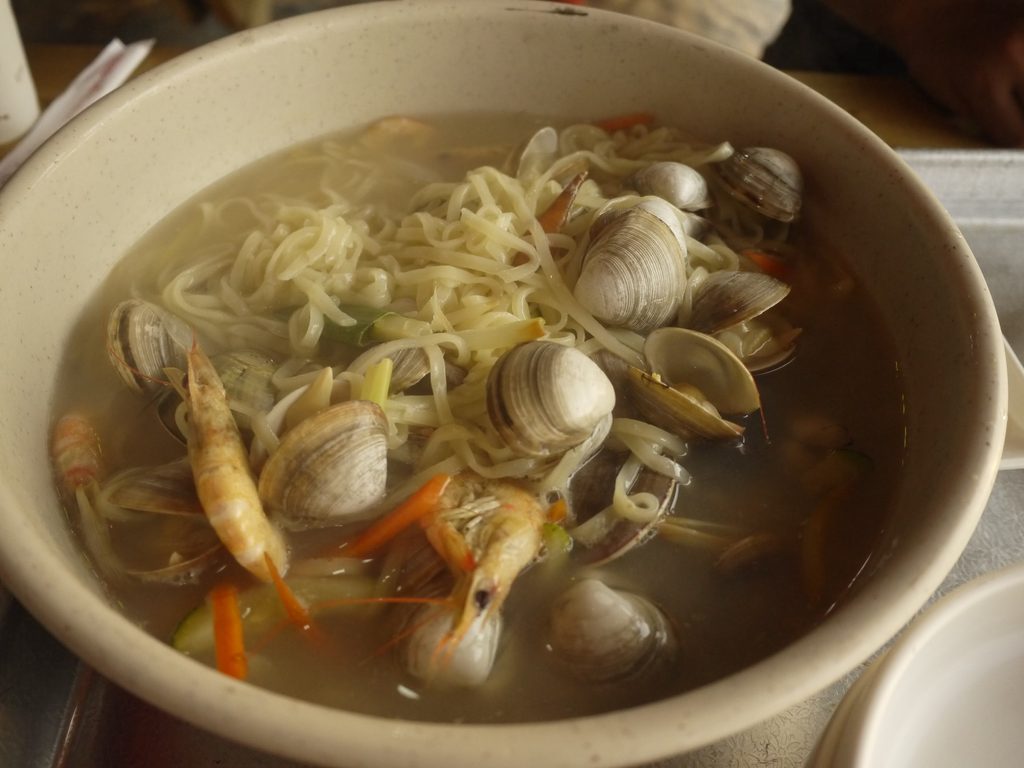
    Kalguksu means “knife-cut noodles.”

    The noodles are made by cutting dough into broad, flat pieces before cooking them in broth.

    Depending on the restaurant, the broth and toppings can vary.

    You may find versions with:

    • Chicken
    • Seafood
    • Clams
    • Dumplings
    • Vegetables
    Korean knife-cut noodle soup kalguksu in Seoul

    When Should You Eat Kalguksu?

    Almost anytime.

    But it’s especially comforting on a cold or rainy day.

    It’s also a good option if you’re looking for a Korean dish that isn’t necessarily spicy.


    9. Bulgogi

    Bulgogi is one of the best-known Korean dishes internationally.

    The name refers to thinly sliced meat that is marinated and grilled or cooked.

    The marinade typically creates a sweet and savory flavor.

    Bulgogi is usually made with beef, although variations exist.

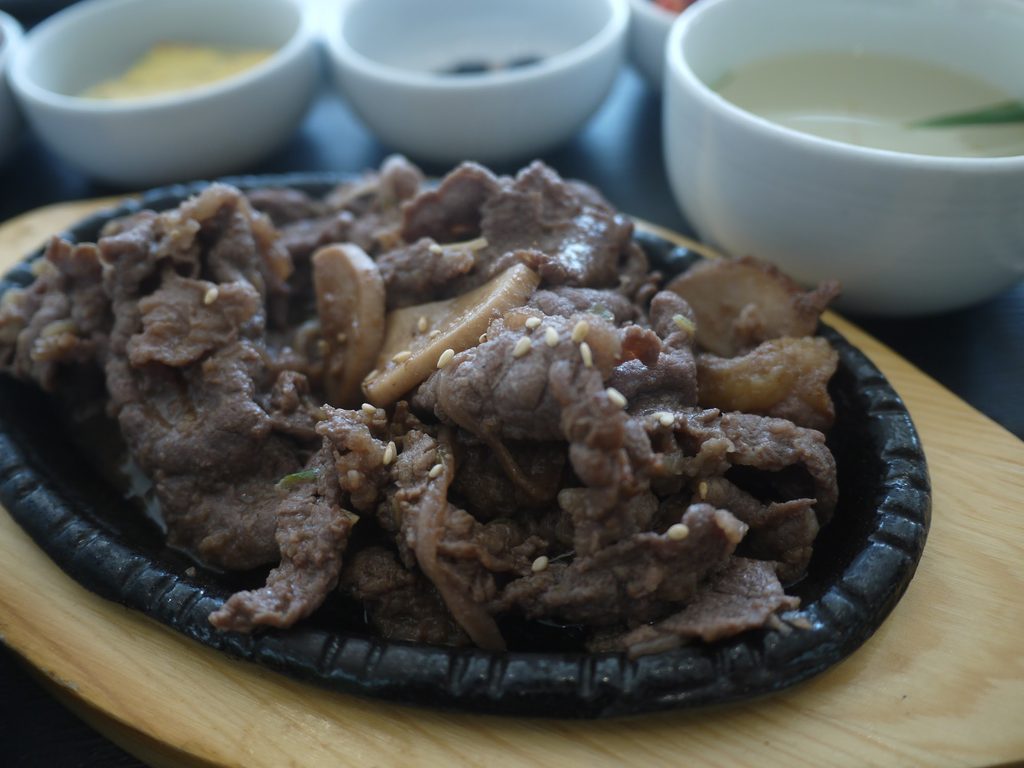
    Korean bulgogi beef served with vegetables in Seoul

    Is Bulgogi Good for First-Time Visitors?

    Absolutely.

    If you’re nervous about trying unfamiliar Korean food, bulgogi is one of the safest places to start.

    The flavors are savory and slightly sweet, and the dish is usually easy to understand even if you’re unfamiliar with Korean cuisine.

    Try it with rice and several Korean side dishes.


    10. Mandu

    Last but definitely not least: mandu.

    Mandu are Korean dumplings.

    They can be:

    • Steamed
    • Boiled
    • Pan-fried
    • Added to soup

    Fillings vary, but you may find meat, vegetables, tofu, or other ingredients inside.

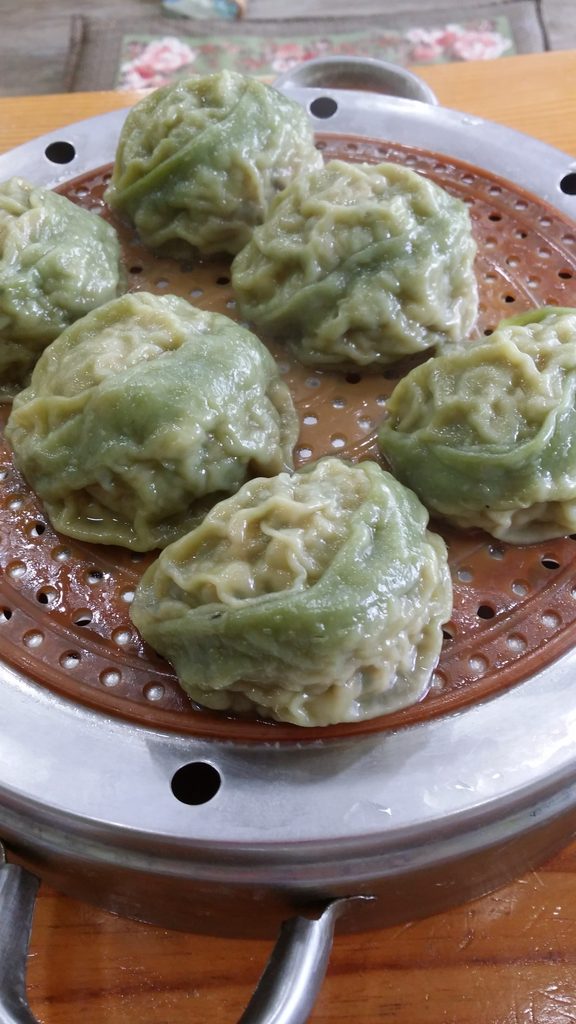
    Korean mandu dumplings served in Seoul

    Why Try Mandu?

    They’re easy to share and usually familiar enough for travelers who aren’t accustomed to Korean food.

    You can also find them at traditional markets, casual restaurants, and noodle shops.

    If you’re visiting Gwangjang Market or another traditional market, keep an eye out for dumplings and other handmade snacks.


    What If You Don’t Like Spicy Food?

    Don’t worry.

    Korean food is not all spicy.

    Some famous dishes are spicy, but there are plenty of milder choices.

    Try:

    • Bulgogi
    • Gimbap
    • Kalguksu
    • Mandu
    • Korean fried chicken
    • Some varieties of bibimbap
    • Grilled meat

    When ordering, you can also ask about the spice level.

    A useful phrase is:

    “Is this spicy?”

    In Korean:

    매워요? (Maewoyo?)

    Even learning one simple phrase like this can make ordering easier.


    What Korean Food Should Vegetarians Try?

    Korean food includes many vegetable-based dishes, but vegetarians should be aware that some seemingly vegetarian dishes may contain meat, seafood, fish sauce, or other animal-based ingredients.

    For example, kimchi can sometimes contain seafood ingredients.

    If you have strict dietary requirements, it’s best to explain your restrictions clearly before ordering.

    You can also research vegetarian and vegan restaurants in Seoul in advance rather than relying entirely on finding suitable dishes after you arrive.


    Where Should You Try Korean Food in Seoul?

    You don’t need to visit a famous restaurant for every meal.

    In fact, some of the best ways to explore Korean food are simply to eat in different neighborhoods.

    Traditional Markets

    Markets are excellent for trying several small dishes in one visit.

    Consider:

    • Gwangjang Market
    • Namdaemun Market
    • Mangwon Market

    Neighborhood Restaurants

    Look for busy restaurants where local residents are eating.

    A crowded restaurant isn’t automatically better, but a steady local crowd can be a useful sign that the restaurant has regular customers.

    Tourist Areas

    Areas such as Myeongdong and Hongdae have an enormous number of restaurants and are convenient for first-time visitors.

    However, don’t assume that every restaurant in a tourist district represents the best or most authentic Korean food.

    Sometimes walking a few streets away from the busiest tourist area can lead you to interesting neighborhood restaurants.


    How Much Should You Budget for Korean Food?

    You don’t need to spend a fortune.

    A simple Korean meal can be relatively inexpensive, while Korean BBQ, premium seafood, and trendy restaurants can cost considerably more.

    For a detailed breakdown of typical food costs in Seoul, read:

    How Much Does Food Cost in Seoul? A Realistic 2026 Guide

    If you’re trying to keep your overall trip budget under control, you can also read:

    Is Seoul Expensive? A Realistic Seoul Travel Budget for 2026


    How to Order Korean Food as a First-Time Visitor

    Ordering can feel intimidating if you can’t read Korean.

    Fortunately, many restaurants in tourist areas have English menus.

    Navigation and translation apps can also help.

    A few useful Korean words can make the experience easier:

    EnglishKoreanPronunciation
    Thank you감사합니다Gamsahamnida
    Delicious맛있어요Masisseoyo
    Spicy매워요Maewoyo
    Not spicy안 매워요An maewoyo
    One, please하나 주세요Hana juseyo
    Water, please물 주세요Mul juseyo

    You don’t need to speak Korean fluently.

    A smile, a little patience, and a willingness to try are usually enough.


    A Simple Korean Food Plan for a 3-Day Seoul Trip

    If you only have three days, here’s one way to fit several Korean foods into your trip.

    Day 1

    Lunch: Bibimbap

    Snack: Tteokbokki + eomuk

    Dinner: Korean BBQ

    Day 2

    Lunch: Gimbap + mandu

    Snack: Korean café dessert

    Dinner: Korean fried chicken

    Day 3

    Lunch: Kalguksu

    Snack: Street food

    Dinner: Bulgogi or another Korean specialty

    You don’t have to follow this exactly.

    The point is to mix different types of Korean food rather than eating the same type of meal every day.


    A Few Korean Foods You Shouldn’t Leave Seoul Without Trying

    If you asked me to narrow the list down to just five, I’d choose:

    1. Korean BBQ

    For the experience as much as the food.

    2. Gimbap

    Simple, affordable, and easy to try.

    3. Tteokbokki

    A classic Korean street-food experience.

    4. Bibimbap

    A colorful and approachable introduction to Korean cuisine.

    5. Naengmyeon

    Something completely different from what many first-time visitors expect.

    But honestly, if you have enough time, try all ten.

    One of the best parts of visiting Korea is discovering which dishes become your personal favorites.


    Final Thoughts

    Seoul is one of those cities where food can become a major part of the trip.

    You can eat a quick bowl of noodles for lunch, grab street food in the afternoon, have Korean barbecue for dinner, and finish the evening at a café.

    And you don’t have to spend a huge amount of money to experience Korean food.

    If this is your first trip, don’t worry about finding the “perfect” restaurant every time.

    Try different neighborhoods.

    Order something you’ve never had before.

    Share dishes with your travel companions.

    And if you find something you love, go back and eat it again.

    That’s part of the fun.

    What About You?

    Which Korean food are you most excited to try in Seoul?

    Are you looking forward to Korean BBQ, street food, bibimbap, fried chicken, or something completely new? If you’ve already visited Korea, what’s the one dish you think every first-time visitor should try?


    More Seoul Travel Guides

    Is Seoul Expensive? A Realistic Seoul Travel Budget for 2026

    Where to Stay in Seoul: 7 Best Areas for First-Time Visitors

    How to Use the Seoul Subway: A First-Time Visitor’s Guide

    How Much Does Food Cost in Seoul? A Realistic 2026 Guide

    Do You Need Cash in Korea? Cards, ATMs & T-money Explained

    How Many Days Do You Need in Seoul? 3, 5, or 7 Days

  • How Many Days Do You Need in Seoul? 3, 5, or 7 Days

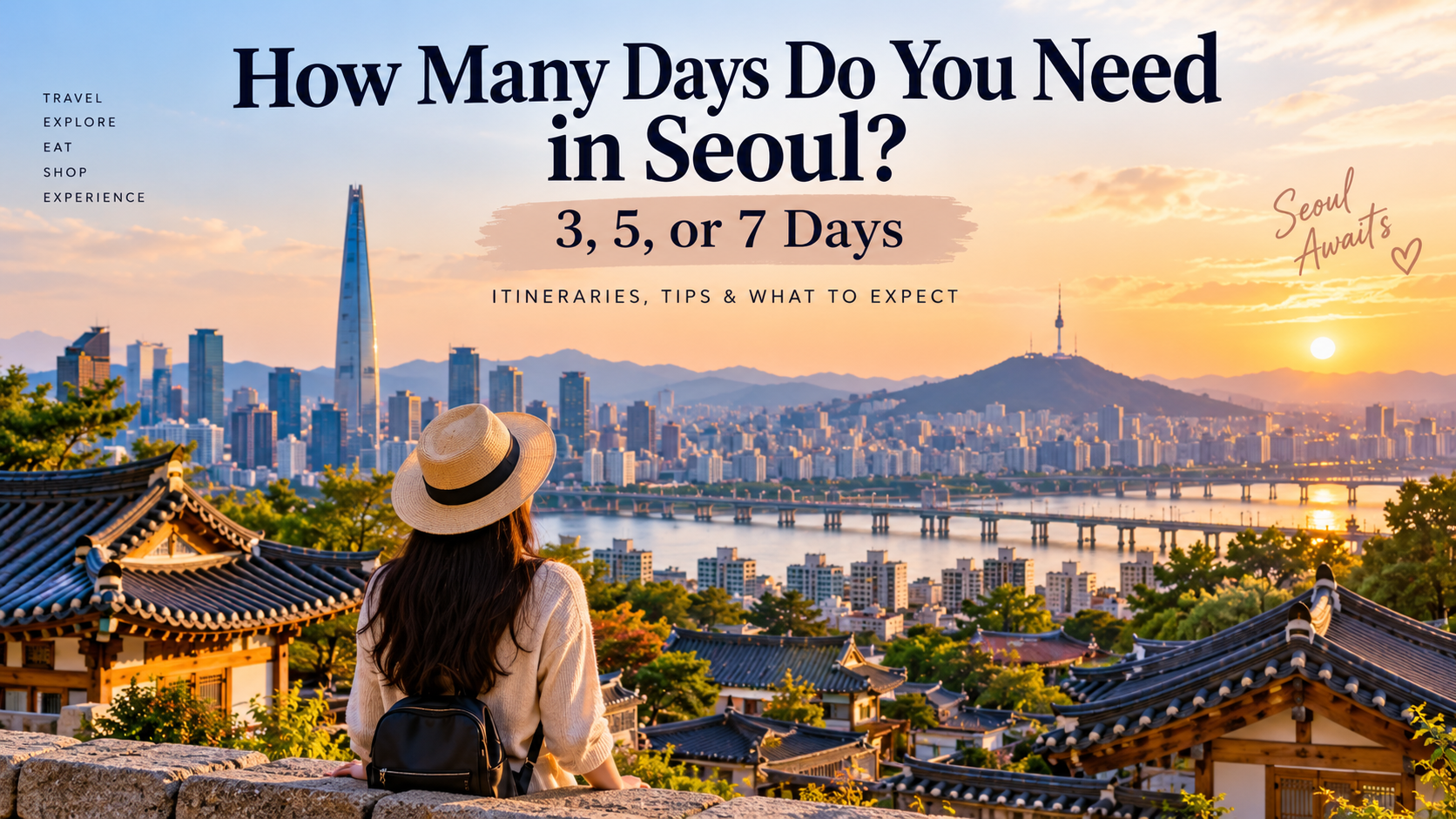
    How Many Days Do You Need in Seoul? 3, 5, or 7 Days

    Planning your first trip to Seoul but not sure how long you should stay?

    You may be wondering whether 3 days is enough for Seoul, whether 5 days would be better, or whether you should spend a full week exploring the city.

    The good news is that there isn’t one perfect answer.

    For a first-time visitor, 3 days is enough to see the major highlights, 5 days gives you a much more comfortable experience, and 7 days allows you to explore Seoul at a slower pace and even consider a day trip outside the city.

    In this guide, I’ll break down what you can realistically see in 3, 5, or 7 days and help you decide which Seoul itinerary is right for your trip.

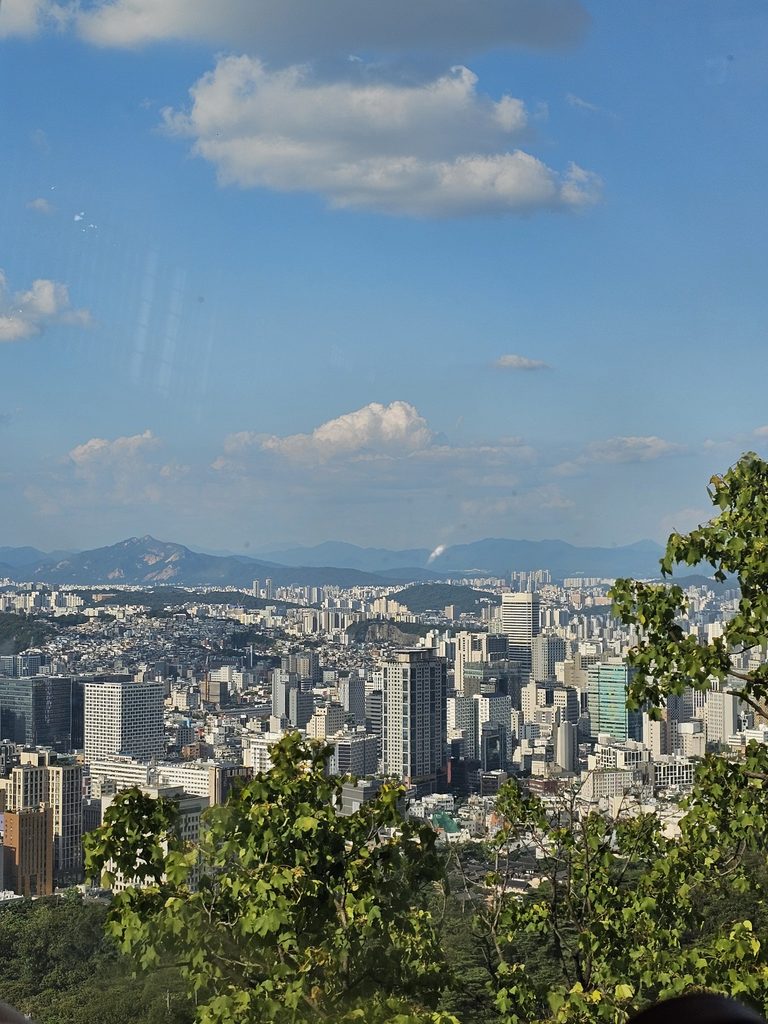
    Seoul skyline and city view in South Korea

    How Many Days Do You Really Need in Seoul?

    If you’re visiting Seoul for the first time, I recommend staying at least 4–5 days if your schedule allows it.

    Three days can work if you’re short on time.

    Five days is ideal for many first-time visitors because you can see the major attractions without rushing from one place to another.

    Seven days is a good choice if you want to experience different neighborhoods, spend more time shopping and eating, visit cafés, and possibly take a day trip outside Seoul.

    Here’s the simple version:

    Length of stayBest forTravel pace
    3 daysMajor highlightsFast
    5 daysFirst-time visitorsComfortable
    7 daysDeeper explorationRelaxed

    If you’re flying a long distance to Korea, I’d personally try to give yourself at least 5 days in Seoul.


    Is 3 Days Enough for Seoul?

    Yes, but you’ll need to prioritize.

    Three days is enough to experience some of the most famous parts of Seoul, but you won’t be able to see everything.

    A good 3-day trip should focus on areas that are relatively close together rather than spending hours crossing the city.

    For example:

    Day 1: Traditional Seoul + Myeongdong

    Day 2: Hongdae + Yeonnam + cafés

    Day 3: Gangnam + modern Seoul

    This gives you a taste of several different sides of the city.

    The downside of a 3-Day Trip

    The biggest problem isn’t the number of attractions.

    It’s the pace.

    You may find yourself spending much of the day walking, transferring between subway lines, and checking the time.

    If you enjoy slow mornings and long meals, three days may feel too short.


    Seoul 3-Day Itinerary

    Day 1: Traditional Seoul + Myeongdong

    Start your first day with some of Seoul’s most recognizable historic sights.

    Morning: Gyeongbokgung Palace

    Begin at Gyeongbokgung Palace, one of Seoul’s most famous historical landmarks.

    Give yourself enough time to walk around the palace grounds rather than simply taking a few photos and leaving.

    Gyeongbokgung Palace in Seoul, South Korea

    Afternoon: Bukchon Hanok Village

    From the palace area, continue toward Bukchon Hanok Village.

    This historic neighborhood is known for its traditional Korean houses, or hanok.

    Keep in mind that Bukchon is a residential area. Be respectful of residents, keep noise down, and follow local visitor guidance.

    Evening: Insadong and Myeongdong

    Spend the afternoon or early evening around Insadong, where you can browse traditional shops, cafés, and restaurants.

    Then head toward Myeongdong for shopping and dinner.

    Myeongdong is particularly convenient for first-time visitors because it combines shopping, restaurants, cafés, and easy transportation.

    If you’re still deciding where to stay, read Where to Stay in Seoul: 7 Best Areas for First-Time Visitors.


    Day 2: Hongdae and the Young Side of Seoul

    Day two can be more relaxed and focused on Seoul’s contemporary culture.

    Morning: Hongdae

    Start your day around Hongdae.

    The area is known for its youthful atmosphere, cafés, shops, street performances, and nightlife.

    Spend the morning exploring the streets rather than following a strict checklist.

    Afternoon: Yeonnam-dong

    Walk toward Yeonnam-dong, a neighborhood next to Hongdae with cafés, restaurants, and small shops.

    This is a good place to slow down after a busy first day.

    Evening: Hongdae

    Return to Hongdae for dinner.

    If you’re interested in Korean barbecue, fried chicken, or Korean street food, this is a good evening to try something different.

    For more information about food costs, read How Much Does Food Cost in Seoul? A Realistic 2026 Guide.


    Day 3: Gangnam and Modern Seoul

    For your final day, experience another side of Seoul.

    Morning: Gangnam

    Head south of the Han River and explore Gangnam.

    You can spend time around:

    • COEX
    • Starfield Library
    • Gangnam shopping areas
    • Garosu-gil

    Afternoon: Seongsu

    If you enjoy cafés, fashion, and contemporary Korean culture, consider spending the afternoon in Seongsu.

    The neighborhood is known for cafés, pop-up stores, restaurants, and converted industrial spaces.

    Evening: Han River

    Finish your trip with a walk along the Han River.

    Depending on the season and weather, you can simply enjoy the river views or pick up some food and have a relaxed evening outdoors.

    Three days will go quickly, but this itinerary gives you a good introduction to Seoul.


    Is 5 Days Enough for Seoul?

    For most first-time visitors, 5 days is my favorite option.

    Five days gives you enough time to see the major attractions without making every day feel like a race.

    You can also dedicate an entire day to shopping, cafés, or neighborhoods that aren’t usually included in a basic tourist itinerary.

    A five-day trip could look like this:

    Day 1: Historic Seoul

    Day 2: Hongdae

    Day 3: Gangnam + Seongsu

    Day 4: Shopping + markets + food

    Day 5: Flexible Seoul day

    The extra two days make a surprisingly big difference.


    Seoul 5-Day Itinerary

    Day 1: Gyeongbokgung, Bukchon and Insadong

    Start with Seoul’s historic center.

    Visit:

    • Gyeongbokgung Palace
    • Bukchon Hanok Village
    • Insadong
    • Ikseon-dong

    Take your time and enjoy a traditional Korean meal.

    Traditional neighborhood in central Seoul

    Day 2: Myeongdong and Namsan

    Spend the second day around Myeongdong.

    Explore the shopping streets and try Korean cosmetics, snacks, and restaurants.

    In the afternoon, head toward Namsan.

    If the weather is clear, the Seoul skyline from Namsan is worth seeing.

    You can finish the evening with dinner in Myeongdong.


    Day 3: Hongdae and Yeonnam

    Spend a full day in western Seoul.

    Explore:

    • Hongdae
    • Yeonnam-dong
    • Local cafés
    • Independent shops
    • Street performances

    You don’t need to schedule every hour.

    This is a good day to simply walk around and see what you find.


    Day 4: Gangnam and Seongsu

    Start in Gangnam and then move toward Seongsu.

    Visit COEX and Starfield Library in the morning, then explore Seongsu in the afternoon.

    This gives you a very different impression of Seoul compared with the traditional neighborhoods you’ve already visited.


    Day 5: Shopping, Markets and Your Favorites

    Keep your final day flexible.

    Return to somewhere you enjoyed, or explore an area you didn’t have time for earlier.

    Good options include:

    • Namdaemun Market
    • Gwangjang Market
    • Dongdaemun
    • More shopping in Myeongdong
    • More cafés in Seongsu
    • A relaxed Han River afternoon

    Leaving one day flexible is one of the biggest advantages of staying five days.

    You don’t have to worry about missing something because you have already built some breathing room into your itinerary.


    Should You Spend 7 Days in Seoul?

    If you have seven days available, yes — especially if you don’t enjoy rushed travel.

    Seven days doesn’t mean you need seven days of sightseeing.

    That’s actually the point.

    You can spend more time in each neighborhood, revisit places you enjoyed, try more restaurants, shop without rushing, and take a day trip outside Seoul.

    A seven-day trip can feel much more like experiencing the city rather than simply checking attractions off a list.


    Seoul 7-Day Itinerary

    Day 1: Historic Seoul

    Visit:

    • Gyeongbokgung Palace
    • Bukchon Hanok Village
    • Insadong
    • Ikseon-dong

    Have a traditional Korean dinner.


    Day 2: Myeongdong and Namsan

    Spend the day shopping and exploring Myeongdong.

    Then visit Namsan and enjoy the city views.

    This is also a good day to try Korean beauty and skincare shopping.


    Day 3: Hongdae and Yeonnam

    Explore Hongdae during the day.

    Spend the afternoon in Yeonnam-dong.

    Stay for dinner and experience Hongdae after dark.


    Day 4: Gangnam

    Spend a full day south of the Han River.

    Consider:

    • COEX
    • Starfield Library
    • Gangnam shopping
    • Garosu-gil
    • Apgujeong
    • Cheongdam

    You don’t need to visit every location.

    Choose two or three that match your interests.


    Day 5: Seongsu

    Give Seongsu its own day.

    Explore cafés, restaurants, shops, pop-up stores, and the neighborhood’s distinctive industrial-meets-modern atmosphere.

    This is a particularly good day for travelers interested in contemporary Korean culture.


    Day 6: Markets + Han River

    Start at a traditional market.

    Try several small dishes rather than having one large meal.

    In the afternoon, head toward the Han River.

    Have a relaxed evening and enjoy Seoul without following a strict sightseeing schedule.


    Day 7: Your Choice

    Keep the last day open.

    You could:

    • Go shopping
    • Revisit your favorite neighborhood
    • Visit a museum
    • Explore another Seoul neighborhood
    • Take a day trip outside Seoul
    • Simply relax

    After six busy days, having a flexible final day can be surprisingly valuable.


    Should You Take a Day Trip From Seoul?

    If you’re staying for seven days, you have enough time to consider a day trip outside Seoul.

    Popular options include places such as:

    • Nami Island
    • Suwon
    • Incheon
    • DMZ-related tours
    • Other destinations accessible from Seoul

    Whether you should take a day trip depends on what kind of traveler you are.

    If this is your first-ever visit to Korea, I’d prioritize Seoul itself if you only have three or five days.

    With seven days, however, a day trip can add variety.


    3 vs. 5 vs. 7 Days in Seoul

    Still can’t decide?

    Here’s my quick comparison.

    3 Days5 Days7 Days
    Major attractionsYesYesYes
    Traditional SeoulYesYesYes
    HongdaeYesYesYes
    GangnamLimitedYesYes
    SeongsuLimitedYesYes
    ShoppingLimitedComfortablePlenty
    Café hoppingLimitedComfortablePlenty
    Flexible timeVery littleSomeLots
    Day tripNot recommendedPossible but rushedGood option
    Overall paceFastComfortableRelaxed

    My Pick: 5 Days

    If you asked me to choose one length for a first trip to Seoul, I’d choose 5 days.

    It’s long enough to experience different sides of the city without requiring you to take a full week off.

    But if you have seven days, don’t feel that you’re spending too long in Seoul.

    You won’t run out of things to do.


    How Much Will You Spend in Seoul?

    The length of your trip obviously affects your budget.

    But your daily spending habits can make an even bigger difference.

    For example, two travelers staying for five days could spend very different amounts.

    One might stay in a budget hotel, eat local meals, and use the subway.

    Another might stay in a luxury hotel, eat at premium restaurants, use taxis, and go shopping every day.

    For a detailed breakdown, read Is Seoul Expensive? A Realistic Seoul Travel Budget for 2026.

    And if you’re planning your daily food budget, read How Much Does Food Cost in Seoul? A Realistic 2026 Guide.


    How Do You Get Around Seoul?

    The subway will probably be your most useful transportation option during a Seoul trip.

    Seoul’s subway network connects most major tourist areas, and English signage makes it relatively accessible to international visitors.

    If you’re staying for several days, a transportation card such as T-money can make getting around easier.

    For a complete beginner’s guide, read How to Use the Seoul Subway: A First-Time Visitor’s Guide.


    Where Should You Stay in Seoul?

    Where you stay can make a big difference to how much time you spend traveling between attractions.

    For a first trip, areas such as Myeongdong, Hongdae, and Jongno/Insadong are popular choices because they provide convenient access to many attractions.

    But the best area depends on your itinerary and what you enjoy.

    For a detailed neighborhood comparison, read Where to Stay in Seoul: 7 Best Areas for First-Time Visitors.


    Do You Need Cash in Seoul?

    You don’t need to carry your entire travel budget in cash.

    Cards are widely used in Seoul, but having some Korean won available is still a good idea.

    A simple combination for most visitors is:

    Credit/debit card + T-money + some Korean won

    For a detailed explanation of cards, ATMs, cash, and T-money, read Do You Need Cash in Korea? Cards, ATMs & T-money Explained.


    How to Make the Most of Your Time in Seoul

    Regardless of whether you stay for three, five, or seven days, there are a few things that can make your trip much easier.

    Group Nearby Places Together

    Don’t try to visit Gyeongbokgung, Gangnam, Hongdae, and Jamsil on the same day.

    Seoul is a large city.

    Choose attractions in the same general area and explore them together.

    Don’t Overplan Every Hour

    Leave some space in your itinerary.

    You may discover a café you love, find a great restaurant, or simply decide that you want to stay longer somewhere.

    A little flexibility makes a trip much more enjoyable.

    Check Subway Exit Numbers

    A Seoul subway station can have many exits.

    Check the correct exit before leaving the station.

    It can save you a surprising amount of walking.

    Plan Around Your Interests

    You don’t have to visit every famous attraction.

    If you love food, spend more time eating.

    If you love shopping, give yourself a shopping day.

    If you’re interested in Korean history, spend more time around the palaces and traditional neighborhoods.

    Your best Seoul itinerary is not necessarily the one with the most attractions.

    It’s the one that matches what you actually enjoy.


    What If You Have More Than 7 Days?

    If you have 8–10 days or more in Korea, I wouldn’t necessarily spend all of that time in Seoul.

    At that point, consider adding another Korean destination.

    You could combine Seoul with places such as:

    • Busan
    • Gyeongju
    • Jeju Island
    • Jeonju

    This gives you a chance to see a very different side of Korea.

    Seoul is exciting and enormous, but it isn’t the whole country.


    Final Recommendation

    So, how many days do you need in Seoul?

    Choose 3 Days If:

    You have limited vacation time and want to see the major highlights.

    Choose 5 Days If:

    You want the best balance between sightseeing, food, shopping, neighborhoods, and relaxation.

    Choose 7 Days If:

    You want to explore Seoul at a slower pace or include a day trip.

    For most first-time visitors, I’d recommend 5 days in Seoul.

    Three days is enough to get a taste.

    Five days lets you actually enjoy the city.

    Seven days gives you the freedom to slow down and explore beyond the standard tourist itinerary.

    And if you’re flying all the way to Korea, that extra day or two can make the trip feel much less rushed.

    What About You?

    How many days are you planning to spend in Seoul?

    If you’ve already visited Seoul, would you recommend 3, 5, or 7 days for a first-time visitor? Share your experience in the comments!


    More Seoul Travel Guides

  • What’s On in Busan This Week: September 5–11, 2026

    What’s On in Busan This Week: September 5–11, 2026

    8 Things to Do in Busan This Week

    Looking for something to do in Busan this week?

    From the famous Gwangalli Drone Light Show to contemporary art, international music, esports and smart-city technology, Busan has plenty happening from September 5 to 11, 2026.

    Here are some of the events worth checking out this week.


    🌌 1. Gwangalli M Drone Light Show

    📍 Gwangalli Beach
    📅 Saturday, September 5
    ⏰ 8:00 PM & 10:00 PM
    💰 Free

    If you’re in Busan tonight, this should be at the top of your list.

    More than 1,000 drones light up the sky above Gwangalli Beach, with Gwangan Bridge creating the backdrop.

    This week’s theme is “Melody of the Forest.” The show lasts about 12 minutes and is presented twice, at 8:00 PM and 10:00 PM.

    The show is held every Saturday throughout the year. During September, performances are at 8 PM and 10 PM.

    Tip: Grab dinner or a coffee around Gwangalli Beach before the show and stay for the second performance if you want a slightly different atmosphere.

    Weather warning: The show can be canceled or delayed because of rain, strong winds, typhoons or technical issues, sometimes even on the day of the event.


    🎨 2. Busan Biennale 2026

    📍 Busan Museum of Contemporary Art, Former Busan Nam High School & Space OneZ
    📅 August 29 – November 1
    🎟️ Admission varies by venue

    The Busan Biennale 2026 is one of the biggest contemporary art events in the city.

    This year’s exhibition, titled “Dissident Chorus,” brings together international artists and explores different perspectives, voices and forms of contemporary art.

    If you’re interested in art, architecture or contemporary culture, this is one of the best events to add to your Busan itinerary this autumn.

    Because the exhibition is spread across multiple venues, it’s worth checking the individual locations before you go.


    🎻 3. Busan International Music Festival

    📍 Multiple venues across Busan
    📅 September 1–22

    Classical music lovers have plenty to choose from this month.

    The Busan International Music Festival 2026 features world-class orchestras and ensembles at venues including Busan Concert Hall, Nakdong Art Center, Busan Cinema Center and Haeundae Cultural Center.

    The festival runs throughout September, so there are multiple opportunities to catch a performance this week and later in the month.

    The festival was previously known as the Busan Maru International Music Festival and was renamed the Busan International Music Festival in 2026.


    🎮 4. VCT PACIFIC FINALS BUSAN 2026

    📍 Sajik Gymnasium
    📅 September 4–6

    If you’re a fan of esports, Busan is hosting the VCT PACIFIC FINALS BUSAN 2026 this weekend.

    The event runs through Sunday, September 6, at Sajik Gymnasium.

    Even if you’re not familiar with the competitive gaming scene, this is an interesting way to experience the scale of Korea’s esports culture — something that is difficult to understand from a typical sightseeing itinerary.


    🍜 5. Busan Dwaeji Gukbap Grand Fair

    📍 Busan
    📅 August 26 – October 18

    Want to try one of Busan’s signature foods?

    Dwaeji-gukbap is a hearty pork soup served with rice and is one of the dishes most closely associated with Busan.

    The 2026 Busan Dwaeji Gukbap Grand Fair runs through October 18, making this a good month to explore the city’s famous pork soup culture.

    If you’re a first-time visitor, don’t leave Busan without trying a bowl of dwaeji-gukbap.


    💎 6. Jean-Michel Othoniel: In the Labyrinth of Love

    📍 F1963, Busan
    📅 August 28 – December 31

    Looking for something a little more artistic?

    French artist Jean-Michel Othoniel is presenting In the Labyrinth of Love at F1963, one of Busan’s most interesting cultural spaces.

    The exhibition features jewel-like glass sculptures and installations exploring themes including mythology, symbolism, dreams and healing.

    F1963 itself is worth visiting: the former industrial site has been transformed into a cultural complex, making it a great combination of art, architecture and cafés.


    🤖 7. World Smart City Expo 2026

    📍 BEXCO
    📅 September 9–11

    Busan isn’t only about beaches and seafood.

    From September 9 to 11, BEXCO hosts the World Smart City Expo 2026, bringing together technology and ideas around AI, mobility, transportation, infrastructure, marine technology, energy and urban development.

    This year’s event marks its 10th anniversary and is being held together with K-ICT WEEK in Busan.

    For travelers interested in technology, startups, AI or the future of cities, this is a very different side of Busan to explore.


    🎬 8. 15th Swedish Film Festival

    📍 Busan Cinema Center
    📅 September 10–14

    If you enjoy independent and international cinema, the 15th Swedish Film Festival begins at Busan Cinema Center on September 10.

    It is a nice option for an evening activity if you’ve already explored Busan’s beaches and major tourist attractions.

    The festival continues through September 14, so visitors staying in Busan next weekend can also include it in their plans.


    🌊 One More Idea: Dadaepo Sunset Fountain

    📍 Dadaepo Beach

    If you want a more relaxed evening, head to Dadaepo Beach for the Dadaepo Sunset Fountain of Dreams.

    The musical fountain operates through September 30, 2026. In September, the evening shows are scheduled for 7:30 PM on weekdays and 7:30 PM and 8:30 PM on weekends and holidays.

    There are no regular shows on Mondays, and schedules can change depending on weather or special events.

    Dadaepo is particularly beautiful around sunset, so this is a good choice if you want to combine the fountain with a beach walk.


    📅 Busan This Week at a Glance

    EventDateLocationBest For
    🌌 Gwangalli Drone Light ShowSep. 5Gwangalli BeachNight views
    🎮 VCT PACIFIC FINALSSep. 4–6Sajik GymnasiumEsports
    🎻 Busan International Music FestivalSep. 1–22Multiple venuesClassical music
    🎨 Busan BiennaleAug. 29–Nov. 1Multiple venuesContemporary art
    🍜 Dwaeji Gukbap Grand FairAug. 26–Oct. 18BusanFood
    💎 Jean-Michel OthonielAug. 28–Dec. 31F1963Art & design
    🤖 World Smart City ExpoSep. 9–11BEXCOAI & technology
    🎬 Swedish Film FestivalSep. 10–14Busan Cinema CenterFilm
    🌊 Dadaepo Sunset FountainUntil Sep. 30Dadaepo BeachSunset & family

    🌟 Our Pick for This Weekend

    If you only have one evening in Busan, here’s an easy plan:

    5:00 PM — Explore Gwangalli Beach

    6:30 PM — Dinner near the beach

    8:00 PM — Watch the Gwangalli Drone Light Show

    8:20 PM — Walk along the beach and enjoy the night view of Gwangan Bridge

    10:00 PM — Catch the second drone performance if you want to stay longer

    It’s one of the easiest ways to experience the atmosphere of Busan without spending much money.

    And the best part?

    The drone show is free.


    🇰🇷 Busan Is More Than Beaches

    Busan is often introduced through Haeundae Beach, Gamcheon Culture Village and fresh seafood.

    But there’s much more happening here.

    From international art and classical music to esports, AI technology, food festivals and spectacular drone shows, Busan has a different event calendar every week.

    We’ll keep updating this series with the best things to see and do in Busan.

    Check back next week for What’s On in Busan: September 12–18.

  • What’s On in Korea: September 2026

    What’s On in Korea: September 2026

    Fireworks, Festivals, Culture & Events You Don’t Want to Miss

    If you’re in Korea this September, you’re in for a treat.

    September marks the beginning of autumn in Korea, bringing cooler weather, colorful festivals, outdoor events, cultural performances, and some of the country’s biggest annual celebrations.

    Here are some of the events happening in Korea this month — including the Seoul International Fireworks Festival happening today, September 5.


    🎆 Seoul International Fireworks Festival — September 5

    📍 Yeouido Hangang Park, Seoul
    📅 September 5, 2026
    ⏰ Fireworks: 8:00 PM–around 9:10 PM
    💰 Free admission

    If there is one event to know about this weekend, it’s the 2026 Seoul International Fireworks Festival.

    Held along the Han River in Seoul, the festival brings together fireworks teams from the United Kingdom, the United States, and South Korea.

    The fireworks show begins at 8:00 PM, with each country’s team presenting its own performance before the Korean team closes the main show. The 2026 festival theme is “Your Infinite Colors.”

    The main event takes place around Yeouido Hangang Park, with views also available from areas across the river, including Ichon Hangang Park and several elevated viewpoints around Seoul.

    Where should you watch?

    Popular viewing areas include:

    • Yeouido Hangang Park – the main festival area and the closest experience
    • Ichon Hangang Park – a great view from across the river
    • Sacheon Park – an elevated viewpoint with city views
    • Banpo Hangang Park – fireworks combined with the Han River skyline
    • Other viewpoints around Seoul – better options if you want to avoid the biggest crowds

    Be aware that this is one of Seoul’s busiest annual events. More than hundreds of thousands of people are expected, and major roads and public transportation around Yeouido will be heavily controlled.

    Our tip: If you are planning to see the fireworks tonight, use public transportation and arrive several hours early. Don’t expect to simply arrive at 7:30 PM and find a good spot!

    If you can’t make it to the Han River, the fireworks will also be available through an online livestream.


    💡 Seoul Light DDP — September 3–20

    📍 Dongdaemun Design Plaza (DDP), Seoul
    📅 September 3–20, 2026

    Looking for something a little less crowded?

    Head to Dongdaemun Design Plaza, one of Seoul’s most recognizable modern landmarks, for Seoul Light DDP.

    The event transforms the huge curved exterior of DDP into a massive media-art display using light, video, and digital artwork.

    It’s a great option for travelers who enjoy photography, architecture, and contemporary Korean culture.


    📚 Seoul Outdoor Library — September 4–November 1

    📍 Seoul Plaza, Gwanghwamun Square & Cheonggyecheon Stream
    📅 Every Friday–Sunday
    💰 Free

    One of the most relaxing ways to experience Seoul this autumn is the Seoul Outdoor Library.

    Instead of sitting inside a traditional library, visitors can read books outdoors in the middle of the city.

    The 2026 program is running from September 4 through November 1 at several locations, including Seoul Plaza, Gwanghwamun Square, and Cheonggyecheon Stream.

    It’s free, easy to visit, and makes a great break from sightseeing.


    🎭 Seoul Intangible Cultural Heritage Festival — September 12–13

    📍 Namsangol Hanok Village, Seoul
    📅 September 12–13, 2026
    💰 Free (some activities may have fees)

    Want to experience a different side of Korea?

    The Seoul Intangible Cultural Heritage Festival brings traditional Korean performing arts and cultural heritage to life at Namsangol Hanok Village.

    For visitors who want more than K-pop and modern Seoul, this is an excellent opportunity to experience traditional Korean culture in a historic setting.


    🌸 Jaraseom Flower Festa — September 12–October 5

    📍 Jaraseom, Gapyeong
    📅 September 12–October 5, 2026

    If you are looking for a day trip outside Seoul, consider Jaraseom Flower Festa.

    Jaraseom island in Gapyeong becomes a colorful autumn garden filled with seasonal flowers.

    Weekend and holiday programs also include busking and local activities, making it a pleasant autumn day trip from Seoul.


    🎨 Busan Biennale — August 29–November 1

    📍 Busan
    📅 August 29–November 1, 2026

    Seoul isn’t the only city worth exploring this month.

    The 2026 Busan Biennale is already underway and continues through November 1.

    If you’re traveling to Busan, this is an opportunity to combine Korea’s famous beaches and food culture with contemporary international art.


    🌊 Gwangalli M Drone Light Show — September

    📍 Gwangalli Beach, Busan
    📅 September 5–26, 2026

    If you are in Busan rather than Seoul this weekend, don’t worry — you can still enjoy a spectacular night show.

    The Gwangalli M Drone Light Show takes place above Gwangalli Beach on Saturdays during September.

    Hundreds of drones create changing patterns and stories in the night sky, with the famous Gwangan Bridge providing the backdrop.

    It’s one of the easiest ways to combine a Korean evening at the beach with a unique modern light show.


    🇰🇷 Chuseok — September 25

    📅 September 25, 2026

    September also brings one of Korea’s most important traditional holidays: Chuseok.

    Often compared to Thanksgiving, Chuseok is a major Korean holiday centered around family, food, harvest traditions, and honoring ancestors.

    In 2026, Chuseok falls on September 25, with the surrounding days forming the main holiday period.

    During Chuseok, travelers can find special cultural programs at museums, palaces, and traditional villages throughout Korea.

    One option in Seoul is the Namsangol Chuseok Festival, taking place September 25–27 at Namsangol Hanok Village. Admission is free, although some activities and food may require payment.


    📅 Korea in September: Quick Guide

    EventDateLocationPrice
    🎆 Seoul International Fireworks FestivalSep. 5SeoulFree
    💡 Seoul Light DDPSep. 3–20SeoulCheck event details
    📚 Seoul Outdoor LibrarySep. 4–Nov. 1SeoulFree
    🎭 Intangible Cultural Heritage FestivalSep. 12–13SeoulFree*
    🌸 Jaraseom Flower FestaSep. 12–Oct. 5GapyeongCheck event details
    🎨 Busan BiennaleAug. 29–Nov. 1BusanCheck venue
    🌊 Gwangalli Drone Light ShowSep. 5–26BusanFree
    🇰🇷 Chuseok FestivalSep. 25–27SeoulFree*

    *Some individual activities may have separate fees.


    🌟 Why September Is a Great Time to Visit Korea

    September is one of the most exciting transition periods in Korea.

    The intense summer heat begins to fade, autumn events start appearing across the country, and major cities come alive with outdoor festivals and cultural programs.

    Whether you want to watch fireworks over the Han River, explore contemporary art in Busan, experience traditional Korean culture, or simply enjoy a cool evening outdoors, there is something happening somewhere in Korea.

    And if you’re in Seoul today, don’t miss the fireworks.

    Just remember: arrive early, take public transportation, and be prepared for huge crowds.

    We’ll keep updating this page with more events happening this week and this month in Korea.

  • Do You Need Cash in Korea? Cards, ATMs & T-money Explained

    Do You Need Cash in Korea? Cards, ATMs & T-money Explained

    If you’re planning your first trip to South Korea, you may be wondering:

    Do I need to carry cash in Korea?

    The short answer is: you don’t need to carry a lot of cash, but having some Korean won is still a good idea.

    Credit and debit cards are widely used in Seoul and other major cities. You can pay by card at many restaurants, cafés, shops, hotels, and attractions.

    However, cash can still be useful for small purchases, traditional markets, certain local businesses, and situations where a particular card isn’t accepted.

    And then there’s T-money, the transportation card that many visitors use for Seoul’s subway and buses.

    This guide explains everything you need to know about cash, credit cards, ATMs, and T-money in Korea, including how much cash to carry and the easiest way to manage money during your trip.


    Do You Need Cash in Korea?

    For most travelers, no — you don’t need to carry a large amount of cash.

    Cards are widely accepted throughout Seoul, particularly at hotels, department stores, cafés, restaurants, convenience stores, and many tourist businesses.

    However, I recommend carrying a small amount of Korean won anyway.

    A simple setup for most visitors is:

    Credit/debit card + T-money card + some Korean won cash

    This gives you flexibility without requiring you to exchange a large amount of money before your trip.


    Can You Use Credit Cards in Korea?

    Yes.

    Major credit and debit cards are widely accepted in South Korea, especially in Seoul.

    You can commonly use cards at:

    • Hotels
    • Restaurants
    • Cafés
    • Convenience stores
    • Department stores
    • Shopping malls
    • Beauty stores
    • Many tourist attractions
    • Large supermarkets
    • Chain stores

    Visa and Mastercard are generally the easiest cards for international visitors to use.

    However, acceptance can vary by business, so having a small amount of cash as a backup is still smart.

    A Good Rule

    Don’t think of your trip as:

    Cash OR card

    Think of it as:

    Card for most purchases + cash for backup and smaller payments.


    How Much Cash Should You Bring to Korea?

    You don’t need to exchange your entire travel budget into Korean won.

    For a typical tourist, I’d start with around ₩50,000–₩100,000 in cash and then get more if necessary.

    That’s enough to give you a comfortable cash buffer without carrying a large amount of money.

    You can use your card for larger expenses such as:

    • Hotels
    • Shopping
    • Restaurants
    • Department stores
    • Attractions

    And use cash when necessary for:

    • Small purchases
    • Traditional markets
    • Street food
    • Small local businesses
    • Transportation-related situations
    • Places that don’t accept your card

    Your exact amount depends on your itinerary and spending habits.

    If you’re planning a budget trip, you may need less.

    If you’re visiting traditional markets or smaller towns outside Seoul, carrying more cash can be useful.


    Should You Exchange Money Before Going to Korea?

    You don’t necessarily need to exchange a large amount of Korean won before leaving home.

    For many travelers, a practical approach is:

    1. Bring a small amount of Korean won.
    2. Bring a credit/debit card with low foreign transaction fees.
    3. Use ATMs or exchange services in Korea if you need additional cash.

    This reduces the risk of ending your trip with a large amount of Korean currency you don’t need.

    Don’t Exchange Too Much

    One common mistake is exchanging hundreds or thousands of dollars into Korean won before the trip.

    It may feel reassuring, but it’s usually unnecessary.

    You’ll have other options once you arrive.


    What Currency Is Used in Korea?

    South Korea uses the Korean won (₩).

    You may see prices written as:

    • ₩5,000
    • ₩10,000
    • ₩15,000
    • ₩50,000

    The symbol is and the currency code is KRW.

    Korean banknotes commonly come in:

    • ₩1,000
    • ₩5,000
    • ₩10,000
    • ₩50,000

    You will also encounter Korean coins.

    Korean won cash for traveling in South Korea

    One Important Tip

    When you’re looking at Korean prices, don’t accidentally treat ₩10,000 as $10.

    The Korean won has a much larger numerical denomination than the U.S. dollar.

    For example:

    ₩10,000 = ten thousand won, not ten dollars.

    You’ll get used to the numbers quickly.


    Where Can You Get Korean Won?

    There are several ways to get Korean won.

    1. Currency Exchange

    Currency exchange counters are available at airports and throughout major tourist areas.

    Airport exchange counters are convenient, but convenience doesn’t always mean the best exchange rate.

    If you’re exchanging a large amount, compare rates when possible.

    2. ATMs

    International visitors can also withdraw Korean won from compatible ATMs.

    However, not every ATM will necessarily accept every foreign card.

    Look for ATMs that support international cards and check the fees displayed before completing the transaction.

    3. Banks

    Banks can also provide currency exchange services, although opening hours and requirements vary.

    For most tourists, an ATM or established currency exchange service is usually more convenient.


    Can You Use an ATM in Korea?

    Yes.

    ATMs are widely available in Seoul, including at banks, convenience stores, transportation hubs, and other locations.

    However, there is an important distinction:

    Not every ATM accepts foreign cards.

    If your card doesn’t work at one ATM, don’t assume that your card is broken.

    Try another ATM, particularly one that clearly indicates support for international cards.

    Before Your Trip

    It’s a good idea to check with your bank:

    • Whether your card can be used internationally
    • Foreign transaction fees
    • International ATM fees
    • Daily withdrawal limits
    • Whether you need to notify the bank about international travel

    This can prevent unpleasant surprises after you arrive.


    Should You Withdraw Cash at the Airport?

    You can, and it can be convenient.

    But you don’t necessarily need to withdraw a large amount immediately after landing.

    If you already have a small amount of Korean won, you can wait until you understand your spending needs.

    If you do use an airport ATM, check the fees and exchange-rate information carefully before confirming the transaction.

    The airport is about convenience, not necessarily getting the absolute best exchange rate.


    What Is T-money?

    If you’re visiting Seoul, you’ll probably hear the name T-money very quickly.

    T-money is a rechargeable transportation card used for public transportation in Korea.

    It is particularly useful for visitors using:

    • Seoul subway
    • City buses
    • Other participating public transportation

    Instead of buying an individual subway ticket for every trip, you simply load money onto the card and tap it when using transportation.


    Do You Need T-money in Korea?

    You don’t absolutely need one.

    But if you’re staying in Seoul for several days and plan to use the subway or buses, I strongly recommend getting one.

    It’s convenient and saves you from repeatedly buying individual tickets.

    For most first-time visitors, this is the simplest combination:

    Credit card → everyday purchases

    T-money → public transportation

    Cash → backup and cash-only situations


    How Much Money Should You Put on T-money?

    You don’t need to load a huge amount at once.

    Start with a modest amount and add more when necessary.

    Your transportation spending depends on:

    • How many days you’re staying
    • How often you use public transportation
    • How far you’re traveling
    • Whether you use buses as well as the subway

    If you’re staying in Seoul and sightseeing every day, you’ll probably use public transportation several times a day.

    You can read our complete subway guide here:

    How to Use the Seoul Subway: A First-Time Visitor’s Guide


    Can You Use a Credit Card Instead of T-money on the Subway?

    This is where things can be confusing for international visitors.

    You should not assume that your normal foreign credit card can simply replace a T-money card at every Seoul subway gate.

    For a straightforward tourist experience, use a transportation card such as T-money for regular subway and bus travel.

    This also makes transfers between public transportation modes easier to manage.


    Do You Need Cash for Korean Restaurants?

    Usually not.

    Many restaurants accept cards, particularly in Seoul.

    However, smaller independent restaurants and certain local businesses may have different payment policies.

    This is one reason I recommend keeping some Korean won with you.

    If you see a restaurant that looks interesting but you’re unsure about payment methods, check before ordering.


    Do You Need Cash for Street Food?

    This is where having cash becomes particularly useful.

    Some street-food vendors and small market stalls may prefer or require cash, while others may accept cards or other forms of payment.

    Don’t assume that every small vendor accepts international credit cards.

    If you’re planning to explore traditional markets or street-food areas, carrying some Korean won is a good idea.

    Korean street food vendor at a traditional market in Seoul


    Do You Need Cash at Korean Convenience Stores?

    Major convenience stores generally accept cards, so you don’t need cash just to buy a drink or snack.

    This makes convenience stores particularly useful for international visitors.

    If your card works, you can usually pay without worrying about having Korean won in your wallet.

    And there are convenience stores almost everywhere in Seoul.


    Can You Use Contactless Payment in Korea?

    Contactless and mobile payments are becoming increasingly common, but you shouldn’t assume that every Korean merchant will accept your particular foreign mobile wallet or contactless payment method.

    Your physical card is a useful backup.

    For a first trip, I’d recommend bringing:

    • Your primary credit card
    • A second card as backup
    • Your phone
    • Some Korean won
    • A T-money card

    This gives you several payment options.


    What About Apple Pay and Other Mobile Wallets?

    Mobile payment availability can vary by country, card issuer, merchant, and payment terminal.

    If you normally rely heavily on Apple Pay or another mobile wallet at home, don’t make it your only payment method in Korea.

    Bring a physical card as a backup.

    This is one of those situations where a little preparation can prevent unnecessary stress.


    Are Korean Won Coins Useful?

    Yes.

    You may receive coins when paying with cash.

    Don’t throw them away.

    Small denominations can be useful for small purchases and certain machines.

    However, you don’t need to carry a huge number of coins around.

    Use them naturally during your trip and you’ll gradually get rid of them.


    Cash vs. Card in Korea: What Should You Use?

    Here’s the simplest way to think about it.

    SituationBest option
    HotelCredit/debit card
    Department storeCredit/debit card
    Large restaurantCredit/debit card
    CaféCard
    Convenience storeCard
    SubwayT-money
    BusT-money
    Small vendorCash can be useful
    Traditional marketCash recommended as backup
    Street foodCash recommended as backup
    EmergencyCash

    This isn’t an absolute rule.

    Payment methods vary by business.

    But it’s a useful starting point for first-time visitors.


    7 Money Tips for Your First Trip to Korea

    1. Bring Two Cards

    Don’t travel internationally with only one card.

    Bring a backup card and keep it separately from your primary card.

    If one card is lost, blocked, or declined, you’ll still have another option.

    2. Check Foreign Transaction Fees

    Some cards charge foreign transaction fees.

    A card with no foreign transaction fee can save you money over the course of a trip.

    3. Don’t Carry All Your Cash Together

    If you’re carrying a significant amount of cash, don’t keep everything in one wallet.

    Keep a backup separately.

    4. Keep Some Korean Won on Hand

    Even if you mostly use cards, having ₩50,000 or so available can make your trip more comfortable.

    5. Don’t Exchange Your Entire Budget

    There’s no need to carry your entire travel budget in cash.

    Use your card for larger purchases and obtain additional cash if necessary.

    6. Check ATM Fees

    Your bank and the Korean ATM operator may charge fees.

    Read the fee information displayed on the ATM before confirming a withdrawal.

    7. Keep Your T-money Separate

    If you use T-money regularly, keep it somewhere easy to reach.

    You’ll be tapping it frequently when using public transportation.


    A Simple Money Setup for a 7-Day Seoul Trip

    If I were planning a one-week Seoul trip, I’d keep it simple.

    In My Wallet

    • 1 primary credit card
    • 1 backup card
    • ₩50,000–₩100,000 cash
    • T-money card

    On My Phone

    • Banking app
    • Card issuer app
    • Navigation app
    • Currency converter

    In My Luggage

    • Backup physical card
    • Some emergency cash stored separately

    You don’t need a complicated system.

    The goal is simply to have more than one way to pay.


    What About Tipping in Korea?

    Unlike the United States, tipping is generally not expected at ordinary restaurants and cafés in Korea.

    You normally pay the stated amount rather than automatically adding a percentage.

    Some businesses may have their own policies or service charges, so check your bill if you’re unsure.

    For everyday travel, you don’t need to build a large tipping budget into your plans.


    Should You Carry U.S. Dollars in Korea?

    U.S. dollars are not a substitute for Korean won when making everyday purchases.

    If you need cash for a purchase, use Korean won.

    If you arrive with U.S. dollars or another foreign currency, exchange them through an appropriate currency exchange service rather than expecting ordinary shops to accept them.


    What If Your Card Doesn’t Work?

    Don’t panic.

    There are several possible reasons:

    • The merchant doesn’t accept your card network
    • The payment terminal doesn’t support your card
    • Your bank declined the transaction
    • Your card has international transactions disabled
    • The business only accepts certain payment methods

    Try another card or pay with cash if you have it.

    If you’re using an ATM, try another ATM that supports international cards.

    This is another reason I recommend having a backup card.


    Final Answer: Do You Need Cash in Korea?

    Yes, but you don’t need much.

    For most visitors to Seoul, a combination of credit/debit card + T-money + a small amount of Korean won is the easiest approach.

    Use your card for most everyday purchases.

    Use T-money for public transportation.

    Keep some cash for small vendors, markets, street food, and unexpected situations.

    You don’t need to spend your first day in Seoul worrying about exchanging a huge amount of money.

    Start with a reasonable amount of Korean won, use your card when convenient, and withdraw or exchange more only when you actually need it.

    My Simple Recommendation

    If you’re a first-time visitor, remember these four things:

    Bring two cards.

    Carry some Korean won.

    Get a T-money card if you’re using public transportation.

    Don’t rely on only one payment method.

    That’s really all you need.


    Planning Your Seoul Trip?

    If you’re still planning your first trip to Seoul, these guides may also help:

    What About You?

    When you travel internationally, do you prefer using a credit card almost everywhere, or do you like carrying cash?

    If you’ve already traveled to Korea, what payment tip would you give to someone visiting for the first time? Share it in the comments!

  • How Much Does Food Cost in Seoul? A Realistic 2026 Guide

    How Much Does Food Cost in Seoul? A Realistic 2026 Guide

    One of the best things about visiting Seoul is the food.

    From a quick bowl of noodles to Korean barbecue, street food, cafés, and traditional restaurants, you can eat very well in Seoul at a wide range of prices.

    But if you’re planning your first trip to Korea, you may be wondering:

    How much does food actually cost in Seoul?

    The answer depends heavily on how and where you eat.

    You can have a simple meal for less than ₩10,000, but a Korean barbecue dinner or a trendy restaurant can easily cost several times more.

    In this guide, I’ll break down realistic Seoul food prices for 2026, including cheap meals, restaurants, Korean barbecue, street food, cafés, convenience stores, and a realistic daily food budget for travelers.


    Quick Answer: How Much Should You Budget for Food in Seoul?

    For most travelers, a reasonable food budget in Seoul is around:

    Travel styleDaily food budget per person
    Budget₩20,000–₩30,000
    Comfortable₩30,000–₩50,000
    Food-focused₩50,000–₩80,000+

    These are practical planning ranges rather than fixed prices.

    A budget traveler can spend less by eating at kimbap restaurants, convenience stores, markets, and inexpensive local restaurants.

    On the other hand, Korean barbecue, seafood, premium restaurants, cocktails, and café hopping can push your daily spending considerably higher.

    The good news is that you don’t need a huge food budget to eat well in Seoul.


    Typical Food Prices in Seoul in 2026

    Here is a useful starting point for planning your trip.

    Food or drinkTypical price
    Convenience store snack/meal₩2,000–₩6,000
    Kimbap₩3,000–₩6,000
    Simple Korean meal₩8,000–₩13,000
    Noodles₩8,000–₩13,000
    Gukbap₩9,000–₩13,000
    Korean fried chicken₩20,000–₩30,000+
    Korean barbecue₩15,000–₩30,000+ per person
    Street food snack₩2,000–₩6,000
    Coffee₩3,000–₩7,000
    Dessert₩4,000–₩10,000+

    These prices are approximate because Seoul restaurant prices vary significantly by neighborhood, restaurant type, portion size, and ingredients.

    Tourist-heavy areas and trendy neighborhoods can also be more expensive than local residential areas.


    Is Food Expensive in Seoul?

    Compared with many major cities in the United States, Seoul can still offer good value for everyday meals.

    But Seoul is not uniformly cheap.

    This is an important distinction.

    A simple local meal can be surprisingly affordable, while a popular restaurant in a trendy neighborhood can be quite expensive.

    For example, an ordinary Korean lunch might cost around ₩8,000–₩13,000, while a meal centered around grilled meat can cost much more.

    Recent Seoul restaurant listings also show individual dishes and set meals in the ₩10,000–₩18,000 range at some restaurants.

    So instead of asking whether “Seoul food is cheap,” it is better to think of Seoul as a city where you have a very wide range of choices.


    How Much Does a Cheap Meal Cost in Seoul?

    If you’re trying to keep your travel budget low, you have plenty of options.

    Kimbap

    Kimbap is one of the easiest budget-friendly meals for travelers.

    A basic roll can often be found for a few thousand won, while more elaborate versions cost more.

    It’s convenient, filling, and easy to take with you.

    Fresh Korean kimbap at a restaurant in Seoul

    Gukbap

    Gukbap literally refers to soup served with rice and is a popular everyday Korean meal.

    Depending on the restaurant and type of soup, you can often find it in the ₩9,000–₩13,000 range.

    It’s especially useful on a cold day when you want something warm and filling.

    Noodles

    Korean noodle dishes are another good-value option.

    Naengmyeon, kalguksu, jjolmyeon, and other noodle dishes can make an affordable lunch or dinner.

    Recent official Seoul tourism listings include traditional cold noodles at ₩10,000 at one established restaurant, although prices vary considerably between restaurants.


    How Much Does Korean Barbecue Cost?

    Korean barbecue is one of the meals many international visitors most want to try.

    It’s also one of the meals where your food budget can increase quickly.

    A typical barbecue restaurant may charge around ₩15,000–₩30,000 or more per person, depending on the type and quality of meat.

    Premium beef can cost substantially more.

    Why Is Korean BBQ More Expensive?

    There are several reasons.

    Meat is generally more expensive than a simple bowl of noodles or soup.

    In addition, barbecue is usually a social meal, and people often order several portions, side dishes, drinks, and sometimes rice or noodles afterward.

    Some restaurants also have minimum ordering requirements or expect customers to order more than one portion.

    A Tip for Solo Travelers

    If you’re traveling alone, check the restaurant’s ordering policy before sitting down.

    Some barbecue restaurants are designed for groups and may be less convenient for solo diners.

    For two or more people, however, Korean barbecue can be one of the most enjoyable meals of a Seoul trip.

    Korean barbecue grilling at a restaurant in Seoul


    How Much Does Korean Fried Chicken Cost?

    Korean fried chicken is another popular choice for visitors.

    A whole order commonly costs around ₩20,000–₩30,000 or more, depending on the restaurant and size.

    The important thing to remember is that one order can be large enough to share.

    If you’re traveling with two or three people, Korean fried chicken can actually be reasonably priced per person.

    And yes, ordering fried chicken in Seoul is absolutely worth trying at least once.


    How Much Does Street Food Cost in Seoul?

    Street food can be one of the easiest ways to try different Korean foods without spending a lot.

    Popular options include:

    • Tteokbokki
    • Eomuk (fish cake)
    • Hotteok
    • Gimbap
    • Twigim (fried snacks)
    • Mandu
    • Roasted sweet potatoes
    • Korean-style corn dogs

    Prices vary by location and vendor, but a small street-food purchase can often cost only a few thousand won.

    Korean street food stall in Seoul

    Where Can You Try Street Food?

    You may find street food around traditional markets, busy shopping areas, and popular tourist districts.

    However, don’t assume that every street-food market is equally cheap.

    Some famous tourist areas charge noticeably more than neighborhood markets.


    How Much Does Coffee Cost in Seoul?

    If you love cafés, this is where your daily food budget can quietly increase.

    A typical coffee may cost roughly ₩3,000–₩7,000, although specialty coffee and trendy cafés can cost more.

    And Seoul has an enormous café culture.

    You can find:

    • Independent coffee shops
    • Dessert cafés
    • Traditional tea houses
    • Large Korean café chains
    • Specialty coffee shops
    • Themed cafés
    • Rooftop cafés

    If you’re visiting Seoul for the cafés as much as the food, consider adding another ₩5,000–₩15,000 per day to your food budget.

    Coffee and dessert at a Seoul café


    How Much Does Food Cost at a Convenience Store?

    Korean convenience stores are extremely useful for travelers.

    You can find inexpensive food and drinks at places such as convenience stores throughout Seoul.

    Depending on what you buy, a simple combination of kimbap, snacks, noodles, or a prepared meal can be considerably cheaper than eating at a sit-down restaurant.

    A convenience-store meal can be a useful option when:

    • You arrive late at night
    • You need a quick breakfast
    • You’re trying to save money
    • You don’t want a full restaurant meal
    • You’re tired after a long day of sightseeing

    But I wouldn’t recommend eating every meal this way.

    One of the best parts of visiting Korea is trying local restaurants and different Korean dishes.


    How Much Does Breakfast Cost in Seoul?

    Breakfast is where you can save money easily.

    Many Korean travelers don’t necessarily eat a large Western-style breakfast every morning.

    For tourists, practical options include:

    Option 1: Convenience Store

    Budget: ₩3,000–₩7,000

    You can pick up coffee, fruit, yogurt, kimbap, bread, or a prepared meal.

    Option 2: Café

    Budget: ₩5,000–₩10,000

    Coffee plus a pastry or simple breakfast item.

    Option 3: Hotel Breakfast

    Budget: ₩10,000–₩30,000+

    This varies greatly depending on the hotel.

    If breakfast is included with your hotel room, take advantage of it.


    How Much Does Lunch Cost in Seoul?

    Lunch is often one of the easiest meals to keep affordable.

    A typical local Korean lunch can fall around ₩8,000–₩13,000.

    Good options include:

    • Kimchi jjigae
    • Doenjang jjigae
    • Bibimbap
    • Gukbap
    • Kalguksu
    • Naengmyeon
    • Kimbap
    • Dumplings

    If you avoid premium restaurants and tourist-heavy locations, you can have a satisfying lunch without spending much.


    How Much Does Dinner Cost in Seoul?

    Dinner has a much wider range.

    Budget Dinner

    ₩8,000–₩15,000

    Think noodles, soup, rice dishes, dumplings, or casual Korean restaurants.

    Mid-Range Dinner

    ₩15,000–₩30,000

    This could include barbecue, chicken, seafood, or a nicer Korean restaurant.

    Special Dinner

    ₩30,000–₩70,000+

    Premium barbecue, seafood, tasting menus, high-end restaurants, or drinks can push the cost much higher.

    This is why your daily food budget depends so much on what you plan to eat for dinner.


    A Realistic Seoul Food Budget for One Day

    Let’s imagine a typical sightseeing day.

    Budget Traveler

    Breakfast: ₩4,000
    Lunch: ₩9,000
    Street food/snack: ₩4,000
    Dinner: ₩12,000

    Total: about ₩29,000

    This is a realistic target if you’re deliberately choosing affordable meals.


    Comfortable Traveler

    Breakfast: ₩7,000
    Lunch: ₩12,000
    Coffee: ₩5,000
    Dinner: ₩20,000

    Total: about ₩44,000

    For many visitors, this is a comfortable middle ground.

    You can eat at regular restaurants, enjoy a café, and still keep your spending under control.


    Food-Focused Traveler

    Breakfast: ₩10,000
    Lunch: ₩15,000
    Coffee/dessert: ₩10,000
    Dinner: ₩35,000

    Total: about ₩70,000

    If trying restaurants is one of the main reasons you’re visiting Seoul, this is a much more realistic budget.


    7 Ways to Save Money on Food in Seoul

    1. Eat Like a Local at Lunch

    Lunch menus can offer good value.

    Look for neighborhood restaurants filled with local office workers or students.

    A busy restaurant at lunchtime can often be a better value than a restaurant designed primarily for tourists.

    2. Don’t Eat Every Meal in a Tourist Area

    Myeongdong, Hongdae, Gangnam, and other popular areas have plenty of great restaurants.

    But prices can vary significantly.

    Walking a few streets away from the busiest tourist zone can sometimes give you more choices at better prices.

    3. Use Convenience Stores Strategically

    You don’t need to live on convenience-store food.

    But they’re excellent for breakfast, snacks, drinks, and emergency meals.

    4. Share Larger Dishes

    If you’re traveling with friends or family, sharing can make dishes such as fried chicken and barbecue more economical.

    5. Drink Water Instead of Ordering Every Drink

    At many Korean restaurants, drinking water is not something you need to budget heavily for.

    If you don’t need soda or another drink, simply stick with water.

    6. Watch Your Café Spending

    A ₩5,000 coffee doesn’t feel expensive.

    But one coffee every day for a week adds up to ₩35,000.

    If you’re on a tight budget, choose your café stops intentionally.

    7. Mix Expensive and Cheap Meals

    You don’t have to choose between eating cheaply all the time and spending a fortune.

    A better strategy is to mix them.

    For example:

    Cheap lunch → café → Korean barbecue dinner

    You can enjoy an expensive meal without making every meal expensive.


    Do You Need Cash to Eat in Seoul?

    Not necessarily.

    Cards are widely useful in Seoul, but having some cash can still be convenient for certain small purchases and situations.

    If you’re visiting Korea for the first time, I’d recommend having a combination of:

    • A credit/debit card
    • A transportation card
    • Some Korean won in cash

    If you’re wondering how much cash to bring and how T-money works, see our guide:

    Do You Need Cash in Korea? Cards, ATMs & T-Money Explained


    Should You Tip at Restaurants in Seoul?

    Traditional tipping is not generally expected at ordinary Korean restaurants.

    You don’t need to automatically add a percentage to your restaurant bill in the way you might in the United States.

    However, individual businesses may have their own policies or service charges, so always check the bill if you’re unsure.

    For most everyday dining, simply paying the stated amount is normal.


    How Much Should You Budget for Food on a 3-Day Seoul Trip?

    Here’s a simple example.

    Budget Trip

    ₩25,000 per day × 3 days = ₩75,000

    Comfortable Trip

    ₩45,000 per day × 3 days = ₩135,000

    Food-Focused Trip

    ₩70,000 per day × 3 days = ₩210,000

    These figures are for food and drinks only.

    They don’t include accommodation, transportation, shopping, attractions, or alcohol.


    How Much Should You Budget for Food on a 7-Day Seoul Trip?

    For a week in Seoul:

    Budget

    ₩25,000 × 7 = ₩175,000

    Comfortable

    ₩45,000 × 7 = ₩315,000

    Food-Focused

    ₩70,000 × 7 = ₩490,000

    If you’re planning a longer trip, you can save money by alternating restaurant meals with cheaper breakfasts, convenience-store food, markets, and casual local restaurants.


    What Should You Eat in Seoul?

    If this is your first trip to Korea, don’t leave Seoul without trying at least a few of these:

    • Korean barbecue
    • Kimchi jjigae
    • Bibimbap
    • Gimbap
    • Tteokbokki
    • Korean fried chicken
    • Naengmyeon
    • Mandu
    • Bulgogi
    • Samgyetang
    • Korean street food
    • Korean desserts and café drinks

    You don’t need to visit expensive restaurants to try Korean food.

    Some of the most memorable meals can be simple dishes at ordinary neighborhood restaurants.


    My Recommendation for First-Time Visitors

    If you’re visiting Seoul for the first time, I’d personally plan around ₩30,000–₩50,000 per person per day for food.

    That gives you enough flexibility to eat at normal restaurants, grab snacks, enjoy a coffee, and occasionally spend more on something special.

    You can spend less, especially if you’re careful.

    You can also spend much more if food is one of the main priorities of your trip.

    The important thing is not to underestimate how much small purchases can add up.

    A coffee here, a dessert there, a street-food snack in the afternoon, and drinks with dinner can turn a ₩30,000 food day into ₩50,000 surprisingly quickly.


    Final Thoughts

    So, how much does food cost in Seoul?

    For most travelers, a realistic food budget is around ₩30,000–₩50,000 per person per day.

    If you’re traveling on a tight budget, you can eat for around ₩20,000–₩30,000 a day by choosing inexpensive restaurants and convenience stores.

    If you’re a serious food lover, budget ₩50,000–₩80,000 or more and give yourself room to enjoy Korean barbecue, cafés, desserts, seafood, and nicer restaurants.

    My biggest tip is simple:

    Don’t try to make every meal cheap.

    Instead, mix inexpensive local meals with a few memorable meals that are worth spending more on.

    That’s usually the best way to experience Seoul’s food culture without letting your travel budget get out of control.

    What About You?

    What Korean food are you most excited to try in Seoul?

    Are you planning to focus on Korean barbecue, street food, traditional Korean dishes, or Seoul’s famous café scene? Let me know in the comments!


    Related Korea Inside Out Guides