If you are looking for something to do in Seoul after dark, Seoul Light DDP is one of the city’s most impressive free nighttime experiences.
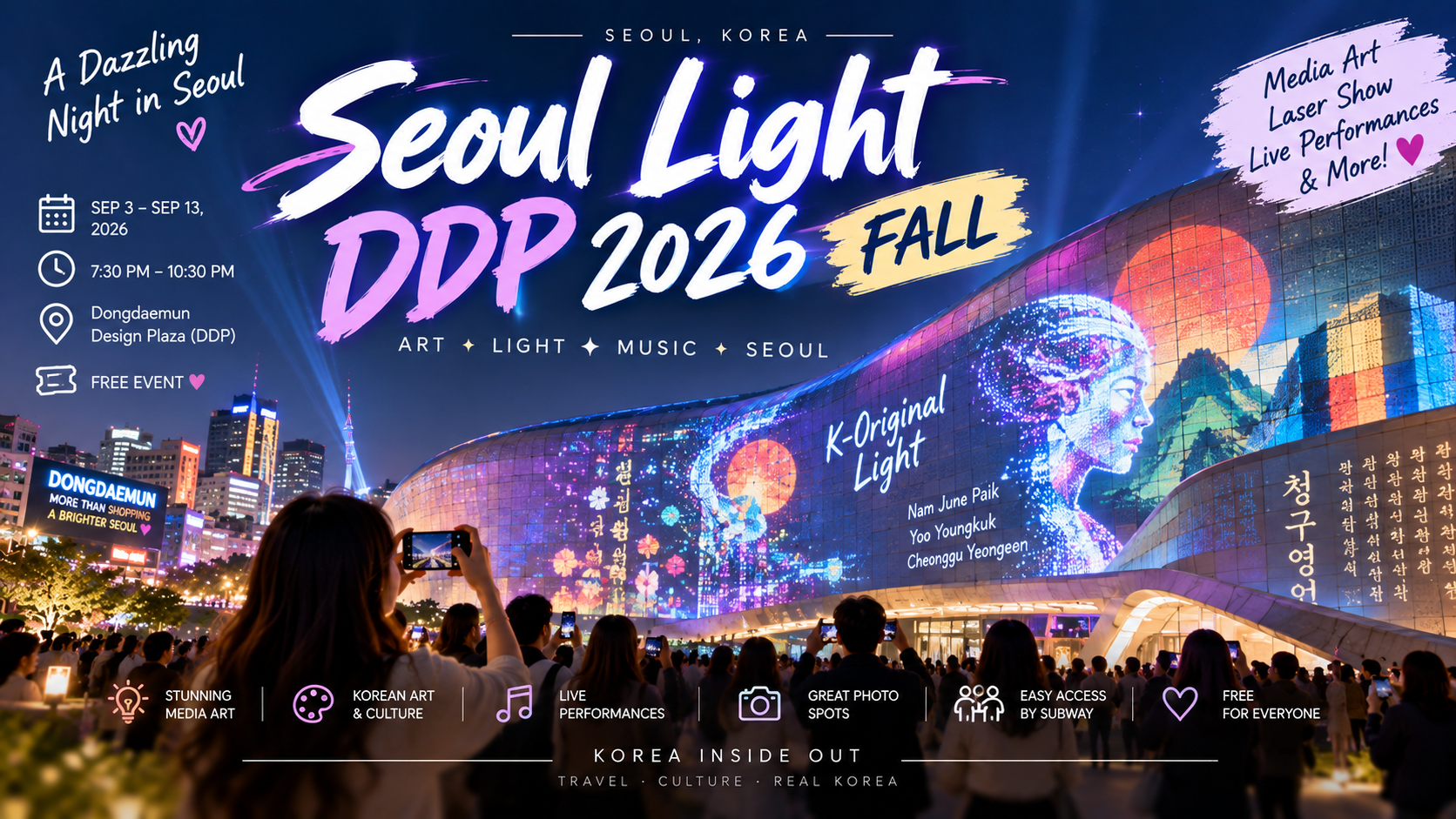
For its 2026 fall season, the event transforms the huge curved exterior of Dongdaemun Design Plaza (DDP) into a giant canvas for light, video, laser art, and live music.
The 2026 fall edition runs from September 3 to September 13, with programs taking place every evening from 7:30 PM to 10:30 PM. Admission is free.
This year’s theme, “K-Original Light,” explores Korean culture and creativity through contemporary media art, featuring works inspired by artists such as Nam June Paik and Yoo Youngkuk, as well as the historic Korean poetry collection Cheonggu Yeongeon.
If you are already planning to visit DDP, it is worth staying until after sunset.
What Is Seoul Light DDP?
Seoul Light DDP is a large-scale outdoor media art festival held at Dongdaemun Design Plaza, one of Seoul’s most recognizable pieces of contemporary architecture.
The curved 222-meter exterior of DDP becomes the screen for large-scale projections and light installations. Instead of simply watching a video on a screen, you are surrounded by the architecture, lights, music, and movement.
The result is particularly impressive after dark.
The 2026 fall program combines:
Large-scale media facade shows
Laser art
Live music performances
Real-time responsive media art
Outdoor nighttime activities
The entire event is free to watch, and you do not need to purchase a separate ticket to see the main shows.
Seoul Light DDP 2026 Fall: Quick Facts
Details
Event
Seoul Light DDP 2026 Fall
Dates
September 3–13, 2026
Time
7:30 PM–10:30 PM
Location
Dongdaemun Design Plaza (DDP)
Admission
Free
Main programs
Media facade, laser art, live performances
Nearest subway
Dongdaemun History & Culture Park Station
Recommended time
Around 7:20–7:30 PM
The event is held around the DDP exterior and Eoullim Square, making it easy to combine with an evening around Dongdaemun.
What Can You See?
The 2026 fall edition is particularly interesting because it connects contemporary digital art with some of Korea’s most important modern and traditional cultural works.
1. The Break Point — Nam June Paik
One of the highlights is a media art piece inspired by Nam June Paik, the Korean-American artist widely regarded as a pioneer of video art.
The work, titled “The Break Point,” draws inspiration from Paik’s video synthesizer and combines media art with a live performance.
Unlike a conventional prerecorded projection, the visuals can respond to the live performance in real time.
This is one of the most distinctive elements of Seoul Light DDP 2026.
2. Finding the Mountain Within Me — Yoo Youngkuk
Another major work is inspired by Korean abstract painter Yoo Youngkuk.
His paintings are famous for their simplified mountains, geometric forms, and strong colors.
For Seoul Light DDP, these ideas are transformed into moving light and digital imagery across the building’s enormous curved surface.
If you have never encountered Yoo Youngkuk’s work before, seeing his colorful abstract landscapes projected onto DDP is a particularly memorable introduction.
3. A Night When Words Shine
The third major media facade work takes inspiration from Cheonggu Yeongeon, an important collection of Korean sijo poetry.
Instead of presenting the old Korean text as a traditional literary exhibit, the work transforms Korean letters, poetry, and natural imagery into contemporary digital patterns and light.
For international visitors, this is an interesting way to experience an aspect of Korean culture that goes beyond the usual palace-and-K-pop itinerary.
4. DDP 365 Light
The festival also introduces DDP 365 Light, a new laser and lighting work created by artist Yoon Jeho.
It uses lasers and lighting to interact with DDP’s unusual architecture.
One interesting thing about this program is that it is not intended to disappear completely when Seoul Light DDP ends.
The Seoul Design Foundation plans to operate DDP 365 Light as an ongoing nighttime content program, with regular screenings gradually expanded after the festival.
So even if you miss the September festival, DDP will continue to have nighttime light programming.
When Should You Visit Seoul Light DDP?
The easiest option is to arrive around 7:20–7:30 PM.
The first program begins at 7:30 PM, and you can then stay for the later screenings.
Weekday schedule
From Monday to Thursday, the main program starts at:
7:30 PM
8:00 PM
8:30 PM
9:00 PM
9:30 PM
10:00 PM
The media facade and laser art are repeated throughout the evening.
Weekend schedule
On Friday through Sunday, the main programs are also scheduled at 7:30 PM, 8:00 PM, 9:30 PM, and 10:00 PM.
The 8:00 PM session includes live performances on selected dates.
For example, the 2026 fall lineup includes performances by SION, HYPNOSIS THERAPY, and SOULSCAPE.
If you are interested in the live music, check the specific date before visiting because the performance schedule changes by day.
Is Seoul Light DDP Free?
Yes.
Seoul Light DDP is a free outdoor event, and you do not need to buy a ticket for the main media facade, laser art, or live performances.
This makes it particularly good for travelers who want an interesting Seoul night activity without adding another expensive attraction to their itinerary.
You can simply walk to DDP, find a good viewing area, and enjoy the show.
How to Get to Seoul Light DDP
The easiest way to reach DDP is by subway.
Dongdaemun History & Culture Park Station
DDP is directly connected to Dongdaemun History & Culture Park Station, served by:
Line 2
Line 4
Line 5
Exit 1 is a convenient choice for reaching DDP.
If you are unfamiliar with Seoul’s subway system, see our guide:
One of the best things about Seoul Light DDP is that you don’t need to make it your entire evening.
DDP sits in the middle of one of Seoul’s busiest shopping and food districts, so you can easily combine the light show with dinner, shopping, or an evening walk.
Option 1: Dongdaemun evening
6:00 PM — Dinner around Dongdaemun ↓ 7:20 PM — Arrive at DDP ↓ 7:30 PM — Seoul Light DDP ↓ 8:30–9:00 PM — Explore DDP and nearby streets ↓ 9:00 PM onward — Shopping or late-night food
Option 2: DDP + local neighborhood
The 2026 festival also introduces the DDP × Dongdaemun Super Pass, connecting the event with restaurants, cafés, shops, and local attractions around Dongdaemun.
More than 140 participating businesses are organized into six themed walking courses, including areas around Sindang-dong, Jangchung-dong, and Gwanghui-dong.
This is a nice option if you want to experience more than the typical tourist side of Dongdaemun.
A Tip for Photographers
DDP is already one of the most photogenic buildings in Seoul, but the projections completely change its appearance at night.
For photos, don’t only photograph the projection itself.
Try including:
The full curve of the DDP building
People watching the show
The surrounding city lights
The projection together with DDP’s architecture
A wide-angle view from Eoullim Square
Because the media art covers such a large surface, a wider shot often works better than trying to capture the entire projection up close.
Is Seoul Light DDP Worth Visiting?
Yes, especially if you’re already visiting Dongdaemun.
The biggest advantage is that there is very little commitment involved.
You don’t need a ticket, reservation, or several hours of your evening. You can simply arrive after dinner, watch a few rounds of the projection, take some photos, and continue exploring Seoul.
The 2026 edition is also more culturally interesting than a typical light show because it combines Korean modern art, traditional literature, digital technology, music, and DDP’s futuristic architecture.
Our tip
If you’re visiting Seoul during the September 2026 event period, put DDP after sunset on your itinerary rather than visiting only during the day.
The fall edition runs from September 3 to September 13, 2026.
How much does it cost?
It is free.
What time does it start?
The first program begins at 7:30 PM, with programs continuing until 10:30 PM.
Where is Seoul Light DDP held?
At Dongdaemun Design Plaza (DDP) in Seoul, primarily around the exterior media facade and Eoullim Square.
Do I need a reservation?
No reservation is required for the main free outdoor program.
Is it good for tourists?
Absolutely. It is easy to reach by subway, free, visually impressive, and can be combined with dinner, shopping, and sightseeing around Dongdaemun.
What makes the 2026 edition different?
The 2026 fall season focuses on “K-Original Light,” bringing works inspired by Nam June Paik, Yoo Youngkuk, and Cheonggu Yeongeon together with laser art and live performances.
Final Thoughts
Seoul Light DDP is one of those Seoul experiences that is difficult to appreciate fully from photographs.
You need to stand in front of DDP and watch the building itself become part of the artwork.
The combination of Korean art, traditional culture, electronic music, lasers, and DDP’s futuristic architecture makes this more than just another nighttime light show.
And because it is free, it’s an easy addition to almost any Seoul itinerary.
If you’re in Seoul on a September evening, don’t just visit DDP during the day. Come back after dark.
Looking for something different to do in Seoul after the usual palaces, shopping streets and night markets?
Here’s an idea that many international visitors don’t know about:
Visit the Seoul Museum of Craft Art after dark.
Located in the heart of central Seoul, near Anguk Station and Insadong, the Seoul Museum of Craft Art (SeMoCA) offers more than exhibitions.
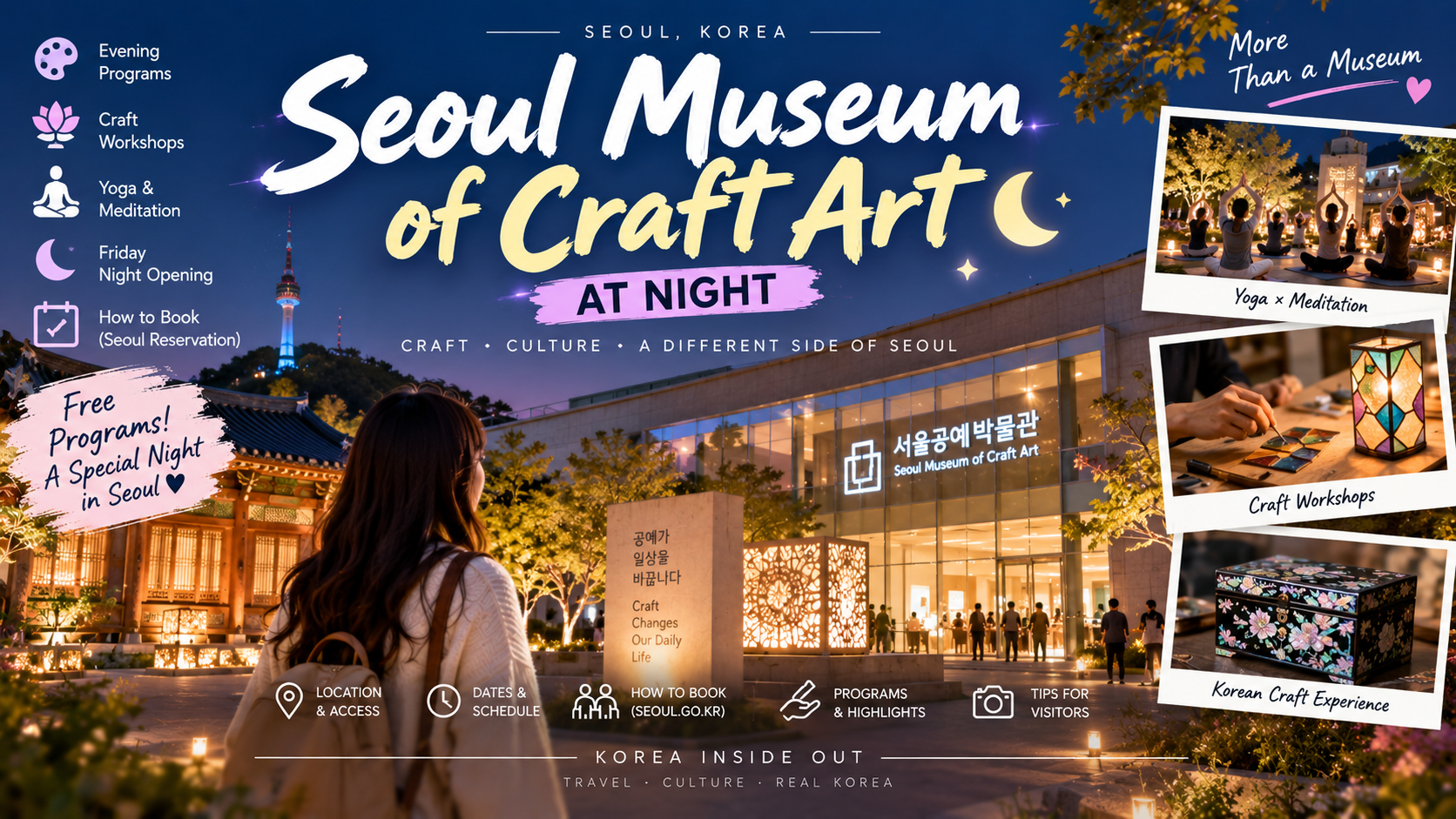
Throughout the year, the museum runs special evening programs where visitors can experience Korean crafts, join creative workshops, or simply slow down with yoga and meditation in the museum’s beautiful outdoor spaces.
And many of these programs are free.
The catch?
You usually need to reserve a spot in advance through Seoul Public Service Reservation, the reservation platform operated by the Seoul Metropolitan Government.
Here’s what to know before you go.
What Is the Seoul Museum of Craft Art?
The Seoul Museum of Craft Art, often called SeMoCA, is one of Seoul’s most interesting museums for visitors who want to understand Korean culture through objects and craftsmanship.
Rather than focusing only on paintings or contemporary art, the museum explores the world of Korean craft — including ceramics, textiles, metalwork, woodwork, lacquerware and other traditional and contemporary crafts.
The museum is located in Anguk, one of the most historic and walkable parts of central Seoul.
That makes it particularly easy to combine with other popular areas such as:
Insadong
Bukchon Hanok Village
Gyeongbokgung Palace
Changdeokgung Palace
Ikseon-dong
Insa-dong’s traditional craft shops
And there’s another reason to put it on your Seoul itinerary:
The museum stays open late on Fridays.
Seoul Museum of Craft Art at Night
The museum’s regular exhibition hours are generally 10 AM–6 PM, but since April 2024, the exhibition galleries have remained open until 9 PM every Friday.
Admission to the museum is free, although some special exhibitions may have separate admission arrangements.
This makes Friday evening a particularly good time to visit.
But the more interesting option is to look for one of SeMoCA’s special evening programs.
These programs can take place after normal museum hours and may include hands-on craft workshops, wellness activities and special cultural experiences.
Why Visit SeMoCA at Night?
For travelers, the evening programs offer something that a normal museum visit doesn’t.
Instead of simply walking through exhibition galleries, you can actually do something.
Depending on the program, you might:
🎨 Make your own craft 🪵 Work with traditional materials ✨ Create a decorative object 🧘 Practice yoga and meditation 🎵 Experience sound-based meditation 🌙 Relax in the museum’s outdoor spaces
It’s also a nice way to experience a quieter side of Seoul.
After a full day of sightseeing, an evening craft or wellness program can be a welcome change from another crowded tourist attraction.
2026 Evening Programs at Seoul Museum of Craft Art
There are several different evening programs during September and October 2026.
The exact schedule changes throughout the year, so it’s important to check the current reservation listing before planning your visit.
Here are some of the most interesting programs currently scheduled.
1. Craft Night: Yoga × Meditation
September–October 2026
One of the most unusual new programs is “Craft Night, Yoga × Meditation.”
Instead of spending the evening indoors, participants use the museum’s outdoor spaces for yoga and meditation.
The museum describes it as an opportunity to enjoy the evening atmosphere of the museum while focusing on relaxation and mindfulness.
The program runs across several evenings from September 19 through October 14, excluding the Chuseok holiday week.
There are several different themes.
September 19 Opening Night
The opening night includes three different programs:
Wind Yoga × Meditation 5:00–6:00 PM
Singing Bowl Yoga × Meditation 5:00–5:30 PM
Headset Yoga × Meditation 6:30–7:30 PM
The programs take place in different outdoor areas of the museum.
The headset yoga session, for example, takes place in the museum’s outdoor craft yard and uses headphones so participants can follow the instructor in a more immersive setting.
Later sessions include:
Gayageum Meditation — September 30
Voice Yoga Meditation — October 3
Sound Bath Meditation — October 7
Singing Bowl Yoga Meditation — October 10
Life Movement — October 14
The later sessions are scheduled for 6:30–7:30 PM.
How much does it cost?
Free.
Who can participate?
The program is open to the general public.
Children aged 5th grade and above may participate with a guardian, subject to the individual program’s rules.
2. Night Workshop: Autumn Glass Art
If yoga isn’t your thing, this may be even more interesting for travelers.
The “Night Workshop: Autumn Glass Art” is a hands-on craft program inspired by stained glass.
Participants make their own glass-art mood lamp while enjoying the museum after its normal operating hours.
The program is part of SeMoCA’s broader Night Craft (夜金) series.
Unlike a traditional class, this is designed as a self-directed craft experience.
You’ll receive instructions and work at your own pace, with museum staff available to help when needed.
2026 Autumn Glass Art
Dates: September 18–October 30 Location: Education Room, Exhibition Building 3, 1st floor Participants: Adults; children in 5th grade or older may participate with a guardian Capacity: 30 people per session Fee: Free Reservation: Seoul Public Service Reservation
The program is scheduled as part of the museum’s monthly Friday evening craft series.
The autumn version focuses on glass art, while the larger annual series rotates through different craft materials by season.
3. Night Craft: Mother-of-Pearl Box Making
Another evening program at SeMoCA is “Najeonham, Crafting with Mother-of-Pearl.”
Najeon is the traditional Korean craft technique of decorating objects with delicate pieces of mother-of-pearl.
This is a particularly interesting option for international visitors because it combines:
Korean traditional craft + museum collection + hands-on making.
Participants first look at representative mother-of-pearl objects from the museum’s collection before using traditional techniques to create their own decorated box.
The September sessions are scheduled for:
September 8
September 15
September 22
September 29
Each session runs from 6:00–7:30 PM.
The program is designed for adults and has a maximum of 20 participants per session.
It is also free.
One important point: this is a real hands-on class, not a kit pickup. Participants are expected to complete the craft during the session.
Do You Need to Pay?
One of the best things about these programs is the price.
Many SeMoCA evening programs are free.
The programs above are currently listed as free on Seoul’s reservation system.
That doesn’t mean you can always just walk in.
Free does not mean no reservation.
Popular programs can fill their limited places quickly.
How to Book a Seoul Museum of Craft Art Evening Program
This is the part international visitors should know.
Seoul operates an official reservation platform called Seoul Public Service Reservation.
The site allows users to reserve a wide range of city-run services and programs, including:
Cultural events
Museum programs
Craft workshops
Classes
Sports facilities
Tours
Parks and leisure programs
Other public services
The English version of the reservation platform is also available.
For SeMoCA programs, the museum’s own program pages repeatedly direct visitors to Seoul Public Service Reservation rather than accepting applications directly through the museum website.
How to search
Go to Seoul Public Service Reservation and search for:
“Seoul Museum of Craft Art”
or
“SeMoCA”
You can also search for the name of a specific program.
The reservation system allows users to browse by categories such as activities, lessons and cultural programs.
A Very Important Reservation Tip
Don’t assume that the museum’s website and the reservation site always show exactly the same availability status.
The museum specifically warns that its own website may show a program as accepting applications while the Seoul Public Service Reservation site may already be full — or vice versa.
The reservation platform is the place to check the actual application status.
This is especially important for popular evening programs with limited places.
Can Foreign Tourists Use Seoul Public Service Reservation?
This is where things can be slightly less straightforward.
The Seoul Public Service Reservation website has an English interface, which is helpful for international visitors.
However, individual program listings and application requirements can vary, and some programs may be presented primarily in Korean.
If you’re a foreign visitor, check the individual reservation page carefully before assuming that a program is suitable for you.
The good news is that the platform itself is designed to handle reservations for a wide range of Seoul’s public programs and services.
How Early Should You Book?
As soon as reservations open.
Many SeMoCA programs are limited to just a few dozen participants.
Insadong ↓ Traditional tea house ↓ SeMoCA exhibition ↓ 🌙 Yoga, meditation or craft workshop ↓ Dinner in Jongno
This is one of those itineraries that feels much more relaxed than trying to visit ten attractions in one day.
What Makes SeMoCA Different From a Normal Museum Visit?
For travelers, the biggest attraction isn’t necessarily the collection.
It’s the experience.
You aren’t just looking at Korean craft behind glass.
You can actually:
Learn about a traditional technique
Make something yourself
Meet other participants
Spend an evening in a historic part of Seoul
Experience a quieter side of Korean culture
And because many programs are free, there’s very little downside to trying one if your schedule lines up.
Is the Seoul Museum of Craft Art Worth Visiting at Night?
Yes — especially if you’ve already seen Seoul’s major tourist attractions.
If you’ve spent several days visiting palaces, markets and shopping districts, an evening at SeMoCA offers something completely different.
It’s slower.
It’s more hands-on.
And it gives you a chance to experience Korean culture rather than simply photograph it.
For travelers interested in Korean design, traditional crafts, wellness or creative activities, this is an especially good option.
Our Favorite 2026 Options
If we were choosing from the current evening programs, we’d shortlist them like this:
🥇 For a uniquely Korean experience
Mother-of-Pearl Box Making
You learn about najeon, one of Korea’s most recognizable traditional decorative crafts, and make your own piece.
🥈 For something creative
Autumn Glass Art
A great choice if you want to make something you can actually take home.
🥉 For relaxation
Headset Yoga × Meditation
Ideal after a long day of sightseeing.
🌙 For something unusual
Sound Bath Meditation
A very different experience from the typical Seoul tourist itinerary.
Seoul Public Service Reservation: A Hidden Travel Resource
Here’s the bigger tip we’d give international visitors:
Don’t think of Seoul Public Service Reservation as just a booking website for Koreans.
It can be a useful source for finding things to do in Seoul.
The platform covers a surprisingly broad range of activities, including cultural programs, exhibitions, classes, sports facilities, park programs and other city-run experiences.
So if you’re looking for something to do beyond the usual tourist attractions, it’s worth checking.
You may find:
Free workshops
Cultural experiences
Walking tours
Museum programs
Outdoor activities
Seasonal events
Craft classes
Some programs are free, while others have fees.
And availability changes constantly.
A Perfect Evening at SeMoCA
Here’s how we’d plan it.
3:00 PM
Explore Insadong.
4:00 PM
Walk toward SeMoCA and visit the museum exhibitions.
5:30 PM
Have an early dinner or coffee nearby.
6:00 PM
Return to the museum for your evening program.
6:30–7:30 PM
🌙 Craft, yoga or meditation.
7:30 PM onward
Walk through the historic streets around Anguk and Insadong.
It’s a simple itinerary, but it gives you something that many Seoul trips lack:
If you’re visiting Seoul, don’t only search for the city’s biggest attractions.
Some of the most memorable experiences are hidden in places that locals use too.
Seoul Museum of Craft Art’s evening programs are a perfect example.
You can spend the day exploring palaces and traditional neighborhoods, then finish the evening making Korean craft, listening to a sound bath, or practicing yoga beneath an old gingko tree.
And because many programs are free, it’s one of those Seoul experiences that’s worth checking even if you don’t normally plan museum activities.
Check Seoul Public Service Reservation before your trip. You might find something you didn’t know Seoul offered.
Imagine sitting beside the Han River on a cool autumn evening, with Seoul’s skyline in the distance.
Then thousands of lights suddenly appear in the sky.
A dragon flies overhead. A Korean landmark takes shape. Characters and colorful images move across the night sky.
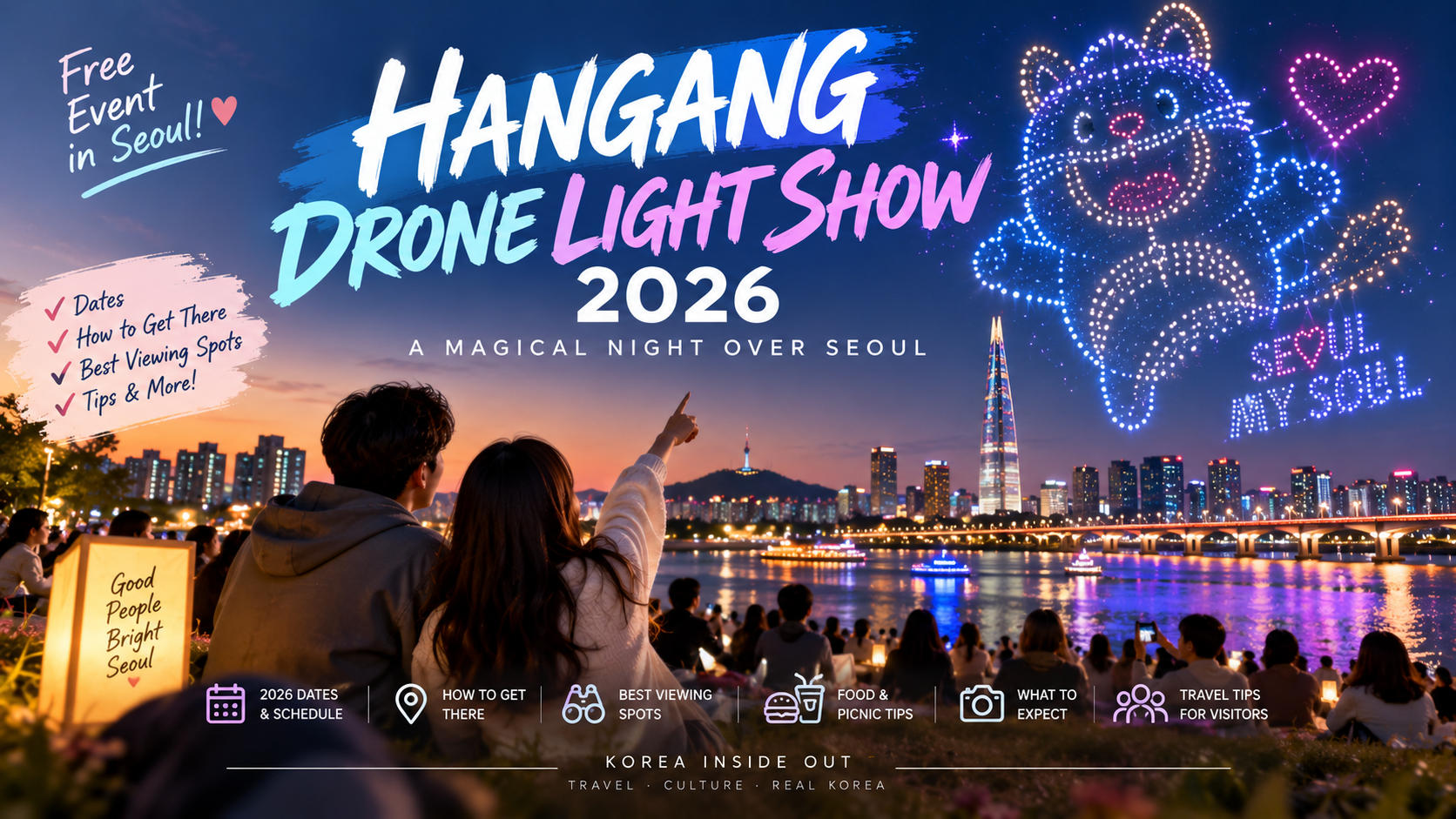
This is the Hangang Drone Light Show, one of Seoul’s most spectacular free nighttime events.
The show combines large-scale drone performances with live music, cultural performances and the atmosphere of a night by the Han River.
And the best part?
It’s free to watch.
Here’s everything international visitors need to know about the 2026 Hangang Drone Light Show, including dates, location, times, how to get there, where to watch and what to expect.
What Is the Hangang Drone Light Show?
The Hangang Drone Light Show is a large-scale nighttime performance in which hundreds or thousands of drones fly above the Han River, creating moving images, patterns and stories in the sky.
The official 2026 program describes it as a signature nighttime light festival combining the scenery of the Han River with drone technology and cultural performances.
For 2026, the show has been expanded into regular spring and autumn seasons, with performances using between approximately 1,200 and 2,000 drones, depending on the program.
The experience is very different from watching a traditional fireworks show.
Instead of explosions, you’ll see images and animations appear, move and transform above Seoul.
It’s also a very Korean way to spend an evening:
Han River + Seoul skyline + K-culture + technology + food.
Hangang Drone Light Show 2026: Quick Facts
2026 Information
Event
Hangang Drone Light Show
Location
Ttukseom Hangang Park
Season
September–October 2026
Remaining dates
October 9 & October 31
Main show
8:30–8:45 PM
Admission
Free
Reservation
Not required
Venue
Ttukseom Hangang Park Waterfront Stage
Nearest subway
Jayang Station, Line 7
Weather
Show may be delayed or canceled
Best for
Couples, families, friends & first-time visitors
The fall season runs from September 12 to October 31, with all three performances taking place at Ttukseom Hangang Park.
When Is the Hangang Drone Light Show in 2026?
The 2026 fall season has three performances:
September 12, 2026 — K-Baseball, Seoul Night
Already held
The first fall performance celebrated Seoul’s three professional baseball teams:
LG Twins
Doosan Bears
Kiwoom Heroes
The show also included a special performance by the LG Twins cheerleading team.
This was the opening event of the fall season.
October 9, 2026
Second fall performance
The theme has not yet been officially announced.
The performance will take place at Ttukseom Hangang Park, with the main drone show scheduled for 8:30–8:45 PM.
October 31, 2026 — Marvel Special Performance
This is the date to remember.
The final fall performance will feature a special collaboration with Marvel.
Even more exciting for drone-show fans, Seoul plans to use 2,000 drones, making it the largest-scale drone performance of the 2026 season.
Marvel characters and stories will be brought to life above the Han River.
If you’re visiting Seoul around Halloween, October 31 could be an especially fun night to experience the Han River.
What Time Does the Drone Show Start?
The main drone performance begins at:
8:30 PM
For the general fall program, the event runs from approximately 7:30 PM to 9:25 PM.
The standard program is:
7:30–8:30 PM Cultural and artistic performances
8:30–8:45 PM ✨ Main Drone Light Show
8:45–8:55 PM ✨ Mini Drone Show
8:55–9:25 PM Cultural and artistic performances
The official program notes that the schedule can vary by individual performance.
For international visitors, this means you don’t necessarily need to arrive at 6 PM just to see the drones.
But arriving earlier is a good idea if you want a comfortable viewing spot.
Is the Hangang Drone Light Show Free?
Yes.
One of the best things about the Hangang Drone Light Show is that there is no admission fee.
The event is designed as a public performance at Hangang Park, and visitors can watch it without purchasing a ticket or making a reservation.
That makes it particularly attractive for travelers.
You could spend the afternoon exploring Seoul, grab some Korean food, head to the Han River in the evening and finish the night with a spectacular drone show — without paying for another attraction.
Where Is the Hangang Drone Light Show?
The 2026 fall performances take place at:
Ttukseom Hangang Park
The main performance area is around the Waterfront Stage.
The official venue address is:
559-5 Jayang-dong, Gwangjin-gu, Seoul
The exact viewing area can become crowded, so don’t wait until the last minute to find your way to the river.
How to Get to the Hangang Drone Light Show
The easiest option for most international visitors is the subway.
🚇 Take Line 7 to Jayang Station
The official event guidance recommends using Exit 1 at Jayang Station.
During the event, Exits 2 and 3 may have restricted access because of crowd-control and safety measures.
Important:
Don’t rely on driving if you can avoid it.
Large crowds are expected, and parking around Ttukseom Hangang Park can become extremely difficult.
The city specifically recommends public transportation on event days.
Do You Need a Reservation?
No.
The event is a free, open public performance with on-site participation rather than ticketed admission.
That doesn’t mean you can arrive at 8:29 PM and expect an empty spot.
The popular viewing areas can become crowded, particularly on good-weather evenings.
If you’re visiting on a busy date, arrive early and treat the Han River itself as part of the experience.
Where Is the Best Place to Watch?
You don’t necessarily have to stand directly in front of the main stage.
Because the drones fly high above the river, there are several areas around the park from which you can see the performance.
Our recommendation:
Find a comfortable spot with an unobstructed view of the sky.
Look for:
A clear view toward the river
Enough open sky above you
Space to sit
A location away from tall trees or structures
You don’t need to squeeze into the densest crowd just to see the drones.
In fact, one of the nicest ways to experience the show is to bring a picnic mat, sit beside the river and watch the sky above Seoul.
How Early Should You Arrive?
For a casual visit:
Arrive around 6:30–7:00 PM
This gives you time to:
Find a good spot
Buy food
Walk along the river
Take photos
Watch the cultural performances
Relax before the drone show
For particularly popular dates such as October 31, we’d arrive even earlier.
The Marvel performance is likely to attract significant crowds.
What Should You Do Before the Drone Show?
Don’t think of the drone show as a 15-minute attraction.
The best way to experience it is as a Han River evening.
For example:
5:30 PM
Arrive at Ttukseom Hangang Park.
6:00 PM
Walk along the Han River.
6:30 PM
Get Korean food or snacks.
7:00 PM
Find a place to sit.
7:30 PM
Watch the cultural performances.
8:30 PM
✨ Drone Light Show
8:45 PM
Mini drone show.
9:00 PM
Enjoy the river at night before heading back.
This is much more relaxing than arriving five minutes before the main show.
Can You Bring Food?
Absolutely.
And we’d recommend it.
One of the best things about experiencing Seoul’s Han River is combining the scenery with Korean food.
You can bring:
Fried chicken
Kimbap
Tteokbokki
Ramyeon
Pizza
Convenience-store snacks
Drinks
The city is also expanding food and delivery options around the event.
For the September 12 performance, Seoul partnered with Baemin to make food delivery more convenient for both local and international visitors, and food trucks and K-food tasting events were also available.
The exact food program may differ by performance, so check the official event announcements for your specific date.
Why the Han River Is the Perfect Setting
The drone show works particularly well because of its location.
Seoul’s skyline becomes part of the performance.
Instead of watching lights against a completely dark background, you get:
🌉 Bridges 🏙️ Seoul’s skyline 🌊 The Han River 🌙 The night sky ✨ Thousands of lights
The result feels less like a traditional theme-park show and more like a giant open-air performance across Seoul’s night sky.
Is the Drone Show Good for Tourists?
Definitely.
In fact, the event has become increasingly international.
During the first five performances of 2026, the Hangang Drone Light Show attracted approximately 125,000 visitors, and foreign visitors accounted for about 34.6% of the audience.
That is important for international travelers because it means you won’t be attending an event designed only for Korean locals.
The show has become part of Seoul’s broader nighttime tourism experience.
Is It Worth Visiting If You’ve Never Been to Seoul?
We think so.
The Hangang Drone Light Show gives you something that many traditional sightseeing attractions can’t:
A chance to experience Seoul the way locals do at night.
You aren’t standing inside a museum.
You aren’t walking through a palace.
You’re sitting beside one of the world’s major urban rivers, eating Korean food, watching the city lights and looking up at a giant digital performance in the sky.
That’s a very different side of Seoul.
Hangang Drone Light Show vs Seoul Fireworks Festival
If you’ve heard about Seoul’s famous fireworks festival, you might wonder how the two compare.
✨ Animated drone formations 🎵 Cultural performances 🌊 More relaxed riverside atmosphere 🆓 Free 📅 Multiple dates each year
If you don’t like enormous fireworks crowds, the drone show can be a much more manageable nighttime experience.
Tips for Taking Photos and Videos
The drone show is incredibly tempting to film.
But your phone may struggle with it.
For better photos:
Use a wide-angle lens
Keep the camera steady
Include the river or skyline in the frame
Avoid excessive digital zoom
Take short video clips rather than filming the entire show
Lower your screen brightness if you’re trying to enjoy the show
And don’t spend the entire 15 minutes looking at your phone.
Look up.
The performance is much more impressive in person.
What Should You Bring?
You don’t need much.
Essentials
✓ Phone ✓ Portable battery ✓ Picnic mat ✓ Light jacket ✓ Water ✓ Snacks ✓ Comfortable shoes
For autumn
September and October evenings can feel noticeably cooler than the daytime.
Bring a light jacket or cardigan, especially if you plan to sit beside the river for several hours.
What Happens If It Rains?
This is important.
The drone show is an outdoor event, so weather can affect the performance.
Rain and strong winds may cause the show to be delayed or canceled.
The official event guidance specifically recommends checking the official website and Instagram before visiting if the weather is questionable.
Our advice:
Don’t make a complicated Seoul itinerary around the drone show if the weather forecast looks terrible.
Check the official event channels on the day of the performance.
If the weather is good?
Head to the river.
Important Transportation Tips After the Show
Here’s something first-time visitors often underestimate:
Leaving can be harder than arriving.
Thousands of people may leave the park at roughly the same time after the show.
The city recommends using public transportation and dispersing through nearby subway exits and access points.
The official guidance specifically recommends:
Jayang Station Exit 1
Using Noyu Interchange or Jayang Interchange if Ttukseom Interchange is too crowded
Avoiding unnecessary car travel
Parking lots 3 and 4 may also have vehicle-exit restrictions until around 9:30 PM after the show.
Our tip:
Don’t rush immediately after the final drone.
Stay for 15–20 minutes.
Let some of the crowd leave first.
You can enjoy the river at night while the area becomes quieter.
What Is Special About October 31?
If you’re choosing between the two remaining 2026 dates, we’d pay special attention to:
October 31, 2026
This isn’t just another drone show.
Seoul has announced a collaboration with Marvel, featuring 2,000 drones — the largest scale planned for the 2026 program.
Marvel characters and stories will appear in the night sky above the Han River.
For international visitors, that’s an especially interesting combination:
Marvel + Seoul + Han River + Korean nighttime culture.
If you’re visiting Seoul around Halloween, put this one on your calendar.
A Perfect Evening at the Han River
If we were planning this for a first-time visitor, we’d keep it simple.
5:00 PM
Finish sightseeing in central Seoul.
5:30 PM
Take the subway toward Ttukseom.
6:00 PM
Arrive at Hangang Park.
6:15 PM
Walk along the river and take photos.
6:45 PM
Pick up dinner and drinks.
7:15 PM
Find a comfortable viewing spot.
7:30 PM
Enjoy the cultural performances.
8:30 PM
✨ Hangang Drone Light Show
8:45 PM
Mini drone show.
9:00 PM
Relax beside the river.
9:20 PM
Start heading toward the subway.
This is one of those Seoul evenings where you don’t need to schedule every minute.
Hangang Drone Light Show 2026: FAQ
Is the Hangang Drone Light Show free?
Yes. The 2026 fall performances are free to watch.
Where is it held?
At Ttukseom Hangang Park.
Do I need a ticket?
No. It is an open public event.
What time does the drone show start?
The main drone performance is scheduled for 8:30 PM–8:45 PM.
How long is the drone show?
The main show lasts approximately 15 minutes, followed by a mini drone show.
How many drones are used?
The 2026 program ranges from approximately 1,200 to 2,000 drones depending on the performance. The October 31 Marvel special is planned to use 2,000 drones.
What happens if it rains?
The event may be delayed or canceled because of rain, strong winds or other weather conditions.
Is it good for children?
Yes. It’s a free outdoor event suitable for families, although the crowds can be large.
Can foreigners attend?
Absolutely. Foreign visitors make up a significant share of the audience.
Do I need to speak Korean?
No. You can enjoy the visual performance without understanding Korean.
2026 Hangang Drone Light Show: Dates at a Glance
Date
Theme
Location
Main Show
Sep. 12
K-Baseball, Seoul Night
Ttukseom
8:30 PM
Oct. 9
To be announced
Ttukseom
8:30 PM
Oct. 31
Marvel Special
Ttukseom
8:30 PM
The October 9 theme had not yet been announced in the official schedule at the time of writing. The October 31 Marvel special is planned as the largest 2026 performance, with 2,000 drones.
Is the Hangang Drone Light Show Worth It?
Yes — especially if you’re already planning to spend an evening along the Han River.
You don’t need to buy an expensive ticket.
You don’t need to book a tour.
You don’t even need to understand Korean.
Just bring something to sit on, grab some food, find a spot beside the river and look up.
For travelers, that’s part of the appeal.
You get to see Seoul’s technology, culture, skyline and everyday riverside life all at once.
And if you’re visiting on October 31, you’ll get something even more unusual:
Marvel characters lighting up the Seoul night sky with 2,000 drones.
That’s an experience worth planning around.
Our Tip
If the weather is clear, arrive at least an hour before the main show.
Don’t just come for the drones.
Come early, get some Korean food, walk along the Han River, watch the performances and enjoy the atmosphere.
The drone show is the highlight — but the Han River evening is the experience.
Event schedules, themes, performance times and weather-related operations can change. Check the official Hangang Drone Light Show website shortly before visiting.
What if you could spread out a picnic mat on a huge green lawn, listen to some of Korea’s best musicians, and spend an autumn evening near the DMZ — for just ₩3,000?
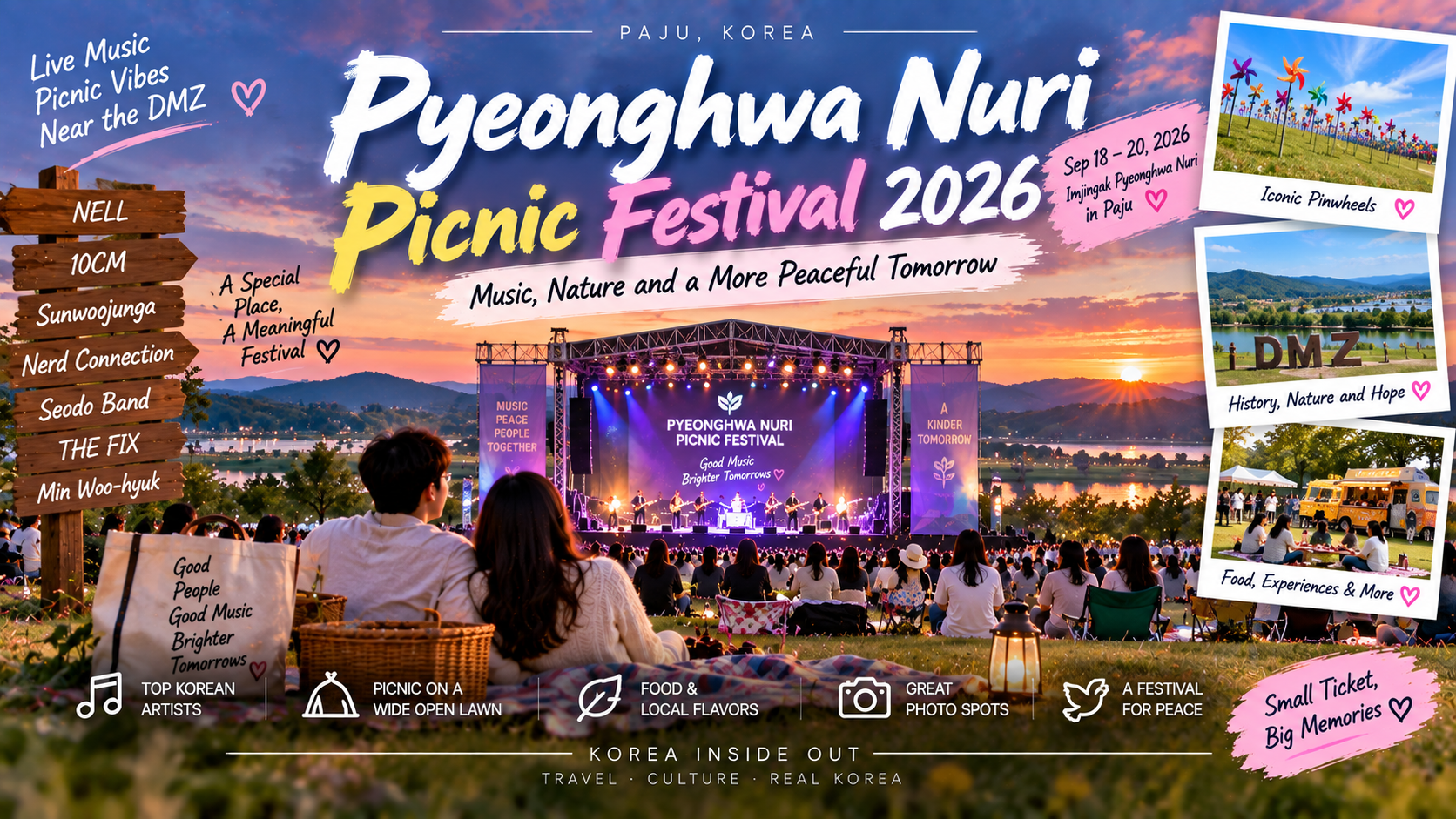
That’s the idea behind the Pyeonghwa Nuri Picnic Festival 2026 (평화누리 피크닉 페스티벌), held at Imjingak Pyeonghwa Nuri in Paju from September 18 to 20, 2026.
The highlight comes on Saturday, September 19, when an impressive lineup takes the outdoor stage:
NELL, 10CM, Sunwoojunga, Nerd Connection, Seodo Band, THE FIX, and musical actor Min Woo-hyuk.
This isn’t a typical standing-room music festival.
You can sit on the grass, enjoy a picnic, explore one of Korea’s most symbolic border areas, try local food, and watch the sun go down before the live music continues into the evening.
If you’re visiting Seoul in September and want an unusual day trip, this is one festival worth knowing about.
It’s built around one of the nicest things to do in Korea during autumn:
spread out a mat on the grass, eat something good, and spend the afternoon outside.
Imjingak Pyeonghwa Nuri has a huge open lawn surrounded by rolling green hills and outdoor art.
During the festival, visitors turn that lawn into a giant picnic area while musicians perform on an outdoor stage.
During the afternoon, it feels relaxed and casual.
As the sun goes down, it gradually transforms into an outdoor music festival.
But there’s another reason the setting is unusual.
You’re right next to the DMZ.
A Music Festival Near the DMZ
Imjingak is one of Korea’s best-known destinations associated with the division of the Korean Peninsula.
Located in Paju, north of Seoul, the area contains memorials, monuments and historical sites connected with the Korean War, division and hopes for reunification.
Pyeonghwa Nuri was developed around the theme of peace.
Even its name tells you what the park represents:
Pyeonghwa (평화) = Peace
That makes the atmosphere very different from attending a concert in central Seoul.
You’re listening to contemporary Korean musicians in a landscape that represents one of the most complicated chapters of modern Korean history.
The festival also includes a Peace Special Stage, reinforcing the connection between the performances and the location.
The Main Concert: September 19
If live music is your main reason for visiting, remember one date:
Saturday, September 19, 2026
The festival itself runs for three days, but the headline concert takes place on Saturday.
And the lineup is surprisingly strong for a ticket that costs only ₩3,000.
NELL
NELL is the headline act.
One of Korea’s most respected modern rock bands, NELL is known for atmospheric sound, emotional songwriting and powerful live performances.
Their music should work particularly well here.
Imagine listening to NELL outdoors as the sun disappears over the huge lawn at Imjingak.
This is probably the performance we’d stay until the end for.
10CM
If you’ve listened to Korean indie music — or watched enough K-dramas — there’s a good chance you’ve heard 10CM.
Known for his distinctive voice and acoustic-driven songs, 10CM has become one of Korea’s most recognizable singer-songwriters.
And honestly, this feels like the ideal setting for a 10CM performance:
grass,
a picnic mat,
cool autumn air,
and sunset.
Sunwoojunga
Sunwoojunga (선우정아) is one of the most distinctive artists on the lineup.
Her music moves between indie, jazz, pop and experimental sounds.
If you’re interested in Korean music beyond mainstream K-pop, she’s one of the artists worth discovering.
Nerd Connection
Nerd Connection brings a younger Korean band sound to the festival.
Known for emotional rock songs and strong live performances, the band has developed a particularly loyal following among younger Korean listeners.
For international travelers curious about what people in Korea listen to beyond idol groups, this festival offers a good introduction.
Seodo Band
For overseas visitors, Seodo Band may be one of the most interesting acts of the day.
The group combines Korean traditional music with contemporary pop and band sounds, creating a style often described as Joseon Pop.
That fusion of traditional Korean musical influences with modern performance feels especially appropriate in a festival built around Korean culture and peace.
THE FIX
THE FIX brings a more powerful rock sound to the lineup.
Their performance should help shift the mood from a relaxed afternoon picnic toward a full evening concert.
Peace Special Stage: Min Woo-hyuk
The festival also includes a special performance connected to its central message of peace.
Musical actor Min Woo-hyuk will appear on the Peace Special Stage.
At another music festival, “peace” might simply be a theme.
Here, the setting gives the word much more weight.
You’re attending a concert at Imjingak, just south of one of the world’s most famous divided borders.
The Ticket Costs Just ₩3,000
This is one of the biggest reasons the festival stands out.
Admission is:
₩3,000 + booking fee
That’s exceptionally inexpensive for a lineup including NELL, 10CM, Sunwoojunga and Nerd Connection.
If seeing the artists is important to you, we’d recommend booking ahead rather than assuming tickets will still be available when you arrive.
DMZ history → Pyeonghwa Nuri → local food → picnic → live music.
That’s a much better reason to travel from Seoul than coming to Paju only for a few hours of music.
More Things to Do at the Festival
The main concert isn’t the only activity.
Additional programs include:
Peace Pinwheel Making
Make a colorful pinwheel inspired by the festival’s peace theme.
Tattoo Sticker Experience
A simple festival activity that’s particularly easy for families with children.
Busking
Smaller live performances take place outside the main stage.
Yoga
There are also programs connected with the Pyeonghwa Nuri camping area.
None of these are necessarily reasons to travel from Seoul on their own.
Together, though, they make it easy to arrive early and spend most of the day here.
Don’t Miss the Giant Pinwheels
Even without a festival, Pyeonghwa Nuri is worth exploring.
One of its most recognizable sights is the huge grassy hill with colorful pinwheels.
The park also has large outdoor artworks spread across the landscape.
And because the area is so open, the atmosphere is completely different from crowded central Seoul.
Our Tip
Don’t arrive just before the concert.
Come while there’s still plenty of daylight.
Walk around Imjingak and Pyeonghwa Nuri, take photos, learn a little about the DMZ and then find your spot on the grass before the main performances begin.
How to Get to Pyeonghwa Nuri from Seoul
This is the part international visitors need to plan carefully.
Imjingak is in Paju, north of Seoul, close to the DMZ.
It’s a perfectly realistic day trip from Seoul, but it isn’t as simple as taking the subway to Hongdae or Myeongdong.
By Public Transportation
Your destination is:
Imjingak Pyeonghwa Nuri (임진각 평화누리)
The closest railway station is Imjingang Station (임진강역).
A typical journey from Seoul involves traveling north toward Munsan Station and continuing toward Imjingang.
From Imjingang Station, the Imjingak area is within walking distance.
Important
Train services toward Imjingang are much less frequent than ordinary Seoul subway services.
Check the timetable for both your outbound and return journey before leaving Seoul.
This becomes especially important after the concert because the festival continues into the evening.
For foreigners who aren’t familiar with Seoul’s public transport system, our How to Use the Seoul Subway guide explains transportation cards, transfers and basic subway navigation.
Is It Easy to Visit from Seoul?
Yes — but plan it as a full-day trip, not simply an evening concert.
Paju is close enough to Seoul to visit without staying overnight, while Imjingak gives you something completely different from the capital.
Our Recommended Plan
Morning: Leave Seoul
↓
Late Morning: Arrive at Imjingak
↓
Lunch: Eat around the Imjingak area
↓
Early Afternoon: Explore Imjingak’s historical sites
↓
Mid-Afternoon: Walk around Pyeonghwa Nuri and take photos
↓
Around 4 PM: Settle into the festival area
↓
Late Afternoon–Evening: Picnic + live performances
↓
After the Concert: Return to Seoul
This makes the journey much more worthwhile.
What Else Can You See at Imjingak?
If you’re already making the journey from Seoul, don’t treat Pyeonghwa Nuri as the only attraction.
Imjingak is closely associated with the history of the Korean Peninsula and the DMZ.
The broader area contains memorials and historical sites related to the Korean War and division of Korea.
That creates an unusual contrast.
During the afternoon, you can learn about one of the most serious parts of modern Korean history.
A few hours later, you’re sitting on the grass listening to live music at a festival centered on peace.
For international travelers, that combination makes this more meaningful than a typical music festival.
Is the Festival Good for Families?
Yes.
The event is open to all ages, and Pyeonghwa Nuri has a huge amount of outdoor space.
Children don’t have to sit quietly in a concert hall.
Families can enjoy the grass, outdoor installations, food and additional activities before the music starts.
If you’re visiting with younger children, we’d arrive early and treat the concert as one part of the day rather than the entire experience.
Is It Good for Couples?
Very.
In fact, this might be one of the better autumn date ideas outside Seoul.
Bring a picnic mat.
Get something to eat.
Sit on the grass.
Watch the sunset.
Listen to 10CM.
And stay for NELL after dark.
It’s a pretty good formula.
What Should You Bring?
September afternoons in Korea can still feel warm, while evenings can become noticeably cooler.
We recommend bringing:
A picnic mat
A light jacket or cardigan
Water
A portable battery
Sun protection
Comfortable shoes
And check the weather before leaving Seoul.
This is an outdoor festival, so weather can make a big difference.
What If It Rains?
Outdoor festival schedules can change because of heavy rain, storms or other unsafe weather conditions.
This is especially important because getting to Imjingak takes more planning than visiting an event in central Seoul.
Which Day Should You Visit?
For international visitors, the answer is easy.
Saturday, September 19
That’s the day of the major live concert.
It’s also when Gyeonggi FOOD FESTA 2026 takes place nearby.
That gives you the best combination of food, activities and live music.
If you’re choosing only one day:
Our Pick: September 19
Come early and make a full day of it.
Is It Really Worth ₩3,000?
Absolutely.
The ticket price is almost surprisingly low considering the lineup.
You’re getting performances featuring:
NELL
10CM
Sunwoojunga
Nerd Connection
Seodo Band
THE FIX
Min Woo-hyuk
And you’re watching them outdoors at one of Korea’s most symbolic locations.
The real cost to consider isn’t the admission ticket.
It’s the time and transportation required to travel from Seoul.
That’s why we recommend combining the festival with sightseeing around Imjingak.
Why International Travelers Should Consider It
Most first-time visitors to Korea spend their evenings in places like Hongdae, Myeongdong, Gangnam and Itaewon.
There’s nothing wrong with that.
But this is a very different Korea.
You’re sitting on a huge lawn near the DMZ.
Korean families and couples are picnicking around you.
Indie and rock musicians are performing on stage.
And the central theme of the event is peace on the Korean Peninsula.
It’s exactly the kind of local experience that’s easy to miss if you never leave central Seoul.
Pyeonghwa Nuri Picnic Festival 2026: Quick Facts
Question
Answer
When is the festival?
Sep 18–20, 2026
When is the main concert?
Sep 19
Where is it?
Imjingak Pyeonghwa Nuri, Paju
How much is admission?
₩3,000 + booking fee
Who is performing?
NELL, 10CM, Sunwoojunga, Nerd Connection, Seodo Band, THE FIX and Min Woo-hyuk
Can children attend?
Yes
Is it outdoors?
Yes
Should I bring a picnic mat?
Yes, especially for the Picnic Zone
Is there food?
Yes, and Gyeonggi FOOD FESTA takes place nearby on Sep 19
Can I visit from Seoul?
Yes — we recommend making it a full-day trip
Nearest station
Imjingang Station
Best day to visit
Saturday, September 19
Final Thoughts
There are plenty of music festivals in Korea.
But there aren’t many where the location tells as much of a story as the performers.
The Pyeonghwa Nuri Picnic Festival takes place beside the DMZ, in a park created around the idea of peace.
During the day, you can explore Imjingak and learn about Korea’s divided history.
In the afternoon, spread out a picnic mat on the grass.
And as the sky gets darker, some of Korea’s best-known indie and rock musicians take the stage.
All for just ₩3,000 plus the booking fee.
If you’re in Seoul on September 19, 2026 and you’re looking for something very different from another day of shopping and sightseeing downtown, this is one day trip we’d seriously consider.
Come early.
Explore Imjingak.
Bring a picnic mat.
Stay for the music.
And make sure you check that last train before you get too comfortable on the grass.
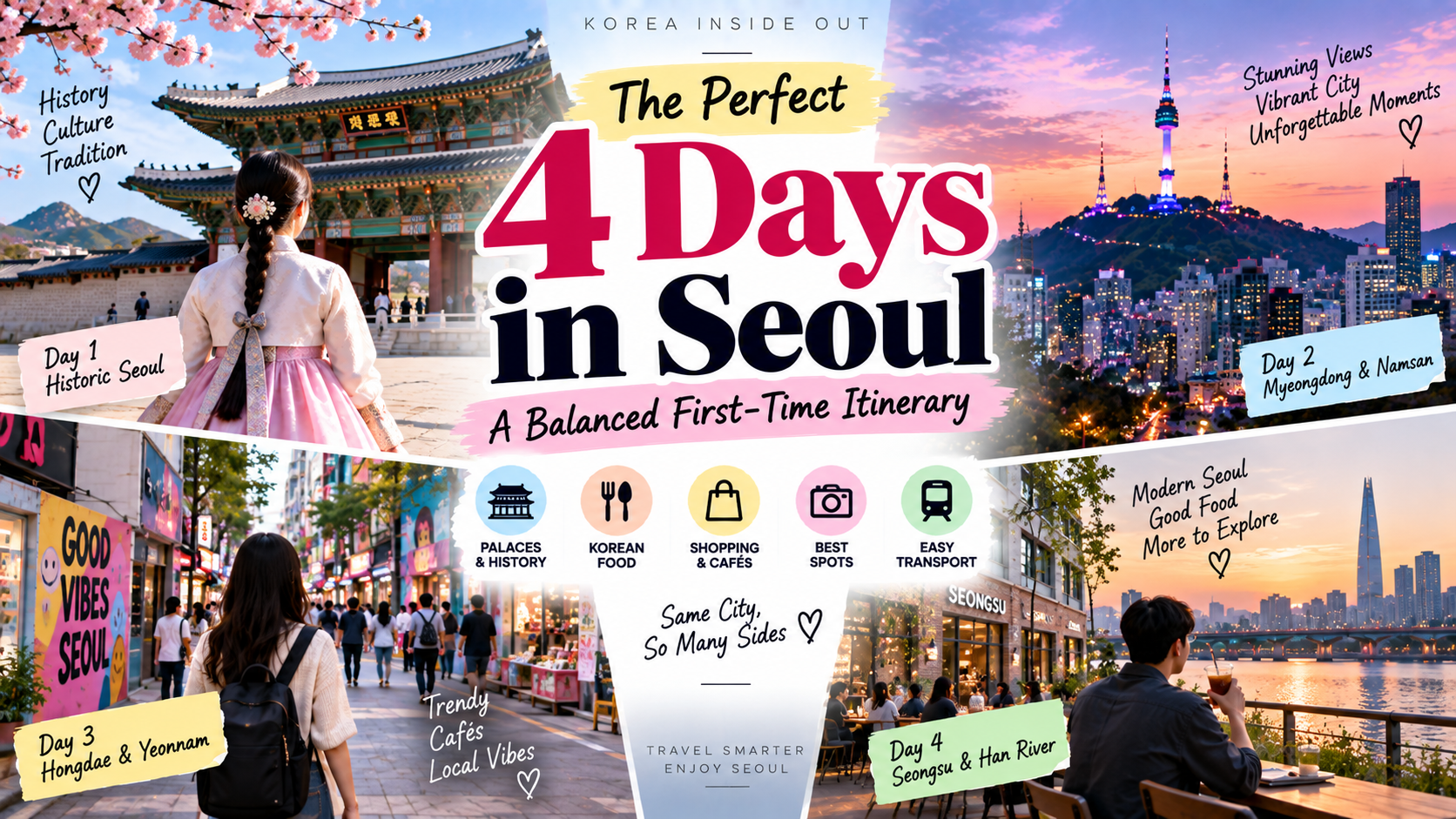
Planning a trip to Seoul and wondering how to spend four days in the city?
Four days is a great amount of time for a first trip to Seoul.
You have enough time to see the city’s famous palaces and traditional neighborhoods, experience modern Seoul, eat plenty of Korean food, and still leave room for cafés, shopping, and a little wandering.
The trick is not trying to visit every famous place.
Seoul is a huge city, and crossing from one side to the other several times a day can eat up more of your vacation than you might expect.
So instead of building an itinerary around a long list of attractions, this guide groups each day around a different part of Seoul.
You’ll experience:
Historic Seoul
Traditional neighborhoods
Korean markets and food
Myeongdong and Namsan
Hongdae and Yeonnam
Seongsu and modern Seoul
The Han River
Shopping and cafés
Seoul at night
And there is still some breathing room.
Is 4 Days Enough for Seoul?
Yes.
Four days won’t let you see every neighborhood in Seoul, but it is enough to get a good introduction to the city.
I think four days is particularly useful for first-time visitors because you can divide your trip into four different Seoul experiences:
Day
Main Experience
Day 1
Historic Seoul
Day 2
Classic Seoul, markets & city views
Day 3
Hongdae, Yeonnam & local-style Seoul
Day 4
Modern Seoul, Seongsu & Han River
This is intentionally different from trying to check off every attraction in a single day.
This is one of the neighborhoods where simply wandering is part of the experience.
Late Morning: Yeonnam-dong
Walk toward Yeonnam-dong.
The atmosphere becomes a little calmer.
You’ll find:
Small cafés
Restaurants
Independent shops
Residential streets
Parks and walking paths
This is a good place to slow down.
If you’ve been sightseeing for two days, you may actually enjoy this part of the itinerary more than another major attraction.
Lunch: Something Casual
Day three is a good day for something casual.
Try:
Gimbap
Korean noodles
Korean fried chicken
Tteokbokki
Pork cutlet
Bibimbap
Don’t worry about making every meal a major event.
One of the pleasures of Seoul is being able to eat well without making a reservation for everything.
Afternoon: Choose Your Own Seoul
This is deliberately a flexible afternoon.
Choose one depending on your interests.
Option A: More Hongdae
Stay in the area and explore more shops and cafés.
Option B: Mangwon
Head toward Mangwon for a more neighborhood-oriented experience.
Explore the market and surrounding streets.
Option C: Museum or Gallery
If the weather is bad, use the afternoon for an indoor cultural experience.
Option D: Shopping
If you’ve been waiting to buy Korean skincare, fashion or souvenirs, this is a good time.
The key is not to add all four.
Choose one.
Evening: Hongdae
Return to Hongdae for dinner.
This is when the neighborhood becomes much more energetic.
Depending on the day, you may see street performances and a much larger evening crowd.
If nightlife isn’t your thing, you don’t need to stay late.
Have dinner, walk around, get dessert and return to your hotel.
Day 4: Modern Seoul — Seongsu, Gangnam & the Han River
Your final day should show you another side of Seoul.
This is where you’ll see the city that often appears in images of modern Korea.
But there is one important rule:
Don’t try to visit every southern Seoul attraction in one day.
Gangnam, Seongsu, Jamsil and the Han River are all large areas.
Choose your priorities.
Morning: Seongsu
Start in Seongsu.
This neighborhood has become known for:
Specialty cafés
Fashion
Pop-up stores
Design
Converted industrial spaces
Trendy restaurants
It feels very different from Bukchon.
That contrast is exactly why it’s worth visiting.
Old Seoul and new Seoul aren’t separate worlds.
They’re both part of the city.
[INSERT YOUR PHOTO: Seongsu café or industrial-style street with modern Korean design. Recommended shot: editorial street scene. Alt text: “Seongsu neighborhood in Seoul with cafés and modern design”]
Lunch: Seongsu
Stay in the area for lunch.
This is a good day to try a modern Korean restaurant, café or casual spot.
Don’t worry about finding the most famous place online.
If you see a busy restaurant that looks interesting, take a look at the menu.
Sometimes your best meal of the trip is the one you didn’t plan.
Afternoon: Choose Gangnam or Jamsil
This is where your itinerary should branch.
Option A: Gangnam
Choose this if you’re interested in:
Modern Seoul
Shopping
K-beauty
Fashion
COEX
Skyscrapers
Upscale cafés
You could explore the COEX area and surrounding streets.
If you’re particularly interested in Korean beauty, Gangnam may be one of the highlights of your trip.
Option B: Jamsil
Choose Jamsil if you’re traveling with children or want entertainment and large-scale attractions.
You can combine:
Lotte World area
Lotte World Tower
Shopping
Seoul Sky
Seokchon Lake
If you have already planned a full day at Lotte World, however, don’t try to squeeze all of this into the same afternoon.
For most travelers, you don’t need to carry a huge amount of cash.
Cards are widely useful, but it’s still smart to have some Korean won available for smaller purchases and situations where card payment isn’t convenient.
Imagine sitting beside a river or in a quiet city park on a cool Korean autumn evening — and suddenly, live music begins.
No expensive concert tickets.
No huge indoor arena.
Just music, moonlight and locals enjoying an evening outdoors.
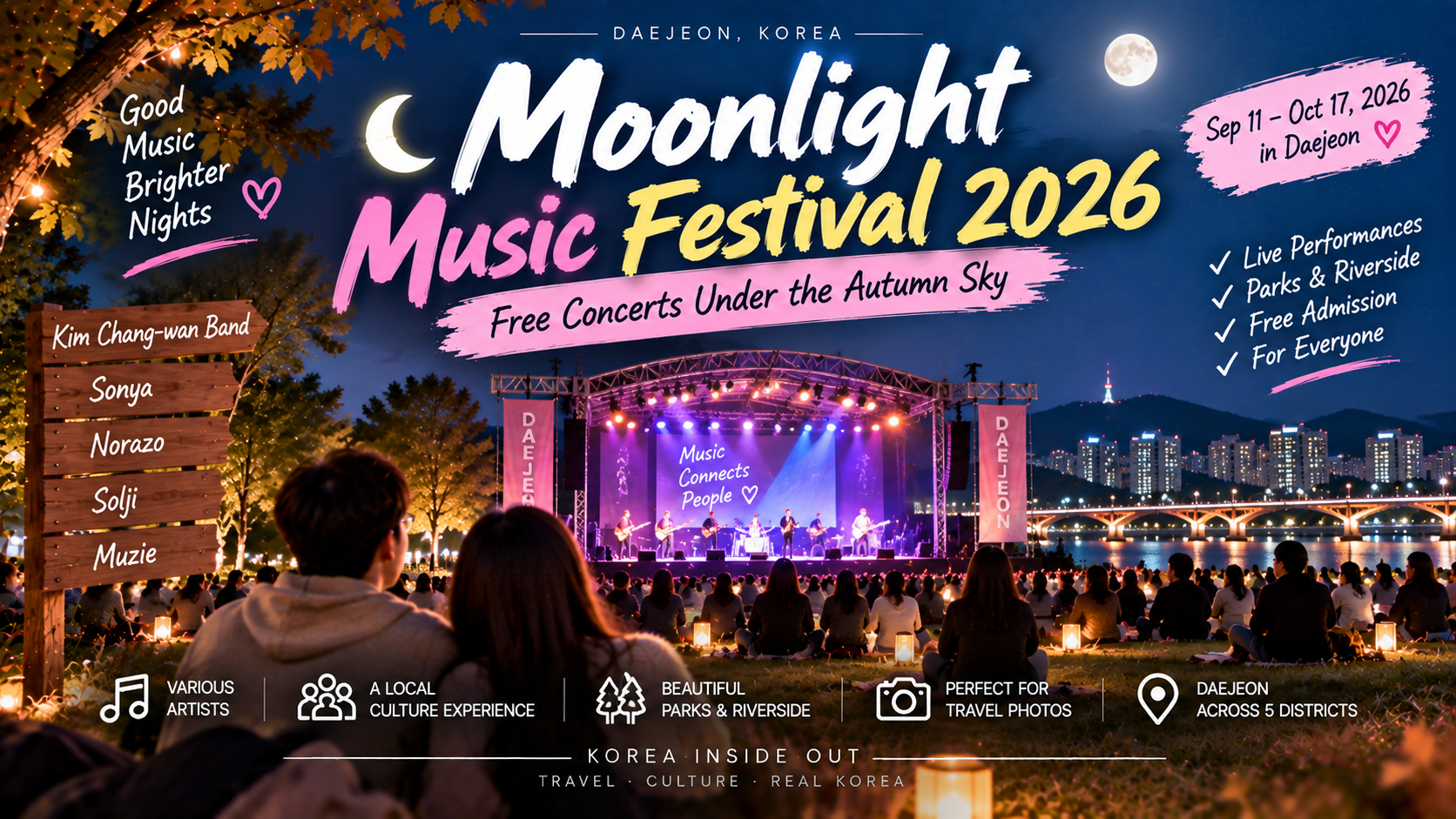
That’s the idea behind Moonlight Music Festival 2026 (달빛 음악공감), a series of five free outdoor concerts taking place across Daejeon from September 11 to October 17, 2026.
And the lineup is surprisingly good.
Popular Korean artists including Kim Chang-wan Band, Sonya, Norazo, Solji and Muzie will perform alongside local musicians at parks and riversides throughout the city.
If you’re traveling around Korea this autumn and want to experience something that feels much more local than the usual tourist attractions, this is one festival worth knowing about.
🌙 Moonlight Music Festival 2026 at a Glance
Details
Festival
Moonlight Music Festival (달빛 음악공감)
Dates
September 11 – October 17, 2026
City
Daejeon
Number of concerts
5
Time
7:00 PM – 8:30 PM
Admission
Free
Reservation
Not required for general viewing
Venues
Parks and riversides across Daejeon’s five districts
Music
Bands, pop, traditional Korean music and more
Age
All ages
Best for
Couples, families, music lovers and travelers looking for local experiences
The festival is organized by the Daejeon Cultural Foundation and hosted by Daejeon Metropolitan City.
🎵 What Is Moonlight Music Festival?
Moonlight Music Festival isn’t a single large festival held in one venue.
Instead, the concerts travel around Daejeon.
From September through October, one concert is held in each of Daejeon’s five districts, bringing live music directly into parks and riverside spaces that locals normally use in everyday life.
That’s part of what makes this event interesting.
Rather than creating a temporary festival venue, Daejeon turns familiar public spaces into outdoor concert halls.
And every performance is free.
The concerts feature both local artists and well-known Korean singers, with music ranging from bands and pop to Korean traditional music.
For international travelers, it’s a chance to experience something that feels less like a tourist attraction and more like joining locals for an autumn evening in the city.
🎤 2026 Concert Schedule & Lineup
There are five performances in total.
September 11 — Gapcheon Ecological Lake Park
📍 Seo-gu
🕖 7:00 PM
Kim Chang-wan Band
CULTA
The festival begins at Gapcheon Ecological Lake Park with one of the biggest names on the lineup: Kim Chang-wan Band.
Kim Chang-wan has been part of Korean popular culture for decades, beginning with the legendary rock band Sanullim.
CULTA, a local vocal-and-guitar duo, also performs.
The setting makes this first concert especially appealing.
Gapcheon Ecological Lake Park provides an open waterside environment that fits perfectly with the festival’s “music under the autumn night sky” concept.
🎙️ September 18 — Eungubi Park
📍 Yuseong-gu
🕖 7:00 PM
Sonya
Bangguseok Pro Muse
The second concert moves to Eungubi Park in Yuseong-gu.
Headlining the evening is Sonya, a Korean singer and musical actress known for her powerful vocals.
Local band Bangguseok Pro Muse joins the lineup.
If you’re staying around Yuseong or visiting Daejeon’s famous hot-spring district, this could be an easy evening activity to add to your itinerary.
🎉 October 3 — Urideul Park
📍 Jung-gu
🕖 7:00 PM
Norazo
Speed
If you’re looking for the most energetic night of the festival, this might be it.
Norazo is known in Korea for high-energy performances, unconventional costumes and catchy songs.
They’re joined by dance group Speed.
The concert takes place at Urideul Park, close to Daejeon’s old downtown area.
And there’s another advantage:
October 3 is National Foundation Day (Gaecheonjeol), a public holiday in Korea.
That makes this a particularly interesting date for travelers who happen to be in Daejeon during the long autumn festival season.
🎶 October 9 — Dongchundang Park
📍 Daedeok-gu
🕖 7:00 PM
Solji
Choi Jae-gu
The fourth concert brings together modern Korean pop and traditional Korean music.
Solji, best known as a member of K-pop group EXID and for her strong vocals, headlines the evening.
Traditional Korean musician Choi Jae-gu also performs.
The venue makes this date particularly interesting.
Dongchundang Park surrounds the historic Dongchundang residence, giving visitors an opportunity to combine Korean heritage with a modern outdoor concert.
October 9 is also Hangeul Day, a national holiday celebrating the Korean alphabet.
For international visitors interested in Korean culture, this may be our favorite date on the schedule.
🌊 October 17 — Daedongcheon Stream
📍 Dong-gu
🕖 7:00 PM
Muzie
Farmacy
The final Moonlight Music Festival concert takes place along Daedongcheon Stream, between Cheolgapgyo and Gajaegyo bridges.
Singer-songwriter and producer Muzie headlines the night, joined by local band Farmacy.
A riverside concert feels like an appropriate ending for a festival built around the idea of bringing music into ordinary outdoor spaces.
By mid-October, evenings in Korea are also noticeably cooler.
Bring a jacket.
⭐ Which Concert Should You Choose?
If you’re only attending one, we’d choose based on the experience you want.
If you want…
Our Pick
🎸 Korean rock
Sep 11 — Kim Chang-wan Band
🎤 Powerful vocals
Sep 18 — Sonya
🎉 A fun, energetic show
Oct 3 — Norazo
🇰🇷 Korean culture + K-pop
Oct 9 — Solji + Choi Jae-gu
🌊 Riverside atmosphere
Oct 17 — Muzie
Our Pick
For an international traveler, we’d probably choose October 9 at Dongchundang Park.
You get a historic setting, Korean traditional music and a well-known K-pop vocalist on the same evening.
And because October 9 is Hangeul Day, it fits nicely into a Korea-focused cultural itinerary.
🍂 Why We Like This Festival
Korea has plenty of enormous festivals.
Fireworks festivals.
K-pop concerts.
Drone shows.
Light festivals.
Those are exciting, but they’re not necessarily what everyday life in Korea feels like.
Moonlight Music Festival is different.
The performances happen in neighborhood parks and beside streams.
People can simply come outside, sit down and listen.
Families come together.
Couples stop by after dinner.
Friends meet in the park.
And local artists share the stage with nationally recognized musicians.
For travelers, these smaller events can sometimes create better memories than major tourist attractions.
You aren’t just watching Korea.
For an evening, you’re participating in ordinary Korean city life.
💰 And Yes — It’s Completely Free
One of the best things about Moonlight Music Festival is the price.
Admission is free.
The performances are designed as open cultural events that anyone can enjoy.
You don’t need an expensive concert ticket to see artists such as Kim Chang-wan Band, Norazo, Solji or Muzie.
That makes this an especially good addition to a budget-friendly Korea itinerary.
Because these are outdoor autumn performances, a little preparation helps.
A light jacket
September evenings may still be mild, but October can become chilly after sunset.
Something comfortable to sit on
Depending on the venue and crowd, a small portable mat can make the experience much more comfortable.
Water
Bring a drink, especially for the earlier September performances.
Portable battery
You’ll probably take more photos and videos than you expect.
Korean navigation app
Search the venue’s Korean name for the most accurate local directions.
☔ What If It Rains?
Because the festival takes place outdoors in parks and along rivers, weather matters.
Outdoor event schedules can change because of rain, storms or safety concerns.
If bad weather is forecast, check the latest announcement from the Daejeon Cultural Foundation before traveling.
This is particularly important if you’re coming all the way from Seoul.
📅 Moonlight Music Festival 2026 Schedule
Date
Venue
Headliner
Local Artist
Sep 11
Gapcheon Ecological Lake Park
Kim Chang-wan Band
CULTA
Sep 18
Eungubi Park
Sonya
Bangguseok Pro Muse
Oct 3
Urideul Park
Norazo
Speed
Oct 9
Dongchundang Park
Solji
Choi Jae-gu
Oct 17
Daedongcheon Stream
Muzie
Farmacy
All performances begin at 7:00 PM.
The official event information lists the performance window as approximately 7:00 PM–8:30 PM.
🍁 A Different Way to Experience Autumn in Korea
Autumn travel in Korea often revolves around one thing:
fall foliage.
And yes, Korea’s red and golden leaves are beautiful.
But autumn is also one of the country’s best seasons for outdoor cultural events.
The heat and humidity of summer begin to disappear.
Evenings become cooler.
Parks become comfortable again.
And cities across Korea fill their calendars with festivals, concerts and performances.
Moonlight Music Festival captures that side of Korean autumn particularly well.
If you’re traveling around Korea in September, you can also check our What’s On in Korea: September 2026 guide for more seasonal events.
🌙 Is Moonlight Music Festival Worth It?
If you’re already visiting Daejeon on one of the five concert dates:
Absolutely.
It’s free, outdoors and easy to add to an evening itinerary.
Would we recommend traveling from Seoul solely for the concert?
That depends on the performer.
Fans of Kim Chang-wan Band, Norazo or Solji may find the trip worthwhile.
For everyone else, we’d combine the concert with a day exploring Daejeon rather than treating it as the only reason for traveling.
That’s the best way to experience it:
Daejeon during the day, local food in the evening, and free music under the autumn sky at night.
🎵 Final Thoughts
Some of the best experiences in Korea aren’t the ones designed specifically for tourists.
They’re the evenings when you unexpectedly find yourself sitting in a park with hundreds of locals, listening to live music as the temperature drops and the city lights come on.
That’s exactly the kind of experience Moonlight Music Festival 2026 offers.
Five nights.
Five neighborhoods.
Five different outdoor stages.
And admission is completely free.
If you’re traveling through Daejeon between September 11 and October 17, 2026, check whether one of the performances overlaps with your trip.
It might turn an ordinary evening in Daejeon into one of those small travel moments you remember long after returning home.
Which performance would you choose — Kim Chang-wan Band, Sonya, Norazo, Solji or Muzie? Let us know in the comments.
Official Information
Event: 2026 Moonlight Music Festival (2026 달빛 음악공감)
Dates: September 11 – October 17, 2026
Performance time: 7:00 PM–8:30 PM
Admission: Free
Organizer: Daejeon Cultural Foundation
Host: Daejeon Metropolitan City
Inquiry: 042-480-1073
Official information: Korea Tourism Organization / Daejeon Cultural Foundation
Performance schedules and outdoor events may change due to weather or other circumstances. Check the latest official information before traveling.
What if you could visit an art exhibition in Seoul without entering a museum?
In Seoul this autumn, you can.
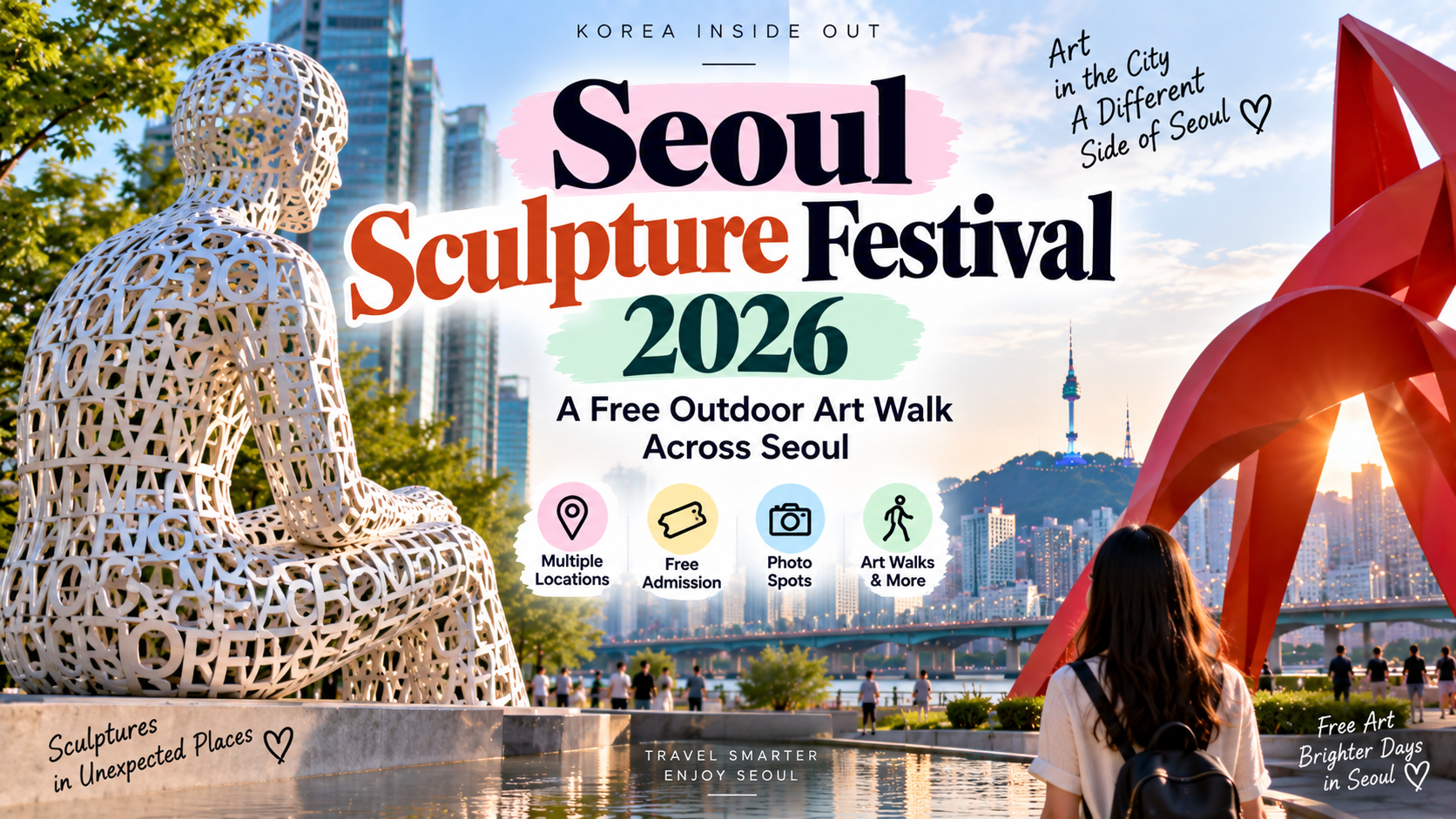
The Seoul Sculpture Festival 2026 has turned some of the city’s parks and public spaces into an open-air gallery, with sculptures displayed among trees, lawns, riverside paths and historic surroundings.
The main festival program took place from late August to early September, but the outdoor sculpture exhibitions continue through November 30, 2026.
Best of all, they are free to visit.
For travelers, this is an easy way to combine contemporary Korean art with a normal day of sightseeing. You can look at sculptures while walking through Seoul, stop for coffee, visit a palace or traditional neighborhood, and continue exploring without buying a museum ticket.
Seoul Sculpture Festival 2026 at a Glance
Details
Outdoor exhibition
August 29 – November 30, 2026
Main locations
Open Songhyeon Green Plaza, Ttukseom Hangang Park, Seoul Forest, Seoul Children’s Grand Park, Pungnaptoseong
Admission
Free
Best for
Art lovers, photographers, couples, families and casual travelers
Format
Outdoor sculpture exhibition
Best season
Autumn
Recommended time
1–3 hours per location
The 2026 festival presents works connected with the Seoul Sculpture Prize as well as invited artists and related sculpture projects around the city. The main festival exhibition at Open Songhyeon Green Plaza includes 15 Seoul Sculpture Prize finalists and 21 invited works.
But the most interesting part for visitors is that the exhibition does not stop at one location.
Several different parts of Seoul become part of the experience.
What Is the Seoul Sculpture Festival?
The Seoul Sculpture Festival is part of Seoul’s broader “Sculpture City Seoul” project.
The city’s goal is to place high-quality sculpture in public spaces rather than keeping contemporary art inside conventional galleries and museums.
That means you don’t have to be an art expert to enjoy it.
You might see a large abstract sculpture while walking through a park.
Another work might look like an oversized animal or human figure.
Others use metal, stone or unusual forms that change depending on where you stand.
The surrounding environment becomes part of the artwork.
A sculpture against a white museum wall is one thing.
A sculpture surrounded by autumn trees and blue sky is something completely different.
1. Open Songhyeon Green Plaza: The Main Exhibition
If you only have time for one location, start here.
Open Songhyeon Green Plaza is located in central Seoul, between major sightseeing areas such as Anguk, Bukchon and Gyeongbokgung.
The exhibition features:
15 Seoul Sculpture Prize finalist works
21 invited works
A dedicated sculpture village
Outdoor public art
Open lawns and walking paths
In total, the 2026 Seoul Sculpture Festival places 36 major works at the main Songhyeon site.
The open setting is what makes this location especially attractive.
Instead of walking through a series of white rooms, you can move between sculptures at your own pace.
There is no fixed route.
You can stop for five minutes or stay for an hour.
And because the exhibition is outdoors, you can photograph the works from different angles.
Why Visit Songhyeon in Autumn?
Autumn is arguably the best time to visit.
The large grassy plaza is framed by trees, and the changing foliage creates a completely different background as the season progresses.
This makes the exhibition particularly appealing to photographers.
The sculptures also work surprisingly well as landmarks for a Seoul walking route.
Try this route:
Anguk Station
↓
Open Songhyeon Green Plaza
↓
Bukchon Hanok Village
↓
Insadong
↓
Gwanghwamun
↓
Gyeongbokgung Palace
You can easily turn the sculpture exhibition into part of a half-day central Seoul itinerary.
2. Seoul Forest: Art Among the Trees
The second location is Seoul Forest.
This is where the concept of an outdoor sculpture exhibition becomes especially interesting.
Instead of placing every work in an open plaza, the sculptures are integrated into a much greener environment.
The “Sculpture Exhibition + Seoul Forest” project runs through October 27, 2026, featuring works by 13 participating artists.
Here, the best approach is not to rush.
Walk through the park.
Look around.
And keep an eye out for sculptures along the way.
This makes Seoul Forest a particularly good choice if you are traveling with someone who isn’t particularly interested in contemporary art.
They can enjoy the park while you explore the artworks.
And everyone gets a break from Seoul’s busy streets.
3. Ttukseom Hangang Park: Art by the River
Another exhibition location is Ttukseom Hangang Park.
This gives you a completely different backdrop.
Instead of historic buildings or forests, sculptures are displayed around one of Seoul’s most iconic modern landscapes: the Han River.
The river, bridges, skyline and open sky become part of the visual experience.
This is also a particularly convenient stop if you are already visiting Ttukseom for other events.
For example, the area is hosting several major autumn programs, including the Seoul Street Arts Festival and the Hangang Drone Light Show.
That means you can combine contemporary sculpture with an evening by the Han River.
4. Seoul Children’s Grand Park: Sculpture You Can Touch and Explore
Traveling with children?
Don’t overlook Seoul Children’s Grand Park.
The sculpture project here is called:
“Sculpture Playground Seoul: Touch, Play and Imagine.”
The exhibition runs through November 30 and includes works by 20 participating artists.
The idea is different from a traditional sculpture exhibition.
Instead of simply asking children to stand back and look at art, the project encourages them to experience sculpture more actively.
That makes this location particularly useful for families.
You can combine:
Sculpture
Playground time
Green space
Walking
Children’s activities
into one easy afternoon.
5. Pungnaptoseong: Sculpture Meets Ancient Seoul
The fifth exhibition area is around Pungnaptoseong, the ancient earthen fortress associated with the Baekje period.
This is perhaps the most unusual setting of the five.
Here, contemporary sculpture is displayed alongside one of Seoul’s important archaeological landscapes.
The contrast is fascinating.
On one side, you have an ancient defensive structure connected with Korean history.
On the other, you have contemporary artists experimenting with form, materials and ideas.
For travelers who enjoy combining history and contemporary culture, this is one of the most interesting locations.
You Don’t Need to Know Anything About Art
One of the best things about the Seoul Sculpture Festival is that you don’t need an art-history background.
You don’t need to know the names of famous Korean sculptors.
You don’t even need to understand the artist’s statement perfectly.
Start with a simple question:
Do I like it?
Then look at it from another angle.
Walk around it.
Notice the material.
Look at how the sunlight changes it.
See how the sculpture interacts with the trees, buildings or people around it.
That is part of the fun of outdoor sculpture.
The Seoul Sculpture Prize
The main exhibition also introduces visitors to the Seoul Sculpture Prize, a relatively new award established by Seoul in 2024.
The project aims to discover sculptors and place their works in major public locations around the city.
The winning and selected works are then given opportunities to be displayed in Seoul’s public spaces.
For international visitors, this offers an interesting way to discover Korean contemporary artists without having to search through individual galleries.
Instead, the city has essentially created a large public-art trail.
How to Turn It Into a Seoul Art Walk
You don’t need to visit all five locations in one day.
In fact, you shouldn’t.
The locations are spread across Seoul, so trying to see everything would turn a relaxing art walk into a transportation challenge.
Instead, choose one area.
Route 1: Central Seoul Art & History
Best for first-time visitors
Morning
Gyeongbokgung Palace
↓
Bukchon Hanok Village
↓
Open Songhyeon Green Plaza
↓
Insadong
↓
Cheonggyecheon
This is the easiest route if you want to combine contemporary art with Seoul’s traditional side.
Route 2: Seoul Forest + Seongsu
Best for couples and younger travelers
Afternoon
Seoul Forest
↓
Sculpture exhibition
↓
Seongsu cafés
↓
Seongsu shopping
↓
Dinner
This is one of the easiest ways to turn the exhibition into a relaxed afternoon.
If you like Seoul’s café and design culture, this is probably the route I would choose.
Route 3: Han River Art Day
Best for a sunny autumn day
Ttukseom Hangang Park
↓
Sculpture exhibition
↓
Han River picnic
↓
Seongsu
↓
Evening performance or drone show
This route works particularly well in September and October.
Why the Festival Is Great for Photographers
Outdoor sculpture is naturally photogenic.
You don’t have to photograph the sculpture by itself.
Instead, use Seoul as part of the composition.
Try:
Sculpture + autumn foliage
Sculpture + Seoul skyline
Sculpture + Han River
Sculpture + people walking past
Sculpture + sunset
Sculpture + traditional Korean architecture
The same sculpture can look completely different depending on the time of day.
Morning: softer light and fewer people.
Afternoon: stronger colors and clearer details.
Golden hour: warm light and long shadows.
Evening: atmospheric city lighting.
If you’re looking for something to photograph in Seoul that isn’t another palace or café, this is an easy alternative.
How Long Should You Spend There?
You don’t need an entire day.
Open Songhyeon Green Plaza
About 45–90 minutes
Add more time if you’re combining it with Bukchon and Insadong.
Seoul Forest
About 1–2 hours
You will probably spend additional time walking around the park.
Ttukseom Hangang Park
About 1–2 hours
Stay longer if you’re having a picnic or waiting for an evening event.
Seoul Children’s Grand Park
2–4 hours
Families will naturally spend much longer because of the other attractions in the park.
Pungnaptoseong
About 1 hour
Best combined with other Songpa-area attractions.
Is the Seoul Sculpture Festival Free?
Yes.
The outdoor sculpture exhibitions are free to visit.
You don’t need a museum ticket or festival pass.
This is one reason the exhibition works particularly well for travelers.
You can simply add it to a day of sightseeing.
If you walk past one of the exhibition locations, stop and take a look.
There is no need to make a major commitment.
When Is the Best Time to Go?
The outdoor exhibition runs until November 30, 2026, so you have plenty of time.
September
Warm but increasingly comfortable.
Good for combining the sculptures with other outdoor events.
October
Probably the best overall month.
Cooler temperatures and autumn colors make the parks particularly attractive.
November
Quieter and more atmospheric.
The foliage will gradually disappear, but the sculptures themselves remain.
If you are visiting Seoul in autumn, October is probably the sweet spot.
Seoul Sculpture Festival vs. a Traditional Museum
So which should you choose?
Outdoor Sculpture Festival
Traditional Museum
Free
Often paid
Outdoors
Indoors
Casual
More structured
Easy to combine with sightseeing
Usually requires dedicated time
Great for photography
Better for detailed viewing
Works well with children
Depends on museum
Parks and city landscapes
Galleries and exhibition halls
The answer doesn’t have to be one or the other.
You can visit a museum in the morning and see outdoor sculpture in the afternoon.
But if you’re short on time, the outdoor festival is an easy cultural experience to add without changing your entire itinerary.
Practical Tips for International Visitors
Wear comfortable shoes
The exhibition locations involve walking, especially if you combine them with nearby attractions.
Check the weather
There is no roof over most of the exhibition.
A rainy day can change the experience significantly.
Go during daylight
You will see the materials and details of the sculptures much more clearly.
Return at sunset
If you are photographing the works, golden hour can be particularly beautiful.
Don’t rush
The best part is often discovering a sculpture unexpectedly while walking.
Combine art with food
The exhibition locations are surrounded by very different food neighborhoods.
Songhyeon works well with Insadong and Jongno.
Seoul Forest works with Seongsu.
Ttukseom works with the Han River and Seongsu.
A Free Art Experience in the Middle of Seoul
The Seoul Sculpture Festival is a good example of something that makes Seoul different from many other major cities.
You don’t always have to enter a cultural institution to experience art.
Sometimes you simply walk through a park.
A sculpture appears between the trees.
You stop.
You look.
You take a photograph.
Then you continue walking.
For travelers, that makes the Seoul Sculpture Festival 2026 one of the easiest cultural experiences to add to an autumn itinerary.
You can combine it with palaces, traditional neighborhoods, cafés, the Han River or Seoul’s modern shopping districts.
And because the outdoor exhibitions continue until November 30, you don’t have to squeeze the experience into one particular festival weekend.
Final Thoughts
Seoul is often described through its palaces, skyscrapers, cafés and nightlife.
But there is another side of the city worth discovering.
Art is increasingly appearing in the spaces between those attractions.
A historic neighborhood can become an outdoor gallery.
A forest can become a sculpture park.
A riverside can become an art space.
And a normal walk through Seoul can unexpectedly turn into an exhibition visit.
If you’re looking for a free, flexible and photogenic cultural experience in Seoul this autumn, the Seoul Sculpture Festival is worth adding to your itinerary.
You don’t need to be an art expert.
Just bring comfortable shoes and take a walk.
Seoul Sculpture Festival 2026
Outdoor exhibition: August 29 – November 30, 2026 Locations: Open Songhyeon Green Plaza, Ttukseom Hangang Park, Seoul Forest, Seoul Children’s Grand Park & Pungnaptoseong Admission: Free Best for: Art, photography, autumn walks and a different side of Seoul
You might be wondering if it is even worth leaving the airport for such a short trip.
Yes — absolutely.
You will not see all of Seoul in 48 hours, and you shouldn’t try.
The best way to enjoy a short Seoul stopover is to choose a convenient neighborhood, group nearby attractions together, and leave enough time to simply enjoy the city.
For a first-time visitor, one night and two days is enough to experience historic Seoul, eat some great Korean food, walk through a traditional neighborhood, do some shopping, and see Seoul after dark.
The key is not trying to do everything.
This guide shows you how I would spend a short Seoul stopover without turning it into a race from one attraction to another.
[INSERT YOUR PHOTO: Wide Seoul city view at golden hour, showing the contrast between traditional buildings and modern skyscrapers. Recommended shot: panoramic skyline. Alt text: “Seoul skyline during a short Seoul stopover”]
Is One Night and Two Days Enough for Seoul?
It is enough for a taste of Seoul, but not enough to properly explore the entire city.
That distinction matters.
Seoul is enormous. Areas such as Gyeongbokgung, Myeongdong, Hongdae, Gangnam, Jamsil, and Seongsu can all feel like destinations of their own.
Trying to visit all of them during a one-night stopover will mostly mean spending your time underground on the subway.
Instead, think of your trip like this:
Time
What to focus on
Arrival day
Historic Seoul + Korean dinner + evening
Overnight
Stay somewhere central
Day 2
One major neighborhood + shopping/food
Before departure
Return to the airport with plenty of buffer
If you have more time, my longer guide compares 3, 5, and 7 days in Seoul. But if you’re only stopping for one night, you need a different strategy.
First: Is This a Stopover or a Layover?
People often use these words interchangeably, but there is a practical difference.
A layover usually means you are connecting between flights.
A stopover generally means you intentionally spend more time in a destination before continuing your journey.
If you’re flying through Incheon International Airport and have an overnight between flights, Seoul can be a very realistic stopover destination.
Korea Tourism Organization also promotes stopover travel from Incheon, including programs designed for travelers who have more than a day between flights.
But don’t assume that every connection gives you enough time to visit Seoul.
You need to consider:
Immigration and entry requirements
Whether you can leave the airport
Whether your checked luggage is transferred automatically
Your next flight’s departure time
Travel time between Incheon Airport and Seoul
How much buffer you want before your next flight
If you’re working with a very short same-day connection, that is a different trip from spending one full night in Seoul.
Where Should You Stay for a One-Night Seoul Stopover?
For a short trip, your hotel location matters more than usual.
You don’t want to spend your only evening commuting across Seoul.
For most first-time visitors, I would look at:
1. Myeongdong
Best for: first-time visitors and maximum convenience
Myeongdong puts you close to shopping, restaurants, cafés, and many of Seoul’s classic sightseeing areas.
It is particularly convenient if you only have one night because you can easily go out for dinner and explore the neighborhood without needing another long journey.
2. Jongno / Insadong
Best for: traditional Seoul
If your priority is palaces, hanok neighborhoods, traditional cafés, and historic Seoul, this is an excellent choice.
You can spend your limited time around Gyeongbokgung, Bukchon, Insadong, and Ikseon-dong without constantly changing neighborhoods.
3. Hongdae
Best for: nightlife and younger travelers
Hongdae is a good choice if you want your short stay to feel more energetic.
It also has convenient airport rail access, which can be useful for a stopover.
The downside is that you’ll be farther from Seoul’s historic center.
If this were my first short visit to Seoul, I wouldn’t try to squeeze in Gangnam, Hongdae, Gyeongbokgung, Namsan, Seongsu, and Lotte World.
I’d keep the first day around central Seoul.
Then I’d use the second day for one additional neighborhood.
Here’s the route.
Day 1: Historic Seoul, Korean Food & Seoul at Night
Afternoon: Check In and Drop Your Bags
The first thing I would do is go to the hotel.
Even if your room isn’t ready, leave your luggage if the hotel allows it.
Don’t start sightseeing with a large suitcase.
Your first afternoon is already going to involve walking, subway stations, and crowded streets. Carrying luggage will make everything harder.
Once you’re luggage-free, head toward Seoul’s historic center.
2:00–4:00 PM: Gyeongbokgung Palace
Start with Gyeongbokgung Palace.
If this is your first trip to Seoul, this is one of the places I’d prioritize even with very limited time.
Gyeongbokgung was the first and largest of Seoul’s Five Grand Palaces and was built in 1395 during the Joseon Dynasty.
The important thing is not to spend your entire afternoon here.
You don’t need to inspect every building.
Walk through the main areas, take your photos, enjoy the architecture, and get a feel for historic Seoul.
[INSERT YOUR PHOTO: Gyeongbokgung Palace courtyard with mountains or palace gate in the background. Recommended shot: wide architectural composition. Alt text: “Gyeongbokgung Palace in Seoul during a short stopover”]
Short-stop tip
If you have less time than expected, don’t skip the palace just because you can’t see everything.
A focused visit is better than trying to see three attractions badly.
4:00–5:30 PM: Bukchon or Samcheong-dong
From Gyeongbokgung, continue toward the Bukchon and Samcheong-dong area.
This is where Seoul starts to feel very different from the modern city you may have seen from the airport.
You’ll see traditional Korean houses, small streets, cafés, galleries, and old neighborhoods surrounded by modern Seoul.
But remember:
Bukchon is a residential area.
People actually live there.
Keep your voice down, avoid blocking narrow streets, and follow local visitor restrictions and signs.
If you are tired from your flight, you can also skip the deeper Bukchon streets and simply enjoy the surrounding Samcheong-dong area.
Seoul’s official tourism guide also highlights Bukchon, Gyeongbokgung, and Insadong as key areas for experiencing traditional Seoul.
5:30–7:00 PM: Insadong and Ikseon-dong
Now slow down.
This is one of the best parts of a short Seoul trip.
Instead of adding another major attraction, walk through Insadong and continue toward Ikseon-dong.
You’ll find:
Traditional tea houses
Korean crafts
Small restaurants
Hanok cafés
Dessert shops
Small boutiques
Narrow atmospheric streets
This is a good time to stop for coffee or tea.
You don’t need to turn every stop into a sightseeing mission.
One of the advantages of a short stopover is that you can focus on a few places that give you a strong sense of Seoul.
7:00–9:00 PM: Korean Dinner
This is the meal I would make a priority.
Don’t settle for fast food simply because you only have one night.
For 2026 planning, a comfortable food budget is roughly ₩30,000–₩50,000 per person per day, although your actual spending can be much lower or higher depending on your choices.
9:00 PM: See Seoul After Dark
You have several choices here.
Option A: Myeongdong
If you’re staying in Myeongdong, simply walk around the shopping streets.
This is probably the easiest option.
Option B: Cheonggyecheon
Take an evening walk along Cheonggyecheon Stream.
It’s a relaxing way to see central Seoul without committing to another major attraction.
Option C: Hongdae
If you are staying in Hongdae or enjoy nightlife, head west for an evening of cafés, shops, street performances, and people-watching.
Option D: Just Go Back to Your Hotel
This is completely acceptable.
Seriously.
If you have just arrived from a long international flight, getting eight hours of sleep may be more valuable than squeezing one more attraction into your itinerary.
A good stopover should leave you wanting to come back to Seoul.
It shouldn’t leave you exhausted.
Day 2: Choose One Side of Seoul
The biggest mistake on your second day is trying to see everything you missed on Day 1.
Instead, choose one neighborhood or one theme.
Here are three good options.
Option 1: Hongdae & Yeonnam-dong
Best for: cafés, shopping, youth culture and nightlife
Start your morning in Hongdae.
Walk around the main streets, explore small shops, grab coffee, and continue toward Yeonnam-dong.
This gives you a completely different side of Seoul from the palace district.
You can easily spend a few hours without needing a strict itinerary.
Suggested route
Hongik University Station → Hongdae → Yeonnam-dong → café → lunch
This is particularly good if your flight leaves later in the evening.
Option 2: Myeongdong & Namsan
Best for: shopping and classic Seoul views
If you stayed somewhere around central Seoul, spend your final morning around Myeongdong.
You can shop for:
Korean skincare
Cosmetics
Snacks
Souvenirs
Fashion
If the weather is good, consider heading toward Namsan for city views.
Don’t make the mistake of scheduling too much before an international flight.
Keep the afternoon relatively flexible.
Option 3: Seongsu
Best for: modern Seoul, cafés and Korean trends
If you’ve already seen the traditional side of Seoul and want something more contemporary, choose Seongsu.
You’ll find:
Cafés
Pop-up stores
Fashion
Design shops
Restaurants
Converted industrial spaces
Seongsu is a good choice if you are more interested in what Seoul feels like today than historical attractions.
The downside is that it is farther from the traditional center, so I would only choose it if this is genuinely the kind of neighborhood you enjoy.
What About Gangnam?
You can visit Gangnam during a one-night stopover.
But I wouldn’t automatically recommend it.
That’s because the biggest enemy of a short Seoul trip is cross-city travel.
If you are staying in Myeongdong and spend your first day around Gyeongbokgung, Bukchon, and Insadong, then travel all the way to Gangnam simply to see COEX and Starfield Library, you have spent a meaningful portion of your limited time getting there.
If Gangnam is specifically what interests you, absolutely go.
Otherwise, save it for your next trip.
What About N Seoul Tower?
N Seoul Tower is another attraction that sounds essential on a first trip.
But it doesn’t have to be.
If the weather is clear and you enjoy city views, it can be a great choice.
If the weather is cloudy, rainy, or hazy, I wouldn’t force it into a one-night itinerary.
A short trip needs flexibility.
Don’t visit an attraction simply because every Seoul itinerary on the internet tells you to.
What Should You Skip on a 1-Night Seoul Stopover?
This may be the most important section of the entire guide.
With only one night, I would skip:
❌ Lotte World
Great attraction, but it deserves a larger part of your day.
If you’re specifically visiting Seoul for theme parks, that’s different. Otherwise, save it for a longer trip.
❌ A full-day DMZ tour
A DMZ tour can take a significant part of the day and often involves fixed schedules.
It’s not a good fit for a first-time one-night stopover unless the DMZ is your main reason for visiting Korea.
❌ Multiple palace visits
One palace is enough.
Gyeongbokgung gives you the classic experience.
❌ Too many shopping districts
Myeongdong + Hongdae + Gangnam + Dongdaemun in two days is unnecessary.
Choose one or two.
❌ A day trip outside Seoul
Don’t spend your only full day traveling somewhere else unless that destination is the actual purpose of your stopover.
Your next trip can be longer.
Where Should You Eat During a Short Seoul Trip?
Because you have limited time, I would use a simple rule:
One traditional meal + one modern/casual meal + one café or street-food experience.
For example:
Day 1 lunch
Kalguksu or dumplings
Day 1 dinner
Korean barbecue
Day 2 breakfast
Café or convenience-store breakfast
Day 2 lunch
Bibimbap or Korean noodles
Day 2 snack
Korean dessert or street food
This gives you variety without turning your entire itinerary into a food checklist.
You don’t want to land after a 12-hour flight and discover that you don’t know how to find your hotel.
What If You Arrive Late on Day 1?
This is very common.
If you don’t arrive in Seoul until 8 or 9 PM, don’t try to follow the full itinerary above.
Instead:
Airport → Hotel → Dinner → Short neighborhood walk → Sleep
Then use the following day for your main sightseeing.
A late arrival actually makes the choice of hotel even more important.
If you have only one night, I’d rather pay a little more for a convenient location than save money on a hotel that adds an hour of transportation to every part of the trip.
What If Your Flight Leaves Late on Day 2?
That’s ideal.
You can have a much more relaxed second day.
For example:
8:00 AM — Breakfast 9:00 AM — Neighborhood walk 11:00 AM — Shopping or attraction 1:00 PM — Lunch 2:00 PM — Café 3:30 PM — Return to hotel 4:00 PM — Collect luggage Airport transfer
The exact timing depends on your flight and airport requirements.
The important rule is simple:
Don’t turn your last day into a race to the airport.
A Better Way to Think About a Seoul Stopover
A short trip isn’t about checking off the maximum number of attractions.
It’s about getting a strong first impression of Seoul.
You want to remember:
Walking through a palace gate
Seeing hanok streets
Eating Korean food
Drinking coffee in a Seoul café
Seeing the city after dark
Hearing the subway announcements
Walking through busy shopping streets
Realizing how different Seoul feels from home
You don’t need 20 attractions to achieve that.
In fact, trying to see 20 attractions may make the experience worse.
My Recommended 1-Night, 2-Day Seoul Itinerary
If you want the simple version, here’s the itinerary I’d choose for a first-time visitor.
Day 1
Hotel → Gyeongbokgung → Bukchon/Samcheong-dong → Insadong → Ikseon-dong → Korean dinner → Myeongdong or Cheonggyecheon
Day 2
Choose one:
Option A — Modern Seoul Hongdae → Yeonnam-dong → lunch → café → airport
Option C — Contemporary Korea Seongsu → cafés → pop-up stores → lunch → airport
This gives you choices without creating three completely different itineraries.
The Biggest Mistake to Avoid
If I could give one piece of advice to someone spending only one night in Seoul, it would be this:
Don’t confuse a short trip with a speed challenge.
Seoul is a city where simply walking around can be part of the experience.
Leave some space.
Have the meal.
Sit in the café.
Take the wrong-looking street.
Look around.
If you discover a neighborhood you love, stay there instead of rushing to the next item on your list.
You can always come back to Seoul.
Seoul Stopover Checklist
Before leaving for your trip, make sure you have:
☐ Hotel booked in a convenient neighborhood ☐ Hotel address saved in Korean and English ☐ Airport-to-hotel route checked ☐ NAVER Map installed ☐ Papago installed ☐ Taxi app installed if needed ☐ Flight and airport information saved ☐ Some Korean won available ☐ Comfortable walking shoes ☐ Weather checked before each day ☐ Enough airport buffer for your departing flight
And most importantly:
☐ Don’t plan every minute
Final Thoughts: Is a Seoul Stopover Worth It?
Absolutely.
One night and two days won’t let you experience everything Seoul has to offer.
But that’s not the goal.
A well-planned Seoul stopover can give you a surprisingly complete first impression of Korea: historic palaces, traditional neighborhoods, Korean food, modern cafés, shopping, nightlife, and the energy of a huge Asian city.
The secret is choosing one part of Seoul at a time rather than trying to conquer the entire city.
If you have a choice between squeezing in ten attractions and enjoying five properly, choose five.
And if you love Seoul after those two days?
That’s exactly what your next trip is for.
What About You?
Are you planning to visit Seoul as a stopover between flights, or are you taking a short 1-night trip just to see the city?
And if you’ve already had a Seoul stopover, what was the one place or experience you would absolutely recommend to someone with only two days?
Looking for something more than palaces and shopping in Seoul this fall?
From September through November, Seoul itself becomes a stage.
The 2026 Seoul Autumn Festa runs from September 18 to November 29, 2026, bringing theater, dance, music, traditional Korean performance, street arts, festivals, and experimental performances to venues across the city.
Rather than being one festival at one location, Seoul Autumn Festa connects performances and festivals happening throughout Seoul under one autumn program.
That means you can see a performance beside the Han River, explore the theater district around Daehak-ro, discover Korean traditional music, or simply add a performance to a sightseeing day.
And for international visitors, there is a particularly interesting selection of performances introducing Korean traditional and contemporary arts.
Seoul Autumn Festa 2026 at a Glance
Details
Dates
September 18 – November 29, 2026
Duration
73 days
Location
Seoul-wide
Main areas
Daehak-ro, Han River parks, Seoul Forest, cultural venues and theaters across Seoul
Genres
Theater, dance, music, traditional arts, street arts and more
Admission
Varies by program
Best for
Culture lovers, couples, families, solo travelers and repeat visitors to Seoul
Opening event
September 18, 7:30 PM
Opening venue
Ttukseom Hangang Park Waterfront Stage
The festival includes 38 festivals, 478 performances, 245 participating works and 558 individual programs, covering theater, dance, music, traditional arts and street performance.
So rather than trying to see everything, the better strategy is to choose a performance based on your interests and travel schedule.
What Is Seoul Autumn Festa?
Seoul Autumn Festa is Seoul’s major autumn performing-arts festival.
The idea is simple: instead of keeping performances inside a small number of theaters, the festival connects performances and festivals taking place throughout the city.
The result is less like a traditional festival and more like a citywide cultural season.
During the 73-day period, Seoul’s theaters, parks, public spaces and cultural venues become places to experience performances.
The Seoul Foundation for Arts and Culture describes the festival as a way of connecting private and public performing arts programs throughout Seoul and making them easier for audiences to discover.
For travelers, this is useful because you don’t have to dedicate an entire day to the festival.
You can simply add one performance to an existing Seoul itinerary.
The Festival Begins by the Han River
The best place to start is the opening night on September 18.
Seoul, Dancing on the Han River
September 18, 2026 — 7:30 PM Ttukseom Hangang Park Waterfront Stage
The opening performance, titled “Seoul, Dancing on the Han River,” brings together dancers and performers to tell the story of Seoul through movement.
The performance is directed by choreographer Lee Ruda and features artists including the Seoul Metropolitan Dance Theatre, Melancholy Dance Company, K-Arts dance performers, Black Toe Dance Company and other leading Korean artists.
The setting is part of the attraction.
Instead of opening inside a conventional theater, the festival begins beside the Han River.
The city skyline, river and evening atmosphere become part of the experience.
According to the festival’s organizers, around 10,000 spectators are expected to gather for the opening event.
Our tip: If you are visiting Seoul that weekend, combine this with an evening at Ttukseom Hangang Park rather than treating it as a standalone performance.
September 19–20: A Weekend of Street Performances
The opening weekend continues with the Seoul Street Arts Festival 2026 on September 19–20.
The festival takes over Ttukseom Hangang Park and Seoul Forest, with circus, parades, mobile performances and audience-participation programs.
One of the highlights is the giant giraffe performance, featuring enormous red giraffes moving through the riverside landscape.
This is also where the festival introduces the idea of Artrekking — following performances on foot rather than sitting in a fixed theater seat.
In other words, you can walk through Seoul while following the art.
Note: Once the Seoul Street Arts Festival article is published, this should be replaced with its exact URL.
The combination makes the opening weekend particularly attractive to travelers.
Friday: Han River opening performance Saturday–Sunday: Street performances, circus and giant giraffes Evening: Seoul Forest and Seongsu
Discover Korean Culture Through the K-Arts Selection
If this is your first trip to Korea and you want to experience something that feels distinctly Korean, look for the festival’s K-Arts Curated Selection.
This collection brings together traditional Korean music and contemporary Korean performing arts.
One example is Mugang II, performed at Donhwamun Traditional Theater on September 20.
The performance brings together the Korean gayageum and the Taiwanese pipa, creating a meeting point between traditional musical cultures.
Another highlight comes later in the festival.
Resonance
October 8 — LG Arts Center Seoul
The Korean world-music group Gong Myoung combines traditional instruments with contemporary musical ideas.
It is a good option if you want to experience Korean traditional sounds without attending a strictly traditional concert.
Neo-Tradition
October 23–24 — Namsangol Hanok Village
Liquid Sound brings together young traditional artists from Korea, China and Japan.
The performances reinterpret traditional Asian arts through a contemporary perspective.
For travelers, this is one of the most interesting parts of Seoul Autumn Festa because it goes beyond the usual tourist experience of watching a traditional performance in a palace.
You get to see how traditional culture is being reinvented by younger artists.
Spend an Evening in Daehak-ro
If you enjoy theater, make Daehak-ro one of your main destinations during the festival.
Daehak-ro is Seoul’s best-known theater district, and Seoul Autumn Festa brings dozens of programs to the area.
During the festival, more than 70 programs are connected with Daehak-ro and surrounding cultural venues.
You can turn a theater visit into a full evening:
Late afternoon: Explore Daehak-ro ↓ Dinner: Eat around Hyehwa ↓ Evening: Watch a play or musical ↓ After the show: Explore the neighborhood
The festival also connects theater with programs such as After Theater, where audiences can continue conversations and discussions after performances.
There is even a local market program, Daengno Market, allowing visitors to experience the neighborhood beyond the theater itself.
What If You Don’t Speak Korean?
This is an important question for international visitors.
Not every performance at Seoul Autumn Festa is designed specifically for non-Korean speakers.
However, the festival includes several options that are more accessible to international audiences.
Physical theater, dance, circus and music can often be enjoyed without understanding every line of dialogue.
There is also a particularly useful program at Daehak-ro Theater Q, where the performance series “Questions of Theater: Evolving Texts” provides real-time translated subtitles through smart glasses for international audiences.
That makes it one of the more interesting options if you want to experience Korean theater but are concerned about the language barrier.
Our tip: When choosing a performance, check whether English subtitles, translated materials or non-verbal performance formats are available before booking.
Find a Performance That Matches Your Taste
The biggest challenge with Seoul Autumn Festa is not finding something to do.
It is deciding what to choose.
There are hundreds of programs.
The festival itself recommends approaching the program according to your interests rather than trying to see as much as possible.
Here is a simple way to choose.
If you love Korean culture
Look for:
Traditional music
Gayageum performances
Pansori
Korean traditional performance
Neo-traditional productions
If you prefer contemporary art
Try:
Contemporary dance
Experimental theater
New Korean creators
International collaborations
Multimedia performances
If you are traveling with children
Look for family-oriented performances and programs connected with Performance Spring, including productions such as The Long Long Night and A Carmen Journey with Percussion.
If you don’t speak Korean
Prioritize:
Dance
Circus
Street arts
Music
Non-verbal performances
Shows with English subtitles
If you want something easy
Choose an outdoor performance.
You can enjoy the atmosphere without committing to a long theater evening.
A Great Choice for Repeat Visitors to Seoul
If this is your first trip to Seoul, you will probably spend plenty of time visiting palaces, markets, shopping districts and famous neighborhoods.
But if you have already seen the major sights, Seoul Autumn Festa offers another way to experience the city.
Instead of asking:
“What tourist attraction should I visit today?”
you can ask:
“What is happening in Seoul tonight?”
You might find a dance performance near the Han River.
Or a play in Daehak-ro.
Or traditional music at a historic venue.
Or contemporary art in a cultural center.
The festival is essentially an invitation to explore Seoul through its performing arts.
How to Plan Seoul Autumn Festa Into Your Trip
You don’t need to plan your entire vacation around the festival.
Instead, choose one or two events.
One-day culture itinerary
Morning — Gyeongbokgung Palace
Start with Seoul’s traditional side.
Lunch — Jongno
Try Korean food around Jongno or Insadong.
Afternoon — Insadong or Bukchon
Explore traditional streets and shops.
Evening — Performance
Head to Daehak-ro, a theater, or one of the festival’s evening venues.
Night — Cheonggyecheon
Finish the evening with a walk through central Seoul.
If you are still deciding how much time to spend in Seoul, our guide to 3, 5 or 7 days in Seoul can help you fit cultural experiences into your itinerary.
A Weekend at the Han River
For September 18–20, you can create an especially interesting Seoul weekend.
Friday, September 18
Seoul Autumn Festa opening
Ttukseom Hangang Park 7:30 PM
Watch the opening performance beside the Han River.
Saturday, September 19
Seoul Street Arts Festival
Explore Ttukseom Hangang Park and Seoul Forest.
Watch street performances and circus acts, then head to Seongsu for dinner and cafés.
Sunday, September 20
Choose another performance from Seoul Autumn Festa or explore one of the traditional Korean programs.
This weekend is a particularly good option if you want to experience a side of Seoul beyond the standard tourist attractions.
Where to Find the Festival
Because Seoul Autumn Festa is spread across the city, there is no single festival entrance.
The best starting point for information is the festival’s integrated information platform.
A dedicated information center operates at the Seoul Foundation for Arts and Culture Daehak-ro Center, where visitors can search performances by interest and connect to booking information using kiosks and QR codes.
The center is particularly useful if you are overwhelmed by the number of choices.
Instead of searching through hundreds of individual performances, you can use the festival’s recommendations to find something suitable for your interests and schedule.
How Much Does Seoul Autumn Festa Cost?
There is no single festival admission fee.
Because Seoul Autumn Festa connects many different performances and festivals, prices depend on the individual event.
Some performances are free, while others require tickets.
Outdoor city programs can be especially attractive to travelers because you can experience the atmosphere of the festival without necessarily buying an expensive theater ticket.
Always check the individual performance information before visiting.
Seoul Autumn Festa 2026: Practical Tips
1. Don’t try to see everything
There are hundreds of programs.
Choose two or three experiences that actually interest you.
2. Check the language information
If you are not comfortable watching a Korean-language performance, look for English subtitles, translated materials, dance, music or non-verbal performances.
3. Book popular performances early
Some theater performances have limited seating and require advance reservations.
4. Use the Han River programs as your easy entry point
Outdoor performances are often the easiest way for visitors to experience the festival without worrying about language or formal theater etiquette.
5. Explore Daehak-ro
Even if you don’t attend a performance, the theater district is worth visiting during the festival.
6. Check the weather
Some of the most interesting autumn programs take place outdoors.
September and October can be beautiful in Seoul, but evening temperatures can change quickly.
7. Combine performances with sightseeing
The festival is spread throughout Seoul, so choose performances that fit naturally into your daily itinerary rather than crossing the city several times.
Is Seoul Autumn Festa Worth Adding to Your Trip?
Absolutely — especially if you want to experience modern Seoul rather than only its historic attractions.
The biggest strength of Seoul Autumn Festa is its scale.
For 73 days, Seoul doesn’t have one single festival location.
The city becomes the festival.
A riverside park can become a stage.
A theater district can become an evening destination.
A traditional music venue can introduce you to Korean culture.
A contemporary dance performance can show you a completely different side of the country.
And because the festival continues from September 18 through November 29, you have plenty of opportunities to find something that fits your trip.
For visitors coming to Seoul in September, the opening weekend is particularly attractive because it combines the Han River opening performance with the Seoul Street Arts Festival.
For travelers visiting in October or November, there are still weeks of performances to discover.
Seoul Autumn Festa 2026: Quick Summary
Dates: September 18 – November 29, 2026
Where: Across Seoul
What: Theater, dance, music, traditional Korean arts, street performance and festivals
Opening:Seoul, Dancing on the Han River — September 18, 7:30 PM
Best area for theater: Daehak-ro
Best for outdoor performances: Han River parks and Seoul Forest
Best for Korean traditional arts: K-Arts curated programs
Best for international visitors: Dance, music, street arts, non-verbal performances and selected shows with English translation
Admission: Varies by program
Final Thoughts
Autumn is one of the best times to experience Seoul.
The weather becomes more comfortable, the parks turn colorful, and the city begins to move outdoors again.
The 2026 Seoul Autumn Festa adds another reason to stay out a little longer.
Instead of simply visiting Seoul’s attractions, you can watch the city perform.
And perhaps that is the best way to experience Seoul in autumn:
walk through the city, find a performance, and let Seoul become your stage.
If you are looking for something different to do in Seoul this September, head to the Han River.
On September 19–20, 2026, the Seoul Street Arts Festival moves to Ttukseom Hangang Park and Seoul Forest, turning the riverside, walking paths, and everyday city spaces into an open-air stage.
Instead of sitting inside a theater, you can walk along the river, stop for a performance, watch circus artists and dancers, and suddenly find yourself standing in front of a group of eight-meter-tall red giraffes.
Best of all, the festival is free.
Here is what international visitors should know before going.
Seoul Street Arts Festival 2026 at a Glance
Details
Dates
September 19–20, 2026
Location
Ttukseom Hangang Park & Seoul Forest
Admission
Free
Performances
20 works, 62 performances
International works
9 works from 5 countries
Korean works
11 works
Main genres
Street theater, circus, dance, opera, visual performance, participatory art
Best for
Couples, families, solo travelers, art lovers, photographers
Nearest subway
Jayang Station (Line 7), Exit 2
The official festival describes the event as a street-arts festival that brings high-quality Korean and international performances into everyday public spaces. In 2026, the festival moves from its previous central-Seoul locations to the Han River and Seoul Forest.
Why Is the Festival Moving to the Han River?
The Seoul Street Arts Festival has traditionally used central Seoul spaces such as Seoul Plaza as its stage.
For 2026, however, the festival is taking a different approach.
Instead of bringing people specifically to a theater or a central plaza, the festival brings the performances into one of Seoul’s most familiar everyday landscapes: the Han River.
That means you do not necessarily need to plan your entire day around the festival.
You can simply walk along the river, ride a bicycle, relax on the grass, or visit Seoul Forest — and encounter a performance along the way.
This is one of the most interesting things about the festival for travelers. You are not simply watching a show. The city itself becomes part of the show.
The 8-Meter Red Giraffes You Don’t Want to Miss
The most spectacular performance of the festival is likely to be Les Girafes, Opérette animalière by French company Compagnie OFF.
Imagine seven enormous red giraffes, each around eight meters tall, slowly moving along the Han River.
The performance combines the giant giraffe puppets with opera, circus elements and a diva’s singing, turning an ordinary riverside walk into something that feels more like a surreal parade.
It is exactly the kind of performance that makes street arts different from a conventional theater show.
You could be walking beside the Han River and suddenly see a herd of giant red giraffes coming toward you.
The festival’s official magazine describes the performance as one of the most dramatic examples of how the Han River itself becomes part of the stage.
Our tip: If you want photographs, arrive early and stay around the riverside performance areas rather than rushing from one show to another.
More International Performances to Look For
The giraffes are the headline attraction, but they are far from the only international performance.
Tancarville — G. Bistaki, France
What can four performers do with something as ordinary as a white sheet?
In Tancarville, French company G. Bistaki transforms laundry sheets into objects that can look like scenery, ghosts, or something completely unfamiliar.
It is a good example of the kind of visual storytelling that works even if you do not speak Korean.
You don’t need to understand dialogue to enjoy the movement, objects and physical comedy.
Pocket Juggling — Undertree, Slovenia
This performance takes ordinary objects — hands, balls and pockets — and turns them into a playful language of rhythm and surprise.
It is another good choice for international visitors because the performance relies heavily on physical movement rather than spoken language.
Shared Pathways — Mano a Mano, Brazil
This Brazilian circus performance uses acrobatics and physical interaction between performers.
It fits particularly well with the festival’s 2026 concept: rather than constructing a huge stage, the performers use the surrounding environment as part of the performance.
You Can Actually Become Part of the Festival
One of the interesting changes this year is the amount of audience participation.
For example, On Veut by French company Ktha Compagnie involves around 100 citizen performers who have gone through workshops before appearing alongside the professional artists.
Another participatory project, Coordinates 442831, uses citizens’ memories and drawings of places that are meaningful to them to create a kind of map of the city.
There is also Dancing for Joy, a citizen dance program designed to bring large groups of people into the performance.
So if you prefer participating rather than simply taking photos, keep an eye on the festival’s reservation announcements. Some programs require advance registration.
What Else Can You See?
The festival is not only about international street theater.
There are Korean performances covering a wide range of styles, including traditional performance, circus, dance and contemporary physical theater.
One example is 52Hz by Korean traditional performing arts group The GWANGDAE, which explores loneliness and human connection through the energy and humor of traditional Korean performance.
Other works approach subjects such as aging, friendship, vulnerability and everyday life.
This is one reason the festival is worth considering even if you are not particularly interested in contemporary art: many of the performances communicate through movement, humor, music and visual spectacle rather than complicated dialogue.
A Festival You Can Explore on Foot
One of the best ways to experience the 2026 festival is simply to walk.
The organizers are continuing the idea of “Artrekking,” which connects performances with the act of exploring the city.
This year, the concept goes beyond walking. Visitors can also experience the festival by bicycle or even use the Han River Bus to move through the area.
That makes the festival particularly easy to combine with a normal Seoul sightseeing day.
A Simple Half-Day Plan
2:00 PM — Start at Ttukseom Hangang Park
Walk along the riverside and explore the festival area.
3:00 PM — Watch a street performance
Choose one of the outdoor performances rather than trying to see everything.
4:00 PM — Relax by the Han River
Grab a drink or snack and enjoy the park.
5:00 PM — Continue toward Seoul Forest
Use the walking paths to explore another part of the festival.
6:30 PM — Dinner
Head toward Seongsu for dinner or cafés.
Evening — Return for a major performance
If the schedule works, come back for one of the larger evening performances, particularly the giant giraffe parade.
The detailed performance timetable should be checked on the official festival website before visiting because individual performance times and locations vary.
Don’t Miss Seoul Stage in Autumn at Seoul Forest
There is another reason to visit Seoul Forest that weekend.
The Seoul Autumn Festa’s Seoul Stage in Autumn program runs at the Seoul Forest Outdoor Stage from September 18–20.
The program includes musical performances, a university musical concert and a musical gala featuring Korean musical-theater performers.
The current schedule includes:
September 18: Seoul Children’s Chwitae Band and Joseon Chef: Han Sang-gung
September 19: University Musical Concert and Musical Gala Concert
September 20: University Musical Concert and Musical Gala Concert
The program is free, although individual arrangements and seating can vary.
This makes September 19–20 an especially good weekend to combine street art + Seoul Forest + Korean musical performances.
How to Get There
The main festival area is around Ttukseom Hangang Park and Seoul Forest.
For Ttukseom Hangang Park, Jayang Station on Seoul Subway Line 7 is the closest station listed by Seoul’s festival information, with Exit 2 about a few hundred meters from the site.
If you are already visiting Seongsu or Seoul Forest, you can also approach the festival from the Seoul Forest side.
This is actually a good way to visit because you can combine the festival with one of Seoul’s most popular café and shopping neighborhoods.
Is the Seoul Street Arts Festival Worth Visiting?
Yes — especially if you have already seen Seoul’s major tourist attractions.
The festival offers something different from the usual Seoul itinerary.
You are not going to another palace, museum or shopping district. Instead, you are experiencing contemporary performance art in one of the places that defines modern Seoul: the Han River.
It is also particularly friendly to international visitors.
You can enjoy many performances without understanding Korean, and the outdoor format means you do not have to commit to a long theater performance.
And because admission is free, you can simply walk around, watch one or two performances, take photos, and leave whenever you want.
For first-time visitors, it also pairs nicely with a broader Seoul itinerary. If you are deciding how long to stay in the city, our guide to how many days you need in Seoul can help you build the rest of your trip.
Seoul Street Arts Festival 2026: Quick Tips
Go in the late afternoon. You will get a combination of daylight performances, sunset by the Han River and evening shows.
Wear comfortable shoes. This is a festival designed around walking and moving between performance spaces.
Bring a picnic mat if you want to stay by the river. There are plenty of places to sit around Hangang Park, but popular areas can fill up.
Don’t plan every minute. Part of the fun is encountering a performance unexpectedly.
Check the schedule before you go. Some performances require advance reservations, while others can be enjoyed freely. The official festival website publishes the detailed timetable and program information.
Consider combining it with Seongsu. Seoul Forest and nearby Seongsu make it easy to turn the festival into a full afternoon and evening.
Final Thoughts
Seoul is often at its most interesting when you stop following the standard sightseeing route.
The Seoul Street Arts Festival 2026 is a perfect example.
For one weekend, the Han River becomes an enormous open-air theater. Giant red giraffes walk beside cyclists, circus performers appear among the trees, dancers and actors occupy ordinary public spaces, and visitors become part of the performances themselves.
If you are in Seoul on September 19 or 20, 2026, put Ttukseom Hangang Park and Seoul Forest on your itinerary.
You might arrive expecting a normal walk along the Han River.