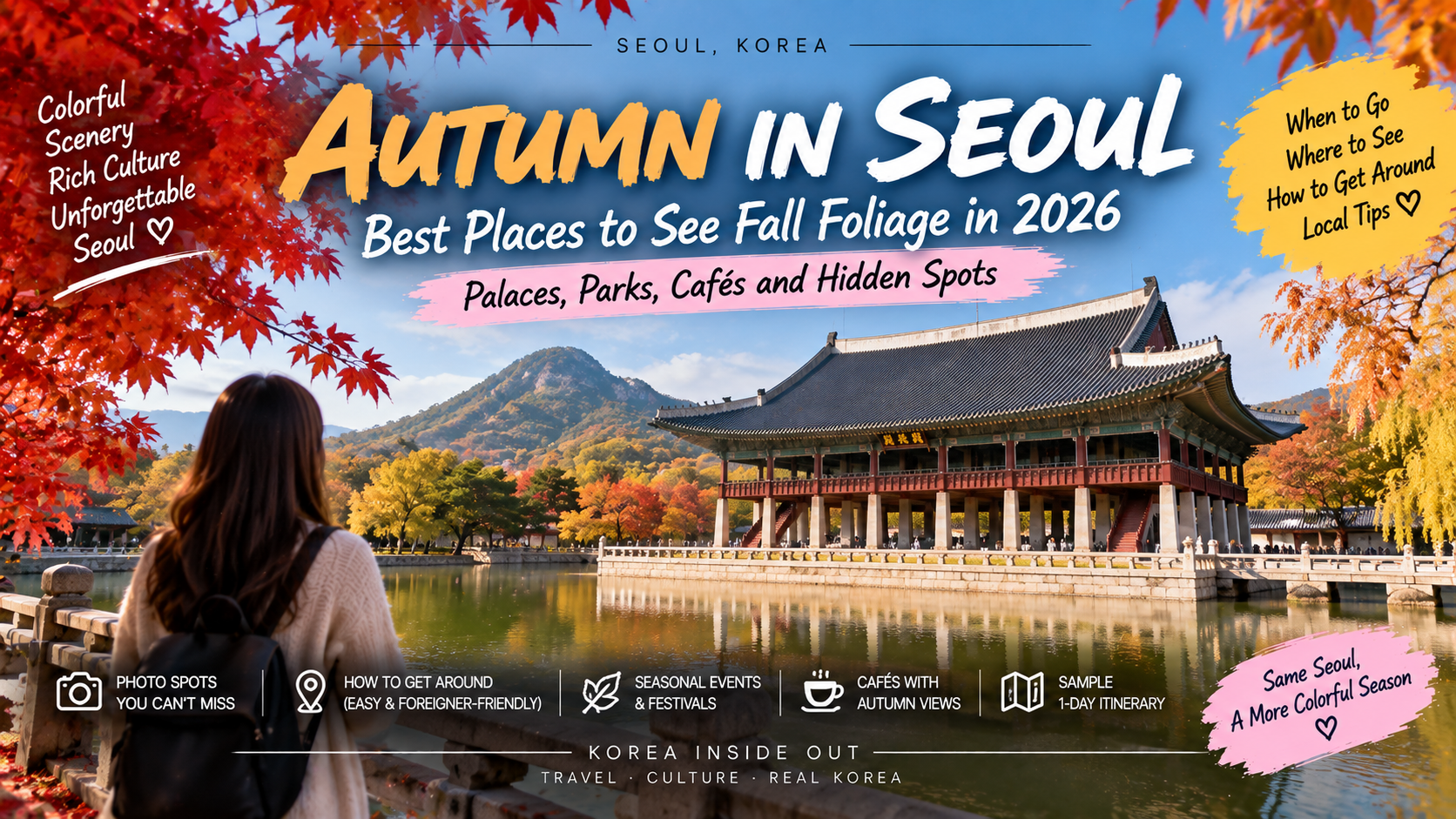
If you ask me when Seoul is most beautiful, autumn is difficult to beat.
Summer’s humidity finally disappears. The sky often becomes clearer. Walking around the city becomes comfortable again. And gradually, Seoul’s mountains, parks, palace grounds and neighborhood streets turn yellow, orange and red.
But there is one thing foreign travelers frequently misunderstand about autumn in Korea:
September is usually too early for peak fall foliage in Seoul.
If you visit in September, you can enjoy cooler evenings and the beginning of autumn, but most trees will still be green.
The more colorful part of the season generally comes later.
So when should you visit, and where should you go?
Here’s how I would plan an autumn trip to Seoul.
When Is Fall Foliage in Seoul?
There is no single guaranteed “peak foliage date.”
Autumn colors depend on temperatures, rainfall and weather patterns, and conditions vary every year.
As a practical planning guide:
Late September
Think early autumn atmosphere rather than autumn foliage.
Days are becoming more comfortable, but most of Seoul is still green.
Early October
You may begin seeing signs of seasonal change, particularly in higher or cooler areas.
Mid-October
Autumn becomes increasingly noticeable.
Late October
This is when travelers have a much better chance of seeing strong autumn colors around Seoul.
Early November
Often one of the most photogenic periods for lower-elevation parks, palace grounds and ginkgo-lined streets.
Mid-November
There can still be beautiful foliage, but leaves are increasingly likely to be falling.
The exact timing changes every year, so check current conditions shortly before your trip rather than relying on a photo posted on exactly the same date last year.
1. Gyeongbokgung Palace — Best for a First Visit to Seoul
Korean: 경복궁
Nearest subway: Gyeongbokgung Station, Line 3
If you’ve never been to Seoul before, Gyeongbokgung is the obvious starting point.
Autumn adds another layer to the palace.
Red and yellow trees appear behind tiled roofs and traditional wooden buildings, creating the kind of scenery many travelers imagine when they picture Korea in autumn.
The palace grounds are large enough that you can spend considerably more time here than expected.
Allow around 1.5–2 hours for a normal first visit.
Go Early If You Want Photos
Gyeongbokgung is one of Korea’s most visited attractions.
During peak autumn weekends, don’t expect to have the palace courtyards to yourself.
If photography matters to you, go earlier in the day.
Weekdays are generally preferable to weekends.
Wear Hanbok If You Want to
You’ll see many visitors wearing hanbok, Korea’s traditional clothing, around Gyeongbokgung.
Numerous rental shops operate around the palace.
Hanbok also makes autumn palace photography especially striking because the bright fabrics contrast beautifully with foliage and palace architecture.
Check current palace admission rules when visiting; qualifying visitors wearing traditional hanbok can receive free admission under the royal-palace admission policy.
2. Deoksugung & Jeongdong — Best Easy Autumn Walk
Korean: 덕수궁 / 정동
Nearest subway: City Hall Station
This is one of the easiest autumn routes in central Seoul.
Deoksugung is smaller than Gyeongbokgung, which makes it much easier to combine with other sightseeing.
After visiting the palace, walk along:
덕수궁 돌담길 — Deoksugung Stone Wall Road
The combination of palace walls, mature trees and historic buildings around Jeongdong gives the area a very different feeling from Seoul’s busier shopping districts.
And in 2026, there’s an extra reason to stay until evening.
The nearby Jeongdong Observatory now has extended Friday and Saturday evening hours, giving visitors an elevated view over Deoksugung after dark.
I’ll cover that in detail in Article 3 below.
3. Seoul Forest — Best Autumn Spot to Combine with Cafés
Korean: 서울숲
Nearest subway: Seoul Forest Station, Suin-Bundang Line
Seoul Forest is one of my favorite recommendations for visitors who want fall foliage without committing to a mountain hike.
The park has broad paths, wooded sections and open lawns, and Korea Tourism Organization includes Seoul Forest among its recommended autumn foliage destinations in Seoul.
But the real advantage is its location.
Seongsu is right next door.
That means you can combine autumn scenery with one of Seoul’s most popular café, shopping and pop-up neighborhoods.
Easy route
Seoul Forest → Seongsu cafés → Seongsu shopping → dinner → Ttukseom Hangang Park
If you’re visiting on October 9 or October 31, you could even finish with the Han River Drone Light Show from Article 1.
That’s a very good full Seoul day without spending hours on transportation.
4. Seokchon Lake — Best Easy Lakeside Foliage Walk
Korean: 석촌호수
Nearest subway: Jamsil Station
Seokchon Lake is best known internationally for spring cherry blossoms.
But autumn is underrated.
Trees surrounding the lake turn yellow and red, while Lotte World Tower rises dramatically behind them.
Korea Tourism Organization also recommends Seokchon Lake as one of Seoul’s autumn foliage destinations.
It’s particularly convenient if you’re already visiting:
- Lotte World
- Lotte World Tower
- Seoul Sky
- Jamsil
- Olympic Park
The path around the lake is easy and mostly flat, making this one of the better options for families.
5. Olympic Park — Best for Space and Families
Korean: 올림픽공원
Nearest subway: Olympic Park Station / Mongchontoseong Station
Olympic Park is huge.
That’s precisely why it works well in autumn.
Unlike famous palace photo spots where dozens of people may be competing for the same angle, Olympic Park gives you room to wander.
There are broad fields, tree-lined paths and the ancient earthworks of Mongchontoseong within the park.
For families, it’s particularly useful because children have space to move around without the constant crowds and narrow paths found at some central Seoul attractions.
Plan at least a couple of hours if you want to explore rather than simply take a few photos.
6. Namsan — Best for Foliage + Skyline Views
Korean: 남산
Namsan is different from the other places on this list because the autumn scenery surrounds you rather than simply appearing as a background.
Walking through the forested areas gives you foliage at eye level, while viewpoints open toward central Seoul.
You don’t have to climb the entire mountain from the bottom.
There are several access points and routes, allowing you to choose anything from a relatively easy stroll to a proper uphill walk.
Late afternoon is particularly good.
You can see the foliage in daylight and stay as the city begins to light up.
7. Sungkyunkwan Myeongnyundang — Best for Ginkgo Trees
Korean: 성균관 명륜당
If you’ve seen photos of enormous yellow ginkgo trees surrounding traditional Korean buildings, there’s a good chance they were taken here.
Myeongnyundang is part of the historic Sungkyunkwan complex.
The giant old ginkgo trees become spectacular when they turn yellow.
Korea Tourism Organization specifically highlights Myeongnyundang among Seoul’s autumn destinations.
This is a much more specific seasonal destination than Gyeongbokgung, though.
Timing matters.
Visit too early and the trees may still be green. Visit too late and much of the foliage may already be on the ground.
If this is one of your main photography goals, check recent Korean social-media posts immediately before visiting.
Search:
명륜당 은행나무
That Korean search phrase is often much more useful for checking current conditions.
8. Haneul Park & Peace Park — Best for a Different Kind of Autumn
Korean: 하늘공원 / 평화의공원
Not every autumn destination needs red maple leaves.
The World Cup Park area offers broader landscapes and autumn grasses, giving you something visually different from palaces and forests.
Korea Tourism Organization highlights the Metasequoia road and Peace Park area among Seoul’s recommended autumn walks.
This is a good choice if you’ve already seen Seoul’s major palaces and want a more spacious outdoor day.
What About Bukhansan?
If hiking is one of the main reasons you’re visiting Korea in autumn, Bukhansan National Park deserves consideration.
Mountain foliage can be spectacular.
But I wouldn’t automatically recommend it to every first-time Seoul visitor.
A proper Bukhansan hike requires more time, appropriate shoes and some planning.
If you only have three days in Seoul, I’d prioritize the city.
If you have five to seven days and enjoy hiking, Bukhansan becomes much easier to justify.
Best Places by Travel Style
First-time visitor
Gyeongbokgung + Deoksugung
You get autumn scenery without sacrificing essential Seoul sightseeing.
Couple
Seoul Forest + Seongsu
Easy, photogenic and full of cafés and restaurants.
Family
Seokchon Lake + Olympic Park
Flat, spacious and easy to combine with Jamsil attractions.
Photographer
Myeongnyundang + palace grounds
But monitor foliage conditions carefully.
Hiker
Namsan or Bukhansan
Choose according to how much time and physical effort you want.
What Should You Wear in Seoul in October?
Layers are the safest choice.
A sunny October afternoon can feel surprisingly comfortable, especially when you’re walking.
But temperatures drop after sunset, and areas around the Han River or elevated viewpoints can feel much cooler.
Bring:
- comfortable walking shoes
- light outerwear
- an extra layer for evenings
- a small umbrella if rain is forecast
The shoes matter more than many visitors expect.
A normal sightseeing day in Seoul can easily involve 15,000–20,000 steps.
What About November?
Don’t automatically dismiss November.
Early November can still be a very attractive time to visit Seoul, especially at lower elevations and in central-city parks.
It can also be less hot and humid than September.
The trade-off is uncertainty.
A windy or rainy period can remove leaves quickly, so travelers visiting specifically for foliage should remain flexible.
A Perfect One-Day Autumn Seoul Itinerary
If this is your first trip, I wouldn’t spend an entire day traveling from one foliage spot to another.
Instead, integrate autumn into a normal Seoul sightseeing day.
9:00 AM — Gyeongbokgung Palace
Go before the biggest crowds arrive.
11:00 AM — Seochon
Explore the neighborhood and have an early lunch.
1:00 PM — Gwanghwamun
Walk through central Seoul.
2:30 PM — Deoksugung
Visit the palace.
4:00 PM — Deoksugung Stone Wall Road & Jeongdong
This area becomes particularly atmospheric in autumn.
Around sunset — Jeongdong Observatory
On the appropriate opening day, see Deoksugung from above.
Evening — City Hall / Cheonggyecheon
Have dinner and finish with a nighttime walk.
You get palaces, neighborhoods, foliage and a night view without spending half the day underground on the subway.
Another Autumn Day: The Trendier Version
For travelers more interested in contemporary Seoul:
Morning
Seoul Forest
Lunch
Seongsu
Afternoon
Cafés, shops and pop-ups around Seongsu
Sunset
Walk toward the Han River
Evening
Ttukseom Hangang Park
On October 9 or October 31, stay for the 2026 Han River Drone Light Show.
How Crowded Is Seoul During Peak Foliage?
Popular locations can become very busy on weekends.
Koreans enjoy autumn outings just as much as international travelers do.
If your schedule is flexible:
Palaces: visit weekday mornings.
Parks: weekday afternoons are easier.
Mountains: avoid peak weekend hiking hours.
Famous ginkgo spots: arrive early.
Don’t expect an empty Instagram location simply because you saw a photo without people.
Korean Search Terms for Checking Current Foliage
This is one of the most useful travel tricks in this article.
Instead of searching only in English, use Korean search terms on Naver.
서울 단풍 — Seoul fall foliage
서울 단풍 명소 — Seoul fall foliage spots
서울 단풍 현황 — current Seoul foliage conditions
경복궁 단풍 — Gyeongbokgung foliage
서울숲 단풍 — Seoul Forest foliage
명륜당 은행나무 — Myeongnyundang ginkgo trees
Add 2026 to your search during your trip.
Recent Korean blog posts and images can tell you far more about current conditions than a generic annual foliage calendar.
How Much Does an Autumn Day in Seoul Cost?
It can actually be one of the cheaper ways to explore Seoul.
Parks such as Seoul Forest, Olympic Park and Seokchon Lake are free.
Your main expenses will often be food, cafés and transportation.
If you’re working out a daily budget, read:
How Much Does Food Cost in Seoul? A Realistic 2026 Guide
And if you’re unsure whether you need Korean won for smaller purchases:
Is Autumn the Best Time to Visit Seoul?
For many travelers, I’d put it very high on the list.
Spring has cherry blossoms.
Winter has snow and holiday atmosphere.
Summer has festivals and long evenings.
But autumn offers perhaps the easiest combination of comfortable sightseeing weather, beautiful scenery and outdoor activities.
The important thing is not to spend your whole trip chasing leaves.
Visit the places you wanted to see anyway — Gyeongbokgung, Seoul Forest, Namsan, Deoksugung — and let autumn make those places better.
For deciding how much time you need overall, start here:
Leave a Reply