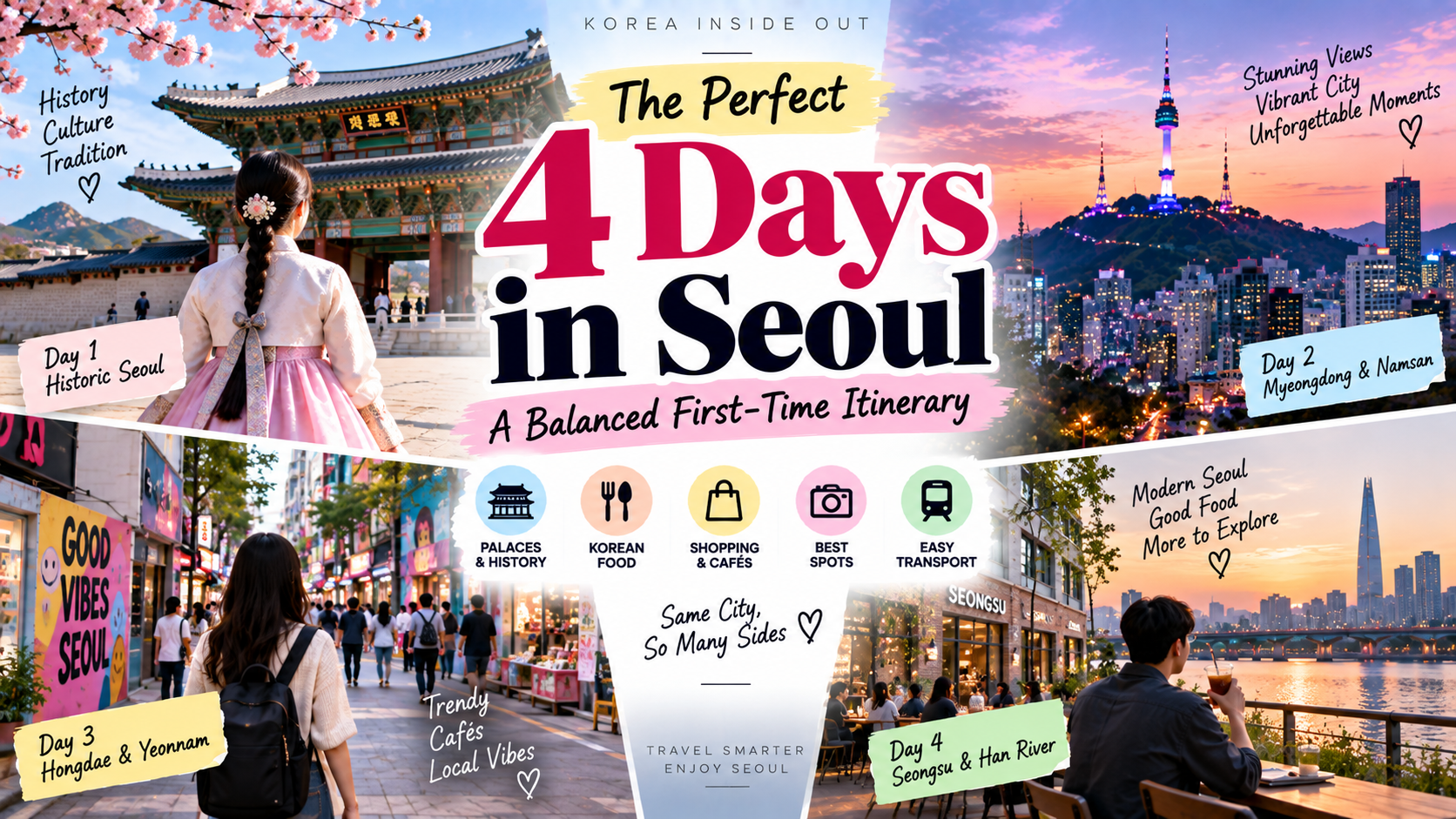
Planning a trip to Seoul and wondering how to spend four days in the city?
Four days is a great amount of time for a first trip to Seoul.
You have enough time to see the city’s famous palaces and traditional neighborhoods, experience modern Seoul, eat plenty of Korean food, and still leave room for cafés, shopping, and a little wandering.
The trick is not trying to visit every famous place.
Seoul is a huge city, and crossing from one side to the other several times a day can eat up more of your vacation than you might expect.
So instead of building an itinerary around a long list of attractions, this guide groups each day around a different part of Seoul.
You’ll experience:
- Historic Seoul
- Traditional neighborhoods
- Korean markets and food
- Myeongdong and Namsan
- Hongdae and Yeonnam
- Seongsu and modern Seoul
- The Han River
- Shopping and cafés
- Seoul at night
And there is still some breathing room.
Is 4 Days Enough for Seoul?
Yes.
Four days won’t let you see every neighborhood in Seoul, but it is enough to get a good introduction to the city.
I think four days is particularly useful for first-time visitors because you can divide your trip into four different Seoul experiences:
| Day | Main Experience |
|---|---|
| Day 1 | Historic Seoul |
| Day 2 | Classic Seoul, markets & city views |
| Day 3 | Hongdae, Yeonnam & local-style Seoul |
| Day 4 | Modern Seoul, Seongsu & Han River |
This is intentionally different from trying to check off every attraction in a single day.
For a shorter stopover, see our guide to Seoul Stopover: What to Do in 1 Night & 2 Days.
If you’re still deciding how long to stay, our broader guide compares How Many Days Do You Need in Seoul? 3, 5, or 7 Days.
Before You Start: Where Should You Stay?
For a four-day trip, I strongly recommend choosing one hotel and staying there for the entire trip.
Moving hotels usually isn’t worth it.
You’ll lose time packing, checking out, carrying luggage, finding the next hotel, and waiting for check-in.
Seoul’s subway system makes it much easier to stay in one convenient neighborhood and explore different parts of the city each day.
For first-time visitors, I would consider:
Myeongdong
Best for:
- First-time visitors
- Shopping
- Central location
- Easy access to major attractions
Hongdae
Best for:
- Nightlife
- Cafés
- Younger atmosphere
- Restaurants
- Travelers who want a lively evening
Jongno / Insadong
Best for:
- Palaces
- Traditional Seoul
- Hanok neighborhoods
- History and culture
Gangnam
Best for:
- Modern Seoul
- Shopping
- Beauty
- Business travelers
- Southern Seoul
For a detailed comparison, see Where to Stay in Seoul: 7 Best Areas for First-Time Visitors.
Day 1: Historic Seoul — Palaces, Hanok Streets & Traditional Korea
Your first day should introduce you to the Seoul that existed long before the skyscrapers.
The best part?
Most of today’s stops are relatively close together.
That means less time on the subway and more time exploring.
Morning: Gyeongbokgung Palace
Start your trip at Gyeongbokgung Palace.
This is probably the one historic attraction I would prioritize on a first trip to Seoul.
The palace gives you an immediate introduction to the Joseon Dynasty and traditional Korean architecture.
Take your time walking through the main areas, but don’t feel that you need to inspect every building.
The goal is to experience the atmosphere.
Optional: Wear a Hanbok
If you want the classic Seoul travel-photo experience, consider renting a hanbok near the palace.
Wearing traditional Korean clothing while walking through the palace grounds can be particularly memorable.
But it is completely optional.
You don’t need a hanbok to enjoy Gyeongbokgung.
Late Morning: Bukchon Hanok Village
After the palace, continue toward Bukchon Hanok Village.
Bukchon is famous for its traditional Korean houses and narrow residential streets.
It is also one of the places where visitors need to remember that Seoul isn’t a giant open-air museum.
People actually live here.
Keep your voice down, follow signs, and avoid entering private areas.
You don’t need to walk every street.
A short visit is enough to appreciate the architecture and atmosphere.
Lunch: Korean Food in the Jongno Area
This is a good day to try something traditional.
Consider:
- Kalguksu
- Mandu
- Bibimbap
- Bulgogi
- Korean barbecue
If you’re new to Korean food, our guide 10 Korean Foods You Should Try on Your First Trip to Seoul can help you decide what to order.
One advantage of Seoul is that you don’t need an expensive restaurant to have a memorable Korean meal.
Some of the best experiences can come from simple neighborhood restaurants.
Afternoon: Insadong
After lunch, walk toward Insadong.
This is a good place to slow down.
Explore:
- Traditional tea houses
- Korean crafts
- Small galleries
- Souvenir shops
- Cafés
- Traditional-style buildings
Don’t turn this into another checklist.
Spend some time browsing.
If you see a café that looks interesting, stop.
If a small shop catches your attention, go inside.
Four days gives you enough time to be spontaneous.
Late Afternoon: Ikseon-dong
Continue toward Ikseon-dong.
The neighborhood is known for its combination of traditional hanok architecture and modern cafés, restaurants and small shops.
This is one of the best examples of the way old and new Seoul exist side by side.
You might have a traditional Korean building next to a modern dessert café.
That’s Seoul.
Evening: Cheonggyecheon or Jongno
For your first evening, keep things easy.
You could:
- Walk along Cheonggyecheon Stream
- Have dinner in Jongno
- Visit a traditional market
- Return to your hotel early
- Head to Myeongdong for some evening shopping
Don’t worry about seeing a major attraction every night.
The city itself is part of the experience.
Day 1 Summary
Gyeongbokgung → Bukchon → Korean lunch → Insadong → Ikseon-dong → evening walk
This gives you a strong introduction to traditional Seoul without spending the entire day underground.
Day 2: Myeongdong, Markets & Seoul Views
Day two is about classic tourist Seoul.
You’ll see some of the city’s most recognizable shopping streets, markets and viewpoints.
Morning: Namdaemun Market
Start at Namdaemun Market.
This is a good place for a casual breakfast or snack and an introduction to Seoul’s traditional market culture.
You don’t need a shopping list.
Walk around and see what catches your attention.
Try something small rather than filling up immediately.
Save room for lunch.
Late Morning: Myeongdong
Walk toward Myeongdong.
This is one of the easiest places in Seoul for first-time visitors.
You’ll find:
- Korean cosmetics
- Skincare
- Fashion
- Restaurants
- Cafés
- Street food
- Convenience stores
- Souvenirs
Myeongdong can feel very touristy.
That’s not necessarily a bad thing.
If you are visiting Seoul for the first time, convenience is valuable.
You don’t have to pretend every tourist area is a hidden local secret.
Sometimes the famous place is famous for a reason.
Lunch: Korean Comfort Food
For lunch, try something different from Day 1.
Good choices include:
- Kimchi jjigae
- Korean fried chicken
- Gimbap
- Naengmyeon
- Mandu
- Bulgogi
If you’re keeping an eye on your travel budget, check How Much Does Food Cost in Seoul? A Realistic 2026 Guide.
Afternoon: Namsan
After lunch, head toward Namsan.
You can walk, take transportation, or use one of the available routes depending on how much energy you have.
The main reason to visit is simple:
The view.
From Namsan, you can see how enormous Seoul really is.
This is one of those moments when looking at a map suddenly makes sense.
The neighborhoods you’ve been exploring aren’t separate little cities.
They’re all part of one enormous metropolitan area.
What if the weather is bad?
Don’t force a viewpoint on a cloudy or rainy day.
You could instead spend more time shopping, visit a museum, or explore another indoor attraction.
A flexible itinerary is better than following your schedule regardless of weather.
Evening: Seoul After Dark
You have several options.
Option 1: Myeongdong
Stay nearby and enjoy the evening shopping streets.
Option 2: Euljiro
Explore the contrast between old industrial streets, restaurants and newer bars and cafés.
Option 3: Han River
If the weather is good, spend the evening by the river.
You don’t need a special activity.
Simply sitting beside the Han River with a snack can be a memorable Seoul experience.
Option 4: Korean Fried Chicken
Order Korean fried chicken and experience one of the country’s favorite casual meals.
You can read more about Korean food in 10 Korean Foods You Should Try on Your First Trip to Seoul.
Day 3: Hongdae & Yeonnam — Young Seoul
Day three changes the mood completely.
You’ve already experienced the historic center.
Now see a more contemporary side of Seoul.
Morning: Hongdae
Start around Hongik University Station.
Hongdae is known for:
- Cafés
- Independent shops
- Fashion
- Music
- Street performances
- Restaurants
- Nightlife
You don’t need a strict list of attractions here.
Walk.
Look around.
Go into interesting shops.
Stop for coffee.
This is one of the neighborhoods where simply wandering is part of the experience.
Late Morning: Yeonnam-dong
Walk toward Yeonnam-dong.
The atmosphere becomes a little calmer.
You’ll find:
- Small cafés
- Restaurants
- Independent shops
- Residential streets
- Parks and walking paths
This is a good place to slow down.
If you’ve been sightseeing for two days, you may actually enjoy this part of the itinerary more than another major attraction.
Lunch: Something Casual
Day three is a good day for something casual.
Try:
- Gimbap
- Korean noodles
- Korean fried chicken
- Tteokbokki
- Pork cutlet
- Bibimbap
Don’t worry about making every meal a major event.
One of the pleasures of Seoul is being able to eat well without making a reservation for everything.
Afternoon: Choose Your Own Seoul
This is deliberately a flexible afternoon.
Choose one depending on your interests.
Option A: More Hongdae
Stay in the area and explore more shops and cafés.
Option B: Mangwon
Head toward Mangwon for a more neighborhood-oriented experience.
Explore the market and surrounding streets.
Option C: Museum or Gallery
If the weather is bad, use the afternoon for an indoor cultural experience.
Option D: Shopping
If you’ve been waiting to buy Korean skincare, fashion or souvenirs, this is a good time.
The key is not to add all four.
Choose one.
Evening: Hongdae
Return to Hongdae for dinner.
This is when the neighborhood becomes much more energetic.
Depending on the day, you may see street performances and a much larger evening crowd.
If nightlife isn’t your thing, you don’t need to stay late.
Have dinner, walk around, get dessert and return to your hotel.
Day 4: Modern Seoul — Seongsu, Gangnam & the Han River
Your final day should show you another side of Seoul.
This is where you’ll see the city that often appears in images of modern Korea.
But there is one important rule:
Don’t try to visit every southern Seoul attraction in one day.
Gangnam, Seongsu, Jamsil and the Han River are all large areas.
Choose your priorities.
Morning: Seongsu
Start in Seongsu.
This neighborhood has become known for:
- Specialty cafés
- Fashion
- Pop-up stores
- Design
- Converted industrial spaces
- Trendy restaurants
It feels very different from Bukchon.
That contrast is exactly why it’s worth visiting.
Old Seoul and new Seoul aren’t separate worlds.
They’re both part of the city.
[INSERT YOUR PHOTO: Seongsu café or industrial-style street with modern Korean design. Recommended shot: editorial street scene. Alt text: “Seongsu neighborhood in Seoul with cafés and modern design”]
Lunch: Seongsu
Stay in the area for lunch.
This is a good day to try a modern Korean restaurant, café or casual spot.
Don’t worry about finding the most famous place online.
If you see a busy restaurant that looks interesting, take a look at the menu.
Sometimes your best meal of the trip is the one you didn’t plan.
Afternoon: Choose Gangnam or Jamsil
This is where your itinerary should branch.
Option A: Gangnam
Choose this if you’re interested in:
- Modern Seoul
- Shopping
- K-beauty
- Fashion
- COEX
- Skyscrapers
- Upscale cafés
You could explore the COEX area and surrounding streets.
If you’re particularly interested in Korean beauty, Gangnam may be one of the highlights of your trip.
Option B: Jamsil
Choose Jamsil if you’re traveling with children or want entertainment and large-scale attractions.
You can combine:
- Lotte World area
- Lotte World Tower
- Shopping
- Seoul Sky
- Seokchon Lake
If you have already planned a full day at Lotte World, however, don’t try to squeeze all of this into the same afternoon.
Give the theme park the time it deserves.
For a dedicated theme-park visit, see our guide to Lotte World: 15 Tips for First-Time Visitors.
Evening: Han River
For your final evening, I would finish somewhere relaxing.
If the weather is good, go to the Han River.
You can:
- Grab convenience-store snacks
- Get a drink
- Sit by the water
- Watch the skyline
- Walk along the riverside
- Take photos at sunset
This is one of those experiences that doesn’t require an expensive ticket.
And after four busy days, that’s exactly what you might want.
Your Complete 4-Day Seoul Itinerary at a Glance
Here’s the entire trip in one place.
Day 1 — Historic Seoul
Gyeongbokgung → Bukchon → Lunch → Insadong → Ikseon-dong → Evening in Jongno
Day 2 — Classic Seoul
Namdaemun → Myeongdong → Lunch → Namsan → Evening in Myeongdong/Euljiro/Han River
Day 3 — Young Seoul
Hongdae → Yeonnam-dong → Lunch → Mangwon or shopping → Hongdae evening
Day 4 — Modern Seoul
Seongsu → Lunch → Gangnam or Jamsil → Han River
This gives you four very different impressions of Seoul.
Should You Visit N Seoul Tower, Lotte World and the Han River?
You can.
But you don’t necessarily need all three.
Think about your travel style.
If you love views
Prioritize:
Namsan + Han River
If you’re traveling with kids
Prioritize:
Lotte World + Jamsil
If you love shopping and beauty
Prioritize:
Myeongdong + Gangnam
If you love cafés and trendy neighborhoods
Prioritize:
Hongdae + Seongsu
If you love history
Prioritize:
Gyeongbokgung + Bukchon + Insadong
The best four-day Seoul itinerary is not necessarily the one with the most attractions.
It’s the one that matches you.
What Should You Skip on a Four-Day Seoul Trip?
Even with four days, there are things I would leave out.
Don’t visit every palace
One or two is enough for a first visit.
Gyeongbokgung gives you the classic experience.
If you’re especially interested in Joseon history, add Changdeokgung.
Otherwise, use the extra time for neighborhoods.
Don’t move hotels every night
It looks efficient on paper.
It isn’t.
Stay in one good location.
Don’t plan a day trip unless you really want one
Four days in Seoul can disappear surprisingly quickly.
If you want to visit Nami Island, Suwon, the DMZ or another destination outside Seoul, that’s fine.
But recognize that you’re giving up most of one Seoul day.
If your trip is your first time in Korea, I would personally stay in Seoul for all four days unless there’s a specific day trip you really want to do.
What About K-Pop and K-Drama Locations?
You can easily add them.
But don’t create a completely separate “K-pop day” unless that’s the main purpose of your trip.
Instead, add K-culture experiences to your existing itinerary.
For example:
Hongdae
→ music, street performances, shops
Gangnam
→ entertainment companies, fashion and beauty
Seongsu
→ pop-ups, cafés and contemporary Korean trends
This makes the experience feel more like exploring Seoul rather than following a themed tour.
How Much Walking Should You Expect?
A lot.
Seoul’s subway makes getting between neighborhoods easy, but many sightseeing areas involve significant walking once you arrive.
A typical day might include:
- Walking between attractions
- Stairs in subway stations
- Hills in some neighborhoods
- Large shopping areas
- Long stretches of standing
Wear comfortable shoes.
This sounds obvious.
But it’s one of the easiest ways to make a Seoul trip more enjoyable.
What Apps Should You Use?
Before your trip, install a few essential apps.
I would recommend:
NAVER Map
For walking, subway and bus directions.
Papago
For Korean translation.
Kakao T or k.ride
For taxis.
Google Maps
Useful for saving places and checking general information.
You don’t need twenty Korean apps.
For a practical breakdown, see Best Apps for Traveling in Seoul: Naver Map, Papago, Kakao T & More.
What About Cash and Cards?
For most travelers, you don’t need to carry a huge amount of cash.
Cards are widely useful, but it’s still smart to have some Korean won available for smaller purchases and situations where card payment isn’t convenient.
If you’re unsure how much cash to bring, read Do You Need Cash in Korea? Cards, ATMs & T-money Explained.
For your overall trip budget, see Is Seoul Expensive? A Realistic Seoul Travel Budget for 2026.
A Simple Food Plan for Four Days
You don’t need to plan every restaurant.
Instead, try to experience different types of Korean food.
Day 1
Lunch: Kalguksu or mandu
Dinner: Korean barbecue
Day 2
Breakfast: Café or gimbap
Lunch: Kimchi jjigae
Dinner: Korean fried chicken
Day 3
Breakfast: Korean bakery or café
Lunch: Tteokbokki + other street food
Dinner: Bulgogi or another Korean specialty
Day 4
Breakfast: Café
Lunch: Modern Korean food in Seongsu
Dinner: Your favorite meal from the trip
That last one is important.
If you discover something you love on Day 1, there’s nothing wrong with eating it again.
What If It Rains During Your 4 Days?
Don’t panic.
Seoul is still very enjoyable in the rain.
If one day has bad weather, move your outdoor plans around.
For example:
Rainy Day
→ COEX
→ museum
→ shopping
→ café
→ Korean food
Clear Day
→ palace
→ Bukchon
→ Han River
→ Namsan
Don’t feel like you have to follow the itinerary in order.
That’s one reason I prefer a neighborhood-based itinerary over a rigid schedule.
Should You Buy a Seoul City Pass?
It depends on how many paid attractions you plan to visit.
If your itinerary includes several attractions covered by a tourist pass, compare the individual ticket prices with the pass before buying.
Don’t buy a pass simply because it sounds convenient.
For a four-day trip focused mostly on neighborhoods, markets, cafés and walking, you may not need one.
The Best Way to Use Four Days in Seoul
If I had to reduce this entire itinerary to one rule, it would be:
Explore Seoul by area, not by attraction.
Don’t do:
Gyeongbokgung → Gangnam → Hongdae → Jamsil → Bukchon → Seongsu
all in one day.
Instead:
Day 1: Jongno
Day 2: Central Seoul
Day 3: West Seoul
Day 4: East/South Seoul
You’ll spend less time commuting and more time experiencing the city.
And you’ll have more energy at the end of the day.
Final Thoughts: Is Four Days in Seoul Enough?
Four days is one of the best lengths for a first Seoul trip.
You can see the famous landmarks without spending your entire vacation rushing between them.
You can eat Korean food.
You can shop.
You can experience historic neighborhoods.
You can see modern Seoul.
You can spend an evening by the Han River.
And, importantly, you can leave some time for the unexpected.
Because that’s often what makes a trip memorable.
You might find a café you love.
You might discover a tiny restaurant.
You might spend an hour browsing a shop you never planned to enter.
You might decide to stay in Hongdae instead of following your original evening plan.
Leave room for those moments.
Seoul is much more than a list of attractions.
Four days gives you enough time to start seeing the city that way.
What About You?
If you had four days in Seoul, what would be the one thing you absolutely wouldn’t want to miss?
Would you choose palaces and traditional Seoul, food, shopping, K-culture, cafés, nightlife, or the Han River?
I’d love to hear what you’d prioritize in the comments.
More Seoul Travel Guides
- How Many Days Do You Need in Seoul? 3, 5, or 7 Days
- Seoul Stopover: What to Do in 1 Night & 2 Days
- Where to Stay in Seoul: 7 Best Areas for First-Time Visitors
- How to Use the Seoul Subway: A First-Time Visitor’s Guide
- 10 Korean Foods You Should Try on Your First Trip to Seoul
- How Much Does Food Cost in Seoul? A Realistic 2026 Guide
- Is Seoul Expensive? A Realistic Seoul Travel Budget for 2026
- Best Apps for Traveling in Seoul: Naver Map, Papago, Kakao T & More
- Do You Need Cash in Korea? Cards, ATMs & T-money Explained
- Lotte World: 15 Tips for First-Time Visitors
Leave a Reply