Category: What’s On in Korea

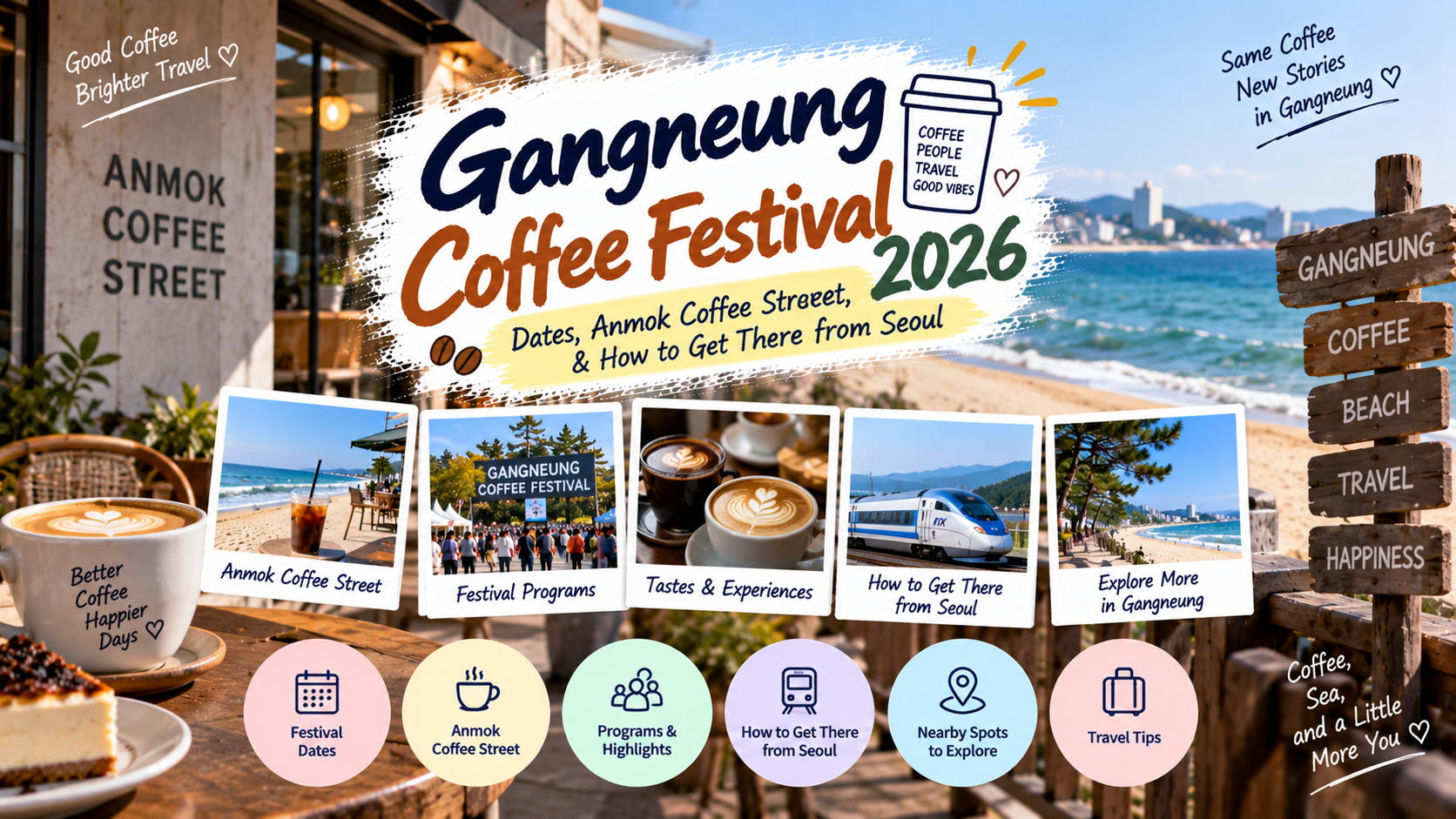
  • Gangneung Coffee Festival 2026: Dates, Anmok Coffee Street, Programs & How to Get There from Seoul

    Gangneung Coffee Festival 2026: Dates, Anmok Coffee Street, Programs & How to Get There from Seoul

    If you love coffee and you are visiting Korea in late October 2026, there is one city worth adding to your itinerary.

    Gangneung.

    From October 21 to October 25, 2026, the coastal city hosts the 18th Gangneung Coffee Festival, one of Korea’s best-known celebrations of coffee culture.

    The main festival area is around Gangneung Coffee Street at Anmok Beach, but the 2026 event extends beyond one street. Programs also spread through participating cafés and other parts of Gangneung, making the festival feel less like a single exhibition hall and more like a city-wide coffee trip.

    The official festival website confirms the five-day schedule for October 21–25, while Korea Tourism Organization’s current event listing gives operating hours of approximately 10 AM to 8 PM and notes that some programs are paid.

    You can check updates through the official Gangneung Coffee Festival website before traveling.

    Gangneung Coffee Festival 2026 at a Glance

    Dates: October 21–25, 2026
    Edition: 18th Gangneung Coffee Festival
    Main venue: Gangneung Coffee Street / Anmok Beach
    Additional venues: Participating locations across Gangneung
    General operating hours: Around 10 AM–8 PM according to the current Korea Tourism Organization listing
    Admission: Many areas can be explored freely; some experiences are paid
    Korean name: 강릉커피축제
    Best for: coffee lovers, couples, solo travelers, café travelers, autumn trips and visitors combining Seoul with Korea’s east coast

    The 2026 program includes coffee tasting and experience zones, markets, master classes, performances, children’s activities, a stamp rally and a fireworks program.

    Why Gangneung Is Korea’s Coffee City

    Gangneung is unusual because coffee is not simply a festival theme added to the city for five days.

    Coffee is already part of its travel identity.

    Anmok Beach is lined with cafés facing the East Sea, and the wider Gangneung area has developed a strong café and roasting culture.

    The official Gangneung city tourism site describes the festival as an event held around Anmok Beach Coffee Street and other parts of the city, with participating cafés offering their own roasted coffee and distinctive flavors.

    That means you do not have to choose between “the festival” and “a normal Gangneung café day.”

    They overlap.

    You can attend a festival program, walk along the beach, visit an independent café and then return to another event later.

    The Main Venue: Anmok Coffee Street

    For a first visit, start at Anmok Beach.

    Korean:

    안목해변

    Coffee Street:

    강릉커피거리

    This is where the festival makes the most sense visually.

    You have the sea on one side and cafés on the other.

    In summer, Anmok can feel like a beach destination with coffee added.

    In late October, the atmosphere is different.

    The weather is cooler, the beach is easier to walk, and sitting with a hot coffee while looking at the East Sea feels much more natural.

    If you are visiting specifically for the festival, give yourself time to walk the area rather than moving directly from one program to another.

    100 People, 100 Flavors

    One of the headline programs listed for 2026 is 100인 100미, often understood as a “100 people, 100 flavors” coffee performance.

    The concept fits the festival well: coffee is not treated as one standardized drink.

    Different people, beans, roasting choices and brewing styles create different results.

    The festival’s official site was still recruiting participants for the 2026 edition in September, which is a useful sign that this is an active current-year program rather than recycled information from an old festival page.

    If this program is a priority for you, check the final daily timetable shortly before your visit.

    The festival lasts five days, but not every major performance happens every day.

    Coffee Experience Zone

    You do not need to be a professional barista to enjoy the festival.

    The current Korea Tourism Organization program includes a dedicated coffee experience zone, alongside coffee-related markets and educational programming.

    Depending on the final daily schedule, this is where visitors may encounter brewing, tasting or coffee-focused activities.

    Some experiences can carry separate fees or have limited capacity.

    If there is one workshop you really want, do not assume that simply arriving at Anmok in the afternoon guarantees a place.

    Check reservations and on-site registration information first.

    Coffee Master Classes

    Another listed 2026 program is the Coffee Master Class.

    This is a good option for travelers whose interest goes beyond taking café photographs.

    Gangneung’s coffee festival attracts people who roast, brew and work professionally in the industry, so the event has a more serious coffee side alongside the casual beach-festival atmosphere.

    For an international visitor, language can be a factor.

    Before paying for a class, check whether it is primarily conducted in Korean and whether translated information is available.

    Even without joining a formal class, however, the markets and tasting-oriented programs make the festival accessible to visitors who do not speak Korean.

    Coffee & Humanities

    The program also includes Coffee and Humanities, reflecting the festival’s broader approach to coffee as culture rather than only a beverage.

    This is one reason I would not describe Gangneung Coffee Festival simply as a giant café market.

    There are sales booths and drinks, of course.

    But the festival also builds programming around the people, history and culture connected with coffee.

    That gives repeat Korea travelers something different from another shopping festival.

    Coffee Busking and Radio

    The 2026 program includes:

    Coffee Busking

    and

    Anmok Coffee RADIO

    along with other small-scale cultural programs around the coffee street.

    These are the kinds of activities I would treat as a bonus rather than building an entire itinerary around one performance time.

    Walk Anmok.

    Drink coffee.

    Stop when something interesting is happening.

    That works better than trying to schedule every 30 minutes of the day.

    “A Night Under the Stars”

    The official 2026 program also lists 별이 빛나는 밤에, which translates roughly as “A Night Under the Stars.”

    Even if you arrive in Gangneung during the morning, staying into the evening can change the atmosphere of the trip.

    Anmok after dark feels very different from the daytime beach.

    If the weather is good, this is one reason an overnight stay can be more satisfying than taking the last possible train back to Seoul.

    Fireworks

    A fireworks program is included in Korea Tourism Organization’s current 2026 festival listing.

    However, the current official sources I checked do not yet provide a clear final fireworks date and time that I would rely on for a flight or hotel decision.

    If fireworks are one of your main reasons for going, check the official festival schedule again closer to October 21.

    Do not book a specific night based solely on an old year’s timetable.

    Coffee Festival Market

    The festival includes both a Coffee Festival Market and a handicraft market, plus a dedicated bean-shop program.

    This is where coffee lovers can spend much more time than expected.

    You may find:

    beans,

    brewing-related products,

    coffee accessories,

    local goods,

    and handmade items.

    If you want to buy beans as souvenirs, remember that fresh coffee is easier to travel with than many Korean food souvenirs.

    Just check your home country’s customs restrictions if you are carrying unusual agricultural products.

    Roasted coffee beans are usually a much simpler souvenir than fresh produce.

    City-Wide Welcome Coffee Shops

    One of the best things about the 2026 structure is that the event is not limited to one fenced festival area.

    The official program lists Welcome Coffee Shops as part of the city-wide program, along with a stamp rally and receipt event.

    That encourages visitors to explore more than the busiest part of Anmok.

    If you are staying overnight, this is worth using.

    Have one coffee at Anmok.

    Then try another neighborhood.

    You will get a better sense of Gangneung than if you simply move between the largest beachfront cafés.

    Stamp Rally

    The festival’s official website currently links to its Stamp Rally program.

    For repeat visitors or people staying one or two nights, this can turn a normal café trip into a reason to explore different participating locations.

    But do not spend the entire day collecting stamps if it takes you far away from places you actually want to see.

    A travel itinerary should still be enjoyable without completing every mission.

    Is the Festival Good for Children?

    Yes — even if your child does not drink coffee.

    The 2026 program includes a kids’ playground and a coffee sports day, alongside experience areas and markets.

    For families, I would combine the festival with the beach.

    Let adults explore coffee programs.

    Give children time outside.

    Then stop for food.

    That balance is much more realistic than expecting a young child to spend five hours watching coffee demonstrations.

    How Much Does It Cost?

    Korea Tourism Organization currently lists the festival as partially paid, which means you should not think of it as one single admission-ticket event.

    Walking around Anmok and experiencing the festival atmosphere does not require you to purchase every program.

    Your actual budget depends on:

    how many coffees you buy,

    whether you join paid experiences,

    what you buy at the market,

    and whether you stay overnight.

    For most travelers, the biggest costs will probably be transportation, accommodation, food and all the coffee you decide you “need to try.”

    How Much Coffee Is Too Much Coffee?

    This sounds silly until you arrive at a coffee festival.

    Do not order a full large drink at every café.

    If you are traveling with someone, share.

    If tasting portions are available, use them.

    Drink water.

    Eat properly.

    After four cafés, “I need to compare one more roast” can become less scientific than you imagined.

    The point is to enjoy Gangneung, not test your maximum caffeine tolerance.

    What Else Should You Eat?

    Gangneung is not only coffee.

    Leave room for a proper meal.

    Depending on your route, you can explore local seafood, Korean restaurants and the city’s food markets.

    A useful rule is:

    coffee for the festival, food from the city.

    Do not spend the entire day surviving on cake and iced Americanos.

    How to Get There from Seoul

    Gangneung is one of the easiest east-coast cities to reach from Seoul by train.

    KTX services connect the Seoul area with Gangneung Station.

    The exact departure station and timetable depend on the train you choose, so use KORAIL or KORAIL Talk for your travel date rather than relying on a timetable copied from an older article.

    Book:

    Destination: Gangneung (강릉)

    October is a popular domestic travel season, and festival weekends can be busy.

    If you know your date, reserve your train rather than waiting until the last minute.

    From Gangneung Station to Anmok Coffee Street

    The festival is not held at Gangneung Station.

    Once you arrive, continue toward:

    강릉커피거리

    or

    안목해변

    by local bus or taxi.

    If you arrive by intercity bus instead of train, Korea Tourism Organization currently lists bus routes 202-1, 302 and 303-1 from the intercity bus terminal area toward the Anmok stop.

    Bus routes can change, so I would still check NAVER Map on the day you travel.

    Can You Visit as a Day Trip from Seoul?

    Yes.

    A day trip is possible if your priority is the festival and Anmok.

    A sensible day would look like:

    morning KTX from Seoul
    → Gangneung
    → lunch
    → Anmok Coffee Street
    → festival programs
    → early dinner
    → evening train to Seoul

    But do not add half of Gangneung to that itinerary.

    You do not need to visit Anmok, Gyeongpo, Ojukheon, Jumunjin and every famous café in one day.

    Why I Prefer One Night

    If your schedule allows it, stay one night.

    That gives you time to see the beach after dark, explore more cafés and avoid watching the clock all afternoon.

    You can also use the second morning for another part of Gangneung before returning to Seoul.

    For a festival built around coffee and atmosphere, slowing down makes sense.

    A 1-Night Gangneung Coffee Festival Itinerary

    Day 1

    Morning train from Seoul.

    Arrive in Gangneung.

    Lunch.

    Check in or leave luggage.

    Spend the afternoon at Anmok Coffee Street.

    Join one festival experience.

    Browse the markets.

    Have dinner.

    Stay for evening programs.

    Day 2

    Slow breakfast or another café.

    Choose one additional Gangneung attraction.

    Lunch.

    Return to Seoul.

    This gives you a much better trip than trying to turn Gangneung into a six-hour checklist.

    Where Should You Stay?

    For the festival itself, staying near Anmok gives you immediate access to the main area.

    But it is not the only reasonable option.

    Central Gangneung can be convenient for restaurants and city transportation.

    Areas closer to Gyeongpo make sense if your trip is also about the coast.

    Choose based on the entire itinerary rather than the festival entrance alone.

    What Is the Weather Like?

    Late October in Gangneung can feel cooler than Seoul travelers expect, especially beside the sea after sunset.

    Bring layers.

    A light jacket during the day may become essential at night.

    Wind also matters along Anmok Beach.

    If you plan to sit outside with coffee, dress for the coast rather than the inside of a café.

    Useful Korean Search Terms

    강릉커피축제 — Gangneung Coffee Festival
    강릉커피거리 — Gangneung Coffee Street
    안목해변 — Anmok Beach
    안목카페거리 — Anmok Café Street
    강릉역 — Gangneung Station
    강릉 카페 — Gangneung cafés
    강릉 맛집 — Gangneung restaurants
    강릉커피축제 일정 — Gangneung Coffee Festival schedule
    강릉커피축제 주차 — festival parking
    강릉커피축제 프로그램 — festival programs

    Should You Drive?

    Driving gives you more freedom to explore Gangneung beyond the festival.

    It can also become inconvenient when many visitors are heading toward the same beachfront area.

    If you are coming only for Anmok and the festival, train + local transport is perfectly reasonable.

    If you want to explore multiple coastal areas, smaller neighborhoods and places outside central Gangneung, a car becomes more useful.

    What Day Should You Visit?

    The festival runs from Wednesday, October 21 through Sunday, October 25.

    Weekdays may be easier if your priority is coffee tasting and browsing.

    The weekend will likely have a more energetic festival atmosphere.

    The best date ultimately depends on the final schedule of the programs you care about.

    Check the official timetable close to your visit.

    FAQ

    When is Gangneung Coffee Festival 2026?

    The 18th Gangneung Coffee Festival runs from October 21 to October 25, 2026.

    Where is it held?

    The main venue is Gangneung Coffee Street around Anmok Beach, with additional programs across the city.

    What time does it open?

    Korea Tourism Organization currently lists festival operating hours of approximately 10 AM to 8 PM, although individual programs and cafés may use different schedules.

    Is Gangneung Coffee Festival free?

    The official tourism listing says some programs are paid. You do not buy one universal ticket simply to walk around Anmok, but certain experiences or classes can have separate fees.

    Is there a fireworks show?

    Fireworks are included in the current 2026 program listing. Check the final official schedule for the exact day and time before planning your visit around it.

    Can I visit from Seoul in one day?

    Yes. KTX makes a day trip practical, but an overnight stay is better if you want to enjoy evening programs and explore Gangneung beyond Anmok.

    Is it worth visiting if I do not know much about coffee?

    Yes. The festival also includes markets, busking, a children’s area, city-wide programs and a beach setting.

    Final Thoughts

    Gangneung Coffee Festival works because Gangneung already makes sense as a coffee trip.

    The festival simply concentrates that identity into five autumn days.

    Come for one program.

    Walk along Anmok Beach.

    Drink coffee somewhere you did not already save on Instagram.

    Browse the market.

    Stay after sunset.

    And if you have time, sleep in Gangneung rather than racing back to Seoul.

    For a broader look at where this fits into an October trip, our Autumn in Korea guide covers seasonal destinations, foliage and other 2026 festivals around the country.

    If coffee, the ocean and slow travel sound better than another full day of Seoul sightseeing, October 21–25, 2026 is a very good time to go east.
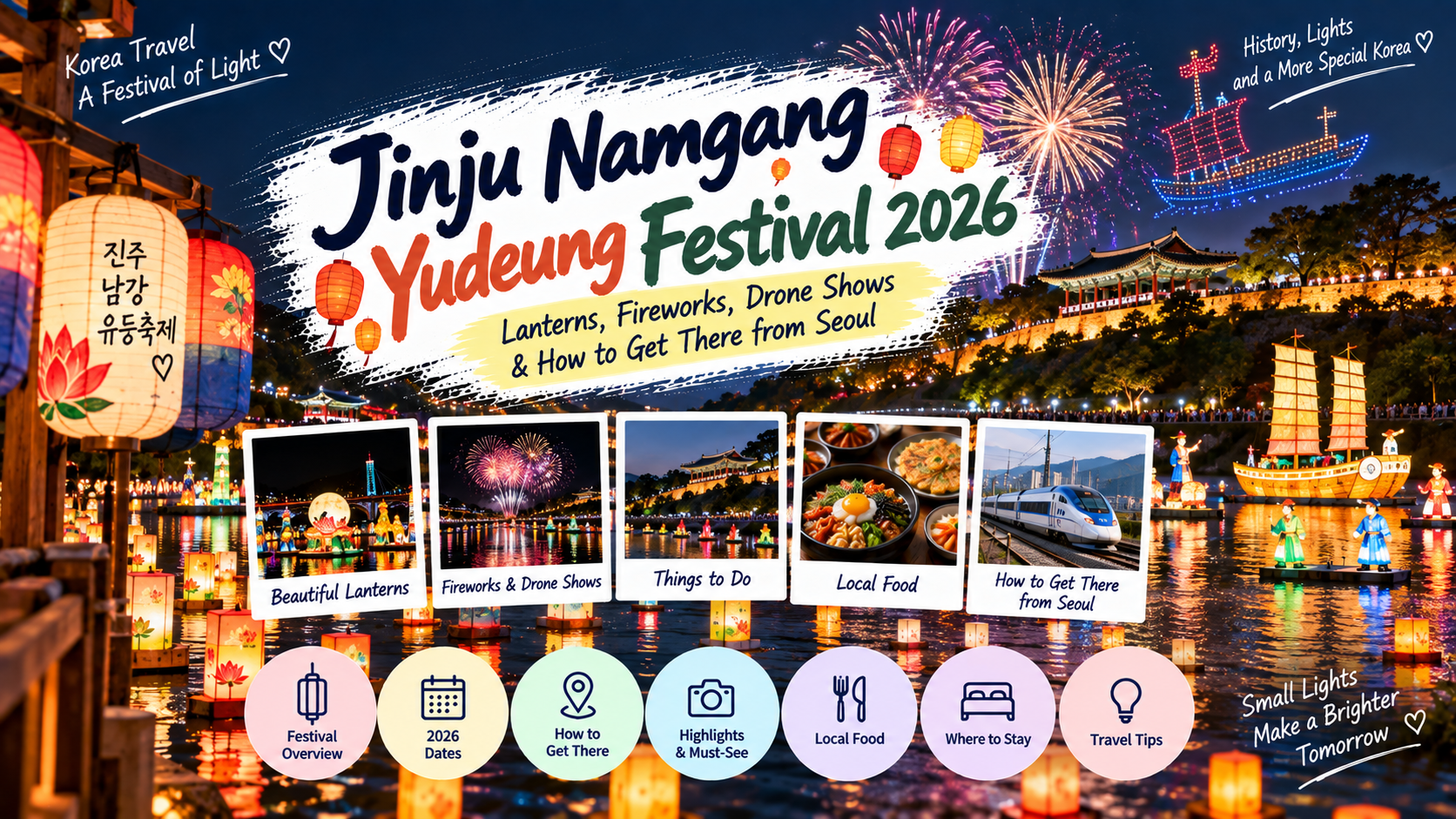
  • Jinju Namgang Yudeung Festival 2026: Lanterns, Fireworks, Drone Shows & How to Get There from Seoul

    Jinju Namgang Yudeung Festival 2026: Lanterns, Fireworks, Drone Shows & How to Get There from Seoul

    If you are visiting Korea in October 2026 and want to experience one autumn festival outside Seoul, Jinju Namgang Yudeung Festival deserves serious consideration.

    From October 3 to October 18, 2026, the riverside city of Jinju in South Gyeongsang Province turns the Namgang River, Jinjuseong Fortress and surrounding streets into a huge nighttime landscape of illuminated lanterns.

    This is not a small display that you can finish in twenty minutes.

    The official 2026 program includes 22 lantern exhibition zones, nighttime performances, food areas, hands-on activities, drone light shows and fireworks over the river. Lanterns are illuminated every night from 6 PM to midnight, while festival booths and pontoon-bridge areas operate from 1 PM to 11 PM.

    If you have already seen Seoul’s palaces, Busan’s beaches and Korea’s major city attractions, Jinju gives you something very different: a regional Korean festival where history, river scenery and large-scale light installations all come together.

    You can check the changing schedule through the official Jinju Namgang Yudeung Festival program before traveling.

    Jinju Namgang Yudeung Festival 2026 at a Glance

    Dates: October 3–18, 2026
    Main area: Namgang River, Jinjuseong Fortress and nearby riverfront districts
    Lantern lighting: 6 PM–12 AM
    Booths and pontoon-bridge operating hours: 1 PM–11 PM
    Korean name: 진주남강유등축제
    Best for: night photography, Korean history, couples, families and autumn regional travel

    The most important thing to understand is that this is primarily an evening festival.

    You can arrive during the afternoon and explore Jinju, but the main visual experience begins after 6 PM.

    Why Does Jinju Have a Lantern Festival?

    The lanterns are not simply decorative.

    According to the festival’s official history, their origin is connected to the Battles of Jinjuseong during the Imjin War in the 1590s.

    During the 1592 battle, defenders used lanterns on the Namgang River both as a military tactic to watch for enemy forces attempting to cross the river and as a way to communicate with family members outside the fortress.

    After the devastating second battle in 1593, local residents continued floating lanterns on the river to honor those who died.

    That tradition eventually developed into today’s festival.

    Knowing that history changes the experience.

    Jinjuseong Fortress is not just a convenient backdrop for an Instagram event. The river, fortress and lanterns are historically connected.

    What Is New and Special in 2026?

    The 2026 festival spreads its lantern displays across 22 themed zones around the Namgang, Jinjuseong and surrounding districts.

    Several themes are particularly interesting for international visitors.

    The Future City Jinju Space Zone reflects Jinju’s identity as an aerospace hub.

    The Our Language, Our Heart zone uses King Sejong and Hangul as a visual theme.

    Around Jinjuseong, visitors can find installations inspired by traditional Korean culture, while the Typo Art in Hangul Zone combines modern graphic design with Korean letters.

    There is also a Space Theme Park Zone on the Sinan riverbank and a K-culture-focused area at Jinju Railway Culture Park.

    This mix is important because the festival is not only historical.

    You will see references to Joseon culture and Jinju’s wartime history, but also Korean popular culture, futuristic design and playful family-oriented installations.

    The Best Nights for Fireworks

    The official 2026 schedule lists fireworks on three nights:

    October 3, October 9 and October 17 at 8 PM.

    The fireworks take place over the Namgang River between Jinju Bridge and Cheonsu Bridge.

    These are likely to be among the busiest festival nights.

    If fireworks are a major reason for your trip, that may be worth the crowds.

    If you mainly want to photograph the lanterns and walk around comfortably, another evening could be a better choice.

    Drone Light Show Dates

    The festival also has three scheduled drone-light-show nights.

    On October 3 and October 17, the drone show is scheduled for 7:50 PM.

    On October 10, it is scheduled for 8 PM.

    October 3 and October 17 therefore combine both a drone show and 8 PM fireworks.

    Those nights offer the most spectacle, but they will also require the most careful planning.

    Do not expect to arrive at the river at 7:55 PM and casually find the perfect viewing spot.

    Which Date Should You Choose?

    For the full opening-night experience, choose October 3.

    The opening program begins with a memorial ceremony at Jinjuseong at 6 PM, followed by a symbolic lantern parade at 6:30 PM and the first official lighting ceremony at 7:30 PM. The drone show follows at 7:50 PM and fireworks at 8 PM.

    If you want fireworks but would rather avoid opening night, October 9 is another option.

    If the drone show is more important, October 10 gives you a scheduled drone event without the same fireworks program.

    For the final major weekend spectacle, choose October 17, when both the drone show and fireworks return.

    If none of these special events matter to you, consider a weekday.

    The lantern displays themselves run every evening throughout the festival.

    Do Not Arrive Only at Night

    It may sound strange to recommend arriving early for a night festival, but Jinju is worth seeing before sunset.

    Start with Jinjuseong Fortress.

    Walk the fortress grounds while you can still clearly see the architecture and the Namgang River.

    Then have an early dinner.

    By the time the lanterns switch on at 6 PM, you will already understand how the festival area is laid out.

    You can then focus on enjoying the lights instead of trying to navigate an unfamiliar city in the dark.

    A Good Festival-Day Itinerary

    A practical day could begin around mid-afternoon at Jinjuseong.

    Spend one to two hours walking the fortress and riverfront. Do not rush through the historical area simply because the lanterns are the headline attraction.

    Around 5 PM, eat dinner before the biggest evening crowds arrive.

    At 6 PM, start with the lantern zones along the Namgang.

    As darkness settles, cross between the riverfront sections and Jinjuseong depending on the current crowd flow.

    If you are visiting on a fireworks or drone-show night, move toward your preferred viewing area well before 8 PM.

    After the major show, do not immediately leave.

    The lanterns remain illuminated until midnight, so the period after the fireworks can actually be one of the nicest times to continue walking.

    Don’t Try to See All 22 Zones

    This is an easy mistake.

    The official program lists 22 exhibition zones, but turning the evening into a completion challenge is not necessary.

    For a first visit, prioritize three areas:

    the Namgang River,

    Jinjuseong,

    and one additional themed area that interests you.

    If you are traveling with children, the more playful character or space-themed zones may be worth adding.

    If photography is your priority, spend more time around the river.

    If Korean history is the reason you came, give Jinjuseong more time.

    Food at the Festival

    The official 2026 festival site confirms food zones, food trucks and a night-market area along the festival grounds.

    That makes it possible to eat inside the festival area, but I still recommend having your main meal relatively early.

    On high-traffic nights, popular food areas become part of the crowd.

    Eating at 5 PM and buying snacks later is usually more comfortable than becoming hungry at exactly 8 PM when everyone is waiting for the fireworks.

    Is There an Entrance Fee?

    The current official festival overview does not present one single all-inclusive admission ticket for the entire festival area.

    Much of the event is spread through public riverside and fortress areas, while certain activities, experiences or special facilities may carry separate charges.

    Because individual programs can change, check the official festival program and reservation information for the specific activity you want rather than relying on an old blog’s price from a previous year.

    How to Get There from Seoul

    Jinju is much farther from Seoul than Suwon or Incheon, so I would treat this as a proper regional trip rather than a casual suburban day trip.

    By Train

    Check Korail services from Seoul Station to Jinju Station for your date.

    Direct or connecting schedules can vary, so look at your actual travel day rather than building the trip around an old timetable.

    Once you reach Jinju Station, use a local bus or taxi toward Jinjuseong (진주성) or the Namgang festival area.

    For navigation in Korea, search the Korean destination name in NAVER Map.

    By Bus

    Long-distance buses also connect Seoul with Jinju.

    The exact Seoul departure terminal and schedule depend on the service you choose, so check the terminal carefully before traveling.

    If you are deciding between train and bus, compare the entire trip — hotel to festival — rather than only the time spent on the vehicle.

    Should You Return to Seoul the Same Night?

    It can be possible depending on that day’s train or bus schedule.

    But for a festival built around nighttime illumination, an overnight stay is much more relaxed.

    This is particularly true on fireworks nights.

    Before leaving Seoul, check the last realistic return connection.

    Do not wait until 10 PM in Jinju to discover that your preferred service has already finished.

    Where Should You Stay in Jinju?

    For a one-night festival trip, convenience matters more than finding the city’s most luxurious hotel.

    Look for accommodation with easy access to:

    Jinjuseong, the Namgang riverfront or central Jinju.

    That lets you enjoy the lanterns without worrying about a long late-night journey after the festival.

    If accommodation near the core festival area becomes expensive on special-event weekends, compare locations based on taxi or local-bus access.

    Driving to the Festival

    Driving gives you flexibility, but the busiest festival evenings can create exactly the type of traffic that makes a car inconvenient.

    The official 2026 transport plan includes temporary parking areas and shuttle buses on October 3–5, October 9–11 and October 16–18.

    If you are driving, use the official transport guidance rather than trying to park immediately beside Jinjuseong.

    On fireworks nights, follow temporary traffic instructions and allow extra time.

    What to Wear in Jinju in October

    October is one of Korea’s best walking months, but the temperature can change significantly after sunset.

    Bring a light jacket or layer even if the afternoon feels warm.

    Wear comfortable shoes.

    This festival involves much more walking than simply standing beside the river and watching a show.

    If rain is in the forecast, check the official festival notices before traveling because outdoor performances can be affected by weather.

    Is This Good for Families?

    Yes.

    The combination of illuminated installations, character displays, river scenery and activity areas makes the festival relatively easy to enjoy with children.

    The main challenge is timing.

    For younger children, arriving around 4–5 PM and staying through the first few hours of illumination may work better than trying to remain until midnight.

    On fireworks nights, expect more noise and much denser crowds.

    Is It Good for Couples?

    Very much so.

    The Namgang after dark is one of the reasons this festival photographs so well.

    Rather than rushing between every installation, choose a slower route along the river, stop for food and spend time around the waterfront.

    October 3 and 17 are the most dramatic nights, but a quieter weekday can actually be better for a relaxed evening.

    Is It Worth Visiting If You Have Only One Week in Korea?

    That depends on your itinerary.

    If this is your first Korea trip and you only have five or six days split between Seoul and Busan, I would not force Jinju into the middle.

    If you have a longer trip, are already traveling through the southern part of Korea, or specifically enjoy seasonal festivals, it becomes much more attractive.

    For broader autumn planning, our Autumn in Korea guide compares foliage areas and other October festivals around the country.

    Jinju works especially well when your trip already includes Busan, Gyeongju or another southern destination.

    Useful Korean Search Terms

    Save these in your phone:

    진주남강유등축제 — Jinju Namgang Yudeung Festival
    진주성 — Jinjuseong Fortress
    진주역 — Jinju Station
    진주남강 — Jinju Namgang River
    유등 — floating lantern / lantern light
    불꽃놀이 — fireworks
    드론 라이트 쇼 — drone light show
    축제 셔틀버스 — festival shuttle bus
    임시주차장 — temporary parking lot

    These are useful in NAVER Map and Korean local search results.

    FAQ

    When is the Jinju Lantern Festival in 2026?

    The 2026 Jinju Namgang Yudeung Festival runs from October 3 through October 18. Lanterns are scheduled to be illuminated from 6 PM until midnight each night.

    When are the fireworks?

    The official 2026 schedule lists fireworks at 8 PM on October 3, October 9 and October 17.

    When are the drone shows?

    Drone shows are scheduled for October 3 and 17 at 7:50 PM, and October 10 at 8 PM.

    Is Jinju a day trip from Seoul?

    It can be done depending on transport schedules, but because the main festival experience happens after dark, an overnight stay is more comfortable.

    What time should I arrive?

    For a first visit, I would arrive during the afternoon, see Jinjuseong before sunset, eat early and be ready for the lanterns from 6 PM.

    Is it only a lantern display?

    No. The 2026 program includes 22 lantern zones, cultural performances, food areas, activity programs, drone shows and fireworks on selected dates.

    Final Thoughts

    Korea has many autumn festivals, but Jinju stands out because the lights belong to the landscape.

    The fortress is there.

    The river is there.

    And the history behind the lantern tradition is tied directly to both.

    That makes the festival feel very different from a temporary light installation built solely for tourism.

    Come before sunset.

    Walk Jinjuseong while there is still daylight.

    Eat before the peak evening crowds.

    Then watch the river change when thousands of lights turn on at 6 PM.

    If your schedule allows, stay overnight instead of racing back to Seoul.

    The best part of the Jinju Namgang Yudeung Festival is not checking every lantern zone off a map.

    It is simply spending an autumn night beside the Namgang when the entire river is glowing.

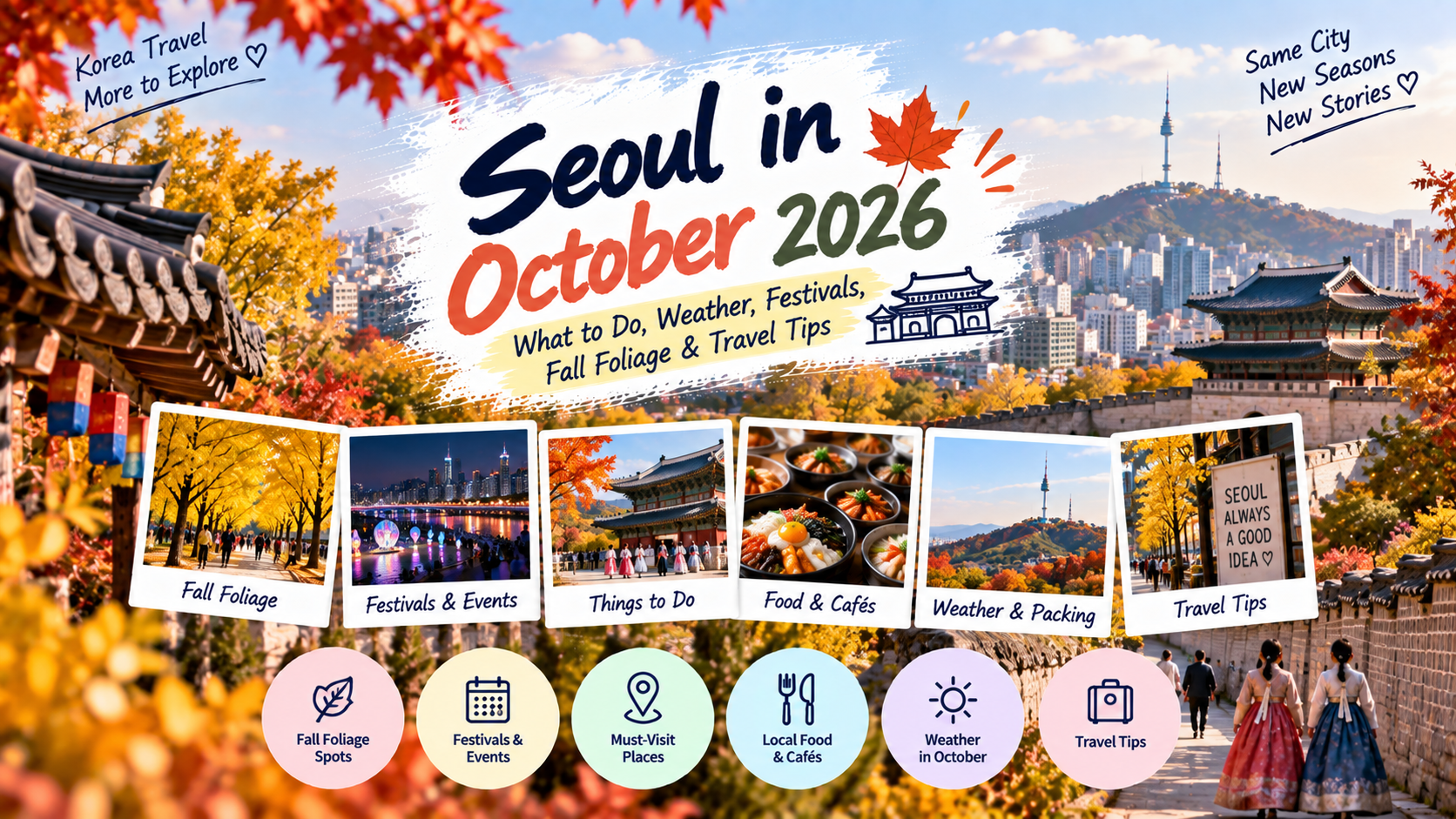
  • Seoul in October 2026: What to Do, Weather, Festivals, Fall Foliage & Travel Tips

    Seoul in October 2026: What to Do, Weather, Festivals, Fall Foliage & Travel Tips

    October is one of the best months to visit Seoul.

    The heavy humidity of summer has usually eased, outdoor sightseeing becomes much more comfortable, and the city gradually changes from early-autumn green to the red and gold colors travelers associate with fall in Korea.

    It is also a busy month for festivals, performances, Han River events and seasonal activities.

    But there is one important thing to understand before planning an October trip:

    “October in Seoul” does not automatically mean “peak fall foliage.”

    Early October and late October can look completely different.

    If you are visiting at the beginning of the month, plan around comfortable weather, outdoor events and neighborhoods. If you are coming later, autumn foliage becomes a much bigger part of the itinerary.

    This guide explains how to plan both.

    Is October a Good Time to Visit Seoul?

    For most travelers, yes.

    October solves one of the biggest problems with summer sightseeing in Seoul: walking outside becomes much easier.

    A typical first-time Seoul itinerary involves much more walking than people expect.

    You walk through palace grounds.

    You walk around Bukchon.

    You walk between cafés in Seongsu.

    You walk along the Han River.

    You walk through huge subway stations.

    You walk around markets.

    In July or August, that can become exhausting.

    October is much better suited to this kind of trip.

    Seoul Weather in October

    October is a transition month.

    Early October can still feel pleasantly mild during the day, while late October generally feels much more like autumn.

    Evenings can be noticeably cooler than afternoons, especially around the Han River.

    The practical answer is simple:

    bring layers.

    A light jacket or cardigan that fits into your bag is more useful than dressing for one fixed temperature all day.

    Comfortable shoes are essential.

    If your itinerary includes palaces, Seoul Forest, the Han River and traditional neighborhoods, you may easily walk 15,000–20,000 steps without intentionally planning a “walking day.”

    Early October vs Late October

    This distinction matters more than the average monthly temperature.

    Early October

    Think:

    comfortable outdoor weather,

    Han River evenings,

    festivals,

    Seongsu,

    palaces,

    markets,

    and long neighborhood walks.

    Mid-October

    Autumn becomes more visible, although foliage conditions depend on the year’s weather.

    Late October

    This is when foliage becomes a much stronger reason to visit parks, palace grounds and mountain areas around Seoul.

    Do not use a photograph taken on October 30 to predict what Seoul will look like on October 3.

    When Is Fall Foliage in Seoul?

    There is no single guaranteed “peak foliage day.”

    Temperature, rainfall and other weather conditions affect timing every year.

    Also, different places change at different speeds.

    Trees on a mountain do not necessarily peak at exactly the same time as trees in a palace courtyard or city park.

    If fall colors are the main reason for your trip, check current foliage information shortly before arrival.

    For broader current travel information and seasonal events, the official Visit Seoul website is worth checking immediately before your trip.

    Where to See Autumn Colors in Seoul

    You do not need to leave Seoul to enjoy autumn scenery.

    Several of the city’s standard attractions become particularly attractive once the leaves begin changing.

    1. Gyeongbokgung Palace

    Gyeongbokgung is already one of the essential first-time Seoul attractions.

    Autumn gives you another reason to slow down rather than rushing through the main courtyard.

    Walk deeper into the palace grounds.

    The contrast between traditional Korean architecture and autumn trees makes this one of the easiest places to combine sightseeing and seasonal scenery.

    If you plan to rent hanbok, allow at least half a day for the whole experience.

    The rental process, changing clothes, photographs and palace visit take longer than many first-time travelers expect.

    Korean search term:

    경복궁

    2. Changdeokgung Palace

    For travelers especially interested in seasonal scenery, Changdeokgung is another important palace to consider.

    Its historic setting and garden areas make it particularly appealing in autumn.

    Some garden access and tour arrangements can differ from simply entering the main palace grounds, so check current official information before planning your visit around one specific section.

    Korean search term:

    창덕궁

    3. Deoksugung and Jeongdong-gil

    Deoksugung is one of the easiest autumn stops to combine with central Seoul.

    You can visit the palace and then walk around Jeongdong-gil.

    This is useful if you want autumn atmosphere without spending an entire day in a park.

    A simple route is:

    City Hall → Deoksugung → Jeongdong-gil → central Seoul café or museum

    Korean search terms:

    덕수궁

    정동길

    4. Seoul Forest

    Seoul Forest works especially well for travelers already planning to visit Seongsu.

    Instead of treating the park as a separate attraction, combine them.

    A good autumn day could be:

    Seongsu café
    → shops and pop-ups
    → lunch
    → Seoul Forest
    → sunset or dinner

    This is one of the easiest ways to experience contemporary Seoul and seasonal outdoor scenery in one neighborhood.

    Search:

    서울숲

    5. Namsan

    Namsan offers a different kind of autumn experience because elevation gives you wider views over the city.

    You do not necessarily need to build the day around Seoul Tower.

    Walking routes around Namsan can be the main attraction.

    If you’re staying around Myeongdong, this is particularly easy to incorporate.

    Search:

    남산

    6. Olympic Park

    Travelers who want wide open spaces rather than traditional architecture can consider Olympic Park.

    It works particularly well for a slower day and can be combined with Jamsil.

    Because the park is large, decide what you actually want to see rather than arriving without checking the map.

    Search:

    올림픽공원

    7. The Han River

    The Han River is not usually the first place people mention for “fall foliage,” but October is one of the best months to actually spend time there.

    The biggest advantage is the weather.

    You can walk, cycle, picnic or simply sit beside the river without dealing with the most intense summer heat.

    If you’re visiting on a Sunday during the autumn festival season, check whether the Car-Free Jamsugyo Bridge Festival is operating on your date.

    Korea Inside Out has a full guide to Jamsugyo Bridge Festival with practical information for international visitors.

    Jamsugyo in October 2026

    The autumn Jamsugyo program continues into October, making it particularly useful for travelers who missed the September dates.

    Jamsugyo sits beneath Banpo Bridge and becomes a pedestrian-oriented public space during the festival.

    The appeal is not just the programmed event.

    It is the combination of:

    Han River,

    sunset,

    walking,

    temporary food and market elements,

    and the atmosphere of Seoul residents spending a Sunday outside.

    Arrive before sunset rather than treating it only as a night attraction.

    A Good Banpo Evening

    Try:

    4:30 PM

    Arrive around Banpo Hangang Park.

    5:00 PM

    Walk the river.

    6:00 PM

    Eat or pick up picnic food.

    Sunset

    Stay beside the river.

    Evening

    Explore Jamsugyo if the festival is operating.

    Then go back to your hotel.

    Do not add Hongdae or Gangnam afterward simply because you still have a few hours left.

    October evenings are much better when you occasionally stop moving.

    Seoul Welcome Week Continues Into October

    Travelers arriving in early October can also catch the final part of Seoul Welcome Week: Autumn Edition, which runs through October 11, 2026.

    The program is designed around international visitors during the autumn travel season.

    Because individual activities and visitor benefits can vary, check current information through Seoul’s official tourism channels rather than relying on an older social-media post.

    This is particularly useful if you are staying around major tourist areas such as Myeongdong.

    Seongsu in October

    Seongsu deserves a place in an October itinerary even without foliage.

    This is one of Seoul’s most dynamic neighborhoods for:

    cafés,

    fashion,

    design,

    pop-ups,

    and brand experiences.

    But Seongsu changes quickly.

    A viral pop-up you saw online two months before your trip may no longer exist.

    Search close to your travel date.

    Useful Korean searches:

    성수 팝업 — Seongsu pop-ups

    성수 카페 — Seongsu cafés

    성수 가볼만한 곳 — things to do in Seongsu

    This is one area where current Korean search results are often more useful than a static “Top 10 Seongsu” article.

    Hongdae and Yeonnam-dong

    Hongdae is another neighborhood that works particularly well from afternoon into evening.

    Shop around Hongdae, then walk toward Yeonnam-dong.

    Have dinner.

    Stay for nightlife if that interests you.

    There is little reason to arrive at 8 AM.

    October’s comfortable weather also makes walking around Yeonnam much more enjoyable than during the hottest part of summer.

    Traditional Seoul in October

    For a first trip, don’t let seasonal content distract you from Seoul’s core attractions.

    A strong historic-day itinerary remains:

    Gyeongbokgung → Bukchon → Insadong → Ikseon-dong

    The difference in October is that walking between them becomes easier.

    This route also avoids one of the most common Seoul planning mistakes: crossing the entire city several times in one day.

    Bukchon Etiquette

    Remember that Bukchon is a residential neighborhood.

    People actually live there.

    Observe local signs and visitor restrictions, keep noise down and avoid blocking entrances for photographs.

    Autumn can bring larger visitor numbers to scenic areas, making respectful behavior even more important.

    October Markets

    October is also a good month for Seoul’s traditional markets.

    For food-focused visitors, Gwangjang Market is an obvious choice.

    For shopping, everyday market atmosphere and proximity to Myeongdong, Namdaemun Market can make more sense.

    Do not automatically visit both because they appear on every travel list.

    Choose based on what you want.

    Gwangjang:

    food,

    bindaetteok,

    yukhoe,

    market atmosphere.

    Namdaemun:

    shopping,

    children’s clothing,

    household goods,

    kalguksu,

    and easy combination with Myeongdong.

    Is October Good for Café Hopping?

    Yes.

    In fact, the weather makes café neighborhoods more enjoyable because you can walk between places rather than taking transportation for every stop.

    But avoid spending the entire trip traveling to cafés you saw on Instagram.

    Choose cafés within neighborhoods you already want to visit.

    For example:

    Seongsu day → Seongsu café

    Bukchon day → Anguk café

    Hongdae day → Yeonnam café

    This saves enormous amounts of travel time.

    What About Day Trips?

    October is one of the better months for day trips from Seoul.

    Possible options include:

    Suwon,

    Namhansanseong,

    Incheon,

    and other destinations in Gyeonggi-do.

    If autumn scenery is important, mountain and fortress destinations become more interesting as the month progresses.

    But if you only have three days in Seoul, you do not need a day trip.

    Seoul itself can easily fill the entire visit.

    Namhansanseong

    Namhansanseong is particularly appealing for travelers who want history plus hiking and mountain scenery.

    The fortress is outside central Seoul, so allow a substantial part of the day.

    Do not schedule it as:

    “Morning Namhansanseong, lunch Gangnam, afternoon Bukchon, sunset Han River.”

    That is too much.

    Give the destination room.

    Search:

    남한산성

    Suwon

    Suwon’s Hwaseong Fortress is another useful autumn day-trip option.

    It offers a different city experience without requiring a flight or long-distance train.

    Again, think of it as a day rather than a quick detour.

    Transportation from your hotel to the station, the journey itself, local movement and meals all add time.

    What If It Rains?

    October is not guaranteed to be sunny.

    Keep one flexible indoor plan.

    Good rainy-day categories include:

    museums,

    shopping malls,

    indoor exhibitions,

    large cafés,

    aquariums,

    and indoor attractions around Jamsil.

    Do not force your carefully planned foliage day during heavy rain.

    Swap days if your itinerary allows it.

    Lotte World on a Rainy Day

    Families often consider Lotte World because much of the experience can continue indoors.

    Its Jamsil location also makes it easier to combine with shopping and other indoor attractions than a more distant outdoor theme park.

    If you’re deciding between Korea’s major theme parks, weather and travel time should be part of the decision — not just the rides.

    What to Eat in October

    There is no single “October food” that every traveler must eat.

    Instead, cooler weather makes certain Korean meals feel particularly satisfying.

    Try:

    kalguksu,

    gukbap,

    jeon,

    grilled meat,

    soups and stews,

    market food,

    and seasonal café desserts.

    If you’re planning your overall food budget, Korea Inside Out’s How Much Does Food Cost in Seoul? explains how different travel styles affect daily spending.

    Do You Need Cash?

    Seoul is highly card-friendly, but I still wouldn’t travel with absolutely no Korean won.

    Traditional markets, transportation-related situations and small purchases can make cash useful.

    For a more detailed breakdown, see Do You Need Cash in Korea?.

    The practical combination for most visitors is:

    credit card,

    some Korean won,

    and a transportation solution such as T-money.

    Getting Around Seoul

    The subway will probably be your main transportation method.

    But remember that “25 minutes by subway” does not necessarily mean 25 minutes from hotel door to attraction.

    You also need to account for:

    walking to the station,

    large station transfers,

    finding the correct exit,

    and walking from the exit to your destination.

    Use Naver Map for actual route planning.

    If you’re preparing for your first trip, How to Use Seoul Subway covers the basics.

    A 3-Day Seoul October Itinerary

    Day 1 — Traditional Seoul

    Gyeongbokgung
    Bukchon
    Insadong
    Ikseon-dong

    Stay around Jongno rather than crossing the city.

    Day 2 — Contemporary Seoul

    Seongsu
    Seoul Forest
    café
    shopping or pop-up
    dinner nearby

    Day 3 — Shopping + Han River

    Myeongdong or Hongdae
    hotel break
    Banpo Hangang Park
    Jamsugyo if operating

    This gives you traditional Seoul, contemporary neighborhoods and the river without turning the trip into a transportation marathon.

    A 5-Day Seoul October Itinerary

    With five days, you can slow down.

    Day 1

    Historic Seoul

    Day 2

    Seongsu + Seoul Forest

    Day 3

    Hongdae + Yeonnam

    Day 4

    Day trip or Jamsil/Gangnam

    Day 5

    Market + Myeongdong + Han River

    The biggest advantage is flexibility.

    If rain is forecast on Day 2, swap it with your indoor-heavy day.

    If Peak Foliage Is Your Priority

    Do not plan only from historical averages.

    As your travel date approaches, check current conditions.

    If foliage is late, focus on neighborhoods and festivals first.

    If colors are developing quickly, move your palace, Seoul Forest or mountain day earlier.

    This is a better strategy than rigidly assigning “foliage day” months before your flight.

    Korean Search Terms for October Travelers

    Save these:

    서울 10월 가볼만한 곳 — places to visit in Seoul in October

    서울 10월 축제 — Seoul October festivals

    서울 단풍 — Seoul fall foliage

    서울 단풍 명소 — Seoul foliage spots

    한강공원 — Hangang Park

    서울숲 — Seoul Forest

    성수 팝업 — Seongsu pop-ups

    남한산성 단풍 — Namhansanseong foliage

    서울 이번 주말 행사 — Seoul events this weekend

    These are especially useful for finding very recent local information.

    Is October Crowded?

    Popular attractions can certainly be busy.

    Good weather brings both international visitors and local residents outside.

    Instead of trying to avoid every crowd, adjust the timing.

    Visit palaces earlier.

    Eat outside peak lunch time when possible.

    Go to the Han River before sunset rather than arriving at the busiest moment.

    Explore popular neighborhoods on weekdays if your schedule allows it.

    Small timing changes can make a bigger difference than trying to discover a supposedly “secret” version of Seoul.

    Where Should You Stay?

    For a first October trip:

    Myeongdong works well for central sightseeing and convenience.

    Hongdae is useful for nightlife and airport access.

    Jongno/Insadong is excellent for traditional sightseeing.

    Gangnam makes sense if your priorities are beauty, shopping and southern Seoul.

    Choose based on itinerary, not simply hotel price.

    A slightly more expensive hotel in the right location can save hours of transportation across a short trip.

    How Many Days Do You Need?

    For a first trip, 3–5 days is a useful range.

    Three days lets you see the essentials.

    Five days gives you time for neighborhoods, a slower pace and perhaps a day trip.

    If you’re still deciding, see How Many Days Do You Need in Seoul?.

    Final Thoughts

    October is not great because Seoul turns into one giant red-and-gold postcard on October 1.

    It doesn’t.

    October is great because the city becomes easier to experience outdoors.

    You can spend longer in palace grounds.

    Walk between cafés.

    Sit beside the Han River.

    Explore Seongsu without immediately searching for air conditioning.

    And as the month progresses, autumn color gradually adds another layer to places that were already worth visiting.

    So don’t build your October trip around one predicted foliage date.

    Build a strong Seoul itinerary first.

    Then use the weather, current events and actual autumn conditions to decide what to move around.

    That’s the advantage of Seoul in October: the season gives you more options, not just more leaves.

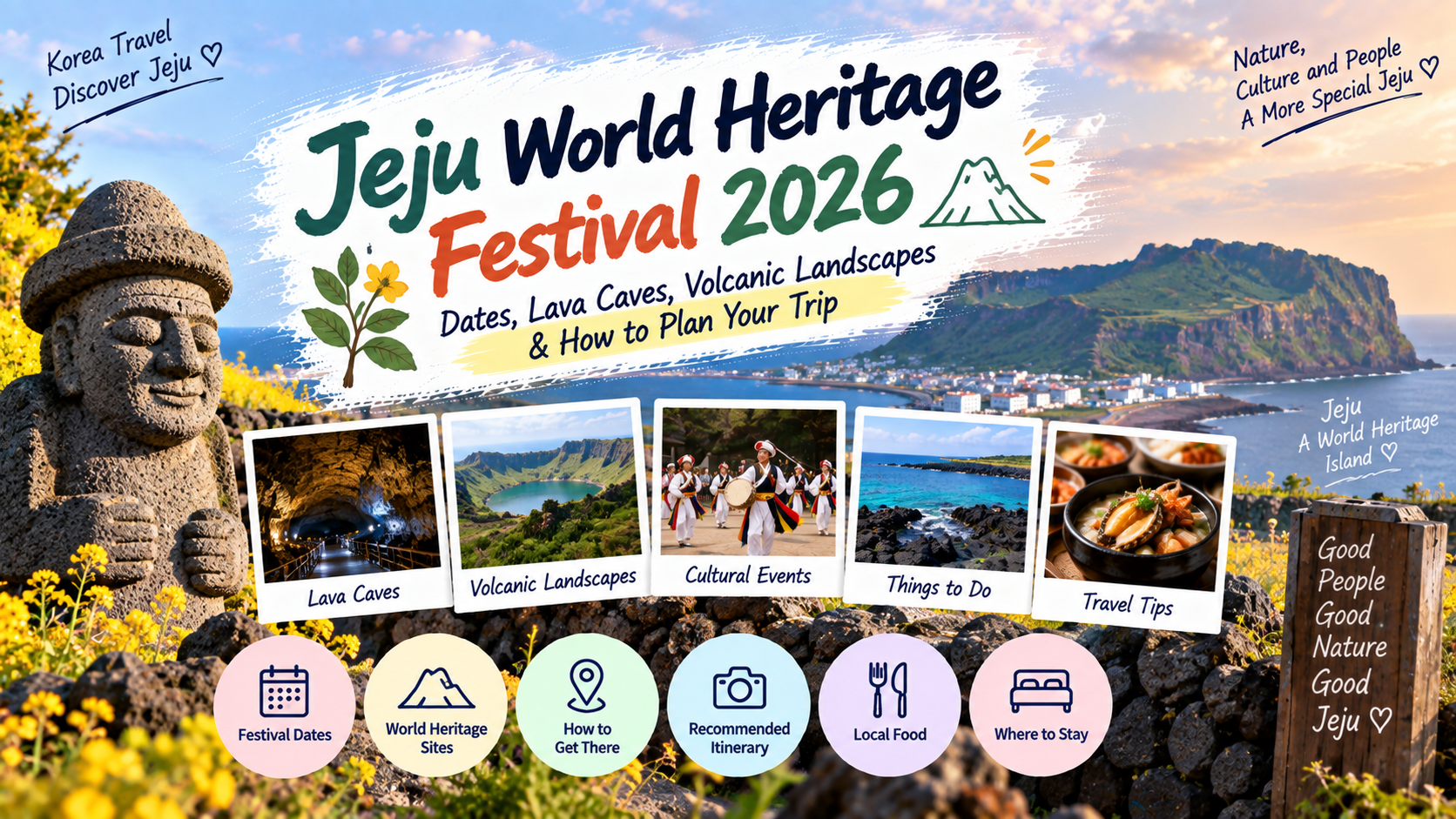
  • Jeju World Heritage Festival 2026: Dates, Lava Caves, Volcanic Landscapes & How to Plan Your Trip

    Jeju World Heritage Festival 2026: Dates, Lava Caves, Volcanic Landscapes & How to Plan Your Trip

    Jeju is famous for beaches, waterfalls and cafés, but some of the island’s most important landscapes exist for a much bigger reason.

    Jeju Volcanic Island and Lava Tubes is a UNESCO World Heritage property, created by the volcanic processes that shaped the island itself.

    And from October 3 to October 18, 2026, Jeju is putting that heritage at the center of a major autumn event: the 2026 World Heritage Festival – Jeju Volcanic Island and Lava Caves.

    The official Visit Jeju tourism portal currently lists the festival for October 3–18 as one of the island’s major October events.

    For international travelers, this is interesting because it offers a way to understand Jeju beyond its Instagram scenery.

    You are not simply looking at a mountain or a cave.

    You are looking at the geological story that created the island.

    Jeju World Heritage Festival 2026 at a Glance

    Dates: October 3–18, 2026

    Destination: Jeju Island

    Theme: Jeju’s volcanic World Heritage landscapes and their inheritance

    Best for: Nature lovers, hikers, geology fans, photographers, repeat Jeju visitors and travelers who want more than cafés and beaches

    The exact individual program schedule should be checked close to your visit because heritage walks, performances and special access programs may have different dates and reservation conditions.

    Visit Jeju specifically notes that festival schedules can change and recommends checking its current Festivals & Events listings before visiting.

    Why Is Jeju a UNESCO World Heritage Site?

    Jeju is a volcanic island.

    That sounds obvious until you start noticing how much of the landscape was actually created by volcanic activity.

    Oreums — the small volcanic cones scattered around the island — appear everywhere.

    Dark volcanic stone walls divide fields.

    Lava formed underground cave systems.

    Hallasan rises from the center of the island.

    And Seongsan Ilchulbong stands dramatically on the eastern coast.

    The UNESCO designation brings several of these geological elements together as one connected natural story.

    That is why a World Heritage Festival makes more sense here than a conventional festival stage with food stalls and music.

    The landscape itself is the main attraction.

    Seongsan Ilchulbong

    For most first-time international visitors, Seongsan Ilchulbong is the easiest World Heritage landscape to add to a normal Jeju itinerary.

    Korean:

    성산일출봉

    The volcanic tuff cone rises directly beside the sea in eastern Jeju.

    It is particularly famous for sunrise, which explains the English nickname “Sunrise Peak.”

    But you don’t have to arrive before dawn.

    If you’re not a morning person, visit during normal daylight and combine it with other eastern Jeju attractions.

    The important thing is to understand what you’re looking at rather than simply climbing for a photograph.

    Hallasan

    Hallasan dominates the center of Jeju.

    Korean:

    한라산

    It is South Korea’s highest mountain and one of the defining features of the island.

    A serious Hallasan hike is not something to casually insert between a café and a museum.

    Routes take time.

    Weather changes.

    And depending on the route and current management rules, reservation or access conditions can apply.

    Check the current official mountain information before hiking rather than relying on an old travel blog.

    If hiking Hallasan is a priority, build the entire day around it.

    Jeju’s Lava-Tube Landscape

    The lava-tube system is another essential part of Jeju’s World Heritage story.

    However, this is an area where travelers should be particularly careful with old information.

    Individual caves or sections can close for conservation, safety, restoration or research.

    Never assume that a cave mentioned in a five-year-old itinerary is currently open to ordinary visitors.

    The World Heritage Festival may also provide special interpretation or programs that are not available during a normal visit.

    Check the official festival and heritage-site notices for your exact dates.

    Don’t Try to See Every Heritage Site in One Day

    Jeju looks small on a map.

    That creates bad itineraries.

    A visitor sees:

    Hallasan,

    Seongsan Ilchulbong,

    a lava cave,

    a waterfall,

    a beach,

    and a café

    and thinks they can simply connect the dots.

    In reality, driving time adds up quickly.

    For a three-day trip, divide Jeju geographically.

    A Better 3-Day World Heritage Itinerary

    Day 1 — Eastern Jeju

    Start with Seongsan Ilchulbong.

    Have lunch in the eastern part of the island.

    Add one nearby attraction rather than driving across Jeju.

    If a World Heritage Festival program is operating nearby, make that your afternoon activity.

    Day 2 — Hallasan or Mid-Mountain Jeju

    Choose a hiking day if conditions are suitable.

    If you don’t want a major hike, explore one or two easier volcanic or forest landscapes instead.

    Do not schedule an important evening reservation after an exhausting mountain day.

    Day 3 — Flexible Jeju

    Use your final day for whichever part of the island you have not explored.

    This also protects the itinerary against bad weather.

    If Day 2 is rainy, swap it with Day 3.

    How to Get to Jeju from Seoul

    For most international travelers, the practical route is a domestic flight.

    Flights operate between the Seoul area and Jeju International Airport.

    There is no KTX train to Jeju.

    Once on the island, transportation becomes the bigger planning question.

    A rental car gives you the most flexibility for rural heritage locations.

    If you don’t drive, buses and taxis can work, but you need to plan routes more carefully.

    Before committing to an itinerary, enter each destination into Naver Map and check the actual travel time.

    Should You Rent a Car?

    For a heritage-focused itinerary, I would strongly consider it if you are comfortable driving in Korea.

    The main advantage is not speed.

    It is flexibility.

    If rain moves in over one side of the island, you can change plans.

    If you find an interesting coastal road, you can stop.

    If a heritage program finishes later than expected, you aren’t immediately worried about a complicated bus connection.

    That said, don’t rent a car simply because every Jeju blog says you must.

    If you plan to stay mainly around Jeju City or one concentrated area, public transportation and taxis may be enough.

    October Weather and What to Wear

    October is one of the most attractive times for outdoor Jeju travel, but the island is exposed to wind and weather can vary.

    Bring layers.

    For heritage walks or volcanic landscapes:

    wear proper walking shoes,

    carry water,

    bring a light outer layer,

    and check weather conditions before leaving.

    Conditions on Hallasan can be very different from the coast.

    Combine the Festival With Jeju’s Other October Events

    October 2026 is unusually busy on Jeju.

    Visit Jeju currently lists the 65th Tamna Cultural Festival for October 17–21 and the 32nd Seogwipo Chilsimni Festival for October 23–25, in addition to the World Heritage Festival.

    That creates a useful progression:

    Oct 3–18: World Heritage Festival
    Oct 17–21: Tamna Cultural Festival
    Oct 23–25: Seogwipo Chilsimni Festival

    If your trip falls in the second half of October, you may be able to combine natural heritage with traditional culture.

    Useful Korean Search Terms

    세계유산축전 제주 — Jeju World Heritage Festival

    제주 화산섬과 용암동굴 — Jeju Volcanic Island and Lava Tubes

    성산일출봉 — Seongsan Ilchulbong

    한라산 — Hallasan

    제주 10월 축제 — Jeju October festivals

    제주 가볼만한 곳 — things to do in Jeju

    Is It Worth Planning a Trip Around?

    If you’re already interested in Jeju’s landscapes, yes.

    But I wouldn’t think of this as a festival where you arrive at one gate and spend the entire day inside.

    The more interesting approach is to let the festival change how you see Jeju.

    A volcanic cone becomes more than a photo spot.

    A stone wall becomes evidence of the island’s geology.

    A mountain becomes part of the same volcanic system that created caves beneath the ground.

    That’s the real reason to visit.

    Jeju is beautiful even if you know nothing about geology.

    Understanding how the island was created makes it considerably more interesting.

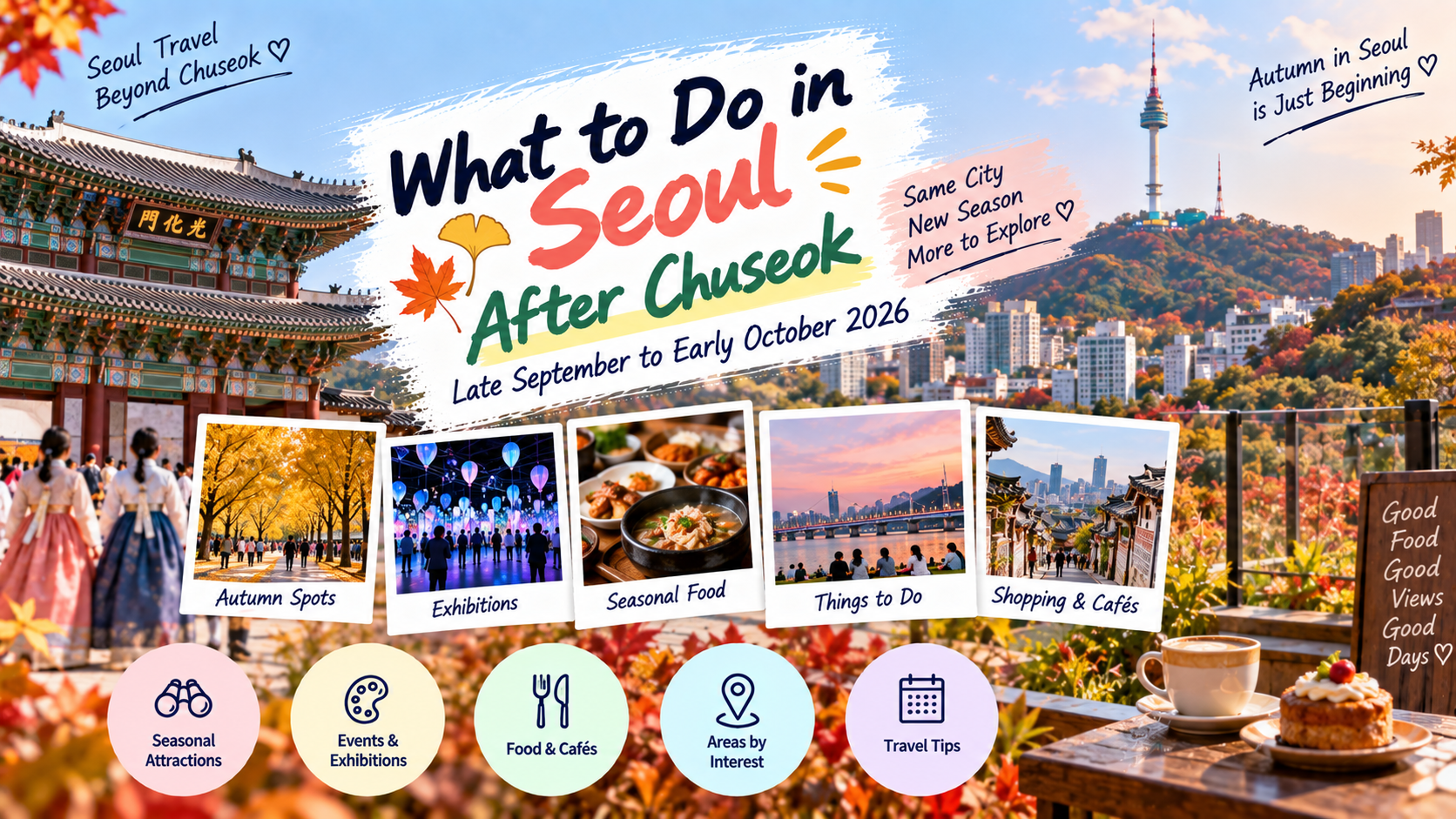
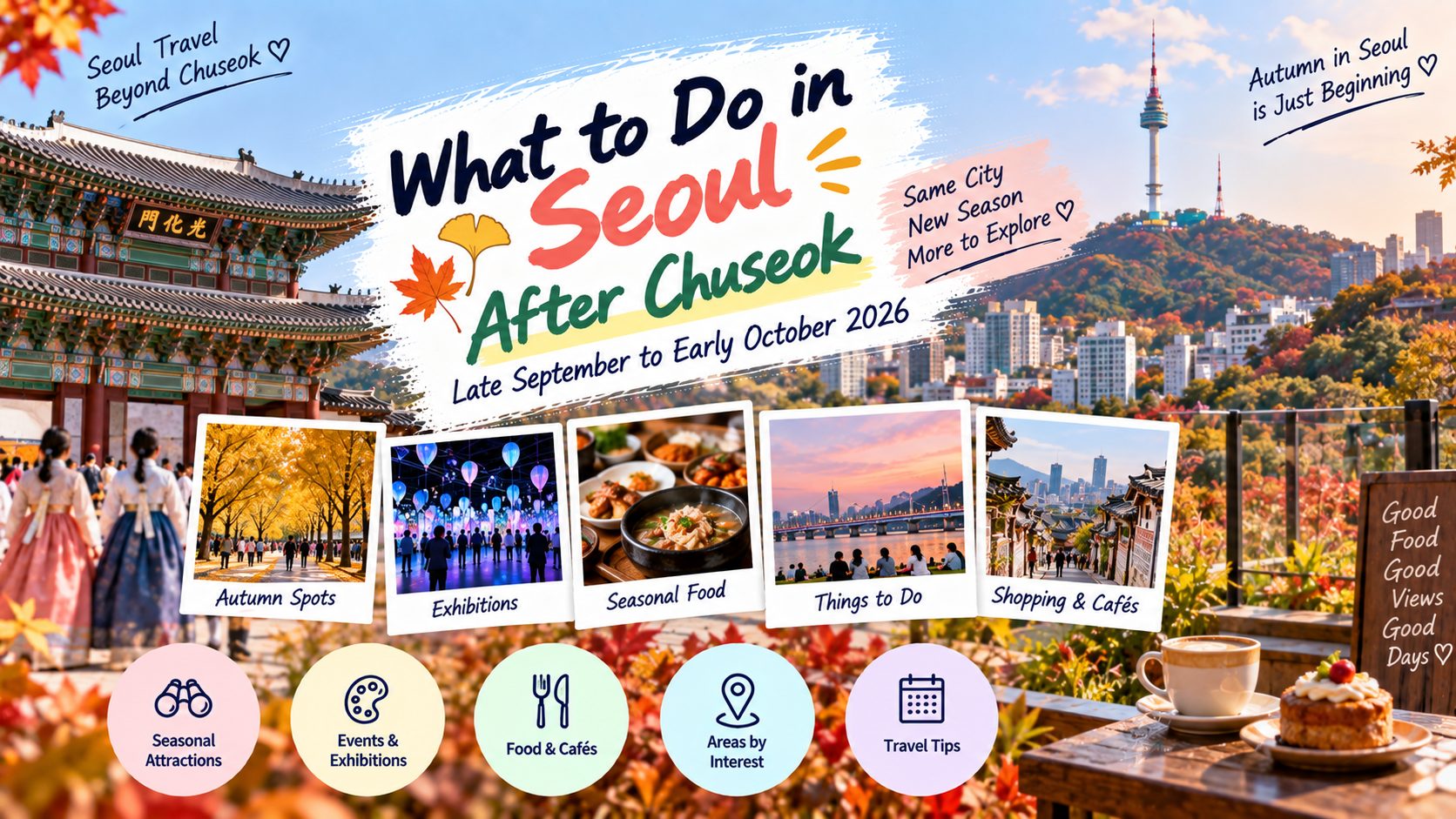
  • What to Do in Seoul After Chuseok 2026: Events, Han River Nights & Early October Travel Guide

    What to Do in Seoul After Chuseok 2026: Events, Han River Nights & Early October Travel Guide

    If you’re arriving in Seoul just after Chuseok 2026, you may actually have picked one of the most convenient times to visit the city.

    Chuseok falls on September 25, 2026, and the holiday period around it can temporarily affect restaurant hours, domestic transportation and some independent businesses.

    But once the main holiday period ends, Seoul does not suddenly become quiet.

    Quite the opposite.

    Several autumn events continue into October, the Han River becomes much more comfortable in the cooler weather, temporary visitor programs remain active, and many businesses return to their normal schedules.

    For travelers arriving around September 28 through early October, the question is no longer:

    “What is open during Chuseok?”

    It becomes:

    “What should I do in Seoul now that Chuseok is over?”

    Here is how I would plan that trip.

    Is Seoul Back to Normal After Chuseok?

    Mostly, yes — but don’t assume every independent business follows exactly the same schedule.

    During Chuseok, many Koreans travel to visit family, which can make intercity transportation unusually busy. Some small restaurants, cafés and shops also close or shorten their hours.

    After the main holiday period, transportation and commercial activity gradually return to their normal patterns.

    That makes the days immediately after Chuseok easier for international travelers who want to combine sightseeing, shopping, cafés and restaurants without organizing the entire itinerary around holiday closures.

    Still, if there is one specific restaurant or shop you are traveling across Seoul to visit, check its latest notice first.

    Useful Korean search terms are:

    추석 휴무 — Chuseok closure

    정상 영업 — normal opening hours

    영업시간 — opening hours

    임시 휴무 — temporary closure

    Naver Map is particularly useful for checking recent Korean-language notices.

    1. Spend an Afternoon at the Han River

    Late September and early October are some of the easiest times of year to actually enjoy the Han River.

    In midsummer, a riverside afternoon can be hot and humid.

    By early autumn, the river becomes much easier to build into a normal sightseeing day.

    You don’t need an elaborate plan.

    Pick a Hangang park, arrive in the late afternoon, walk, get something to eat and stay through sunset.

    If your dates still fall in September, Korea Inside Out’s What’s On Along the Han River This September is a useful starting point because it brings several temporary river programs together instead of treating each one as an isolated attraction.

    The important idea is this:

    Don’t think of the Han River as something you have to “see.” Think of it as somewhere to spend time.

    That’s when it starts to make sense.

    2. Go to Jamsugyo on a Sunday

    One of Korea Inside Out’s strongest current Seoul searches is the Car-Free Jamsugyo Bridge Festival, and the useful thing for post-Chuseok travelers is that the autumn season continues into October.

    On festival Sundays, Jamsugyo becomes a pedestrian-oriented space beside Banpo Hangang Park, with changing seasonal programs.

    That gives visitors a very different experience from simply photographing Banpo Bridge from the riverbank.

    You can read the full practical guide in Jamsugyo Bridge Festival: Seoul’s Car-Free Sunday by the Han River.

    Because individual Sunday themes and operating details can vary, check the latest city information before making a special trip.

    If your Seoul dates include a Sunday, however, I would seriously consider keeping that afternoon or evening open for Banpo.

    3. Arrive Before Sunset, Not After Dark

    This applies to almost every Han River itinerary.

    Many travelers think:

    “Banpo is a night-view attraction, so I’ll go after dinner.”

    You can.

    But you miss half the experience.

    Arrive before sunset and you get:

    daylight on the river,

    the transition into evening,

    people picnicking,

    the skyline changing,

    and finally the bridge and city lights after dark.

    That progression is much more memorable than arriving at 9 PM, taking three photographs and leaving.

    A simple itinerary could be:

    4:30 PM — arrive around Banpo

    5:00 PM — walk along the river

    6:00 PM — food or picnic

    sunset — stay by the river

    evening — Jamsugyo/Banpo atmosphere

    Then head back to your hotel without adding another major neighborhood.

    4. Seoul Welcome Week Continues Beyond Chuseok

    Another reason late September and early October work well is Seoul Welcome Week: Autumn Edition.

    The 2026 autumn program runs from September 19 through October 11, so it does not end when Chuseok ends.

    The program was designed for the autumn peak travel period and international visitors, with visitor services and K-culture experiences connected with major tourism areas.

    Check the official Visit Seoul website during your trip for current programs and other events happening on your exact dates.

    This is particularly useful because small exhibitions and temporary programs often change faster than general travel guides can keep up.

    If you’re staying around Myeongdong, it is especially easy to see what is happening without reorganizing your entire itinerary around one event.

    5. Use the Week After Chuseok for a Classic Palace Day

    Not every day needs to chase a temporary festival.

    If this is your first Seoul trip, the historic center still deserves a full day.

    A very practical route is:

    Gyeongbokgung → Bukchon → Insadong → Ikseon-dong

    These places fit together geographically.

    That matters.

    One of the most common first-time Seoul mistakes is creating an itinerary from a list of famous attractions without looking at where they actually are.

    For example:

    Gyeongbokgung
    → Gangnam
    → Hongdae
    → Jamsil

    may technically be possible.

    It is not a pleasant sightseeing day.

    Keep neighborhoods together.

    6. Gyeongbokgung Is Easier When the Weather Cools

    Gyeongbokgung Palace involves more walking than many visitors expect.

    There are large open courtyards and multiple areas to explore.

    That can be tiring during Korea’s hottest summer weather.

    Late September and early October are generally much more comfortable for this kind of outdoor sightseeing.

    If you want to rent hanbok, add extra time.

    The process includes:

    choosing an outfit,

    changing,

    hair styling if you want it,

    walking to the palace,

    taking photographs,

    and returning the clothes.

    A “quick palace visit” can easily turn into half a day.

    That’s perfectly fine.

    Just don’t schedule five other neighborhoods afterward.

    7. Continue to Bukchon — But Remember People Live There

    Bukchon Hanok Village is beautiful, but it is not a theme park.

    It is also a residential neighborhood.

    Walk quietly, respect signs and restrictions, and avoid blocking entrances for photographs.

    This matters especially when visitor numbers are high.

    The attraction is not one single “photo spot.”

    It is the experience of walking through an older part of Seoul where traditional architecture remains woven into the modern city.

    8. Finish the Day Around Insadong or Ikseon-dong

    After Gyeongbokgung and Bukchon, don’t automatically jump on the subway for another distant neighborhood.

    Stay nearby.

    Insadong is useful for traditional crafts, tea and souvenirs.

    Ikseon-dong has a very different feel: narrow alleys, cafés, restaurants and renovated hanok spaces.

    It can become crowded, especially in the evening, but it works naturally as the final part of a Jongno day.

    This is a much more efficient itinerary than crossing Seoul again just because a restaurant went viral on social media.

    9. Spend Another Half-Day in Seongsu

    If the palace district represents historical Seoul, Seongsu represents a very different side of the city.

    The neighborhood has become known for:

    cafés,

    fashion,

    design,

    brand pop-ups,

    and constantly changing commercial spaces.

    The word “constantly” matters.

    A pop-up mentioned in an old travel article may already be gone.

    For current information, try Korean searches such as:

    성수 팝업 — Seongsu pop-up

    성수 카페 — Seongsu café

    성수 가볼만한 곳 — things to do in Seongsu

    Search close to your actual travel date rather than building the entire day around something you saw months earlier.

    10. Combine Seongsu With Seoul Forest

    Seongsu and Seoul Forest are an easy combination.

    You could do:

    Morning

    Slow breakfast or café.

    Late morning

    Browse Seongsu shops and pop-ups.

    Lunch

    Stay in the neighborhood.

    Afternoon

    Walk through Seoul Forest.

    Late afternoon

    Continue toward the river or stay in Seongsu.

    Evening

    Dinner nearby.

    This kind of day works particularly well after several days of intensive sightseeing.

    You are still exploring Seoul, but you are not racing between landmarks.

    11. Is Late September Already Peak Fall Foliage?

    Usually, you should not assume so.

    This distinction is important for international travelers.

    Autumn weather is not the same thing as peak autumn foliage.

    Late September and early October can feel much more autumnal than August, but central Seoul may not yet have the dramatic red-and-gold foliage you see in promotional photographs.

    Foliage timing changes with weather and location.

    If colorful leaves are the main reason for your trip, check current official foliage information closer to your dates.

    Don’t choose a hotel or book a flight solely because an old article says “October = peak fall.”

    Korea’s autumn colors develop progressively.

    12. But Early Autumn Is Still Great for Walking

    You don’t need peak foliage to enjoy Seoul in autumn.

    This period works because you can spend more time outside.

    A walking-oriented day might include:

    Cheonggyecheon,

    Deoksugung,

    Jeongdong-gil,

    Gwanghwamun,

    Seoul Forest,

    or the Han River.

    The city starts to feel different when you stop using the subway for every two-stop journey.

    13. Shop After the Holiday Rush

    If shopping is important to your trip, the post-Chuseok period can be more straightforward than the holiday itself because businesses return toward their regular schedules.

    Different neighborhoods serve different purposes.

    Myeongdong

    Best for an easy first-time mix of cosmetics, tourist-friendly shopping and food.

    Hongdae

    Fashion, youth culture, restaurants and nightlife.

    Seongsu

    Pop-ups, design and trend-focused shopping.

    Gangnam

    Department stores, beauty and modern commercial Seoul.

    Jamsil

    Large-scale shopping and attractions around Lotte World Mall.

    You do not need to visit all five.

    Choose one or two based on what you actually want to buy.

    14. Myeongdong Is Still Useful for First-Time Visitors

    Myeongdong is sometimes dismissed as “too touristy.”

    It is touristy.

    That’s also why it is convenient.

    For a first Korea trip, the concentration of:

    cosmetics,

    restaurants,

    shops,

    currency exchange,

    hotels,

    and visitor services

    can be extremely useful.

    If you’re staying nearby, use that convenience rather than spending an hour traveling somewhere else for every meal.

    15. Hongdae Works Better Later in the Day

    Hongdae doesn’t need to be an early-morning destination.

    For most travelers, afternoon into evening makes more sense.

    You can combine:

    shopping,

    cafés,

    Yeonnam-dong,

    dinner,

    and nightlife

    without rushing.

    If you’re staying around Hongdae, it also has the advantage of direct AREX access to Incheon Airport via the all-stop train.

    That makes it a particularly practical neighborhood at the beginning or end of a Korea trip.

    16. Take a Slow Day After Chuseok

    This is especially useful if you’ve already spent several days in Korea.

    Not every day needs:

    20,000 steps,

    three subway transfers,

    two palaces,

    a market,

    a tower,

    and a night view.

    A slow Seoul day can be:

    late breakfast,

    one neighborhood,

    one café,

    a park,

    dinner,

    and the Han River.

    You’ll probably remember more of it.

    17. What About Day Trips?

    Once the Chuseok transportation rush settles, day trips become easier to consider again.

    Options from Seoul include places such as:

    Suwon,

    Incheon,

    and parts of Gyeonggi-do.

    But ask yourself whether you actually need one.

    If you only have three days in Seoul, you don’t need to leave the city just because a “best Korea itinerary” says you should.

    If you have five to seven days, a day trip becomes much more reasonable.

    18. Suwon for History Without Going Too Far

    Suwon can work well if you want a historical destination outside Seoul without committing to a long-distance trip.

    Hwaseong Fortress is the main draw.

    The trip is manageable from Seoul and gives you a different urban atmosphere from the capital.

    Still, allow most of a day.

    A “half-day trip” often becomes a full day once you include hotel-to-station travel, waiting and meals.

    19. Incheon for a Different Urban Day

    Many travelers only associate Incheon with the airport.

    But the city itself can work as a day trip depending on your interests.

    The important thing is not to confuse:

    Incheon International Airport

    with

    Incheon sightseeing areas.

    They are not the same destination.

    Check your exact route before deciding something is “near the airport.”

    20. What If It Rains?

    Early autumn is not guaranteed sunshine.

    Keep at least one flexible indoor day.

    Possible choices include:

    museums,

    shopping malls,

    large cafés,

    indoor exhibitions,

    and attractions around Jamsil or central Seoul.

    Don’t force an outdoor Han River evening during heavy rain simply because your itinerary says Tuesday is “Han River Day.”

    Move things around.

    Flexibility is one of the biggest advantages of staying several nights in one city.

    21. What to Wear in Seoul After Chuseok

    Layers are useful.

    Daytime can still feel mild or warm, while evenings may feel cooler — particularly beside the river.

    Comfortable shoes matter much more than travelers sometimes expect.

    Seoul trips involve a lot of walking even when you use the subway.

    Also remember that subway stations themselves can involve long underground transfers.

    “Ten minutes by subway” does not necessarily mean “ten minutes door to door.”

    22. Use Naver Map for Actual Navigation

    Google Maps is useful for saving places before your trip.

    For day-to-day transportation in Korea, I recommend also having Naver Map available.

    It is particularly useful for:

    subway routes,

    bus routes,

    walking directions,

    station exits,

    and Korean place names.

    If you’re new to Korean travel apps, Korea Inside Out’s guide to the best apps for traveling in Seoul explains the practical differences.

    23. Useful Korean Search Terms

    Save these:

    서울 가볼만한 곳 — things to do in Seoul

    서울 이번 주말 행사 — Seoul events this weekend

    한강공원 — Hangang Park

    잠수교 — Jamsugyo

    성수 팝업 — Seongsu pop-ups

    서울숲 — Seoul Forest

    추석 휴무 — Chuseok closure

    정상 영업 — normal opening

    서울 10월 축제 — Seoul October festivals

    These are particularly useful when you want information that has appeared too recently to be well covered in English.

    A 4-Day Post-Chuseok Seoul Itinerary

    If you have four full days, this is how I would structure them.

    Day 1 — Historic Seoul

    Gyeongbokgung
    Bukchon
    Insadong
    Ikseon-dong

    Keep the whole day around Jongno.

    Day 2 — Contemporary Seoul

    Seongsu
    Seoul Forest
    café or shopping
    relaxed dinner

    Day 3 — Shopping + Han River

    Myeongdong or Hongdae
    rest at hotel
    Banpo Hangang Park before sunset
    Jamsugyo if your date matches a festival Sunday

    Day 4 — Choose Your Interest

    Either:

    Gangnam/Jamsil,

    a museum day,

    a day trip,

    or simply return to the neighborhood you liked most.

    This final flexible day is important.

    Trips are often better when you have time to revisit somewhere rather than constantly seeing new places.

    If You Only Have 2 Days

    Don’t try to copy the four-day itinerary.

    Do this instead.

    Day 1

    Gyeongbokgung
    Bukchon
    Insadong
    Myeongdong

    Day 2

    Seongsu
    Seoul Forest
    Han River

    That’s enough.

    You will not “finish” Seoul in two days.

    You don’t need to.

    If You Have 5–7 Days

    Then start adding:

    Hongdae,

    Gangnam,

    Jamsil,

    a day trip,

    museums,

    markets,

    and slower neighborhood exploration.

    This is where Korea Inside Out’s broader planning guides become useful.

    If you’re still deciding the length of your stay, see How Many Days Do You Need in Seoul?.

    Should You Visit Seoul Immediately After Chuseok?

    Yes.

    There is no reason to avoid Seoul simply because your trip begins just after Korea’s major autumn holiday.

    In some ways, the timing is easier.

    You can still catch the autumn atmosphere and ongoing seasonal programming while many businesses return to normal operations.

    The biggest mistake would be treating “after Chuseok” as a dead period between the holiday and peak fall foliage.

    It isn’t.

    Final Thoughts

    Late September and early October are a transition period in Seoul.

    Chuseok is ending.

    The weather is changing.

    Autumn events are continuing.

    The Han River becomes easier to enjoy.

    Neighborhood walking becomes more pleasant.

    And the city gradually moves toward the foliage season that will come later.

    That transition is exactly what makes the period interesting.

    Don’t spend the entire trip chasing whichever temporary event appears first in Google.

  • Busan in October 2026: Festivals, Events & What to Book Before You Go

    Busan in October 2026: Festivals, Events & What to Book Before You Go

    October is one of the easiest months to recommend for a trip to Busan.

    The intense summer heat is fading, evenings are more comfortable for walking along the coast, and the city’s autumn cultural calendar is packed with events.

    For travelers visiting in October 2026, that means you can build a trip around live music, performing arts, film culture, night markets and Busan’s famous beaches — without making the entire itinerary dependent on one festival.

    The trick is knowing which events are worth planning around, which experiences can stay flexible, and how much time you actually need in a city that is much larger than many first-time visitors expect.

    Before your trip, check the official Visit Busan events calendar for last-minute additions and schedule changes.

    Why Visit Busan in October?

    Busan in October works particularly well for travelers who want to spend a lot of time outdoors.

    Summer in Korea can be hot and humid. By October, walking-heavy itineraries generally become much easier.

    That matters in Busan because many of the city’s best experiences involve being outside:

    Gwangalli Beach at night,

    Haeundae and Dongbaekseom,

    coastal walks,

    Gamcheon Culture Village,

    traditional markets,

    and neighborhoods that are more enjoyable when you can simply wander.

    October is also one of Busan’s strongest cultural months.

    Busan International Rock Festival — October 2–4

    One of the biggest early-October events is the Busan International Rock Festival, scheduled for October 2–4, 2026.

    If live music is one of the reasons you’re coming to Busan, treat the festival as the main event of the day rather than trying to squeeze it between five tourist attractions.

    A better festival day looks like this:

    slow breakfast,

    one nearby attraction,

    early lunch,

    festival,

    late dinner if you still have energy.

    Trying to visit Gamcheon, Jagalchi, Haeundae and Gwangalli before a full music festival is a good way to spend most of your day in transit.

    Always confirm the latest lineup, ticket conditions and venue information through official festival channels shortly before your visit.

    BPAM — Busan International Performing Arts Market

    The Busan International Performing Arts Market, or BPAM, also takes place in early October.

    Despite the word “market,” this is not a food market or shopping event.

    It is connected to performing arts and brings together performances and arts-industry programs.

    For international visitors interested in Korean culture beyond K-pop, palaces and food, October can therefore be a good time to encounter contemporary theater, dance and other performing arts in Busan.

    Check individual performances before planning around them because accessibility for non-Korean speakers will vary.

    Visual performance and dance may be easier to enjoy without Korean than dialogue-heavy theater.

    Busan’s Film Culture

    Busan and cinema are closely connected.

    Even outside a specific screening, the Busan Cinema Center is an important part of the city’s contemporary cultural identity.

    In Korean, search:

    영화의전당

    If film is one of the main reasons for your October trip, choose your accommodation after checking where your actual screenings and events are located.

    Busan is not compact enough to assume that any hotel described as “central” will be convenient for every venue.

    Starry Sea Busan Night Market — Until October 18

    Another useful October option is the Starry Sea Busan Night Market, which runs from September 26 through October 18, 2026.

    It takes place at Hwamyeong Ecological Park and combines Korean traditional alcohol, food, picnic areas and hands-on activities.

    The market gives you a very different Busan evening from Gwangalli or Haeundae.

    Instead of ocean views and dense tourist neighborhoods, the setting is around the Nakdong River and ecological park area.

    If you’re staying in Busan for three or more nights, this is exactly the type of experience that can make the trip feel less repetitive.

    See the latest details through Visit Busan’s official event information.

    Gwangalli Is Still Worth a Night Without a Festival

    Not every evening needs a ticketed event.

    Gwangalli is one of the simplest places to spend an autumn evening.

    Arrive before sunset.

    Find a café.

    Walk along the beach.

    Have dinner.

    Then return to the waterfront after dark to see Gwangan Bridge illuminated across the water.

    This is a good reminder when planning an event-heavy trip: temporary festivals should improve your itinerary, not take it over completely.

    Haeundae After Summer

    Haeundae has a different atmosphere once the peak summer beach season is over.

    You can still enjoy the waterfront, but October is better suited to walking and exploring nearby areas rather than treating the beach purely as a swimming destination.

    A Haeundae day can include:

    Haeundae Beach,

    Dongbaekseom,

    The Bay 101 area,

    Cheongsapo,

    or coastal areas toward Songjeong.

    Don’t automatically combine all of them.

    Choose based on the weather and how much walking you actually want to do.

    Gamcheon and Nampo-dong

    For first-time visitors, the older downtown side of Busan is still worth a day.

    You can combine:

    Gamcheon Culture Village

    with

    Jagalchi Market

    and

    Nampo-dong / BIFF Square

    much more naturally than trying to add Haeundae in the middle of the same route.

    This is one of the most useful Busan planning principles:

    group attractions geographically.

    A map may make Busan look manageable.

    Repeatedly crossing the city makes it feel much bigger.

    How Many Days Do You Need in Busan?

    For a first trip, I would recommend at least two nights.

    Three nights is better if you’re attending an October event.

    2 Nights

    Day 1: Arrive → Gwangalli

    Day 2: Haeundae or Nampo/Gamcheon

    Day 3: Morning sightseeing → departure

    3 Nights

    Day 1: Arrival + Gwangalli

    Day 2: Major festival or event

    Day 3: Classic Busan sightseeing

    Day 4: Relaxed breakfast → departure

    That extra night prevents the trip from becoming a race.

    Where to Stay in Busan

    Your best neighborhood depends on the itinerary.

    Haeundae

    Choose Haeundae if beaches, coastal attractions and eastern Busan are the priority.

    Gwangalli

    Good for travelers who want cafés, restaurants and one of Korea’s best urban night views.

    Seomyeon

    A practical urban base with useful transportation connections.

    Nampo

    Good for Jagalchi, BIFF Square and the older downtown area.

    Do not choose a hotel simply because an online list says it is in the “best area.”

    Choose the area that reduces your travel time.

    How to Get to Busan from Seoul

    For many international travelers, the KTX from Seoul Station to Busan Station is the easiest option.

    The train makes a Seoul + Busan itinerary very practical.

    But book earlier around:

    weekends,

    major festivals,

    and Korean public holidays.

    Also remember that arriving at Busan Station does not mean you’ve arrived at Haeundae.

    Busan Station is in the older central part of the city, while many famous beach attractions are farther east.

    Allow for the final local journey.

    Should You Fly Instead?

    Sometimes.

    A domestic flight can make sense depending on your itinerary.

    If you’re coming from Jeju, for example, flying to Gimhae International Airport is much more logical than returning to Seoul first.

    If you’re already in central Seoul, however, KTX can be extremely convenient because you avoid airport check-in and airport transfers.

    Compare the door-to-door time, not just the advertised flight time.

    Sample 3-Day October Itinerary

    Day 1 — Gwangalli

    Arrive in Busan.

    Check in.

    Head to Gwangalli in the afternoon.

    Walk the beach.

    Have dinner nearby.

    Stay for the bridge lights.

    Day 2 — Event Day

    Keep the morning intentionally light.

    Visit one attraction close to your event venue.

    Eat early.

    Attend the festival, performance or screening.

    Leave the rest of the evening flexible.

    Day 3 — Choose One Side of Busan

    Option A:

    Gamcheon Culture Village
    Jagalchi
    Nampo-dong

    Option B:

    Haeundae
    Dongbaekseom
    Cheongsapo or another eastern coastal area

    Both are good.

    Doing both in a rushed half-day is not.

    What Is Busan Weather Like in October?

    October is generally a transitional autumn month.

    Daytime can still feel pleasantly mild, while evenings near the sea may feel cooler.

    Bring layers.

    A light jacket is useful after sunset, particularly around Gwangalli and Haeundae.

    Comfortable shoes matter more than you might expect.

    Busan includes hills, large subway stations and coastal walking routes.

    Rainy-Day Backup Plans

    Do not assume every October day will be clear.

    Useful indoor or mixed-weather options include:

    museums,

    shopping complexes,

    cafés,

    Busan Cinema Center programming,

    and indoor attractions around major commercial districts.

    Build one or two alternatives into your itinerary instead of forcing a coastal walk during bad weather.

    What Should You Book First?

    If you’re traveling for a major October event, use this order:

    1. Seoul–Busan transportation

    2. Hotel

    3. Festival/event tickets

    4. Special experiences

    5. Restaurants

    Why transportation first?

    Because a perfect concert ticket is much less useful if your preferred KTX is sold out.

    Don’t Trust Last Year’s Event Article

    This is especially important in October.

    A 2025 festival article can still appear high in Google.

    Always check the year.

    Verify:

    dates,

    venue,

    ticket conditions,

    opening hours,

    transportation notices,

    and weather-related changes

    against the official 2026 information.

    Korean Search Terms

    부산 10월 축제 — Busan October festivals

    부산국제록페스티벌 — Busan International Rock Festival

    부산 공연 — Busan performances

    영화의전당 — Busan Cinema Center

    광안리 — Gwangalli

    해운대 — Haeundae

    부산 야시장 — Busan night market

    부산 가볼만한 곳 — things to do in Busan

    Is October Better Than Summer?

    It depends on why you’re visiting.

    If you want peak beach season and swimming, summer has obvious advantages.

    But if you care more about:

    walking,

    festivals,

    food,

    neighborhoods,

    cafés,

    coastal views,

    and evenings outside,

    October can be easier and more enjoyable.

    Final Thoughts

    Busan deserves more than being treated as “the second city after Seoul.”

    October makes that especially obvious.

    You can watch live music, explore contemporary Korean performance, spend a night beside Gwangan Bridge, eat at a riverside night market and still have enough permanent attractions to fill several days.

    The best approach is not to schedule every festival you find.

    Choose one or two temporary experiences, then build the rest of your trip around Busan itself.

    That way, even if the weather changes or an event schedule shifts, the trip still works.

  • Starry Sea Busan Night Market 2026: Food, Makgeolli & Autumn Nights by the Nakdong River

    Starry Sea Busan Night Market 2026: Food, Makgeolli & Autumn Nights by the Nakdong River

    Busan is famous for beaches, seafood, and dramatic coastal views, but one of the city’s most interesting autumn experiences in 2026 is happening away from the ocean.

    From September 26 to October 18, 2026, the Starry Sea Busan Night Market returns for an autumn edition at Hwamyeong Ecological Park, beside the Nakdong River.

    This is not just a conventional food market.

    The program combines Korean traditional alcohol, food trucks, outdoor dining, picnic spaces, hands-on activities, and a relaxed riverside setting. For international travelers who have already visited Gwangalli and Haeundae, it is also a good excuse to see a very different side of Busan.

    The official Visit Busan event listing provides the latest schedule and program information.

    Starry Sea Busan Night Market 2026 at a Glance

    Dates: September 26–October 18, 2026

    Location: Lotus Flower Garden, Hwamyeong Ecological Park

    Thursday–Saturday: 5:00 PM–10:00 PM

    Sunday: 4:00 PM–9:00 PM

    Korean name: 별바다부산 나이트마켓

    The location is near Hwamyeong Auto Camping Ground in northern Busan.

    That is important because this is not the same tourist zone as Gwangalli, Haeundae, Nampo-dong, or Jagalchi.

    You should plan it as a destination rather than expecting to stumble across it during a beach walk.

    Why This Night Market Is Different

    Night markets are not unusual in Korea.

    What makes this one interesting is the combination of food and Korean traditional drinks with a riverside outdoor atmosphere.

    The program is divided into several themed areas.

    Spirit Busan

    This section focuses on Korean traditional alcoholic drinks.

    If you’ve only tried soju during your Korea trip, this is an opportunity to explore drinks such as makgeolli and other regional or craft-style Korean alcohol.

    Makgeolli is a cloudy rice-based alcoholic drink traditionally served with foods such as jeon, or Korean savory pancakes.

    You don’t need to be an alcohol enthusiast to enjoy the market, but this section gives the event a more distinctive Korean identity than a generic collection of food trucks.

    Starlight Food Zone

    Food is one of the main reasons to come.

    The event includes outdoor food vendors and food trucks, with dishes designed to pair with the traditional drinks available at the market.

    I would not arrive after eating a full dinner.

    Instead, treat the market as dinner itself.

    Try several smaller dishes rather than ordering one large meal immediately.

    If you’re traveling with friends, sharing makes this much easier.

    Picnic and “Campnic” Areas

    One of the nicest parts of the concept is that the event is designed around spending time outdoors.

    Visit Busan describes picnic and “campnic” spaces where visitors can sit and enjoy the evening rather than simply buying food and leaving.

    That makes the market particularly attractive in late September and early October, when Busan evenings can be much more comfortable than the humid peak of summer.

    Arriving before sunset is a good idea.

    You can see the park in daylight, get food before the busiest evening period, and then stay as the atmosphere changes after dark.

    Hands-On Programs

    The market also includes activity programs rather than functioning only as a place to eat.

    Official information mentions programs such as:

    • traditional alcohol-making experiences,
    • children’s cooking activities,
    • running and yoga,
    • self-cooking areas,
    • and local market activities.

    Some programs may use advance reservations as well as on-site participation.

    If there is one specific activity you want to do, check the official schedule before traveling across Busan solely for it.

    Is This Good for Families?

    Yes, especially earlier in the evening.

    The outdoor setting, food, picnic spaces and children’s programs make it easier to visit with kids than a nightlife-focused market.

    Families may prefer Sunday, when the market begins at 4 PM rather than 5 PM.

    You can arrive in daylight, eat early and leave before it gets too late.

    How to Get There

    Search for:

    화명생태공원

    or

    별바다부산 나이트마켓

    in Naver Map.

    Hwamyeong is in northern Busan, so the travel time can be substantial if you are staying near Haeundae or Gwangalli.

    Check the route from your actual hotel rather than estimating based on “Busan” as a whole.

    Busan is much larger than many first-time visitors expect.

    Don’t Combine It With Too Much

    This is particularly important.

    If you’re spending the morning around Haeundae, then going to Gamcheon, then Nampo, then trying to reach Hwamyeong for the night market, you will spend a huge part of your day in transit.

    A better strategy is to combine destinations geographically.

    For example:

    Afternoon

    Explore northern or central Busan at a relaxed pace.

    4:30–5:00 PM

    Head toward Hwamyeong Ecological Park.

    Evening

    Night market dinner, drinks and picnic.

    After

    Return to your hotel rather than adding another major attraction.

    Korea trips become much better when you stop treating every day as a checklist.

    Can You Combine It With the Gwangalli Drone Show?

    On September 26, the opening night overlaps with the special Chuseok Gwangalli drone-and-laser show.

    I would choose one.

    The Gwangalli event has a single 8 PM show and is expected to attract significant crowds.

    Hwamyeong and Gwangalli are not next door to each other.

    Trying to eat quickly at the night market and then race across Busan for an 8 PM drone show is exactly the kind of itinerary that looks possible on paper and becomes stressful in real life.

    If you have two nights:

    September 26: Gwangalli
    September 27: Starry Sea Busan Night Market

    works much better.

    How to Get There from Seoul

    The fastest common public-transport option from Seoul is the KTX to Busan Station.

    However, late September 2026 overlaps with the Chuseok travel period.

    Intercity transportation can sell out during major Korean holidays.

    If you are traveling during the holiday period, secure your Seoul–Busan transportation before planning the rest of the itinerary.

    Once you arrive at Busan Station, the night market is still not immediately nearby.

    Allow additional local travel time to Hwamyeong.

    This is another reason to stay overnight rather than trying to make the market a Seoul day trip.

    Should You Visit Busan Just for This Market?

    Probably not.

    But if you’re already in Busan between September 26 and October 18, it is worth considering.

    The appeal is not that this is Korea’s biggest market.

    It isn’t.

    The appeal is the combination of Busan autumn weather + Nakdong River + Korean food + traditional drinks + a local evening atmosphere.

    That is very different from spending every night around Haeundae.

    What to Eat and Drink

    The exact vendor lineup can vary, so I wouldn’t build your visit around one specific dish.

    Instead, look for Korean foods that work well in an outdoor market environment.

    Jeon is particularly good with makgeolli.

    Grilled foods, Korean street snacks and smaller shared dishes are also easy choices.

    If you don’t drink alcohol, the market is still worth visiting.

    The food, picnic areas and activities are not dependent on drinking.

    What to Bring

    Bring:

    • a light jacket,
    • comfortable shoes,
    • a portable battery,
    • and a payment method plus some backup cash.

    Late September evenings can feel cooler beside the river.

    Also remember that outdoor event conditions can change with weather.

    Check the official listing on the day you visit.

    Useful Korean Search Terms

    별바다부산 나이트마켓 — Starry Sea Busan Night Market

    화명생태공원 — Hwamyeong Ecological Park

    전통주 — Korean traditional alcohol

    막걸리 — makgeolli

    부산 야시장 — Busan night market

    부산 가볼만한 곳 — things to do in Busan

    Is It Worth It for First-Time Busan Visitors?

    If you only have one night in Busan, I would still prioritize Gwangalli or another iconic coastal area.

    If you have two or three nights, the answer changes.

    A night at Hwamyeong gives you something the classic Busan itinerary doesn’t: a relaxed riverside evening that feels more local and seasonal.

    That’s where this market fits best.

    Final Thoughts

    Busan is easy to reduce to a handful of famous images: Haeundae Beach, Gwangan Bridge, Jagalchi Market and Gamcheon Culture Village.

    They’re famous for good reasons.

    But a city becomes much more interesting when you spend part of the trip away from its postcard locations.

    The Starry Sea Busan Night Market is a good example.

    Come hungry, arrive before dark, don’t over-schedule the evening, and let the night market be the destination rather than another box to check.

  • Andong Maskdance Festival 2026: Dates, Hahoe Village, Performances & How to Get There from Seoul

    Andong Maskdance Festival 2026: Dates, Hahoe Village, Performances & How to Get There from Seoul

    If you are traveling in Korea between late September and early October 2026 and want to experience something beyond Seoul, the Andong Maskdance Festival is one of the strongest cultural reasons to leave the capital.

    The 2026 festival runs from September 24 to October 4, bringing Korean mask dance, international performances, parades and cultural programs to several locations across Andong.

    This is not simply a modern festival using traditional masks as decoration.

    Andong is home to Hahoe Village, one of Korea’s best-preserved traditional villages and the birthplace of Hahoe Byeolsingut Talnori, the famous Hahoe mask dance drama.

    That combination makes Andong especially interesting for international travelers: you can see a major contemporary festival and then visit the cultural landscape that gave one of Korea’s most famous mask traditions its historical context.

    The dates and principal venues are confirmed by the official Andong Maskdance Festival website.

    Andong Maskdance Festival 2026 at a Glance

    Dates: September 24–October 4, 2026

    City: Andong, Gyeongsangbuk-do

    Main areas:
    Former Andong Station / Central Line 1942
    Downtown Andong
    Talchum Park
    Hahoe Village
    Mask Dance Performance Hall
    Other locations around Andong

    Korean name: 안동국제탈춤페스티벌

    The official festival theme for 2026 is:

    “Dancing Mask, Finding Various Faces.”

    The festival website lists both Korean and international mask-dance performances among the principal programs.

    Why Andong Is Different From Seoul’s Cultural Festivals

    Seoul has plenty of opportunities to see Korean traditional culture.

    You can visit palaces, rent hanbok, watch performances and explore hanok neighborhoods.

    But Andong offers something different.

    Here, the festival is closely connected to a region with its own living cultural traditions.

    Andong has long been associated with Confucian culture, traditional houses, folk traditions and Hahoe Village.

    That means a trip here feels less like seeing traditional culture inserted into a modern city and more like entering a place where those traditions developed.

    The Masks Are More Than Souvenirs

    The most recognizable Hahoe masks have exaggerated expressions.

    Some smile.

    Some appear foolish.

    Others look aristocratic or mischievous.

    They were not originally created simply as decorative objects.

    Traditional mask performances could use humor, satire and exaggerated characters to comment on society.

    That is one reason the performances remain surprisingly accessible even if you don’t speak Korean.

    You may not understand every line, but body language, costumes, masks, music and character relationships communicate much of the story.

    Don’t Skip Hahoe Village

    If you’re traveling all the way from Seoul to Andong, I would not visit only the downtown festival.

    Make room for Hahoe Folk Village.

    Hahoe is a UNESCO-listed historic village surrounded by a bend in the Nakdong River.

    Traditional tiled-roof and thatched houses remain within the village, and the surrounding landscape is part of the experience.

    Search in Korean:

    안동 하회마을

    If you have only one day in Andong, the biggest challenge is balancing Hahoe Village with the festival.

    Don’t try to see everything.

    A Good One-Day Andong Plan

    Morning — Travel from Seoul

    Leave early.

    Andong is far enough from Seoul that a late start will waste much of the day.

    Late Morning — Hahoe Village

    Visit the village before the main festival crowds and evening atmosphere become your focus.

    Walk slowly.

    This isn’t an attraction where you need to race from building to building.

    Lunch — Andong Food

    Try one of Andong’s regional specialties.

    The most famous options include:

    Andong jjimdak (안동찜닭)
    Braised chicken with vegetables and glass noodles.

    Heotjesabap (헛제사밥)
    A regional meal inspired by traditional ritual food.

    Afternoon — Return Toward Central Andong

    Move to the main festival area and check the day’s official performance schedule.

    Because programs vary by date, do not rely on a generic blog schedule.

    Use the official festival website on the day you visit.

    Evening — Festival Atmosphere

    Stay for performances and the evening festival atmosphere before returning to your accommodation or station.

    Should You Stay Overnight?

    If your schedule allows it, yes.

    Andong works much better as an overnight destination than as a rushed Seoul day trip.

    Staying one night means you can:

    visit Hahoe Village without watching the clock,

    enjoy evening festival programs,

    eat dinner in Andong,

    and travel back to Seoul the following day.

    It also makes it easier to experience Andong as a destination rather than simply collecting one festival.

    How to Get There From Seoul

    Andong is southeast of Seoul in North Gyeongsang Province.

    Train services connect Seoul with Andong, but schedules and availability vary.

    During the Chuseok travel period in particular, do not assume you can buy a ticket immediately before departure.

    Check Korean rail availability before finalizing the trip.

    Useful search terms:

    서울 안동 KTX — Seoul to Andong train

    안동역 — Andong Station

    안동국제탈춤페스티벌 — Andong Maskdance Festival

    하회마을 — Hahoe Village

    If you are traveling during Chuseok, transportation reservations matter more than usual because domestic travel demand is high.

    How Much Time Do You Need?

    Day Trip

    Possible, but tiring.

    Best if your main priority is the festival and one major cultural stop.

    One Night

    Much better.

    You can combine Hahoe Village, regional food and the festival without constantly checking the time.

    Two Nights

    Worth considering if you are especially interested in traditional Korean culture and want to explore more of the Andong region.

    What Should International Visitors Expect?

    Do not expect every festival program to have full English interpretation.

    Instead, plan around the parts that work well visually and culturally even without language:

    mask dance,

    parades,

    music,

    traditional costumes,

    crafts,

    Hahoe Village,

    and food.

    This is also where Papago can be useful for notices and temporary schedule changes.

    What to Eat in Andong

    Andong Jjimdak

    Probably the easiest regional dish for first-time visitors.

    Chicken is braised in a sweet-savory soy-based sauce with vegetables and glass noodles.

    Portions can be large, so it is particularly convenient for couples or families.

    Andong Soju

    Andong is famous for traditional soju.

    If you drink alcohol, you may see traditional Andong soju sold around the city.

    Remember that traditional varieties can be much stronger than ordinary Korean green-bottle soju.

    Heotjesabap

    This is more culturally distinctive.

    It gives travelers another way to connect Andong’s food traditions with the region’s Confucian heritage.

    What to Wear

    Late September and early October can be pleasant for walking, but temperatures may differ between afternoon and evening.

    Bring:

    comfortable walking shoes,

    a light outer layer,

    and rain protection if the forecast looks uncertain.

    Hahoe Village and the festival together can involve much more walking than you expect.

    Korean Search Terms

    Save these before your trip:

    안동국제탈춤페스티벌 — Andong Maskdance Festival

    안동 하회마을 — Andong Hahoe Village

    안동역 — Andong Station

    안동찜닭 — Andong jjimdak

    안동 맛집 — popular restaurants in Andong

    Is the Andong Maskdance Festival Worth the Trip?

    For travelers interested primarily in shopping, cafés and K-pop, Andong probably should not replace an essential Seoul day.

    But if you want to understand Korea beyond its biggest city, this is exactly the kind of trip worth considering.

    The festival gives you spectacle.

    Hahoe Village gives you context.

    Andong’s food and historic landscape give you a sense of place.

    Together, those things make the journey much more meaningful than simply watching a traditional performance somewhere in Seoul.

    For the latest daily performance schedule, use the official Andong Maskdance Festival website before you travel.

  • Busan Chuseok Weekend 2026: 3,000-Drone Laser Show, Night Market & What to Do

    Busan Chuseok Weekend 2026: 3,000-Drone Laser Show, Night Market & What to Do

    If you are traveling in Korea during Chuseok 2026, Seoul is not the only city worth watching.

    Busan has one of the most visually spectacular holiday weekends of the year coming up on Saturday, September 26, 2026.

    At Gwangalli Beach, 3,000 drones will take over the night sky for a special Chuseok edition of the Gwangalli M Drone × Laser Show. On the same day, the autumn edition of the Starry Sea Busan Night Market opens beside the Nakdong River.

    That gives travelers two very different ways to experience Busan after dark: a huge beachfront drone-and-laser spectacle and a more relaxed riverside night market filled with food, Korean traditional drinks and picnic spaces.

    If you’re considering a Busan side trip during the Chuseok holiday, here’s how to plan it.

    Busan Chuseok Weekend 2026 at a Glance

    Saturday, September 26

    Gwangalli M Drone × Laser Show Chuseok Special
    8:00 PM
    Gwangalli Beach
    3,000 drones
    One performance only

    September 26–October 18

    Starry Sea Busan Night Market
    Hwamyeong Ecological Park Lotus Flower Garden

    Thursday–Saturday: 5:00 PM–10:00 PM
    Sunday: 4:00 PM–9:00 PM

    Both have been announced through Visit Busan’s current official event listings.

    The Big Event: 3,000 Drones Over Gwangalli Beach

    Gwangalli’s drone show is not new.

    The Gwangalli M Drone Light Show has become one of Busan’s signature nighttime attractions, with themed drone performances taking place above Gwangalli Beach.

    But September 26 is different.

    To celebrate Chuseok, Visit Busan has announced a special performance called “Moonlit Feast of Chuseok.”

    Instead of a normal program, the show will combine 3,000 drones with a laser show over Gwangalli Beach.

    And there is one detail you really need to know:

    There is only one show that night, at 8:00 PM.

    Visit Busan specifically warns that the September 26 performance will take place only once.

    Do not arrive expecting a second performance later in the evening.

    Where Is the Drone Show?

    The show takes place at:

    Gwangalli Beach
    219 Gwanganhaebyeon-ro, Suyeong-gu, Busan

    Korean search term:

    광안리해수욕장

    For navigation in Korea, paste the Korean name into Naver Map or KakaoMap.

    The main backdrop is Gwangan Bridge, one of Busan’s most recognizable night views.

    Even without the drone show, Gwangalli is worth visiting after dark.

    With 3,000 drones overhead, however, September 26 should be a particularly busy evening.

    Arrive Early

    I would not arrive at 7:50 PM.

    Visit Busan has already announced traffic control in the Gwangalli area from 7:00 PM to 9:00 PM, covering the area from the Gwangalli SUP Zone intersection toward Millak Hoe Town.

    Temporary public Wi-Fi suspension is also scheduled from 5:00 PM to 9:00 PM.

    For a major one-off holiday show, expect crowds.

    A much better plan is to arrive in Gwangalli during the late afternoon.

    Have dinner, walk along the beach, choose your viewing area and stay for the 8 PM show.

    A Simple Gwangalli Afternoon

    If this is your first time in Busan, try something like this:

    3:30 PM — Arrive around Gwangalli

    Walk the beach before the evening crowd peaks.

    4:30 PM — Coffee with a bridge view

    There are plenty of cafés around the waterfront.

    Rather than racing from attraction to attraction, this is a good day to stay in one neighborhood.

    6:00 PM — Early dinner

    Eat before the biggest crowds gather.

    Busan seafood is an obvious choice, but you don’t need to make the evening entirely about raw fish. Gwangalli has restaurants covering almost every category.

    7:00 PM — Find your viewing area

    Traffic restrictions begin around this time.

    8:00 PM — Drone × Laser Show

    There is only one performance.

    After the show

    Stay around Gwangalli rather than immediately joining everyone heading toward the subway.

    A slower exit can make the evening much more pleasant.

    Weather Can Change the Plan

    Drone shows depend on weather and communication conditions.

    Visit Busan states that the September 26 show may be canceled or delayed because of rain, strong winds, typhoons or communication conditions, including changes announced one day before or on the day itself.

    So check the official listing again before leaving your hotel.

    This is especially important during late September, when weather conditions can change.

    Visit Busan: Gwangalli M Drone × Laser Show Chuseok Special

    The Other New Night Event: Starry Sea Busan Night Market

    September 26 is also the opening day of the 2026 September Starry Sea Busan Night Market.

    This is a completely different experience.

    Instead of the beach and a huge crowd looking into the sky, the night market takes place at the Lotus Flower Garden in Hwamyeong Ecological Park, next to Hwamyeong Auto Camping Ground.

    The autumn edition runs from September 26 through October 18, 2026.

    Operating hours are:

    Thursday–Saturday: 5 PM–10 PM
    Sunday: 4 PM–9 PM

    What’s at the Night Market?

    This isn’t simply a row of food trucks.

    Visit Busan lists several themed areas.

    Spirit Busan

    Pop-ups featuring Korean traditional alcoholic drinks and makgeolli.

    Starlight Food Zone

    Outdoor food and food trucks designed to pair with traditional drinks.

    Picnic & “Campnic” Zones

    Relaxed outdoor seating and picnic-style spaces around sunset.

    Starlight Kitchen

    Programs include traditional alcohol-making experiences, children’s cooking classes, running and yoga activities, and a self-cooking zone.

    Local Market

    A flea-market-style area featuring local small businesses and children’s market activities.

    Some experience programs use advance reservations as well as on-site registration, so check the official information if there is a particular activity you want to join.

    Visit Busan: 2026 Starry Sea Busan Night Market

    Can You Do the Drone Show and Night Market on the Same Night?

    Technically, you could try.

    I wouldn’t.

    The venues are in different parts of Busan, and the Gwangalli show will create unusual Saturday-night crowds.

    Trying to rush from Hwamyeong to Gwangalli for a single 8 PM performance turns what should be a relaxed evening into a transportation challenge.

    A better plan is:

    September 26: Gwangalli drone show
    September 27: Starry Sea Busan Night Market

    The market runs on Sunday from 4 PM to 9 PM.

    That gives each experience enough time.

    A Two-Day Busan Chuseok Weekend

    Day 1 — Saturday, September 26

    Morning: Gamcheon Culture Village or Jagalchi area

    Lunch: Nampo-dong

    Afternoon: Move to Gwangalli

    Sunset: Gwangalli Beach

    8 PM: 3,000-drone Chuseok show

    Evening: Gwangalli

    Day 2 — Sunday, September 27

    Morning: Haeundae or another coastal area

    Afternoon: Relax

    Late afternoon: Head to Hwamyeong Ecological Park

    4 PM onward: Starry Sea Busan Night Market

    This is much more comfortable than trying to collect every Busan attraction in two days.

    How to Get to Busan from Seoul

    During a normal week, the KTX is the obvious choice for many travelers.

    But this is Chuseok.

    That changes everything.

    Korea Tourism Organization’s current Chuseok travel guide specifically warns that train and express-bus tickets can sell out quickly during major holidays.

    If you haven’t booked Seoul–Busan transportation yet, do not assume you can simply buy a KTX ticket on the morning of September 26.

    Check availability before building the rest of the trip.

    If transportation is sold out, don’t force Busan into the itinerary. There are plenty of Chuseok programs in Seoul and Gyeonggi-do as well.

    If You’re Already in Busan

    Then this weekend is much easier.

    Use Busan’s public transportation and allow more time than usual around Gwangalli.

    Useful Korean search terms:

    광안리해수욕장 — Gwangalli Beach
    광안리 M 드론라이트쇼 — Gwangalli M Drone Light Show
    별바다부산 나이트마켓 — Starry Sea Busan Night Market
    화명생태공원 — Hwamyeong Ecological Park
    추석 — Chuseok

    Is the Drone Show Free?

    The official Visit Busan listing presents the Gwangalli performance as the public beach event; there is no separate admission ticket listed for watching the show from Gwangalli Beach.

    You do not need to book a theater seat.

    What you do need is time.

    For a one-show-only Chuseok special, arriving early is worth far more than arriving at the exact starting time.

    What If You Miss September 26?

    The night market continues until October 18.

    Busan also has a much broader autumn event calendar. Visit Busan’s current listings include events extending into October, including the Busan International Rock Festival and other cultural programs.

    So September 26 is not the only good autumn weekend to visit.

    The unusual part of this particular weekend is the combination of Chuseok + 3,000-drone special + opening night of the autumn night market.

    Is Busan Worth Adding to a Seoul Trip?

    If you have only three days in Korea, probably not.

    Stay in Seoul and enjoy it properly.

    If you have five to seven days and can secure transportation, Seoul + Busan is much more realistic.

    That distinction matters.

    One of the easiest ways to make a Korea trip exhausting is treating the country like a checklist.

    Busan deserves at least an overnight stay, and preferably two nights.

    Final Thoughts

    Seoul gets most of the attention during a first Korea trip.

    But the latest Korea Inside Out search data is starting to show something interesting: travelers are finding the site’s Busan event content too.

    And September 26 gives Busan an unusually strong travel hook.

    A single evening brings together Gwangalli Beach, Gwangan Bridge, Chuseok, 3,000 drones and lasers.

    Meanwhile, another part of the city is beginning a three-week autumn night market beside the river.

    If you are already planning to be in Busan over the Chuseok weekend, don’t treat September 26 like an ordinary Saturday.

    Plan around it.

  • Jeju During Chuseok 2026: A Green Onion Festival, Autumn Countryside & What Travelers Need to Know

    Jeju During Chuseok 2026: A Green Onion Festival, Autumn Countryside & What Travelers Need to Know

    Jeju during Chuseok doesn’t have to mean crowded beaches and closed restaurants.

    If you’re visiting the island over Korea’s biggest autumn holiday in 2026, there is a surprisingly local experience starting on September 24: a festival where visitors can walk through Jeju farmland, harvest green onions and taste them fresh.

    Yes, green onions.

    It may sound much less glamorous than a drone show in Busan or a major festival in Seoul.

    But that is exactly why the 2026 Boromwat Green Onion Festival is interesting.

    It offers something travelers don’t usually get from Korea’s major tourist attractions: a glimpse of Jeju’s agricultural landscape and a hands-on rural experience during Chuseok.

    The official Visit Jeju festival listing describes the event as a festival where visitors can harvest and taste fresh green onions themselves, surrounded by open fields and Jeju’s volcanic landscape.

    Here is how to decide whether it belongs in your Jeju itinerary.

    2026 Boromwat Green Onion Festival at a Glance

    Starts: September 24, 2026

    End date: Until the available green onions are exhausted

    Location: Boromwat, Pyoseon-myeon, Seogwipo

    Address: 2350-104 Beonyeong-ro, Pyoseon-myeon, Seogwipo-si, Jeju

    Korean name: 보롬왓

    The festival begins just as the Chuseok holiday period gets underway.

    One unusual detail is that there is no fixed closing date.

    Visit Jeju states that the festival continues until the green onions allocated for the event are exhausted.

    That means this is not an event where I would rely on an old itinerary several weeks later.

    If the festival is the main reason for your visit, check the latest Boromwat information before you drive across the island.

    What Exactly Is Boromwat?

    Boromwat is in the countryside of eastern Jeju, in the Pyoseon area of Seogwipo.

    This is not central Jeju City and it isn’t the dense tourist strip around Jungmun.

    That’s part of the appeal.

    Jeju’s image overseas is usually built around beaches, volcanic peaks, waterfalls and cafés.

    But agriculture is also an important part of the island’s landscape.

    Drive outside the main towns and you quickly encounter fields bordered by Jeju’s distinctive dark volcanic stone walls.

    Boromwat turns that rural setting into a visitor experience.

    Why Visit a Green Onion Festival?

    If you’ve traveled all the way to Korea, harvesting green onions may not be the first activity on your bucket list.

    But consider what most first-time Jeju itineraries look like:

    Seongsan Ilchulbong.

    A waterfall.

    A beach.

    A café.

    Another café.

    Maybe a museum.

    All of those can be worthwhile.

    But after a few days, a hands-on rural experience can become one of the more memorable parts of the trip precisely because it doesn’t feel like another conventional attraction.

    Visit Jeju describes the 2026 festival around three simple elements: harvesting, tasting and the surrounding fields.

    For families, that simplicity can work particularly well.

    Why Chuseok Makes the Timing Interesting

    Chuseok is one of Korea’s most important traditional holidays.

    Food, harvest and family are central to the season.

    A farm experience therefore feels unusually appropriate during this particular week.

    That doesn’t mean the festival itself should be treated as a traditional Chuseok ritual. It is a contemporary visitor event.

    But it does offer a more grounded connection to the harvest season than spending the entire holiday inside shopping malls.

    Combine It With Eastern Jeju

    The biggest mistake would be driving a long distance solely for one short activity and then driving back.

    Instead, treat Boromwat as part of an eastern Jeju day.

    A practical itinerary could look like this:

    Morning — Seongsan Ilchulbong

    Start early at one of Jeju’s best-known volcanic landmarks.

    Late morning or lunch — Eastern Jeju

    Eat in the Seongsan or Pyoseon area rather than returning toward Jeju City.

    Afternoon — Boromwat

    Visit the fields and festival.

    Late afternoon — Pyoseon

    Continue toward the coast or a nearby café.

    Sunset

    Choose your sunset location according to the weather rather than trying to cross the entire island.

    This approach matters in Jeju.

    Distances may look short on a map, but driving between attractions takes time.

    Do You Need a Car?

    For this particular type of Jeju itinerary, a rental car is the easiest option.

    Jeju has public buses, but rural attractions are much easier to combine when you can control your own schedule.

    If you don’t drive, check the route in Naver Map before committing to the itinerary.

    Search:

    보롬왓

    rather than relying only on an English transliteration.

    For taxi travel, save the Korean address as well.

    How to Get There From Seoul

    You cannot take a train from Seoul to Jeju.

    For most travelers, the practical route is a domestic flight from the Seoul area to Jeju International Airport.

    Once you land, you still need to travel across the island toward Pyoseon.

    This is why I would not recommend Jeju as a spontaneous one-day side trip from Seoul during Chuseok.

    Give the island proper time.

    At least two nights makes far more sense than flying in, racing around and flying back.

    Chuseok Transportation Warning

    Holiday travel in Korea requires more planning than an ordinary September weekend.

    Domestic flights, trains and intercity transportation can become much busier as Koreans travel to see family.

    If your itinerary includes both Seoul and Jeju, secure the long-distance part of the trip before building your detailed sightseeing schedule.

    The same principle applies to rental cars.

    Don’t design a car-dependent Jeju itinerary and only afterward discover that the vehicle category you wanted is unavailable.

    What Else Is Happening in Jeju?

    One advantage of using Jeju’s official tourism portal is that it maintains a dedicated festivals and events section rather than requiring travelers to rely on old travel blogs.

    The official Visit Jeju portal is the first place I would check shortly before your trip.

    Event schedules in Korea can change, and smaller local festivals are especially likely to publish updates close to the date.

    What to Wear

    Late September is a transitional season.

    For a farm visit, practical shoes matter more than fashionable ones.

    If the ground is damp, white sneakers may not be your best idea.

    I would bring:

    comfortable closed shoes,

    a light outer layer,

    sun protection,

    and something that can handle a little dirt.

    This is a field experience, not an indoor exhibition.

    What About Rain?

    Outdoor agricultural events are obviously more weather-sensitive than museums or shopping malls.

    Check the weather the morning of your visit.

    If conditions are poor, keep a flexible backup plan.

    Jeju has enough museums, cafés and indoor attractions that you don’t need to force an outdoor itinerary in bad weather.

    Is It Worth It for International Travelers?

    I wouldn’t fly to Jeju solely for this festival.

    But if you’re already visiting Jeju over Chuseok, I think it can be a very good addition.

    It works best for:

    families with children,

    repeat visitors to Jeju,

    travelers interested in local food,

    people who prefer rural scenery,

    and anyone who wants something different from the standard checklist.

    If this is your first and only day in Jeju, prioritize the island’s major landscapes.

    If you have three or four days, this is exactly the sort of smaller local experience that can make the itinerary feel less generic.

    Useful Korean Search Terms

    보롬왓 — Boromwat

    보롬왓 쪽파축제 — Boromwat Green Onion Festival

    제주 추석 행사 — Jeju Chuseok events

    표선 가볼만한 곳 — things to do in Pyoseon

    제주 동쪽 여행 — eastern Jeju travel

    Saving Korean search terms makes it easier to find recent local information in Naver Map.

    A Better Way to Think About Jeju

    Jeju is often marketed as Korea’s tropical-looking escape.

    That description isn’t wrong, but it is incomplete.

    The island is also farms, villages, stone walls, seasonal produce and landscapes shaped by volcanic soil.

    A green onion festival is unlikely to become the most famous attraction on your Korea itinerary.

    It doesn’t need to.

    If you’re already on Jeju during Chuseok, spending part of a day in a field, harvesting something grown on the island and then continuing through eastern Jeju may tell you more about the place than another hour in a souvenir shop.

    And that is exactly the kind of travel experience worth making room for.