If you will be in Seoul during Chuseok 2026, don’t assume the city shuts down.
Chuseok is one of Korea’s most important traditional holidays, and yes, some independently owned restaurants and shops may close or change their hours.
But for travelers, the holiday can also be one of the most interesting times of the year to experience Korean culture.
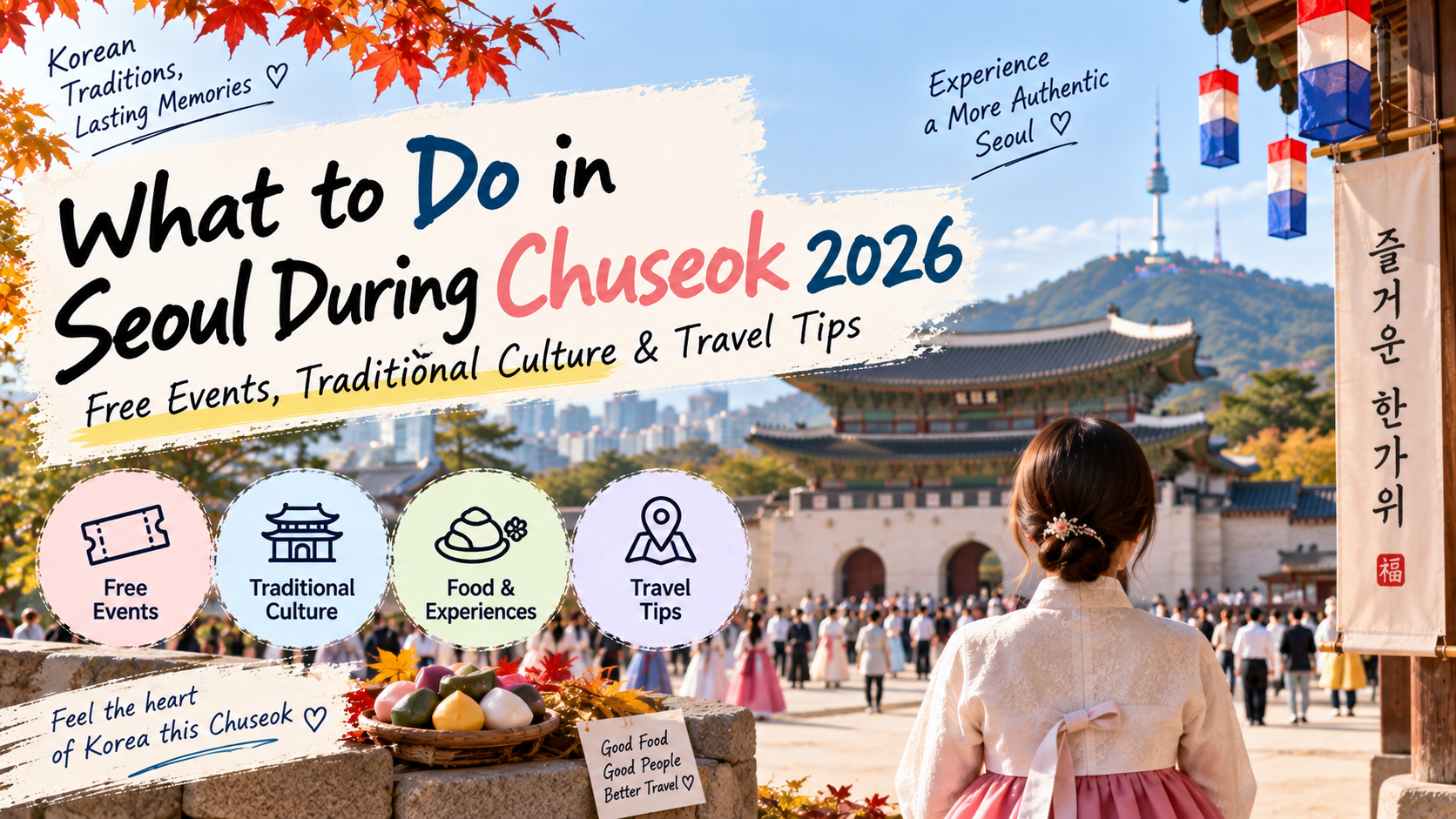
In 2026, Chuseok falls on Friday, September 25, with the main holiday period running around September 24–27.
During those days, Seoul and nearby destinations are hosting traditional music performances, hanbok experiences, folk games, food programs and special cultural events.
The key is knowing where to go.
Chuseok 2026 at a Glance
Main Chuseok day: September 25, 2026
Best sightseeing period: September 24–27
Expect: Some independent restaurants and businesses to close or shorten hours
Also expect: Special holiday programs at palaces, hanok villages and cultural attractions
Biggest transportation issue: Intercity trains and buses
The official Korea Tourism Organization’s newly published 2026 Chuseok Holiday Travel Guide specifically recommends booking transportation early because trains and express buses sell out quickly during major Korean holidays.
That matters much more if you are traveling from Seoul to Busan, Gyeongju, Jeonju or another city.
If you are simply sightseeing within Seoul, the holiday is much easier to manage.
1. Go to Namsangol Hanok Village for Chuseok
For a first-time visitor, this is probably the easiest Chuseok recommendation.
Namsan Moonlight Madang will take place at Namsangol Hanok Village from September 25 to 27.
The official Korea Tourism Organization lists traditional performances, hanbok experiences, traditional games and a K-food market among the programs.
Namsangol is already worth visiting because traditional Korean houses sit right in central Seoul.
During Chuseok, however, the setting makes much more sense.
Instead of simply photographing hanok architecture, you can see traditional holiday culture happening around you.
Getting there
Search:
남산골한옥마을
The nearest convenient subway station is Chungmuro Station.
If you are staying around Myeongdong, this is particularly easy to add to your itinerary.
2. See Traditional Korean Music for Free
Another excellent Chuseok option is the 2026 Yeoyujak Concert.
It runs on September 24 and 25 at Seoul Donhwamun Traditional Theater’s Gugak Madang.
The concert features Korean traditional music and lasts about 50 minutes.
Most importantly for travelers, admission is free.
The venue is around a 600-meter walk from Jongno 3-ga Station.
This makes it very easy to combine with:
Changdeokgung Palace Ikseon-dong Jongmyo Insadong
Instead of crossing Seoul for a single performance, build it into a Jongno day.
From September 25 to 27, the Korean Confucian Culture EXPO takes place at the historic Sungkyunkwan area.
The official Chuseok guide lists experiences involving traditional rituals, folk games, Korean Seonbi culture and Korean medicine culture.
This is a much less obvious tourist choice than Gyeongbokgung.
That is exactly why it may be interesting.
If you have already seen Seoul’s major palaces and want something more connected to traditional Korean thought and education, this can add a different dimension to your trip.
4. Make Chuseok a Palace Day
Chuseok is also a natural time to explore Seoul’s royal heritage.
Gyeongbokgung and Changdeokgung are both easy to combine with nearby traditional neighborhoods.
A practical route is:
Gyeongbokgung → Bukchon → Insadong → Ikseon-dong
Do not try to combine this with Gangnam, Jamsil and Hongdae on the same day.
One of the easiest mistakes in Seoul is underestimating travel time between neighborhoods.
During a holiday, keeping each day geographically compact becomes even more useful.
5. Escape Seoul for Namhansanseong
If you want a short excursion rather than a long intercity trip, consider Namhansanseong Fortress in Gyeonggi-do.
The official Chuseok guide lists special programs from September 24 to 27, including traditional Korean music performances, cultural activities, fortress trail tours and evening walks.
This is a particularly good choice if the weather is clear.
Namhansanseong combines history with hiking and autumn scenery, so it feels very different from central Seoul.
From Seoul
Allow roughly half a day rather than trying to squeeze it between central Seoul attractions.
Search the Korean name:
남한산성
in Naver Map for the most practical route from your hotel.
6. Go to the Han River on Sunday
If you are still in Seoul on Sunday, September 27, there is another particularly good option.
The autumn Car-Free Jamsugyo Bridge Festival runs every Sunday from September 6 through October 25.
September 27 has a special Moonlight Hangawi Madang program tied to the Chuseok season.
The festival runs around Jamsugyo and Banpo Hangang Park, with the main autumn event hours from 2 PM to 10 PM.
This is especially relevant for Korea Inside Out readers because the Jamsugyo guide is already one of the site’s strongest Google entry pages.
Rather than treating Chuseok only as a traditional-palace experience, you can combine tradition during the day with contemporary Seoul by the river at night.
7. What About Restaurants?
This is where Chuseok requires flexibility.
Large shopping malls, chain cafés, convenience stores and tourist-oriented areas are generally easier to navigate than small independent businesses.
But an individual restaurant may decide to close.
Do not travel 45 minutes across Seoul for one restaurant without checking its latest information.
Use Naver Map and look for:
추석 휴무 — closed for Chuseok
추석 영업 — open during Chuseok
영업시간 — opening hours
If you see recent Korean reviews or a notice posted by the business, trust those over an old blog post.
8. Convenience Stores Are Your Safety Net
One of the easiest things about traveling in Korea is the density of convenience stores.
CU, GS25, 7-Eleven and emart24 are everywhere.
Even if a restaurant plan fails, you are unlikely to be stranded without food.
That doesn’t mean you should spend Chuseok eating convenience-store ramyeon.
It simply means you don’t need to panic if a restaurant closes unexpectedly.
9. Shopping During Chuseok
Major department stores and shopping centers may operate special holiday hours, and individual branches can differ.
Check the exact branch before visiting.
If shopping is a major part of your trip, I would avoid building an entire Chuseok day around a single store.
Instead combine shopping with an area where you have alternatives.
For example:
Myeongdong Hongdae Seongsu Jamsil
all give you multiple backup options.
10. The Biggest Chuseok Problem Is Not Seoul
It is transportation between cities.
Korea Tourism Organization specifically warns travelers that trains and express buses can sell out quickly during major holidays.
Millions of Koreans travel to visit family.
So if your itinerary says:
September 24 — Seoul September 25 — Busan September 26 — Gyeongju
you need to take transportation availability seriously.
If tickets are unavailable, staying in Seoul during the peak holiday and moving afterward may be much less stressful.
A Simple Chuseok Itinerary
September 24
Jongno Changdeokgung Ikseon-dong Yeoyujak traditional music concert
September 25 — Chuseok Day
Gyeongbokgung area Namsangol Hanok Village Traditional games and cultural programs
September 26
Seongsu or Hongdae Cafés and shopping Relaxed evening
September 27
Morning sightseeing Banpo Hangang Park Jamsugyo Chuseok program in the afternoon/evening
This itinerary avoids unnecessary long-distance travel and still gives you both traditional and modern Seoul.
Korean Search Terms to Save
추석 — Chuseok
추석 행사 — Chuseok events
추석 서울 행사 — Chuseok events in Seoul
남산골한옥마을 — Namsangol Hanok Village
남한산성 — Namhansanseong
추석 휴무 — Chuseok closure
추석 영업 — open during Chuseok
Is Chuseok a Bad Time to Visit Seoul?
No.
It is simply a different time to visit.
If your priority is visiting a long list of specific independent restaurants and shops, Chuseok can complicate your plans.
But if you want to experience Korean culture, traditional performances, palaces, hanok villages and holiday atmosphere, it can be an unusually memorable time to be here.
The smartest approach is not to fight the holiday.
If you are in Seoul this weekend and want to do something that feels very different from the usual palace-shopping-café itinerary, head east.
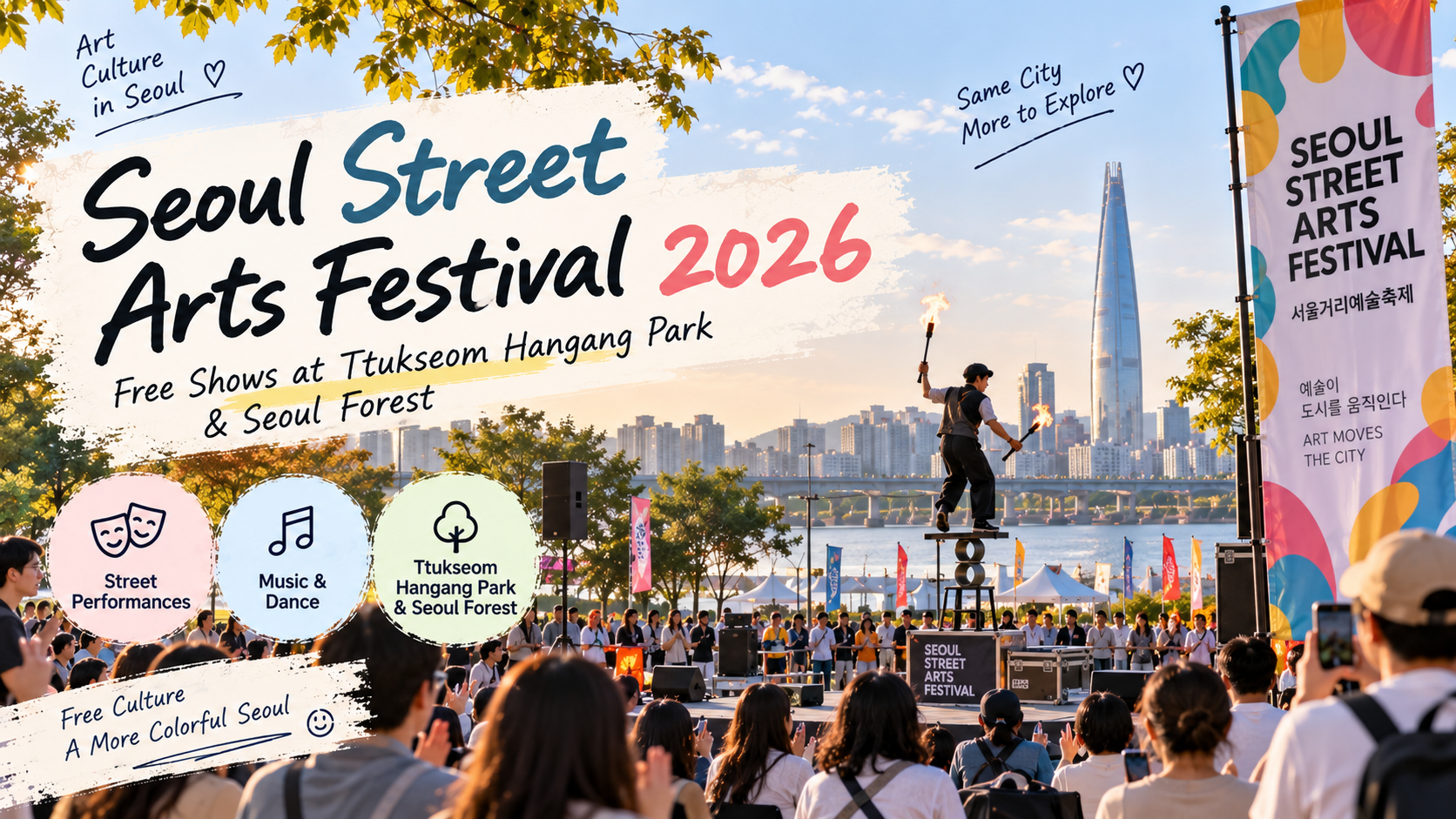
On September 19 and 20, 2026, the Seoul Street Arts Festival takes over Ttukseom Hangang Park and Seoul Forest with circus, contemporary dance, traditional performances, large-scale outdoor theater and participatory programs.
And the best part for travelers?
Much of it is free.
This is one of those Seoul events that works especially well for visitors because you do not necessarily need to understand Korean to enjoy it. A giant puppet moving through a park, an acrobat balancing above a crowd or a circus performer juggling beside the Han River does not require subtitles.
The festival also happens in two places that are already worth visiting on their own.
So even if you know nothing about contemporary street performance, this can still be a very good way to spend an autumn afternoon in Seoul.
Seoul Street Arts Festival 2026 at a Glance
Dates: September 19–20, 2026 Main locations: Ttukseom Hangang Park and Seoul Forest Admission: Free for the festival’s public performances and activities What you’ll see: Street theater, circus, dance, traditional performance, roaming performances and participatory programs Best for: Families, couples, solo travelers, photographers and anyone looking for something free to do in Seoul this weekend
According to Seoul’s official city information, the 2026 festival includes 20 works presented 62 times, including international productions from France, Lithuania, Chile, Slovenia and Brazil.
That is a surprisingly large amount of programming for one weekend.
Why This Festival Is Different
Seoul has plenty of festivals.
Some are essentially concerts. Others are food markets, exhibitions or seasonal photo spots.
The Seoul Street Arts Festival is different because the city itself becomes part of the performance.
You might be walking through a park when performers suddenly move through the crowd.
A grassy area becomes a circus stage.
A riverside path becomes part of a moving performance.
The official Seoul announcement highlights circus, contemporary dance, traditional performance and mobile works designed specifically around the spatial character of the Han River and Seoul Forest.
For travelers, that makes the festival easy to enjoy casually.
You do not necessarily need to sit inside a theater for two hours.
You can walk, watch something interesting, continue exploring and stop again when another performance catches your attention.
The Giant Giraffes
One of the most visually unusual performances is a large-scale parade featuring giant red giraffe figures.
The performance is scheduled for the evening at Ttukseom Hangang Park and is exactly the kind of outdoor spectacle that makes this festival photogenic even if you know nothing about street theater.
According to Seoul’s official festival information, the giraffe performance runs during the festival evenings as part of the large-scale outdoor program.
If photography is important to you, I would arrive before sunset.
You can enjoy the Han River in daylight, find something to eat, watch the sky change and then stay for the evening performances.
Circus Without Going to a Circus
Another major part of the festival is circus.
But don’t imagine a traditional circus tent.
Street arts can include balancing, juggling, Chinese pole techniques, physical theater and performances that interact directly with public spaces.
That means the atmosphere is much more casual than going to a formal show.
You may be standing only a short distance from the performers.
For families traveling with children, this is one of the easiest festival genres to enjoy because there is often very little language barrier.
Ttukseom Hangang Park
If you have never been to Ttukseom before, the festival is a good excuse to visit.
Ttukseom is one of Seoul’s major Hangang parks and has a very different atmosphere from the central tourist districts.
Instead of palaces and shopping streets, you get:
Wide riverside views
Grass
Cycling paths
Picnic areas
Local families
Runners
Convenience-store snacks
Views across the Han River
The festival adds temporary performances on top of that.
So I would not treat Ttukseom simply as an event venue.
Treat it as a Han River afternoon with a festival happening inside it.
That distinction makes the day much more relaxed.
Seoul Forest
The second major location is Seoul Forest.
This is another excellent place to combine with a normal sightseeing day.
Seoul Forest gives you green space and walking paths, while nearby Seongsu gives you cafés, fashion, pop-ups and restaurants.
That creates one of the easiest full-day combinations in Seoul:
Seongsu → Seoul Forest → Ttukseom Hangang Park → evening festival performance
You are not spending the entire day at a festival.
You are experiencing several different sides of contemporary Seoul in one compact area.
How to Get There
For Ttukseom Hangang Park, the easiest subway access is generally around Ttukseom Resort Station on Line 7.
For Seoul Forest, Seoul Forest Station on the Suin-Bundang Line is convenient.
Because performances are spread across different locations, check the specific performance venue before choosing which station to use.
Do not simply type “Seoul Street Arts Festival” into a map and assume every performance happens at one pin.
In Korea, I recommend checking routes with Naver Map or KakaoMap in addition to Google Maps.
Useful Korean search terms are:
서울거리예술축제 — Seoul Street Arts Festival 뚝섬한강공원 — Ttukseom Hangang Park 서울숲 — Seoul Forest 성수동 — Seongsu-dong
A Good Half-Day Itinerary
If I were visiting as a traveler, I would do this:
1:00 PM — Lunch in Seongsu
Start with lunch around Seongsu.
There are countless cafés and restaurants in this area, so you do not need to plan every meal in advance.
2:30 PM — Explore Seongsu
Browse cafés, shops and pop-ups.
Do not over-schedule this part.
Seongsu changes constantly, and wandering is part of the appeal.
4:00 PM — Seoul Forest
Walk through Seoul Forest and check the day’s festival schedule.
Watch one or two performances.
5:30 PM — Move toward Ttukseom Hangang Park
Head toward the river before sunset.
Pick up drinks or snacks along the way.
Evening — Festival + Han River
Watch the larger outdoor performances and enjoy the river after dark.
This is a much more interesting Seoul evening than simply returning to Myeongdong after dinner.
Another Free Event Today: Seoul Philharmonic Park Concert
September 19 is unusually busy.
The Seoul Philharmonic Orchestra is also holding a free outdoor Park Concert at Seoul Children’s Grand Park tonight from 7:00 PM to 8:30 PM.
The concert is conducted by Jaap van Zweden and features pianist Suh Hai-Kyung and musical actor Choi Jae-rim. The official Visit Seoul listing confirms that admission is free.
This creates two very different choices:
Street arts + Han River or free classical concert in a park
Trying to do both would make the day unnecessarily complicated.
Choose whichever fits your travel style.
You Can Also See Free Taekwondo Today
There is another interesting option on September 19.
Seoul’s regular city Taekwondo performances are scheduled today at Namsangol Hanok Village, with performances at 2 PM and 4 PM.
A separate Taekwondo street performance is also scheduled at DDP today at 2 PM and 4 PM.
These performances are free, although the city notes that schedules may change depending on weather and on-site conditions.
That means a traveler looking for free cultural experiences in Seoul today actually has several strong choices.
This Is Part of a Bigger Autumn Arts Season
The Street Arts Festival is not happening in isolation.
Seoul Autumn Festa 2026 began on September 18 and continues through November 29.
Visit Seoul describes it as a citywide performing-arts festival connecting performances and festivals across Seoul under one autumn arts brand. Venues include indoor and outdoor performance spaces, Han River areas and cultural venues throughout the city.
This matters if you are visiting later than this weekend.
Even if you miss the Street Arts Festival, autumn 2026 still has a large amount of cultural programming ahead.
What If It Rains?
Outdoor festivals always require flexibility.
Check the official schedule on the morning you visit, especially for outdoor circus and mobile performances.
Do not build your entire Seoul itinerary around one performance without checking weather and last-minute notices.
A useful backup is Seongsu.
If weather changes, you can move indoors to cafés, shops and other spaces nearby instead of losing the whole afternoon.
Is It Worth Going If You Don’t Speak Korean?
Yes.
In fact, I think street arts is one of the easier cultural events for international travelers.
A dialogue-heavy theater performance can be difficult without Korean.
Circus, movement, dance, puppetry and visual performance are different.
You can often understand the emotional or visual idea without understanding every word.
That makes this festival particularly accessible for visitors.
Is It Good for Kids?
Very likely.
The official city program includes family-oriented activities such as an EDM party for children and kite-making activities alongside performances.
Families should still check individual performance descriptions because not every work will appeal equally to young children.
But as a general weekend destination, Ttukseom and Seoul Forest are already family-friendly places.
What Should You Bring?
Keep it simple:
Comfortable shoes, water, a portable battery and something light to sit on if you plan to stay by the river.
September weather can feel warm in the afternoon and cooler after sunset, so a light layer is useful for evening.
And do not forget that you may walk much more than expected.
Street arts festivals reward people who move around.
Final Thoughts
The best Seoul experiences are not always the famous attractions you planned months before your flight.
Sometimes they are temporary.
You arrive in a neighborhood expecting a normal park.
There is a crowd.
Music starts.
A circus performer climbs into the air.
A giant red giraffe moves beside the Han River.
And suddenly your ordinary Saturday in Seoul becomes one of the things you remember most about the trip.
If you are in Seoul on September 19 or 20, 2026, the Seoul Street Arts Festival is one of the easiest free events to add to your itinerary.
Combine it with Seongsu, Seoul Forest and the Han River rather than treating it as an isolated festival.
Most travelers pass through Gimpo Airport because they are flying somewhere else.
Very few realize there is a major aviation museum almost next door.
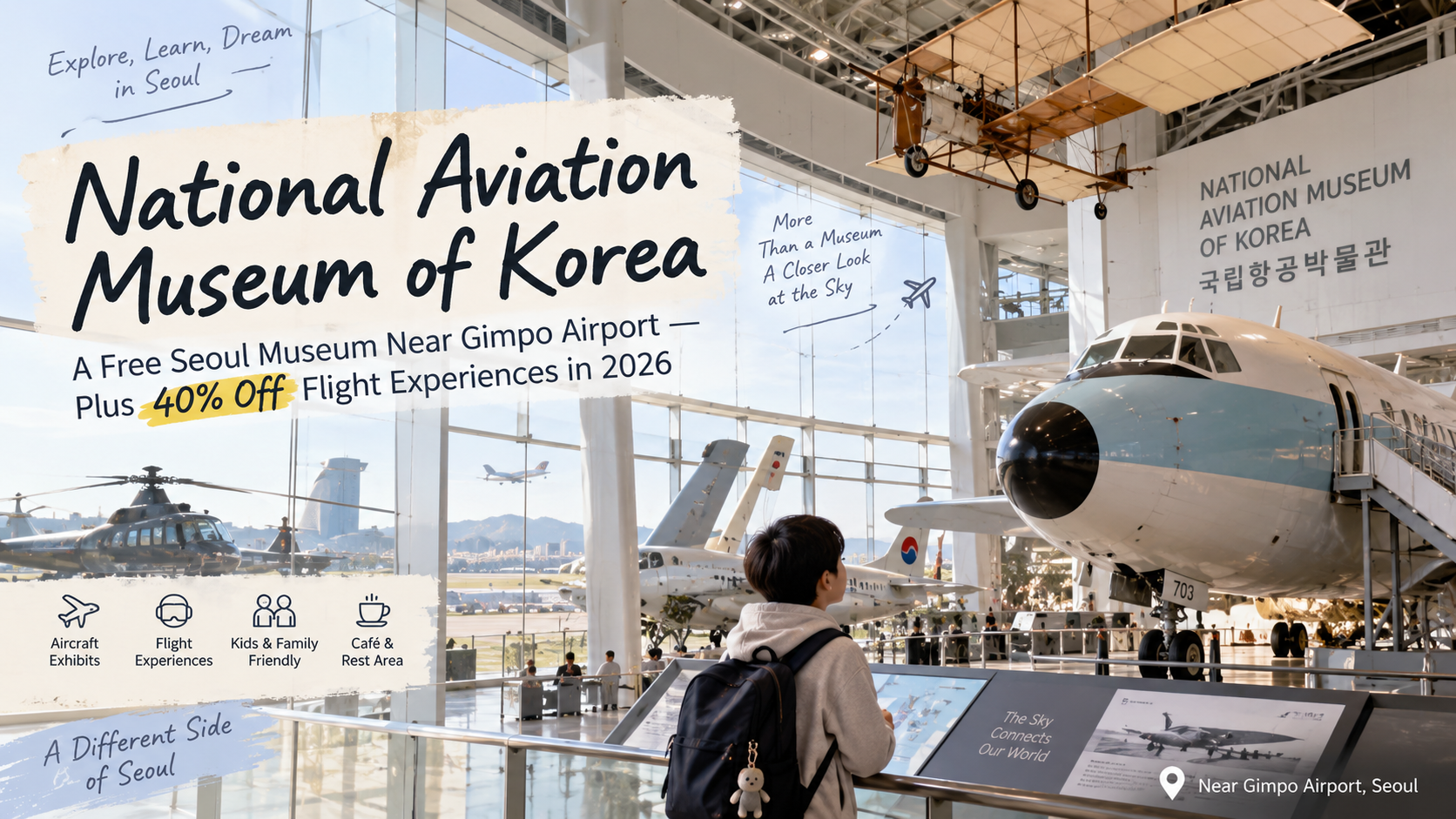
The National Aviation Museum of Korea (국립항공박물관) is located only a short distance from Gimpo Airport and explores Korean aviation history through aircraft, exhibitions and hands-on experiences.
The museum itself is particularly useful for families, aviation enthusiasts and travelers looking for a rainy-day Seoul activity.
And in 2026, there is an extra reason to visit.
Through December 31, eligible air travelers can receive up to 40% off four paid aviation experiences at the museum.
Why Put This on a Seoul Itinerary?
Seoul has an enormous number of museums.
Most first-time travelers naturally prioritize the National Museum of Korea, palace museums or contemporary-art museums.
The National Aviation Museum fills a different niche.
It works particularly well if:
you’re traveling with children,
someone in your family loves airplanes,
the weather is bad,
you have time before or after a Gimpo flight,
or you’ve already visited Seoul’s major historic attractions.
Its proximity to the airport is the biggest practical advantage.
Where Is It?
National Aviation Museum of Korea
Korean: 국립항공박물관
Address:
177 Haneul-gil, Gangseo-gu, Seoul
The museum’s official site lists the address as 서울 강서구 하늘길 177.
It is beside the Gimpo Airport complex rather than in central Seoul.
How to Get There by Subway
Travel to:
Gimpo International Airport Station (김포공항역)
The airport is served by several rail lines, including Seoul Subway Lines 5 and 9 and the Airport Railroad.
From the domestic terminal, follow signs toward the museum.
Official museum transport information places it roughly 400 meters from the domestic terminal, and airport shuttle-bus options are also available.
That makes it much easier to reach than many travelers expect.
The Museum Is Not Only for Children
It is easy to assume this is basically an airplane playground.
It isn’t.
Korea’s aviation history is closely connected with the country’s rapid modernization, industrial development and changing relationship with international travel.
The museum gives context to how Korean aviation developed rather than simply displaying aircraft.
Children may be more excited by the simulators, but adults interested in transport or Korean modern history can get plenty out of it too.
The Four Paid Experiences
The current Travel Month promotion covers four paid experiences.
Pilot & Air Traffic Control Experience
Regular price: ₩5,000
Discounted aviation-traveler price: ₩3,000
Air Sports Experience
Regular price: ₩5,000
Discounted price: ₩3,000
Black Eagles Experience
Regular price: ₩3,000
Discounted price: ₩2,000
Cabin Training Experience
Regular price: ₩3,000
Discounted price: ₩2,000
The promotion runs through December 31, 2026.
That is a maximum reduction of 40%.
Who Qualifies for the Discount?
This is where you need to read the conditions carefully.
The discount is intended for air-transport users.
When booking online or at the museum, select the special aviation preferential fare (항공 우대).
When entering the experience area, you need to show evidence of a booking or boarding pass from an eligible Korean airline from within the previous one month.
So this is not simply a universal 40% discount for everyone walking into the museum.
If you’ve recently flown domestically or internationally on an eligible carrier, however, it is worth checking.
Do You Need a Reservation?
The discount can be selected for online or on-site reservations, according to Korea Tourism Organization’s current promotion information.
For popular experience slots, booking ahead is the safer option.
The museum itself and individual experience programs can have different access conditions, so don’t assume that arriving at the museum guarantees an immediate simulator slot.
A Perfect Stop Before a Gimpo Flight?
Potentially — but leave a generous buffer.
This works best when you have several spare hours, not 45 minutes before boarding.
Airport security, baggage and check-in should always take priority.
A much more relaxed plan is:
museum first → return to domestic terminal → check in → fly.
Or visit after arriving at Gimpo if you’re not carrying too much luggage.
What If You Are Flying Through Incheon?
The museum is not near Incheon International Airport.
This is an important distinction.
Gimpo Airport is in western Seoul.
Incheon Airport is far outside central Seoul.
Do not schedule the National Aviation Museum as a quick stop before an Incheon flight.
It makes much more sense as a Seoul day activity or as part of a Gimpo Airport itinerary.
Family Travel Tip
For families, the museum can solve a common Seoul itinerary problem.
Children may eventually tire of palaces, shopping streets and cafés.
An aviation museum introduces something completely different without requiring a full theme-park day.
And because it is indoors, it is useful when rain disrupts an outdoor itinerary.
How Much Time Do You Need?
For a casual visit, I would allow around two hours.
Add more time if you book multiple paid experiences.
If you’re traveling with a child who is seriously interested in aircraft, you may stay considerably longer.
Avoid scheduling another tightly timed attraction immediately afterward.
Combine It with Western Seoul
The museum is not in the same area as Gyeongbokgung, Myeongdong or Gangnam.
So don’t travel all the way west just for a 30-minute visit.
The easiest reason to go is when you already have a Gimpo Airport flight.
Otherwise, you could combine western Seoul attractions depending on your interests and available time.
One Current Caveat: Aviation Library Closure
There is also a temporary detail worth knowing.
The museum’s Aviation Library announced a temporary closure from September 14, 2026 until around early January 2027.
That relates to the library rather than the entire National Aviation Museum, but travelers specifically hoping to use the library should not rely on older information showing normal operation.
This is exactly why checking current Korean information shortly before visiting matters.
Korean Search Terms
국립항공박물관 — National Aviation Museum of Korea
김포공항 — Gimpo Airport
조종관제체험 — Pilot & Air Traffic Control Experience
항공레포츠체험 — Air Sports Experience
블랙이글스탑승체험 — Black Eagles Experience
기내훈련체험 — Cabin Training Experience
항공 우대 — Aviation preferential discount
Is It Worth It?
For every first-time Seoul visitor? Probably not.
If you only have three days, the palaces, neighborhoods, food and central Seoul sights should come first.
But for families, aviation fans, repeat visitors or anyone using Gimpo Airport, this is a genuinely useful addition.
It also has something many Seoul attractions don’t:
a natural reason to visit on the way to somewhere else.
Instead of spending several empty hours around an airport, you can turn them into an actual Seoul experience.
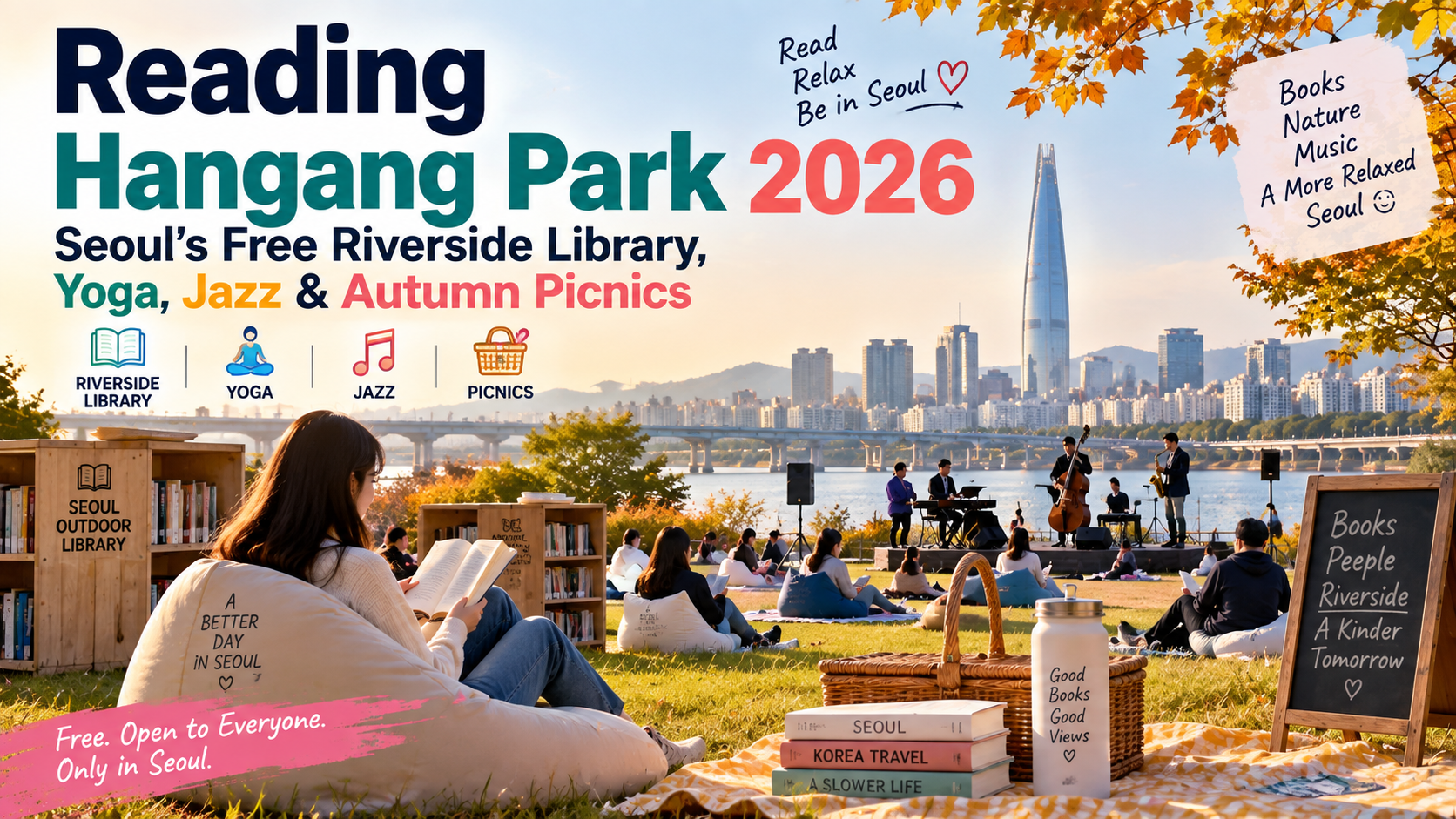
Imagine spending a Saturday afternoon beside the Han River on a giant beanbag, choosing a book from thousands available for free, listening to live music and watching the sun begin to set over Seoul.
That’s essentially the idea behind Reading Hangang Park (책읽는 한강공원).
The outdoor library has returned to Yeouido Hangang Park for autumn 2026, running on Saturdays through October 31.
But calling it an “outdoor library” doesn’t quite explain the experience.
There are books, of course — around 6,000 of them at the opening event — but there are also board games, children’s activities, performances and special weekend programs including sunset yoga, traditional Korean games and an autumn jazz festival.
For travelers, it’s one of the easiest ways to experience the Han River without buying a ticket or committing to a formal attraction.
Reading Hangang Park 2026: Quick Guide
Dates: September 12–October 31, 2026
Regular day: Saturday
Hours: 1:00 PM–8:00 PM
Location: Yeouido Hangang Park Multi Plaza and surrounding lawn
Admission: Free
Nearest subway: Yeouinaru Station, Line 5
Walking time: About five minutes from Exit 2
There is one calendar exception: during the Chuseok holiday week, the program moves from Saturday, September 26 to Sunday, September 27.
Weather matters because this is an outdoor program, so schedules may change in rain or unsafe conditions.
What Is There to Do?
The simplest answer is: you can do almost nothing.
And that’s part of the attraction.
Seoul sightseeing can become surprisingly intense.
Palace. Subway. Market. Café. Museum. Shopping. Another subway.
Reading Hangang Park is a place where you can deliberately stop sightseeing for a while.
Find a seat, borrow a book and stay beside the river.
But if sitting still isn’t your thing, there are plenty of other activities.
Around 6,000 Books
At the autumn opening, the outdoor library offered roughly 6,000 books.
Don’t visit expecting a huge English-language library.
This is primarily a Seoul public cultural program for local residents.
For foreign visitors, the experience is as much about the atmosphere as the actual reading.
Walk around, look through the collections and enjoy seeing how Seoul transforms a public riverside park into a temporary cultural space.
Board Games and Children’s Areas
Families may get more out of this event than couples expecting a quiet literary afternoon.
The program includes board games and children’s play areas.
The current setup has included activity zones and even inflatable play facilities for younger children.
That means parents don’t necessarily have to choose between a playground day and a Han River day.
Free Picnic Equipment
One particularly useful detail for travelers is the free equipment available from the information booth.
The city reports that visitors can borrow items including:
picnic mats
camping tables
sun umbrellas
subject to availability.
That is useful if you’re staying in a hotel and don’t want to buy a picnic mat simply for one afternoon.
Arrive earlier if borrowing equipment is important to you.
Special Events Change Every Weekend
This is where the program becomes much more than an outdoor reading area.
On September 19, the park hosts Sunset Healing Yoga.
On September 27, the special Chuseok Sunday program includes traditional Korean activities such as rice-cake pounding, giant yutnori, jegichagi and tuho.
On October 3, there is a book-decorating craft program.
On October 17, the park hosts the Hangang Autumn Jazz Festa.
On October 24, there is a book-sharing event.
So the experience can be completely different depending on which weekend you visit.
If you’re in Seoul this weekend, this is the most immediate reason to go.
The September 19 program combines the riverside setting with sunset yoga.
Even if you don’t participate, Yeouido around sunset is worth visiting.
The wide river, open sky and city skyline make it one of Seoul’s easiest sunset locations.
September 27: A Chuseok Experience
The September 27 edition may be especially interesting for international visitors.
Instead of the normal Saturday schedule, the event moves to Sunday and incorporates traditional Korean holiday activities.
Programs include traditional games such as yutnori, jegichagi and tuho, along with rice-cake pounding.
If you’re visiting Korea around Chuseok and want a low-pressure introduction to traditional holiday culture, this could be much easier than finding a specialized cultural program.
This is probably the date I would circle if your Seoul trip falls in mid-October.
A riverside outdoor library combined with autumn weather and jazz is exactly the kind of event that doesn’t necessarily appear on a first-time visitor’s checklist but can become one of the more memorable evenings of a trip.
Because special-program details can change, verify the latest timetable closer to the date.
How to Get There
Take Subway Line 5 to:
Yeouinaru Station (여의나루역)
Use Exit 2.
The main Reading Hangang Park area is around a five-minute walk away.
Seoul’s newer notice also mentions Exits 2 and 3 for access to the park.
Search in Naver Map or Kakao Map:
여의도한강공원 멀티플라자
What Should You Bring?
You don’t need much.
A light jacket becomes useful after sunset.
Bring sunscreen on bright afternoons, a reusable water bottle and perhaps a portable charger.
If you plan to stay for several hours, buy food before settling in.
What Should You Eat?
Yeouido Hangang Park is a classic place for a Seoul picnic.
Convenience-store ramen is the obvious choice.
Kimbap, fried chicken and simple snacks are also easy.
For international travelers without a Korean phone number, food delivery can be less straightforward than it looks when you see locals ordering chicken directly to the park.
The site’s current search data is already showing strong interest in Han River activities, and Reading Hangang Park fits naturally into that cluster without repeating the same festival.
You could spend the morning elsewhere and arrive at Yeouido around 3 or 4 PM.
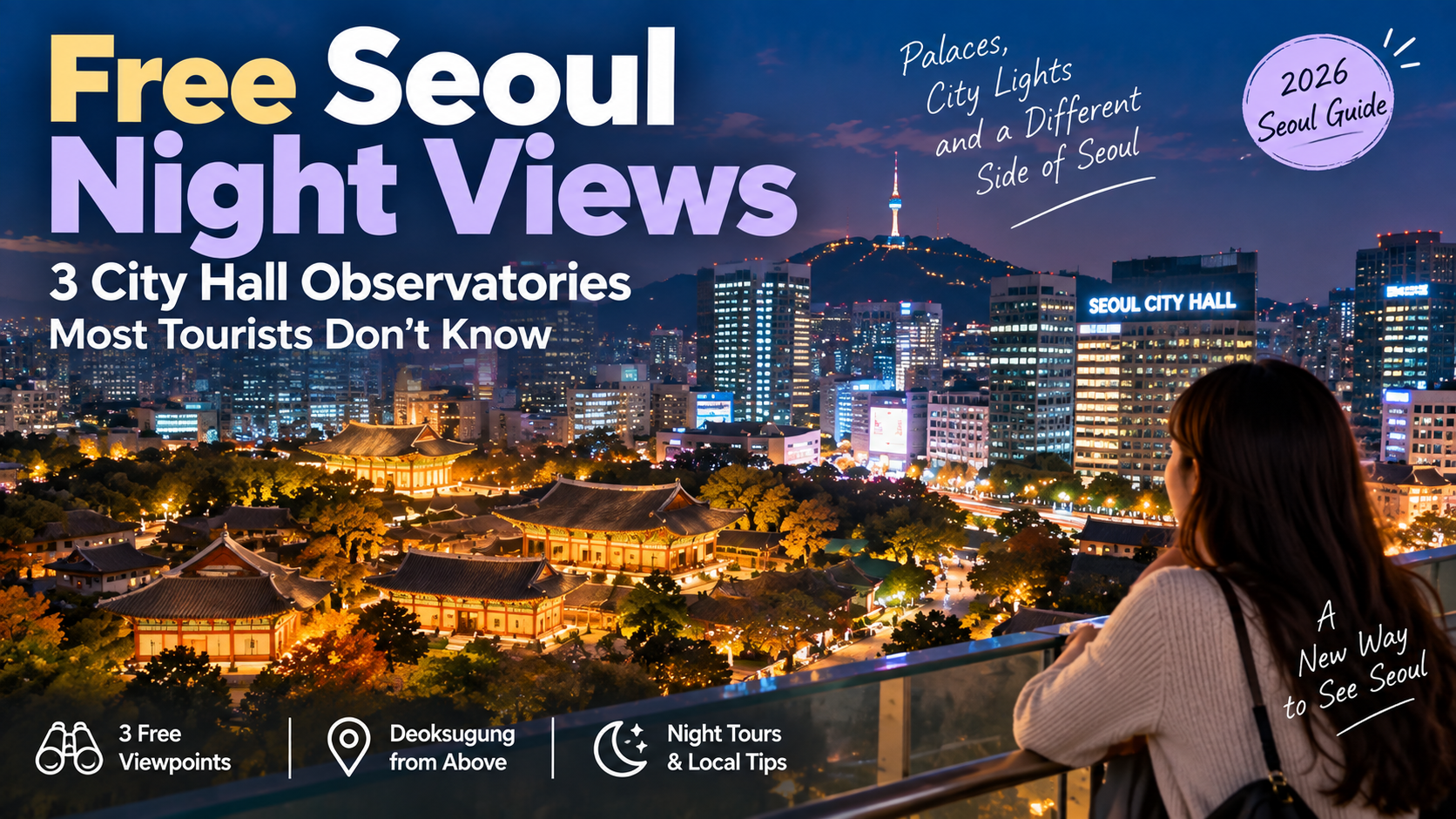
Instead of looking down from a skyscraper hundreds of meters above the ground, these viewpoints put you close enough to actually recognize what you’re seeing: Deoksugung Palace, Seoul Plaza, Jeongdong and the historic center surrounded by modern office towers.
And for foreign travelers, they’re still surprisingly under the radar.
Here’s how to visit them.
Why These Viewpoints Are Different
These aren’t really competitors to Seoul Sky.
The appeal is completely different.
From a very high observation deck, Seoul becomes an enormous carpet of buildings.
From the City Hall viewpoints, you’re close enough to distinguish palace roofs, streets, churches and individual buildings.
At sunset, you can watch traditional palace architecture below while the modern city begins lighting up around it.
That’s the view I find more interesting.
1. Jeongdong Observatory — Best Overall View
Korean: 정동전망대
Location: Seosomun Building 1, 13th floor 서울시 중구 덕수궁길 15
Nearest subway: City Hall Station
If you only visit one of the three viewpoints, make it this one.
Jeongdong Observatory looks directly over Deoksugung Palace and the historic Jeongdong area.
Traditional palace roofs sit below you while modern Seoul rises behind them.
It is especially good around sunset.
Jeongdong Observatory Opening Hours
As of September 2026, Seoul lists:
Monday–Thursday: 1:30 PM–5:30 PM
Friday: 1:30 PM–10:00 PM
Saturday: 9:00 AM–10:00 PM
During the winter period from November through February, Friday and Saturday nighttime operation is scheduled to end at 9:00 PM.
Admission: Free.
The observatory does not require a reservation for ordinary individual visits.
Because schedules can change for city events or operational reasons, check the official information on the day you visit.
The Observatory Is Much Bigger Now
Jeongdong Observatory used to be a relatively small space.
After renovation, Seoul expanded it from 117 square meters to 322 square meters — about 2.8 times its previous size.
The seating has also been rearranged toward the windows.
That makes it much more practical as an actual stop rather than somewhere you walk into, take one photo and immediately leave.
There’s a Café Too
Another advantage is Cafe Darak (카페다락).
You can sit near the view rather than simply standing at a window.
Seoul says the café and observation areas have been separated to make the space more comfortable, and nighttime-specific menu items are also being offered during the extended opening period.
Don’t come expecting a luxury rooftop bar.
That’s not the point.
The appeal is being able to sit above Deoksugung for very little money while enjoying a view many tourists don’t know exists.
2. Haneul Observatory — Best Modern City View
Korean: 하늘전망대
Location: Seoul City Hall, 9th floor Nearest subway: City Hall Station, Lines 1 & 2
Haneul Observatory is inside Seoul’s modern City Hall building.
If Jeongdong Observatory is primarily about the palace and historic district, Haneul Observatory feels more like a view of central contemporary Seoul.
The observatory opened earlier in 2026 and has now become part of Seoul’s expanded nighttime viewing program.
On nighttime-opening days, it works particularly well as part of a City Hall evening rather than as a standalone destination.
Don’t Miss the Building Itself
Even before reaching the observatory, the modern Seoul City Hall building is interesting.
Its huge curved glass façade sits immediately behind the former City Hall building, which now houses the Seoul Metropolitan Library.
The juxtaposition is very Seoul:
historic architecture in front, enormous contemporary glass structure behind.
Inside, Seoul City Hall also contains a large vertical garden and public spaces.
3. Haneultteul — Best Outdoor Rooftop Feeling
Korean: 하늘뜰
Location: Seoul Metropolitan Library, 5th-floor rooftop garden
This one is different again.
Haneultteul is an outdoor rooftop garden on the old City Hall building, now Seoul Metropolitan Library.
Instead of viewing Seoul through glass, you can step outside and look toward:
Seoul Plaza
Sejong-daero
surrounding central Seoul buildings
The rooftop landscaping and lighting have also been improved as part of the expanded program.
Haneultteul Opening Hours
Seoul currently lists:
Tuesday–Friday: 9:00 AM–9:00 PM
Saturday–Sunday: 9:00 AM–6:00 PM
It is closed on the library’s closing days and public holidays.
Haneultteul normally operates March through November and closes during the winter months from December through February.
Because it is outdoors, operations are more susceptible to weather and other conditions than an indoor observatory.
Which of the Three Should You Choose?
If you don’t have time for all three:
Best palace view
Jeongdong Observatory
Best City Hall experience
Haneul Observatory
Best outdoor atmosphere
Haneultteul
If you’re visiting on a Friday and have plenty of time, you can reasonably combine them because they are all in the same general area.
The Best Time to Visit
I would aim for 30–45 minutes before sunset.
That lets you see three versions of Seoul:
daylight,
sunset/blue hour,
night.
This is particularly effective from Jeongdong Observatory because the palace changes dramatically as daylight fades and the city lights come on.
Check Seoul’s sunset time on the day of your visit rather than relying on a fixed time.
Combine It with Deoksugung Palace
This is what turns the viewpoint into a genuinely good travel itinerary.
Don’t come to City Hall, ride an elevator, take a photo and leave.
Start at Deoksugung Palace (덕수궁).
It’s one of Seoul’s five major royal palaces and is particularly convenient because it sits immediately beside City Hall.
After visiting the palace, walk along:
덕수궁 돌담길
Deoksugung Stone Wall Road
Then continue into Jeongdong.
In autumn, the trees around the palace wall make this one of central Seoul’s nicest walks.
Finish at Jeongdong Observatory as the sun goes down.
A Great 4-Hour Central Seoul Evening
Here’s how I would actually do it.
4:30 PM — Deoksugung Palace
Explore the palace before sunset.
5:45 PM — Deoksugung Stone Wall Road
Walk slowly through Jeongdong.
Around sunset — Jeongdong Observatory
See the palace from above.
7:00 PM — City Hall
Walk back toward Seoul Plaza.
7:30 PM — Dinner
Choose City Hall, Euljiro or Myeongdong.
9:00 PM — Cheonggyecheon
Finish with an evening walk along the stream.
This route gives you traditional Seoul, modern Seoul and nighttime Seoul without wasting time crossing the city.
New in 2026: City Hall Night Tours
There is another reason this area is more interesting this year.
Starting September 18, 2026, Seoul is introducing a guided nighttime version of its City Hall tour.
The Night Tong-Tong Tour (야간 통통투어) runs on Fridays and Saturdays from:
7:30 PM–8:30 PM
The approximately one-hour program includes City Hall’s history, the vertical garden and exhibition spaces before finishing with nighttime views from the observation areas.
The ordinary viewpoints can be visited independently, so you do not need to join the guided tour simply to see the city views.
If you specifically want the guided program, check the latest Seoul information for reservation availability before going.
Another Free Evening Activity: Seoul Plaza Outdoor Library
During autumn 2026, Reading Seoul Plaza (책읽는 서울광장) is also operating outside City Hall.
The autumn season runs from September 4 through November 1, 2026.
In September, Friday-to-Sunday sessions operate into the evening from 4 PM to 10 PM, before switching toward daytime operation in October.
The setup typically includes colorful seating and books spread across Seoul Plaza.
If your dates line up, this makes an unusually good free evening:
Deoksugung → sunset → observatory → Seoul Plaza outdoor library
Are the Viewpoints Really Free?
Yes.
Seoul lists the observation spaces as free public facilities. Ordinary individual viewing does not require a separate admission ticket.
That’s what makes them especially useful for budget travelers.
You don’t have to pay observation-deck prices every time you want a city view.
Important Caveat: Check Before You Go
These are public facilities rather than conventional tourist attractions.
That means schedules can be affected by:
public holidays
nearby large demonstrations
special events
weather
building operations
Seoul specifically notes that operations can be adjusted according to conditions around City Hall.
So if seeing one particular observatory is important to you, verify the day’s schedule before traveling across the city.
How to Get There
For all three viewpoints, the easiest base station is:
City Hall Station (시청역) Lines 1 and 2
For Jeongdong Observatory, Seoul recommends City Hall Station Exits 11 or 12, followed by a short walk toward the Seosomun building.
For Seoul City Hall and Haneultteul, Exit 5 is convenient.
Korean Search Terms to Save
정동전망대 — Jeongdong Observatory
하늘전망대 — Haneul Observatory
하늘뜰 — Haneultteul rooftop garden
서울시청 — Seoul City Hall
서울도서관 — Seoul Metropolitan Library
덕수궁 — Deoksugung Palace
덕수궁 돌담길 — Deoksugung Stone Wall Road
야간 통통투어 — City Hall night tour
Again, Korean search terms are particularly useful in Naver Map and Kakao Map.
Free View vs. Paid Observation Deck: Which Is Better?
They’re different experiences.
Go to Seoul Sky if you want to understand the enormous scale of Seoul from one of its tallest buildings.
Go to N Seoul Tower if you want the classic mountain-top skyline experience.
Come here if you want to see central Seoul up close.
From Jeongdong Observatory, you’re not looking at an anonymous collection of buildings.
You’re looking down at Deoksugung.
You can see the palace you were walking through an hour earlier and understand how it sits within modern Seoul.
For me, that’s what makes the view interesting.
Is It Worth Visiting on a First Trip to Seoul?
Yes — but I wouldn’t necessarily give it its own half-day.
Instead, attach it to something you’re already doing nearby.
If you’re visiting:
Deoksugung → add Jeongdong Observatory.
Gwanghwamun → walk south toward City Hall.
Myeongdong → walk to City Hall before or after dinner.
Cheonggyecheon → combine it with an evening walk.
That’s the kind of attraction I love finding when traveling: something free, local and easy to insert into an itinerary without reorganizing the entire day.
And because the expanded nighttime opening only began in September 2026, it’s still something many older English-language Seoul guides don’t mention.
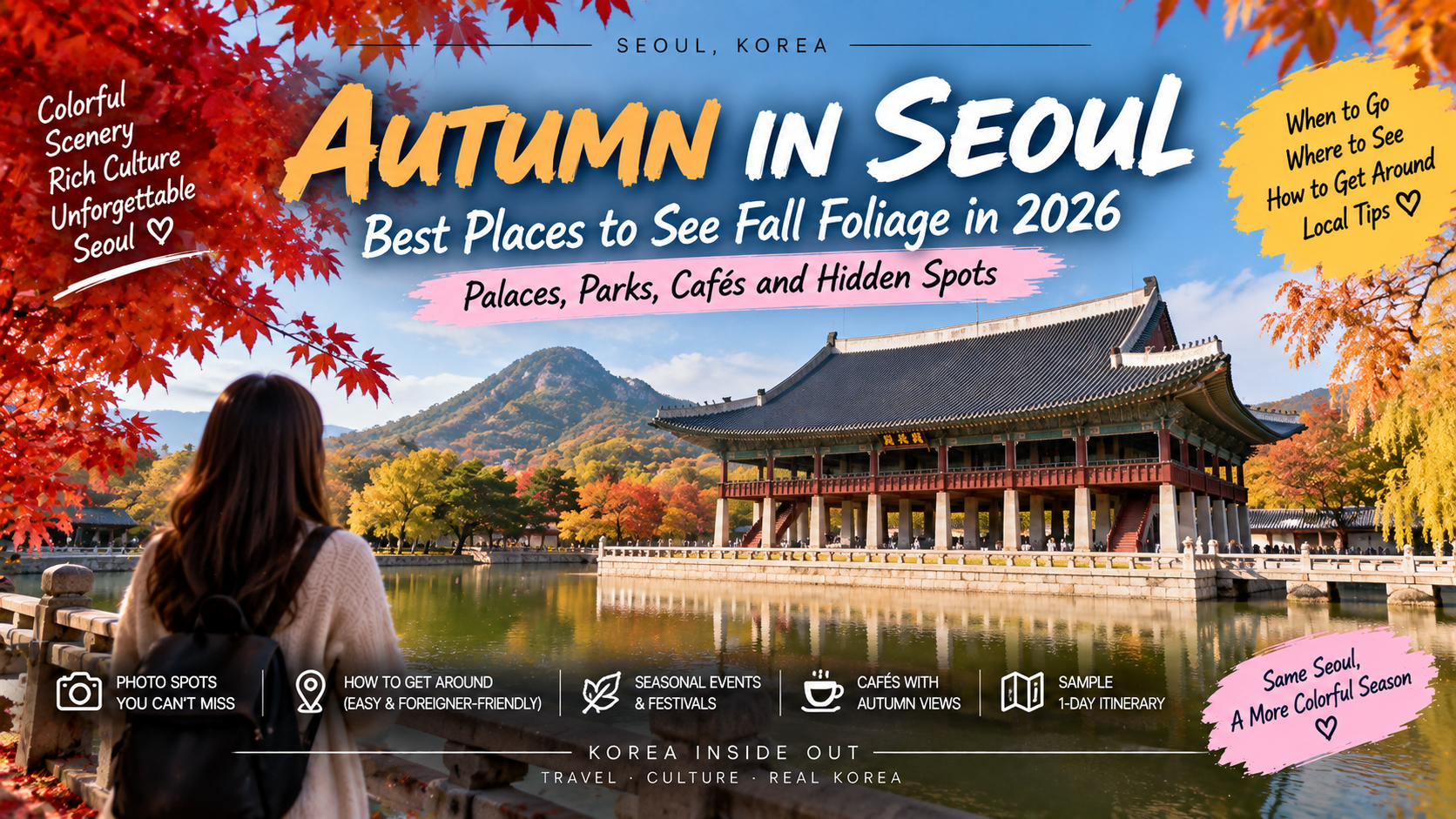
If you ask me when Seoul is most beautiful, autumn is difficult to beat.
Summer’s humidity finally disappears. The sky often becomes clearer. Walking around the city becomes comfortable again. And gradually, Seoul’s mountains, parks, palace grounds and neighborhood streets turn yellow, orange and red.
But there is one thing foreign travelers frequently misunderstand about autumn in Korea:
September is usually too early for peak fall foliage in Seoul.
If you visit in September, you can enjoy cooler evenings and the beginning of autumn, but most trees will still be green.
The more colorful part of the season generally comes later.
So when should you visit, and where should you go?
Here’s how I would plan an autumn trip to Seoul.
When Is Fall Foliage in Seoul?
There is no single guaranteed “peak foliage date.”
Autumn colors depend on temperatures, rainfall and weather patterns, and conditions vary every year.
As a practical planning guide:
Late September
Think early autumn atmosphere rather than autumn foliage.
Days are becoming more comfortable, but most of Seoul is still green.
Early October
You may begin seeing signs of seasonal change, particularly in higher or cooler areas.
Mid-October
Autumn becomes increasingly noticeable.
Late October
This is when travelers have a much better chance of seeing strong autumn colors around Seoul.
Early November
Often one of the most photogenic periods for lower-elevation parks, palace grounds and ginkgo-lined streets.
Mid-November
There can still be beautiful foliage, but leaves are increasingly likely to be falling.
The exact timing changes every year, so check current conditions shortly before your trip rather than relying on a photo posted on exactly the same date last year.
1. Gyeongbokgung Palace — Best for a First Visit to Seoul
Korean: 경복궁 Nearest subway: Gyeongbokgung Station, Line 3
If you’ve never been to Seoul before, Gyeongbokgung is the obvious starting point.
Autumn adds another layer to the palace.
Red and yellow trees appear behind tiled roofs and traditional wooden buildings, creating the kind of scenery many travelers imagine when they picture Korea in autumn.
The palace grounds are large enough that you can spend considerably more time here than expected.
Allow around 1.5–2 hours for a normal first visit.
Go Early If You Want Photos
Gyeongbokgung is one of Korea’s most visited attractions.
During peak autumn weekends, don’t expect to have the palace courtyards to yourself.
If photography matters to you, go earlier in the day.
Weekdays are generally preferable to weekends.
Wear Hanbok If You Want to
You’ll see many visitors wearing hanbok, Korea’s traditional clothing, around Gyeongbokgung.
Numerous rental shops operate around the palace.
Hanbok also makes autumn palace photography especially striking because the bright fabrics contrast beautifully with foliage and palace architecture.
Check current palace admission rules when visiting; qualifying visitors wearing traditional hanbok can receive free admission under the royal-palace admission policy.
2. Deoksugung & Jeongdong — Best Easy Autumn Walk
Korean: 덕수궁 / 정동 Nearest subway: City Hall Station
This is one of the easiest autumn routes in central Seoul.
Deoksugung is smaller than Gyeongbokgung, which makes it much easier to combine with other sightseeing.
After visiting the palace, walk along:
덕수궁 돌담길 — Deoksugung Stone Wall Road
The combination of palace walls, mature trees and historic buildings around Jeongdong gives the area a very different feeling from Seoul’s busier shopping districts.
And in 2026, there’s an extra reason to stay until evening.
The nearby Jeongdong Observatory now has extended Friday and Saturday evening hours, giving visitors an elevated view over Deoksugung after dark.
I’ll cover that in detail in Article 3 below.
3. Seoul Forest — Best Autumn Spot to Combine with Cafés
Korean: 서울숲 Nearest subway: Seoul Forest Station, Suin-Bundang Line
Seoul Forest is one of my favorite recommendations for visitors who want fall foliage without committing to a mountain hike.
The park has broad paths, wooded sections and open lawns, and Korea Tourism Organization includes Seoul Forest among its recommended autumn foliage destinations in Seoul.
But the real advantage is its location.
Seongsu is right next door.
That means you can combine autumn scenery with one of Seoul’s most popular café, shopping and pop-up neighborhoods.
Easy route
Seoul Forest → Seongsu cafés → Seongsu shopping → dinner → Ttukseom Hangang Park
If you’re visiting on October 9 or October 31, you could even finish with the Han River Drone Light Show from Article 1.
That’s a very good full Seoul day without spending hours on transportation.
4. Seokchon Lake — Best Easy Lakeside Foliage Walk
Korean: 석촌호수 Nearest subway: Jamsil Station
Seokchon Lake is best known internationally for spring cherry blossoms.
But autumn is underrated.
Trees surrounding the lake turn yellow and red, while Lotte World Tower rises dramatically behind them.
Korea Tourism Organization also recommends Seokchon Lake as one of Seoul’s autumn foliage destinations.
It’s particularly convenient if you’re already visiting:
Lotte World
Lotte World Tower
Seoul Sky
Jamsil
Olympic Park
The path around the lake is easy and mostly flat, making this one of the better options for families.
5. Olympic Park — Best for Space and Families
Korean: 올림픽공원 Nearest subway: Olympic Park Station / Mongchontoseong Station
Olympic Park is huge.
That’s precisely why it works well in autumn.
Unlike famous palace photo spots where dozens of people may be competing for the same angle, Olympic Park gives you room to wander.
There are broad fields, tree-lined paths and the ancient earthworks of Mongchontoseong within the park.
For families, it’s particularly useful because children have space to move around without the constant crowds and narrow paths found at some central Seoul attractions.
Plan at least a couple of hours if you want to explore rather than simply take a few photos.
6. Namsan — Best for Foliage + Skyline Views
Korean: 남산
Namsan is different from the other places on this list because the autumn scenery surrounds you rather than simply appearing as a background.
Walking through the forested areas gives you foliage at eye level, while viewpoints open toward central Seoul.
You don’t have to climb the entire mountain from the bottom.
There are several access points and routes, allowing you to choose anything from a relatively easy stroll to a proper uphill walk.
Late afternoon is particularly good.
You can see the foliage in daylight and stay as the city begins to light up.
7. Sungkyunkwan Myeongnyundang — Best for Ginkgo Trees
Korean: 성균관 명륜당
If you’ve seen photos of enormous yellow ginkgo trees surrounding traditional Korean buildings, there’s a good chance they were taken here.
Myeongnyundang is part of the historic Sungkyunkwan complex.
The giant old ginkgo trees become spectacular when they turn yellow.
Korea Tourism Organization specifically highlights Myeongnyundang among Seoul’s autumn destinations.
This is a much more specific seasonal destination than Gyeongbokgung, though.
Timing matters.
Visit too early and the trees may still be green. Visit too late and much of the foliage may already be on the ground.
If this is one of your main photography goals, check recent Korean social-media posts immediately before visiting.
Search:
명륜당 은행나무
That Korean search phrase is often much more useful for checking current conditions.
8. Haneul Park & Peace Park — Best for a Different Kind of Autumn
Korean: 하늘공원 / 평화의공원
Not every autumn destination needs red maple leaves.
The World Cup Park area offers broader landscapes and autumn grasses, giving you something visually different from palaces and forests.
Korea Tourism Organization highlights the Metasequoia road and Peace Park area among Seoul’s recommended autumn walks.
This is a good choice if you’ve already seen Seoul’s major palaces and want a more spacious outdoor day.
What About Bukhansan?
If hiking is one of the main reasons you’re visiting Korea in autumn, Bukhansan National Park deserves consideration.
Mountain foliage can be spectacular.
But I wouldn’t automatically recommend it to every first-time Seoul visitor.
A proper Bukhansan hike requires more time, appropriate shoes and some planning.
If you only have three days in Seoul, I’d prioritize the city.
If you have five to seven days and enjoy hiking, Bukhansan becomes much easier to justify.
Best Places by Travel Style
First-time visitor
Gyeongbokgung + Deoksugung
You get autumn scenery without sacrificing essential Seoul sightseeing.
Couple
Seoul Forest + Seongsu
Easy, photogenic and full of cafés and restaurants.
Family
Seokchon Lake + Olympic Park
Flat, spacious and easy to combine with Jamsil attractions.
Photographer
Myeongnyundang + palace grounds
But monitor foliage conditions carefully.
Hiker
Namsan or Bukhansan
Choose according to how much time and physical effort you want.
What Should You Wear in Seoul in October?
Layers are the safest choice.
A sunny October afternoon can feel surprisingly comfortable, especially when you’re walking.
But temperatures drop after sunset, and areas around the Han River or elevated viewpoints can feel much cooler.
Bring:
comfortable walking shoes
light outerwear
an extra layer for evenings
a small umbrella if rain is forecast
The shoes matter more than many visitors expect.
A normal sightseeing day in Seoul can easily involve 15,000–20,000 steps.
What About November?
Don’t automatically dismiss November.
Early November can still be a very attractive time to visit Seoul, especially at lower elevations and in central-city parks.
It can also be less hot and humid than September.
The trade-off is uncertainty.
A windy or rainy period can remove leaves quickly, so travelers visiting specifically for foliage should remain flexible.
A Perfect One-Day Autumn Seoul Itinerary
If this is your first trip, I wouldn’t spend an entire day traveling from one foliage spot to another.
Instead, integrate autumn into a normal Seoul sightseeing day.
9:00 AM — Gyeongbokgung Palace
Go before the biggest crowds arrive.
11:00 AM — Seochon
Explore the neighborhood and have an early lunch.
1:00 PM — Gwanghwamun
Walk through central Seoul.
2:30 PM — Deoksugung
Visit the palace.
4:00 PM — Deoksugung Stone Wall Road & Jeongdong
This area becomes particularly atmospheric in autumn.
Around sunset — Jeongdong Observatory
On the appropriate opening day, see Deoksugung from above.
Evening — City Hall / Cheonggyecheon
Have dinner and finish with a nighttime walk.
You get palaces, neighborhoods, foliage and a night view without spending half the day underground on the subway.
Another Autumn Day: The Trendier Version
For travelers more interested in contemporary Seoul:
Morning
Seoul Forest
Lunch
Seongsu
Afternoon
Cafés, shops and pop-ups around Seongsu
Sunset
Walk toward the Han River
Evening
Ttukseom Hangang Park
On October 9 or October 31, stay for the 2026 Han River Drone Light Show.
How Crowded Is Seoul During Peak Foliage?
Popular locations can become very busy on weekends.
Koreans enjoy autumn outings just as much as international travelers do.
If your schedule is flexible:
Palaces: visit weekday mornings.
Parks: weekday afternoons are easier.
Mountains: avoid peak weekend hiking hours.
Famous ginkgo spots: arrive early.
Don’t expect an empty Instagram location simply because you saw a photo without people.
Korean Search Terms for Checking Current Foliage
This is one of the most useful travel tricks in this article.
Instead of searching only in English, use Korean search terms on Naver.
서울 단풍 — Seoul fall foliage
서울 단풍 명소 — Seoul fall foliage spots
서울 단풍 현황 — current Seoul foliage conditions
경복궁 단풍 — Gyeongbokgung foliage
서울숲 단풍 — Seoul Forest foliage
명륜당 은행나무 — Myeongnyundang ginkgo trees
Add 2026 to your search during your trip.
Recent Korean blog posts and images can tell you far more about current conditions than a generic annual foliage calendar.
How Much Does an Autumn Day in Seoul Cost?
It can actually be one of the cheaper ways to explore Seoul.
Parks such as Seoul Forest, Olympic Park and Seokchon Lake are free.
Your main expenses will often be food, cafés and transportation.
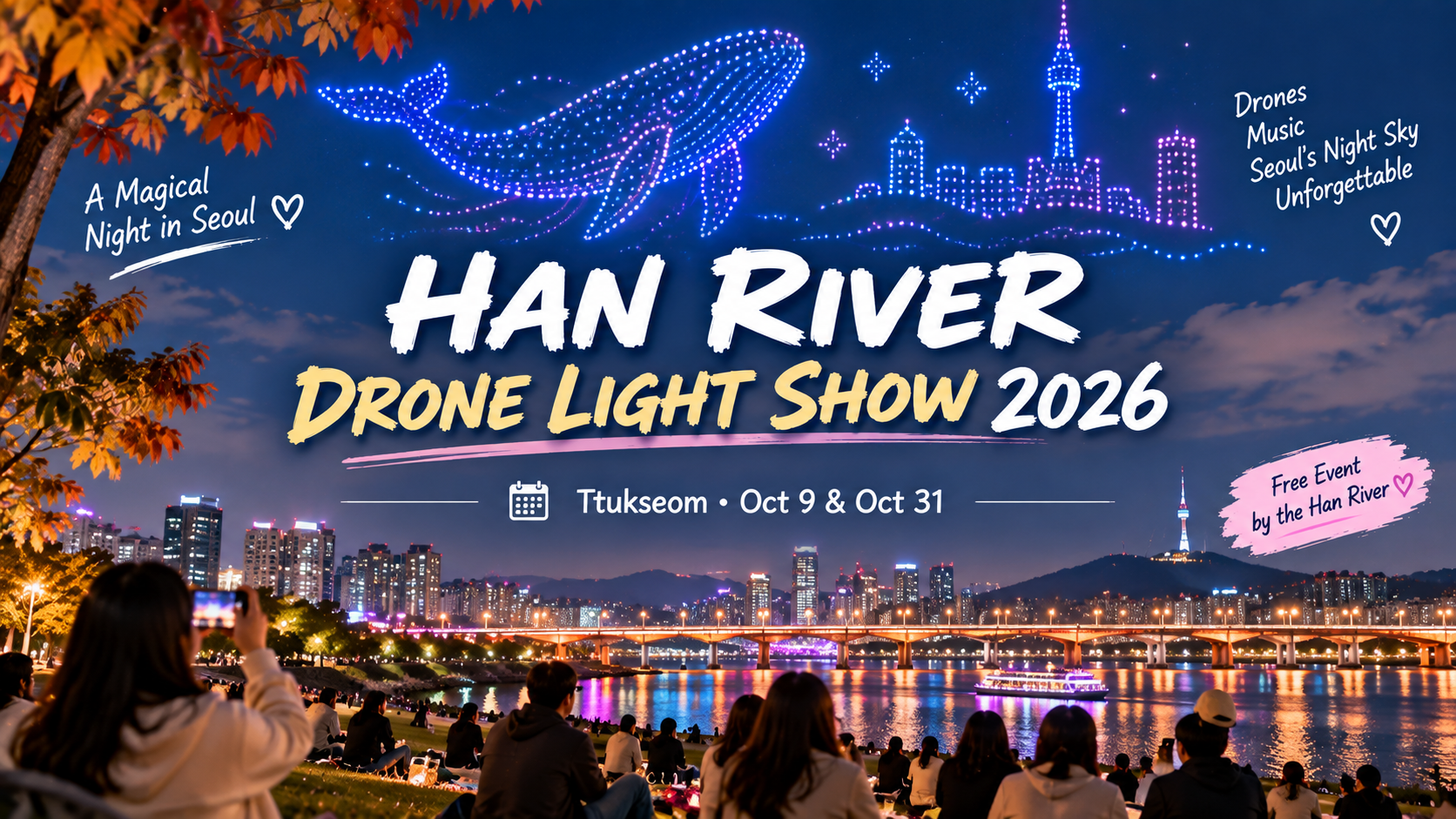
There are plenty of reasons to spend an evening by the Han River when visiting Seoul, but this autumn there is an especially good one.
The 2026 Han River Drone Light Show (한강 드론 라이트 쇼) is back at Ttukseom Hangang Park, with hundreds of synchronized drones turning the night sky into a giant moving canvas.
The first show of the autumn season took place on September 12, but travelers visiting Seoul in October still have two chances to see it: October 9 and October 31, 2026.
Best of all, the show is free and you do not need a reservation.
But there is one catch: it can get very crowded.
If you’re planning to go, knowing when to arrive, which subway exit to use, where to wait before the show and what happens if the weather turns bad can make a big difference.
Here’s what you need to know.
2026 Han River Drone Light Show at a Glance
The remaining autumn performances are:
Friday, October 9, 2026 Saturday, October 31, 2026
Location: Ttukseom Hangang Park (뚝섬한강공원), around the waterfront stage
Main drone show: 8:30 PM–8:45 PM
Pre-show cultural performances: 7:30 PM–8:30 PM
Post-show cultural performances: 8:45 PM–9:15 PM
Admission: Free
Reservation: Not required
Seoul’s official announcement confirms both remaining October dates and the 15-minute main performance. Because this is an outdoor drone event, the city also warns that the schedule may change because of rain, strong winds or other weather conditions.
This is important because older English travel information may still refer to this station as Ttukseom Resort Station (뚝섬유원지역). The station was renamed Jayang Station in 2024.
For Korean map apps, search:
뚝섬한강공원
or
자양역
For navigating Seoul, I recommend using Naver Map or Kakao Map rather than relying entirely on Google Maps.
Which Subway Exit Should You Use?
On a normal day, several exits provide access toward Ttukseom Hangang Park.
Drone-show days are different.
Seoul specifically recommends using Jayang Station Exit 1 because Exits 2 and 3 may be restricted for crowd-safety reasons during the event.
That is worth remembering because thousands of people may be leaving the park at roughly the same time after the show.
If the main Ttukseom underpass becomes congested, Seoul also recommends the nearby Noyu (노유나들목) or Jayang (자양나들목) access points.
What Is the Show Actually Like?
Don’t expect a traditional fireworks show.
Instead, hundreds of drones fly in synchronized formations, creating huge illuminated pictures and animations above the Han River.
The September 12 performance, for example, was themed around Korean professional baseball, with imagery inspired by Seoul’s three professional baseball teams and their fan culture. It ended with Seoul’s city-brand imagery across the night sky.
Each performance can have a different theme, which is part of the appeal.
The actual drone section lasts only about 15 minutes, but the overall event runs much longer because cultural performances take place before and after it.
That is why I wouldn’t recommend traveling all the way to Ttukseom simply to arrive at 8:25 PM and leave at 8:45 PM.
Make it a Han River evening instead.
What Time Should You Arrive?
For a comfortable experience, I would aim for:
6:30–7:00 PM
That may sound early for an 8:30 PM drone show, but there are several advantages.
You can walk around the river before dark, buy dinner or snacks, find a decent viewing area and avoid arriving during the biggest rush.
The cultural performances begin at 7:30 PM, so arriving around 7 PM also means there is something to watch while you wait.
If you want a particularly good position near the main waterfront stage, consider arriving even earlier.
Where Is the Best Place to Watch?
You don’t necessarily need to stand directly beside the stage.
What matters most is having a relatively unobstructed view of the sky above the river.
A little distance can actually make the drone formations easier to see because the images are designed on a very large scale.
Try to avoid standing immediately behind:
tall trees
tents or temporary structures
large groups holding phones overhead
structures that block the river-facing sky
If photography is important to you, arrive before sunset and choose your position while there is still enough light to understand the surroundings.
Bring Something to Sit On
This is a very Korean Han River habit worth copying.
Bring a small picnic mat — 돗자리 (dotjari) in Korean.
You can buy inexpensive mats around many Han River parks or convenience stores, although availability varies.
Sitting by the river with food before the show is far more pleasant than standing for two hours waiting for it to begin.
In October, however, the temperature can drop quickly after sunset.
A light jacket is a good idea even if the afternoon feels warm.
What Should You Eat?
Part of the fun of visiting the Han River is eating beside it.
Easy options include:
Convenience-store ramen
Many Han River convenience stores have machines for cooking instant noodles.
Kimbap
Cheap, portable and easy to eat outside.
Fried chicken
Ordering fried chicken to Hangang parks is practically a Seoul tradition, although delivery can be more complicated for visitors without a Korean phone number or Korean delivery app.
For foreign travelers, buying food before entering the busiest part of the park is often easier.
A Very Useful Waiting Spot: Hangang Plus Plus
Here’s a tip many foreign visitors won’t know.
Near Jayang Station is Hangang Plus Plus (한강플플), a renovated cultural space inside the distinctive structure formerly known as the Ttukseom J-Bug.
From August through December 2026, it is staying open until 10 PM on Fridays and Saturdays. Seoul specifically notes that it can be useful as a waiting and resting space for visitors coming to the drone show.
That matters if:
you arrive very early,
the weather becomes chilly,
you’re traveling with children,
or you simply don’t want to sit outside for several hours.
Search:
한강플플
Interestingly, the space connects directly toward Jayang Station Exit 3 under normal circumstances, although crowd-control arrangements around station exits can change during the drone event itself.
Can You Drive to Ttukseom Hangang Park?
Technically, yes.
Practically, I wouldn’t recommend it on drone-show night.
Seoul strongly recommends public transportation because of expected congestion. The city also warns that vehicles in Ttukseom Hangang Park’s Parking Lots 3 and 4 may face exit restrictions until around 9:30 PM after the performance.
That makes the subway much easier for most travelers.
Getting Back After the Show
This is probably the least enjoyable part of the evening.
Thousands of people may start walking toward Jayang Station at almost exactly the same time.
You have two strategies.
Option 1: Leave immediately
If you have children, an early morning the next day or a long subway journey back to your hotel, start moving as soon as the show finishes.
Option 2: Don’t leave immediately
The second cultural performance continues until around 9:15 PM.
Instead of joining the first giant wave heading to the subway, stay around for a little while.
Walk beside the river, watch the post-show performance or wait for the crowd to thin.
For many travelers, this is actually the more pleasant option.
What Happens If It Rains?
Always check before leaving your hotel.
Drone performances are much more sensitive to weather than normal concerts.
Rain matters, but wind matters too.
Even if Seoul looks relatively dry, conditions above the Han River can make drone operations unsafe.
The city explicitly states that performances may change depending on weather conditions and recommends checking the official event channels before visiting.
Can You Combine the Drone Show with Seongsu?
Absolutely — and this is probably my favorite itinerary.
Ttukseom Hangang Park is close enough to Seoul Forest and Seongsu to make them part of the same afternoon and evening.
Easy Half-Day Itinerary
2:00 PM — Seoul Forest
Walk through the park.
3:30 PM — Seongsu
Explore cafés, shops and pop-ups.
5:30 PM — Early dinner
Eat in Seongsu before heading toward the river.
6:30–7:00 PM — Ttukseom Hangang Park
Find your viewing spot.
7:30 PM — Cultural performance
8:30 PM — Drone Light Show
8:45 PM onward — Stay by the river or slowly head back
It’s a much better use of the day than crossing Seoul solely for a 15-minute show.
More Han River Events in Autumn 2026
The drone show is not the only reason the Han River is particularly interesting this autumn.
The Jamsugyo Bridge Festival is running on Sundays through October 25, turning the lower-level Jamsugyo Bridge into a car-free festival space.
Those articles pair naturally with the drone show because autumn 2026 is shaping up to be an unusually good season for experiencing Seoul along the river.
Korean Search Terms to Save
한강 드론 라이트 쇼 — Han River Drone Light Show 뚝섬한강공원 — Ttukseom Hangang Park 자양역 — Jayang Station 한강플플 — Hangang Plus Plus 뚝섬 수변무대 — Ttukseom Waterfront Stage
Copying the Korean term directly into Naver Map or Kakao Map usually gives better results than searching in English.
Final Tips
The Han River Drone Light Show isn’t something I’d build an entire Seoul trip around.
But if your dates match October 9 or October 31, it is absolutely worth adding to your itinerary.
It’s free, easy to reach by subway and gives you an excuse to spend an autumn evening the way many Seoul residents do: eating by the river, watching the sunset and staying until the city lights come on.
Just remember three things:
Arrive early. Use public transportation. Check the weather before you go.
And if you’re still deciding how to structure the rest of your trip, read:
What if one of Seoul’s islands turned into a giant outdoor light-art gallery after dark?
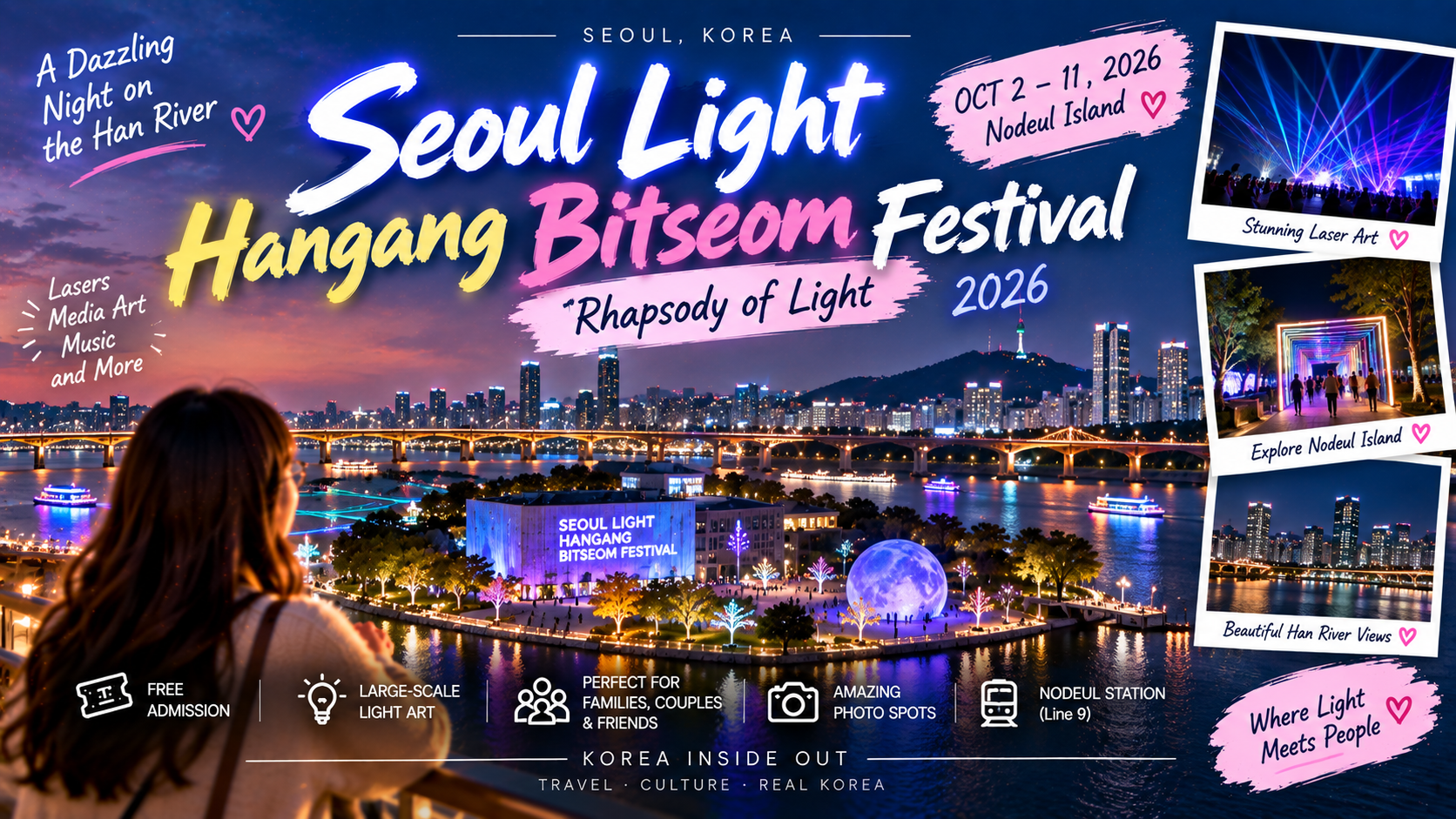
This October, Nodeul Island will become the stage for one of Seoul’s most spectacular nighttime events: the 2026 Seoul Light Hangang Bitseom Festival.
From October 2 to 11, 2026, visitors can explore large-scale laser installations, media art, projection mapping, light walks and audiovisual works across Nodeul Island.
And the best part?
Admission is free.
The 2026 festival is titled “Rhapsody of Light”, bringing together light, nature, technology and the Han River in a festival designed to be experienced after sunset.
If you are visiting Seoul in October and looking for something different from the usual palaces, shopping streets and nightlife, this is one event worth putting on your itinerary.
Seoul Light Hangang Bitseom Festival 2026 at a Glance
Details
Dates
October 2–11, 2026
Time
6:30 PM–10:30 PM
Location
Nodeul Island, Seoul
Admission
Free
Main theme
Rhapsody of Light
Main programs
Laser Art, Light of Companionship, Bitseom Lecture
Best time to visit
After sunset
Best for
Couples, photographers, families, art lovers and first-time visitors
Nearest subway
Nodeul Station, Line 9
The official festival describes Bitseom as Korea’s largest waterfront laser-art festival. It rotates among six Han River islands, and 2026 marks the festival’s Nodeul Island edition. Previous editions were held at Seorae Island in 2023, Yeouido in 2024 and Ttukseom in 2025.
What Is the Seoul Light Hangang Bitseom Festival?
The Seoul Light Hangang Bitseom Festival is a nighttime media-art festival built around the Han River.
Rather than putting all the artwork inside a gallery, the festival uses the landscape itself as part of the exhibition.
Bridges become canvases.
Walking paths become light trails.
Open spaces become stages for laser installations.
Buildings and indoor venues become screens for video and kinetic works.
And the Han River provides the backdrop.
The festival’s central concept is called “Bitseom 3L”, referring to three major programs:
Laser Art
Light of Companionship
Bitseom Lecture
For 2026, these programs are brought together under the theme “Rhapsody of Light.”
2026 Theme: Rhapsody of Light
The 2026 festival takes a slightly different approach from simply filling the island with colorful lights.
The theme, Rhapsody of Light, uses the natural elements of the Han River as part of a larger story.
The festival connects the energies of:
Water
Fire
Earth
Air
Life
The idea is to use light as a bridge between nature, art, technology and the city.
That makes Nodeul Island particularly suitable as the setting.
The island sits in the middle of the Han River, surrounded by water and connected to Seoul’s urban landscape.
During the day, it is a peaceful riverside destination.
At night, it becomes a completely different environment.
1. Laser Art: The Main Attraction
If you only have time for one part of the festival, make it Laser Art.
The Laser Art program runs throughout the festival:
October 2–11 6:30 PM–10:30 PM
Large-scale laser installations and media artworks will be placed across Nodeul Island.
But this isn’t simply a laser show that you stand in one place and watch.
The exhibition is spread throughout the island.
As you walk from one area to another, different forms of light and media art appear around you.
The official festival information describes outdoor large-scale laser installations and media art, along with light walking paths and projection mapping around the connecting bridges and entrance areas.
That makes the experience closer to an open-air nighttime art walk than a conventional performance.
Walk Through a Landscape Made of Light
One of the most appealing aspects of the festival for travelers is that you don’t have to understand contemporary art to enjoy it.
You can simply walk.
Follow a glowing path.
Stop in front of a laser installation.
Watch light move across a surface.
Take photographs.
Then continue toward another part of the island.
This makes the festival particularly accessible to international visitors.
There is no language barrier when the main attraction is light, movement, sound and visual effects.
And because the exhibition is spread across Nodeul Island, you can experience it at your own pace.
2. Light of Companionship
The second part of the 3L program is Light of Companionship.
In 2026, it is scheduled for four evenings:
October 3
October 4
October 9
October 10
The program runs from 7:30 PM to 8:30 PM on those dates.
Unlike the Laser Art exhibition, which runs throughout the festival period, Light of Companionship is a more specific scheduled program.
If you want to experience as much of the festival as possible, these four dates are particularly useful.
Our tip: If your Seoul trip overlaps with October 3, 4, 9 or 10, consider choosing one of those evenings for your visit.
You can arrive before 7:30 PM, explore the Laser Art installations first, then stay for Light of Companionship.
3. Bitseom Lecture: Light, Technology and Art
The third part of the festival is Bitseom Lecture.
Rather than simply looking at light art, the lecture program explores the ideas and technology behind it.
The official schedule lists the lecture program throughout the festival period, from October 2–11, 6:30 PM–10:30 PM.
For visitors interested in how media art is created, this can add another layer to the experience.
Instead of simply asking:
“How did they make that?”
you can learn more about the relationship between light, technology and contemporary art.
The detailed program should be checked on the official festival website as the event approaches because individual lecture schedules and participation information may be updated.
The Festival Also Extends Indoors
Don’t assume everything happens outside.
One of the interesting features of the 2026 edition is the combination of outdoor and indoor media art.
Inside Nodeul Island’s facilities, the festival will present:
Kinetic art
Installations
Video works
Audiovisual performances
University participation programs
So if you visit and the evening becomes chilly, there are still indoor components to explore.
The result is a festival that moves between the island’s natural environment and its built spaces.
Why Nodeul Island Is the Perfect Location
Nodeul Island is already one of Seoul’s more interesting Han River destinations.
Located in the middle of the river, it has a combination of:
Riverside views
Open lawns
Walking paths
Cultural spaces
Restaurants and cafés
Performance venues
Views of Seoul’s bridges and skyline
At night, the island becomes particularly atmospheric.
The lights of the surrounding city reflect on the Han River.
Bridges stretch across the water.
And the island’s own lighting and festival installations add another layer.
During the Bitseom Festival, the island essentially becomes an outdoor nighttime art district.
The Best Time to Visit
Don’t arrive at 6:30 PM and immediately leave after taking a few photographs.
The best experience is to stay for several hours.
6:30 PM — Arrive at Nodeul Island
The festival opens.
Start exploring the outdoor installations while the sky is transitioning from blue hour to darkness.
7:00 PM — Explore the Laser Art
Walk through the light installations and projection areas.
7:30 PM — Light of Companionship
If you are visiting on October 3, 4, 9 or 10, watch the scheduled program.
8:30 PM — Explore the indoor works
Take a look at the kinetic art, video works and installations.
9:00 PM — Walk along the riverside
Step away from the main festival areas for a moment.
Look back toward Seoul’s skyline and bridges.
9:30 PM — Return to the main exhibition
This is a good time for nighttime photography because the surroundings are fully dark.
10:30 PM — Festival closes
Head back toward the subway or continue your evening in Yongsan.
A Great October Date Night in Seoul
If you’re traveling as a couple, Bitseom Festival can easily become a full evening date.
Start with dinner around Yongsan or Ichon.
Then head to Nodeul Island.
Walk through the light installations.
Take photographs beside the Han River.
Stop for a drink.
Watch the scheduled evening program if you’re visiting on one of the Light of Companionship dates.
Then finish with a nighttime walk along the river.
Unlike a conventional exhibition, there is no need to spend two hours standing quietly inside a gallery.
You can talk, walk and explore at your own pace.
A Good Option for Families Too
The festival isn’t just for couples or art enthusiasts.
Families can also enjoy it.
Children tend to respond naturally to:
Bright lights
Moving images
Projection mapping
Large-scale installations
Interactive-looking environments
And because much of the experience takes place outdoors, children have more room to move around than they would in a conventional museum.
The only thing to keep in mind is the late operating time.
If you’re traveling with younger children, an earlier visit around 6:30–8:30 PM may be more comfortable.
Why Photographers Should Visit
This may be one of the most photogenic Seoul events of October.
The festival gives you several layers to work with:
Foreground: Light installations
Middle ground: People walking through the exhibition
Background: Han River and bridges
Far background: Seoul skyline
This combination makes it possible to take photographs that feel distinctly like Seoul rather than simply photographs of an art installation.
Try photographing the lights with:
Banpo Bridge
Hangang bridges
Reflections on the river
Seoul’s skyline
People walking through the installations
And don’t forget to turn around.
Sometimes the best photograph isn’t the artwork itself.
It is the artwork with Seoul behind it.
How to Get to Nodeul Island
Nodeul Island is accessible by public transportation.
By Subway
The easiest options include:
Nodeul Station — Line 9
From the station, walk toward Nodeul Island.
You can also approach from:
Yongsan Station — Line 1
or
Sinyongsan Station — Line 4
The Seoul Culture Portal lists all three stations as walking-access options.
For most visitors, Nodeul Station on Line 9 is the most straightforward choice.
By Bus
A number of buses also serve the surrounding area, including routes such as 150, 151, 152, 500, 501, 504, 506, 507, 605, 750A, 750B, 751 and 752.
Because the festival is expected to attract large crowds, public transportation is the better option.
What Should You Bring?
Comfortable shoes
You will be walking around the island.
A light jacket
October evenings in Seoul can feel cool, especially beside the Han River.
Your phone or camera
This is definitely an event where you’ll want one.
Portable battery
You may take far more photos and videos than expected.
A small umbrella
October is generally pleasant, but autumn rain is always possible.
Patience
Some of the most photogenic installations may attract crowds.
Wait a few minutes and you’ll usually get a better view.
Is the Festival Free?
Yes.
The 2026 Seoul Light Hangang Bitseom Festival is free to visit, although some individual programs may have separate participation or reservation procedures.
The official festival terms state that the festival itself is free and that advance reservations are required for programs where specified.
This makes it particularly attractive for travelers who want a memorable Seoul night without spending money on an expensive attraction.
Seoul Light DDP vs. Bitseom Festival
If you are interested in Seoul’s nighttime media-art scene, you may also come across Seoul Light DDP.
The two experiences are quite different.
Seoul Light DDP
Bitseom Festival
Setting
DDP in central Seoul
Nodeul Island in the Han River
Main style
Large-scale façade media art
Laser art + installations + light walk
Atmosphere
Urban and futuristic
Riverside and immersive
Best for
Architecture + media art
Nature + light + river views
Photography
DDP architecture
Han River + light installations
Admission
Free
Free
If you have already visited Seoul Light DDP this autumn, Bitseom is a good way to experience a completely different side of Seoul’s nighttime art scene.
Replace the DDP link with the published Seoul Light DDP article URL if needed.
Combine Bitseom Festival With a Han River Evening
You don’t have to spend the entire day on Nodeul Island.
Instead, make it the final stop of a Han River itinerary.
Option 1: Yongsan + Nodeul Island
Afternoon: Explore Yongsan
↓
Dinner: Yongsan or Ichon
↓
6:30 PM: Nodeul Island
↓
Evening: Bitseom Festival
Option 2: Han River + Nodeul Island
Late afternoon: Walk along Ichon Hangang Park
↓
Sunset: Enjoy the river
↓
6:30 PM: Head to Nodeul Island
↓
Night: Bitseom Festival
This is probably the most relaxed option.
How Long Should You Spend at the Festival?
For a quick visit:
1–1.5 hours
You can see several major installations and take photographs.
For a relaxed visit:
2–3 hours
This is what I recommend.
You will have enough time to explore the outdoor works, look around the indoor spaces and enjoy the Han River atmosphere.
For visitors attending Light of Companionship:
3–4 hours
Arrive before the scheduled program, explore the Laser Art first, watch the program, then continue exploring afterward.
When Should You Go?
October 2
Best for opening-night atmosphere.
October 3–4
Best if you want to combine Laser Art with Light of Companionship.
October 9–10
Another excellent weekend because Light of Companionship returns.
October 11
Last chance to experience the festival.
If you have flexibility, I would choose October 3, 4, 9 or 10 because these dates combine the main Laser Art exhibition with the scheduled Light of Companionship program.
What Makes Bitseom Different From Other Seoul Light Festivals?
Seoul now has several major nighttime light-art events.
But Bitseom has a particularly strong identity because it combines light and the Han River.
At DDP, architecture is the canvas.
At Bitseom, the environment is much larger.
You have:
Island + river + bridges + skyline + trees + light + sound.
That makes the experience feel less like watching a projection and more like entering a temporary nighttime landscape.
And because the festival moves between different Han River islands each year, the same concept can feel completely different depending on the location.
The 2026 Nodeul Island edition is particularly interesting because Nodeul is itself a cultural destination rather than simply a park.
Practical Tips for International Visitors
Check the official schedule before visiting
The festival website is the best place to confirm detailed program information, especially for scheduled programs and reservations.
Visit after sunset
The festival is designed for nighttime viewing.
Don’t stay in one spot
Part of the fun is exploring the island.
Wear comfortable shoes
You’ll walk more than you expect.
Bring a jacket
The riverside can feel cooler than central Seoul.
Use public transportation
The island can become crowded during major events.
Allow extra time
Don’t schedule another attraction immediately after the festival.
Give yourself time to enjoy the riverside atmosphere.
Is Seoul Light Hangang Bitseom Festival Worth Visiting?
Yes — especially if you want to experience a more contemporary side of Seoul.
The festival isn’t simply a collection of pretty lights.
It brings together contemporary art, technology and one of Seoul’s defining natural landscapes.
For international visitors, it also has another major advantage:
you don’t need to speak Korean to enjoy it.
You can walk.
Look.
Listen.
Take photographs.
And experience Seoul’s Han River at night.
The 2026 Seoul Light Hangang Bitseom Festival is also completely free, making it one of the easiest high-impact evening activities to add to an October itinerary.
Seoul Light Hangang Bitseom Festival 2026: Quick Summary
Dates: October 2–11, 2026
Time: 6:30 PM–10:30 PM
Location: Nodeul Island
Theme:Rhapsody of Light
Admission: Free
Main programs:
Laser Art: October 2–11, 6:30–10:30 PM
Light of Companionship: October 3–4 & October 9–10, 7:30–8:30 PM
Bitseom Lecture: October 2–11
Best for: Night photography, couples, families, contemporary art, Han River views
Nearest subway: Nodeul Station, Line 9
Final Thoughts
There are many ways to experience Seoul at night.
You can climb a tower.
Walk through a busy shopping district.
Visit a palace under the lights.
Or sit beside the Han River.
But for ten nights in October, Nodeul Island offers something different.
The island becomes a canvas.
Laser installations appear among the trees.
Light trails lead you across the island.
Projection mapping transforms ordinary spaces.
The river reflects the glow.
And Seoul’s skyline becomes part of the artwork.
If you are visiting Seoul between October 2 and 11, 2026, put Nodeul Island after dark on your itinerary.
Bring your camera, wear comfortable shoes, and give yourself a few hours.
Looking for an easy escape from Seoul this autumn?
Just outside the capital, an island in the middle of the Bukhangang River is turning into a huge garden filled with colorful seasonal flowers.
Jaraseom Flower Festa 2026 runs from September 12 to October 5, 2026, in Gapyeong, a popular day-trip destination east of Seoul.
And this isn’t just a place to look at flowers.
You can walk through large flower gardens, watch weekend performances, try small hands-on activities, buy local products and snacks, and even enjoy views of the river from a boat.
If you’re visiting Korea in September or early October, Jaraseom is one of our favorite ideas for a relaxing autumn day trip from Seoul.
You pay ₩7,000 to enter, but ₩5,000 is returned in local currency that can be used at participating businesses in Gapyeong.
That means the effective cost of visiting can feel much lower if you’re planning to eat, drink coffee or buy something locally during your trip.
🌼 What Is Jaraseom Flower Festa?
Jaraseom (자라섬) is an island in Gapyeong surrounded by the Bukhangang River.
It’s actually made up of four sections — East, West, Middle and South islands — and has become one of Gapyeong’s best-known outdoor destinations.
You may also recognize the name because Jaraseom is home to the famous Jarasum Jazz Festival.
But during spring and autumn, flowers take center stage.
The southern section of Jaraseom is transformed into a large seasonal flower garden, creating long walking paths surrounded by colorful blooms.
For international visitors staying in Seoul, the biggest appeal is simple:
You can escape the city and experience the Korean countryside without traveling very far.
🌺 What Flowers Can You See?
The exact appearance of the gardens depends on weather and blooming conditions, but Jaraseom’s autumn displays typically feature a mixture of colorful seasonal flowers.
Previous autumn gardens have included flowers such as:
Zinnias
Sunflowers
Penstemon
Cleome
Petunias
Korean chrysanthemums
Asters
Rather than visiting for one famous flower, the attraction here is the variety.
Different sections of the garden create completely different colors and backgrounds.
One moment you might be walking beside bright yellow flowers.
A few minutes later, you’re surrounded by pink, purple and red.
And behind everything is the river and the surrounding mountains of Gapyeong.
That’s what makes Jaraseom particularly photogenic.
📸 Why Jaraseom Is Great for Photos
If photography is one of the reasons you’re traveling in Korea, give yourself some extra time here.
The scenery isn’t limited to close-up flower photos.
You can photograph:
flowers + mountains
flowers + river
flowers + open sky
flowers + walking paths
That combination gives Jaraseom a completely different atmosphere from flower gardens inside Seoul.
It feels much more open.
Our tip
Try visiting in the late afternoon if the weather is clear.
The midday sun can be quite strong even in September, while the softer afternoon light tends to work better for portraits and landscape photos.
It also makes the temperature more comfortable for walking.
🎵 There’s More Than Just Flowers
The Flower Festa isn’t simply an outdoor garden.
On weekends and public holidays, additional programs are scheduled around the festival.
Visitors can expect activities such as:
🎤 Busking & Live Performances
Busking performances and shows by local artists add a festival atmosphere to the gardens.
If you prefer a quieter visit focused mostly on photography, a weekday may be better.
If you want more energy and activities, choose a weekend.
🎈 Family Activities
Hands-on activities such as balloon art are also planned, making the festival an easy option for families traveling with children.
🛍️ Local Products
Local agricultural and specialty products from the Gapyeong area are sold at the festival.
This is also where the local-currency refund becomes useful.
☕ Food & Snacks
Food and drink booths operate around the festival area.
The official festival information currently lists examples including:
Tteokbokki
Chicken skewers
Bungeoppang
Eomuk
Drinks
Bakery items
Don’t expect a giant night market, though.
We’d treat the food stalls as snacks rather than the main reason to visit.
🚢 See Jaraseom from the Water
One of the more unusual additions to the Flower Festa is the opportunity to experience the surrounding Bukhangang River from the water.
Boat services are being operated in connection with the festival, allowing visitors to combine the flower gardens with views of the river.
Gapyeong is surrounded by mountains and water, so seeing the landscape from a boat offers a completely different perspective from walking through the gardens.
If the weather is good and you have enough time, this can turn a simple flower-garden visit into a much more complete Gapyeong day trip.
Boat operations can be affected by weather and operating conditions, so check the latest information when you arrive.
🚗 Getting Around Jaraseom Is Easier Than You Might Think
Jaraseom is bigger than it first appears.
Fortunately, during the festival an electric vehicle service runs between the entrance area and the vicinity of the festival grounds.
This can be especially useful for:
Families with young children
Older travelers
Visitors carrying camera equipment
Anyone who doesn’t want to spend the entire day walking
That said, comfortable shoes are still highly recommended.
This is fundamentally an outdoor walking festival.
🚆 How to Get to Jaraseom from Seoul
For most international travelers, public transportation is the easiest option.
The main gateway is Gapyeong Station (가평역).
From Seoul, you can travel toward Gapyeong using rail services along the Gyeongchun corridor, including ITX-Cheongchun depending on your departure point and schedule.
Once you arrive at Gapyeong Station, continue toward Jaraseom by local transportation or taxi.
Because routes and schedules can change, check your preferred Korean navigation app on the day of your trip.
Our tip
Don’t search only for “Jaraseom.”
Try searching the Korean name as well:
자라섬
And for the festival:
자라섬 꽃 페스타
Korean navigation apps often provide more accurate local transportation information when you use the Korean destination name.
🗺️ Make It a Full Gapyeong Day Trip
You don’t necessarily need to return to Seoul immediately after seeing the flowers.
Gapyeong is one of the most popular day-trip areas around Seoul.
And one famous destination is extremely close.
Jaraseom + Nami Island
Nami Island is only a short distance from Jaraseom, making these two places an obvious combination.
A possible itinerary could look like this:
Morning
Leave Seoul
↓
Late Morning
Explore Nami Island
↓
Lunch
Eat around Gapyeong
↓
Afternoon
Visit Jaraseom Flower Festa
↓
Late Afternoon
Walk through the flower gardens and take photos
↓
Evening
Dinner or café in Gapyeong
↓
Night
Return to Seoul
This works particularly well for travelers who want to spend one full day outside Seoul without constantly changing destinations.
🍂 Why September Is a Great Time to Visit Gapyeong
There’s another reason we like this trip.
September sits between Korea’s hot summer and peak autumn foliage season.
The mountains aren’t necessarily covered in red and orange leaves yet.
But the air gradually becomes cooler, outdoor festivals return, and spending several hours walking outside becomes much more enjoyable.
Flowers give you the autumn colors before the trees fully change.
We think so — especially because of the refund system.
The entrance fee is ₩7,000, but visitors receive ₩5,000 back in Gapyeong local currency.
You can use the refunded value at participating festival booths as well as eligible restaurants and cafés around Gapyeong.
So instead of thinking of it as simply paying ₩7,000 to enter a flower garden, think of it as:
₩7,000 admission → ₩5,000 returned to spend locally
If you’re already planning to buy a snack, coffee or meal in Gapyeong, it’s a pretty visitor-friendly system.
Gapyeong residents can enter free.
👨👩👧 Is Jaraseom Flower Festa Good for Families?
Yes.
In fact, this may be one of the easier autumn festivals for families.
There’s plenty of open space, the main attraction doesn’t require standing in one place for a performance, and children can simply walk around and explore.
The additional activities such as balloon art also give younger visitors something to do beyond looking at flowers.
Just remember that Jaraseom is large.
If you’re visiting with small children, don’t try to see every corner of the island.
Pick the flower gardens and a few nearby activities and keep the day relaxed.
💑 Is It Good for Couples?
Definitely.
If Seoul’s cafés and shopping districts are starting to feel a little repetitive, Jaraseom offers a completely different kind of date.
You can walk through the gardens, take photos together, sit beside the river and stop at a café in Gapyeong before returning to Seoul.
For couples visiting Korea in autumn, we’d put this in the same category as a Nami Island or foliage day trip:
easy, scenic and slow-paced.
⏰ When Should You Visit?
There are two ways we’d approach it.
Weekday
Choose a weekday if your priority is:
Photography Quiet walks Fewer people Relaxing in the gardens
Weekend or Public Holiday
Choose a weekend if you want:
Busking Local performances More festival atmosphere Additional activities
For photography, we’d lean toward a weekday afternoon.
For families, a weekend may be more fun.
⚠️ Things to Know Before You Go
Check the flowers before traveling
Flower conditions depend on weather.
If you’re making the trip mainly for photography, check recent official updates or social media before leaving Seoul.
Wear comfortable shoes
You’ll probably walk more than you expect.
Bring sun protection
September in Korea can still be sunny and warm during the afternoon.
Bring a light layer later in the season
By late September and early October, temperatures can feel noticeably cooler after sunset.
Check boat operations
River services may change depending on weather and operating conditions.
Keep some flexibility
Outdoor festival programs can change because of rain or other conditions.
🌸 Is Jaraseom Flower Festa Worth a Day Trip from Seoul?
If you only have two or three days in Seoul, probably not.
There are simply too many major sights to see in the city.
But if you have five days or longer, Jaraseom becomes much more interesting.
It’s particularly good for travelers who want:
🌸 Autumn flowers 📸 Photography 🏞️ Korean countryside scenery 💑 A relaxing couple’s day trip 👨👩👧 A family-friendly outdoor activity 🚆 An easy escape from Seoul
Festival dates: September 12 – October 5, 2026 Location: Jaraseom, Gapyeong, Gyeonggi-do Address: 60 Jaraseom-ro, Gapyeong-eup, Gapyeong-gun Admission: ₩7,000 (₩5,000 refunded in Gapyeong local currency) Inquiry: 031-580-2601
Festival schedules, flower conditions, boat services and individual programs may change depending on weather and on-site conditions. Check the latest official information before traveling.