Category: What’s On in Korea

  • 3 Free Observation Decks Near Seoul City Hall: Where to See Seoul at Night

    3 Free Observation Decks Near Seoul City Hall: Where to See Seoul at Night

    You don’t have to pay for an expensive observation deck to enjoy a great view of Seoul.

    In fact, some of the city’s most interesting viewpoints are completely free.

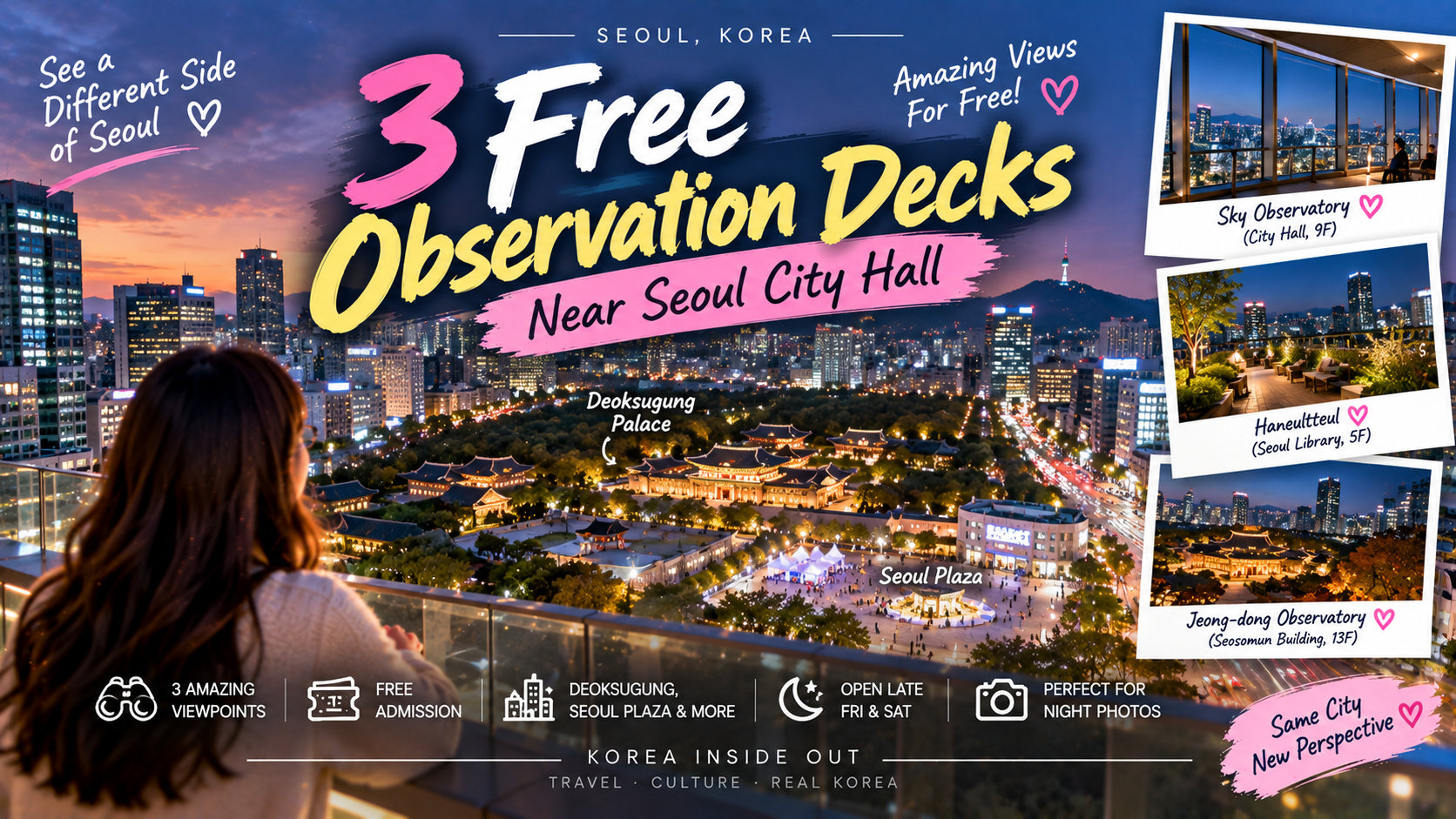
    Around Seoul City Hall, three public observation spaces offer very different views of central Seoul: Sky Observatory at Seoul City Hall, Haneultteul Rooftop Garden at Seoul Library, and Jeong-dong Observatory.

    The best part?

    Since September 2026, all three have been available for evening visits on Fridays and Saturdays, making them an easy addition to a Seoul night itinerary.

    From one viewpoint, you can look down on Deoksugung Palace.

    From another, Seoul Plaza and the bright lights of Sejong-daero spread out below you.

    And from the third, you can enjoy the historic Deoksugung area from above while having a drink at a rooftop café.

    Here is how to visit all three.

    Seoul City Hall’s Free Observation Decks at a Glance

    Observation spotBest viewNight hours
    Sky ObservatoryDeoksugung, Gwanghwamun, Sungnyemun & central SeoulFri–Sat until 10 PM
    HaneultteulSeoul Plaza & Sejong-daeroFri until 9 PM
    Jeong-dong ObservatoryDeoksugung & Jeong-dongFri–Sat until 10 PM
    AdmissionFreeNo admission fee
    Best timeAround sunset and after dark—

    The three spaces are close enough to combine into one evening walk, although their operating hours differ.

    The City Hall area is also surrounded by some of Seoul’s best-known attractions, including Deoksugung Palace, Seoul Plaza, Seoul Library and Jeong-dong.

    That makes this much more than simply a trip to an observation deck.

    It can become a free Seoul night-view walking route.


    1. Sky Observatory: The Best Overall City View

    Start at Sky Observatory (Haneul Jeonmangdae) inside Seoul City Hall.

    The observation space is located on the 8th and 9th floors of the main City Hall building, with the 9th floor serving as the main viewing area.

    Large windows give you a panoramic view over central Seoul.

    Look toward one direction and you can see the long stretch of Sejong-daero.

    Turn another way and you’ll see the traditional roofs of Deoksugung Palace.

    The distinctive red roof of Seoul Anglican Cathedral also stands out among the modern city buildings.

    This mixture of old and new is one of the most interesting aspects of the view.

    You’re looking at a royal palace, historic buildings and modern Seoul skyscrapers at the same time.

    What Can You See?

    From Sky Observatory, you can see landmarks and areas including:

    • Deoksugung Palace
    • Gwanghwamun
    • Sejong-daero
    • Sungnyemun Gate
    • Seoul City Hall
    • Seoul Anglican Cathedral
    • Central Seoul’s surrounding skyline

    The view is particularly attractive after sunset, when traffic along Sejong-daero creates long lines of lights through the city.

    If this is your first visit to Seoul and you want one free viewpoint that gives you a broad introduction to central Seoul, this is probably the one to choose.


    How to Visit Sky Observatory

    The entrance is inside the main Seoul City Hall building.

    You can enter through the City Hall lobby and take the dedicated elevator to the observation area.

    There is no admission fee and no advance reservation is required.

    Opening hours

    Monday–Thursday: 7:30 AM–6:00 PM

    Friday–Saturday: 7:30 AM–10:00 PM

    During November and December, the evening closing time is scheduled to move earlier to 9:00 PM.

    If you’re visiting specifically for the night view, Friday or Saturday evening is the easiest time to combine it with the other observation spaces.


    2. Haneultteul: A Rooftop Garden Above Seoul Plaza

    The second viewpoint is completely different.

    Haneultteul is the rooftop garden on the 5th floor of Seoul Library, the former Seoul City Hall building.

    Instead of looking through large windows, you step outside into an actual rooftop garden.

    Trees, plants and subtle lighting surround the space.

    And below you is Seoul Plaza.

    This is perhaps the most atmospheric of the three viewpoints.

    You are not simply looking at Seoul from a high floor.

    You are sitting above the city with the evening air around you.

    The View from Haneultteul

    Look down and you’ll see Seoul Plaza.

    Depending on the evening, you may see:

    • The illuminated Seoul Plaza
    • People relaxing in the outdoor library
    • Sejong-daero
    • Seoul City Hall
    • Historic and modern buildings around the square

    The view is particularly interesting when an event is taking place at Seoul Plaza.

    You may be able to see the lights, stage or crowds from above.

    This gives you a completely different perspective from street level.


    Why Haneultteul Feels Different

    If Sky Observatory is about panoramic city views, Haneultteul is about atmosphere.

    It is an outdoor rooftop garden.

    You can feel the breeze.

    You can see the trees and plants around you.

    And you are close enough to the city that you can hear the activity below.

    For couples, this may actually be the most romantic of the three viewpoints.

    It feels more like a hidden rooftop garden than a conventional observation deck.


    Haneultteul Opening Hours

    The rooftop garden is open:

    Tuesday–Friday: 9:00 AM–9:00 PM

    Saturday–Sunday: 9:00 AM–6:00 PM

    It is closed during the winter period from December through February.

    Because the evening hours are different from Sky Observatory, check the operating hours carefully if you’re trying to visit multiple viewpoints in one night.


    3. Jeong-dong Observatory: The Most Romantic View

    The third location is Jeong-dong Observatory, on the 13th floor of Seoul City Hall’s Seosomun Building.

    If you’re interested in Korean history, this may be your favorite.

    The view focuses on Deoksugung Palace and the historic Jeong-dong neighborhood.

    Instead of looking primarily at modern skyscrapers, you see palace roofs, historic buildings and the tree-lined streets of Jeong-dong.

    The result is a much quieter and more historic view of Seoul.


    Have a Drink While Looking at Deoksugung

    One of the biggest advantages of Jeong-dong Observatory is the café.

    The Cafe Darak is located inside the observatory.

    You can sit down with a cup of tea or coffee while looking out toward Deoksugung.

    This makes Jeong-dong Observatory particularly appealing if you don’t simply want to take photographs and leave.

    You can slow down.

    Have a drink.

    Watch the city lights come on.

    And look down at the palace.

    The observatory was recently expanded to around 2.8 times its previous size, giving visitors a more comfortable space to enjoy the view.


    Jeong-dong Observatory Opening Hours

    Monday–Thursday: 1:30 PM–5:30 PM

    Friday: 1:30 PM–10:00 PM

    Saturday: 9:00 AM–10:00 PM

    During the winter period from December through February, the evening closing time moves earlier.

    Unlike some observation decks, Jeong-dong Observatory does not require you to buy an expensive ticket.

    Admission is free.


    Which Observation Deck Is Best?

    If you only have time for one, choose according to what you want to see.

    If you want…Go to…
    A broad Seoul city viewSky Observatory
    Deoksugung + modern SeoulSky Observatory
    Seoul Plaza from aboveHaneultteul
    An outdoor rooftop gardenHaneultteul
    A romantic atmosphereJeong-dong Observatory
    Deoksugung Palace from aboveJeong-dong Observatory
    Coffee + a viewJeong-dong Observatory
    The best first-time visitor optionSky Observatory
    A quiet eveningJeong-dong Observatory

    The nice thing is that you don’t necessarily have to choose.

    You can visit all three as part of one evening.


    The Best Free Seoul Night View Route

    If you want to make the most of the area, I recommend visiting them in this order:

    Stop 1 — Sky Observatory

    Start at Seoul City Hall.

    Go up to the 9th floor and see central Seoul from above.

    Spend around 30–45 minutes here.

    ↓

    Stop 2 — Seoul Plaza

    Come back down to street level.

    Walk across Seoul Plaza and take a look at Seoul City Hall from outside.

    If the Reading Seoul Plaza outdoor library is operating, this is a great time to stop and relax.

    ↓

    Stop 3 — Haneultteul

    Walk into the old City Hall building, now Seoul Library.

    Take the elevator to the rooftop garden.

    Enjoy the view over Seoul Plaza.

    ↓

    Stop 4 — Deoksugung Stone Wall Road

    Walk along the famous Deoksugung Stone Wall Road toward Jeong-dong.

    This is one of the most atmospheric walking routes in central Seoul, especially after sunset.

    ↓

    Stop 5 — Jeong-dong Observatory

    Finish your evening on the 13th floor.

    Have a drink at Cafe Darak.

    Look down at Deoksugung Palace.

    This gives you three completely different perspectives of Seoul in one evening.


    Don’t Miss Deoksugung at Night

    One of the reasons this route works so well is that Deoksugung Palace is right next to the observation spaces.

    After seeing Seoul from above, you can walk along the palace walls.

    The palace itself may not always be open for nighttime entry, but the exterior and surrounding streets are beautiful after dark.

    There is also a nighttime royal guard-changing ceremony at Daehanmun Gate on selected evenings.

    So if you’re planning your visit around a Friday or Saturday night, check the current schedule.

    You could potentially combine:

    City Hall viewpoint → Seoul Plaza → Deoksugung → Jeong-dong → dinner

    into one easy evening.


    Add Seoul’s Outdoor Library

    Another nice bonus is Reading Seoul Plaza, the city’s outdoor library program.

    The library turns Seoul Plaza into a large open-air reading and relaxation space with books, beanbags and evening programming.

    During September, the nighttime program operates from 4:00 PM to 10:00 PM on Fridays through Sundays.

    That means you can go up to Haneultteul and literally look down at people relaxing and reading below.

    It creates a surprisingly beautiful city scene.

    If you’re visiting Seoul in September, this is an easy combination to add to your itinerary.


    Join the Nighttime City Hall Tour

    If you want more than just the views, Seoul has also introduced a new Night Tongtong Tour.

    Starting September 18, the guided tour operates every Friday and Saturday from 7:30 PM to 8:30 PM.

    A professional guide takes visitors through parts of Seoul City Hall before finishing with nighttime views.

    The route includes:

    • City Hall’s 1st-floor model
    • Seoul Gallery
    • Vertical garden
    • Robot café
    • Sky Observatory
    • Lounge
    • Seoul Library’s Haneultteul on Fridays

    The tour requires advance online reservation.

    For travelers who want to understand the building and its history rather than simply take photographs, this is a particularly interesting option.


    A Perfect Free Evening in Central Seoul

    You can build an entire evening around these viewpoints without spending much money.

    5:00 PM — Gwanghwamun

    Start your evening around Gwanghwamun Square.

    Walk south along Sejong-daero toward City Hall.

    6:00 PM — Sky Observatory

    Go up to Seoul City Hall and enjoy the first city view.

    6:40 PM — Seoul Plaza

    Walk around the square and take photographs of City Hall.

    7:00 PM — Haneultteul

    Go up to the Seoul Library rooftop.

    Watch the lights of Seoul Plaza come on.

    7:45 PM — Deoksugung Stone Wall Road

    Walk toward Jeong-dong.

    8:15 PM — Jeong-dong Observatory

    Have a coffee or tea while looking down at Deoksugung.

    9:00 PM — Dinner

    Finish the evening around Jeong-dong, City Hall or nearby Euljiro.

    This is a particularly good itinerary for travelers who have already visited Seoul’s major palaces during the day and want to see a different side of the city at night.


    Why These Free Viewpoints Are Worth Knowing

    Seoul has several famous paid observation decks.

    N Seoul Tower is probably the most famous.

    Lotte World Tower’s Seoul Sky offers an even higher view.

    But those aren’t necessarily the best choice for every traveler.

    Sometimes you don’t need to see the entire Seoul metropolitan area.

    You might want to see Deoksugung.

    Or Seoul Plaza.

    Or the traffic moving down Sejong-daero.

    Or the contrast between a royal palace and modern office buildings.

    That’s where these smaller observation spaces become interesting.

    They show you central Seoul itself, rather than simply showing you a distant skyline.


    Best Time to Visit

    For photography, arrive shortly before sunset.

    This gives you three different views:

    Daylight

    You can clearly see the architecture and landmarks.

    ↓

    Golden hour

    The city takes on warm colors.

    ↓

    Night

    The streets and buildings light up.

    This is especially effective from Sky Observatory because you can watch central Seoul transform from day to night.

    For Jeong-dong Observatory, arriving after sunset can be better if your priority is the palace night view.


    Tips for Visiting

    1. Check the opening hours

    The three spaces have different schedules.

    Don’t assume that all three stay open until the same time.

    2. Friday and Saturday are best for a night-view route

    The special evening opening makes these the easiest days to combine all three with other nighttime attractions.

    3. No expensive ticket is necessary

    All three spaces are free.

    4. Bring a camera or phone

    The views are very photogenic, although indoor lighting at Sky Observatory can cause reflections on the glass.

    For better night photographs through glass, move your phone or camera as close to the window as possible and avoid bright objects behind you.

    5. Don’t rush between the viewpoints

    The walking route itself is part of the experience.

    Especially between Seoul Library and Jeong-dong Observatory, the streets around Deoksugung are beautiful at night.

    6. Check for temporary closures

    Because these are public buildings and rooftop spaces, operating hours can change because of weather, events or building circumstances.


    Is Seoul City Hall’s Free Observation Route Worth Visiting?

    Yes — especially for travelers who want a free night activity in central Seoul.

    The biggest advantage isn’t the height.

    It’s the variety.

    From Sky Observatory, you see modern Seoul stretching along Sejong-daero.

    From Haneultteul, you look down at Seoul Plaza from a rooftop garden.

    From Jeong-dong Observatory, the historic roofs of Deoksugung become the star of the view.

    Three viewpoints.

    Three different versions of Seoul.

    And all without paying for an observation-deck ticket.

    If you’re visiting Seoul on a Friday or Saturday evening this autumn, this is one of the easiest ways to experience the city after dark.

    Seoul City Hall Free Observation Decks: Quick Summary

    Sky Observatory
    8th–9th floors, Seoul City Hall
    Best for: panoramic central Seoul views
    Friday–Saturday until 10 PM

    Haneultteul
    5th-floor rooftop garden, Seoul Library
    Best for: Seoul Plaza and an outdoor atmosphere
    Friday until 9 PM

    Jeong-dong Observatory
    13th floor, Seoul City Hall Seosomun Building
    Best for: Deoksugung Palace and a quieter atmosphere
    Friday–Saturday until 10 PM

    Admission: Free

    Best night: Friday or Saturday

    Best time: Around sunset

    Best combination: City Hall → Seoul Plaza → Deoksugung Stone Wall Road → Jeong-dong

    Final Thoughts

    You don’t always need to climb Seoul’s tallest tower to get a memorable view of the city.

    Sometimes the more interesting view is much closer.

    A palace roof glowing under the city lights.

    Cars moving along Sejong-daero.

    Seoul Plaza shining below a rooftop garden.

    And the historic streets of Jeong-dong quietly sitting between modern buildings.

    The three free observation spaces around Seoul City Hall offer exactly that kind of Seoul experience.

    If you’re looking for a free thing to do in Seoul at night, put this route on your list.

    It is simple, central, photogenic — and it gives you a view of Seoul that many first-time visitors never see.

    For more ideas for your Seoul itinerary, see our guide to How Many Days Do You Need in Seoul: 3, 5 or 7 Days?.
  • What to Do in Seoul During Chuseok 2026: Free Events, Traditional Culture & Travel Tips

    What to Do in Seoul During Chuseok 2026: Free Events, Traditional Culture & Travel Tips

    If you will be in Seoul during Chuseok 2026, don’t assume the city shuts down.

    Chuseok is one of Korea’s most important traditional holidays, and yes, some independently owned restaurants and shops may close or change their hours.

    But for travelers, the holiday can also be one of the most interesting times of the year to experience Korean culture.

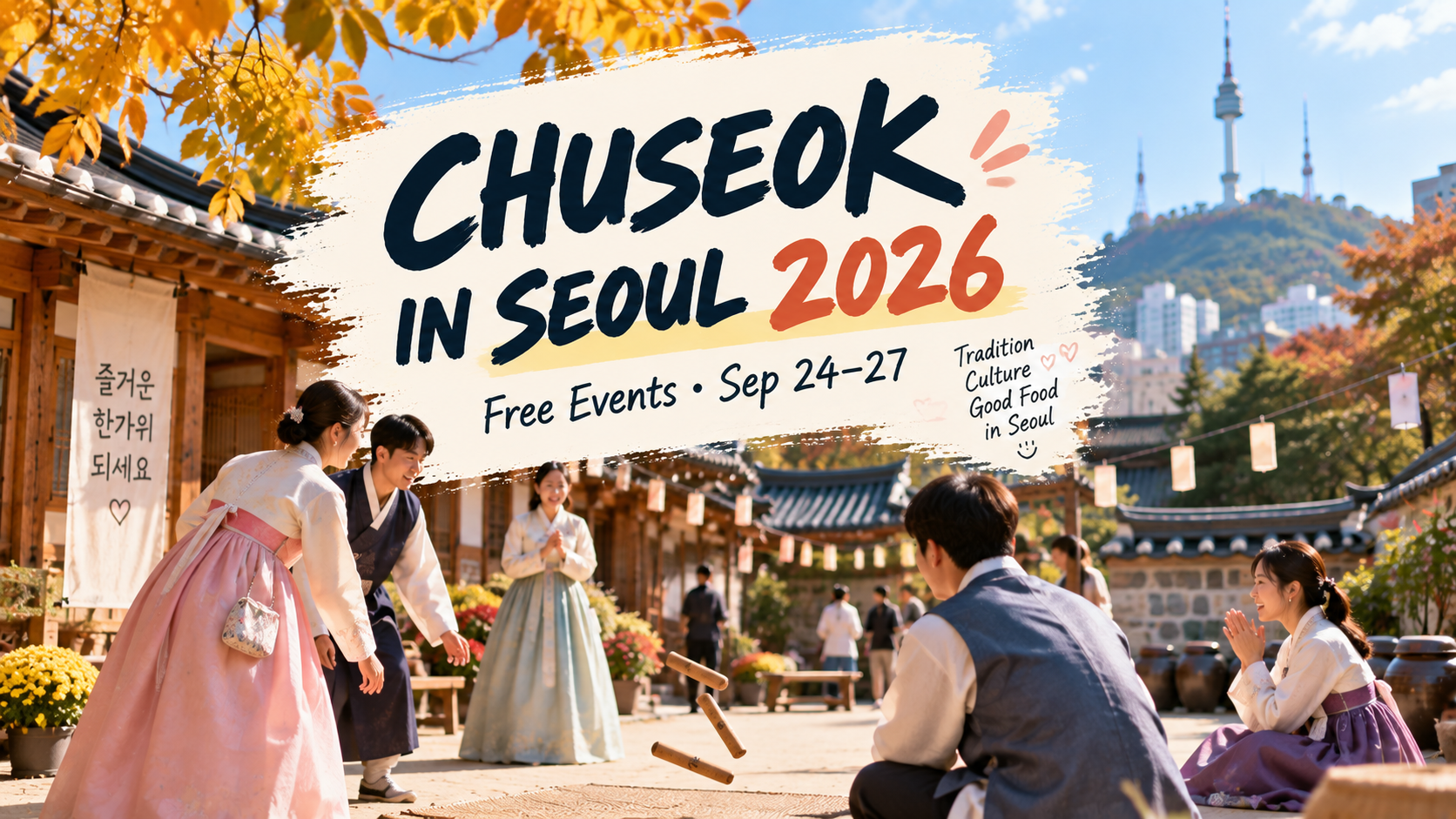
    In 2026, Chuseok falls on Friday, September 25, with the main holiday period running around September 24–27.

    During those days, Seoul and nearby destinations are hosting traditional music performances, hanbok experiences, folk games, food programs and special cultural events.

    The key is knowing where to go.

    Chuseok 2026 at a Glance

    Main Chuseok day: September 25, 2026

    Best sightseeing period: September 24–27

    Expect: Some independent restaurants and businesses to close or shorten hours

    Also expect: Special holiday programs at palaces, hanok villages and cultural attractions

    Biggest transportation issue: Intercity trains and buses

    The official Korea Tourism Organization’s newly published 2026 Chuseok Holiday Travel Guide specifically recommends booking transportation early because trains and express buses sell out quickly during major Korean holidays.

    That matters much more if you are traveling from Seoul to Busan, Gyeongju, Jeonju or another city.

    If you are simply sightseeing within Seoul, the holiday is much easier to manage.

    1. Go to Namsangol Hanok Village for Chuseok

    For a first-time visitor, this is probably the easiest Chuseok recommendation.

    Namsan Moonlight Madang will take place at Namsangol Hanok Village from September 25 to 27.

    The official Korea Tourism Organization lists traditional performances, hanbok experiences, traditional games and a K-food market among the programs.

    Namsangol is already worth visiting because traditional Korean houses sit right in central Seoul.

    During Chuseok, however, the setting makes much more sense.

    Instead of simply photographing hanok architecture, you can see traditional holiday culture happening around you.

    Getting there

    Search:

    남산골한옥마을

    The nearest convenient subway station is Chungmuro Station.

    If you are staying around Myeongdong, this is particularly easy to add to your itinerary.

    2. See Traditional Korean Music for Free

    Another excellent Chuseok option is the 2026 Yeoyujak Concert.

    It runs on September 24 and 25 at Seoul Donhwamun Traditional Theater’s Gugak Madang.

    The concert features Korean traditional music and lasts about 50 minutes.

    Most importantly for travelers, admission is free.

    The venue is around a 600-meter walk from Jongno 3-ga Station.

    This makes it very easy to combine with:

    Changdeokgung Palace
    Ikseon-dong
    Jongmyo
    Insadong

    Instead of crossing Seoul for a single performance, build it into a Jongno day.

    2026 Yeoyujak Concert details

    3. Experience Korean Confucian Culture

    From September 25 to 27, the Korean Confucian Culture EXPO takes place at the historic Sungkyunkwan area.

    The official Chuseok guide lists experiences involving traditional rituals, folk games, Korean Seonbi culture and Korean medicine culture.

    This is a much less obvious tourist choice than Gyeongbokgung.

    That is exactly why it may be interesting.

    If you have already seen Seoul’s major palaces and want something more connected to traditional Korean thought and education, this can add a different dimension to your trip.

    4. Make Chuseok a Palace Day

    Chuseok is also a natural time to explore Seoul’s royal heritage.

    Gyeongbokgung and Changdeokgung are both easy to combine with nearby traditional neighborhoods.

    A practical route is:

    Gyeongbokgung → Bukchon → Insadong → Ikseon-dong

    Do not try to combine this with Gangnam, Jamsil and Hongdae on the same day.

    One of the easiest mistakes in Seoul is underestimating travel time between neighborhoods.

    During a holiday, keeping each day geographically compact becomes even more useful.

    5. Escape Seoul for Namhansanseong

    If you want a short excursion rather than a long intercity trip, consider Namhansanseong Fortress in Gyeonggi-do.

    The official Chuseok guide lists special programs from September 24 to 27, including traditional Korean music performances, cultural activities, fortress trail tours and evening walks.

    This is a particularly good choice if the weather is clear.

    Namhansanseong combines history with hiking and autumn scenery, so it feels very different from central Seoul.

    From Seoul

    Allow roughly half a day rather than trying to squeeze it between central Seoul attractions.

    Search the Korean name:

    남한산성

    in Naver Map for the most practical route from your hotel.

    6. Go to the Han River on Sunday

    If you are still in Seoul on Sunday, September 27, there is another particularly good option.

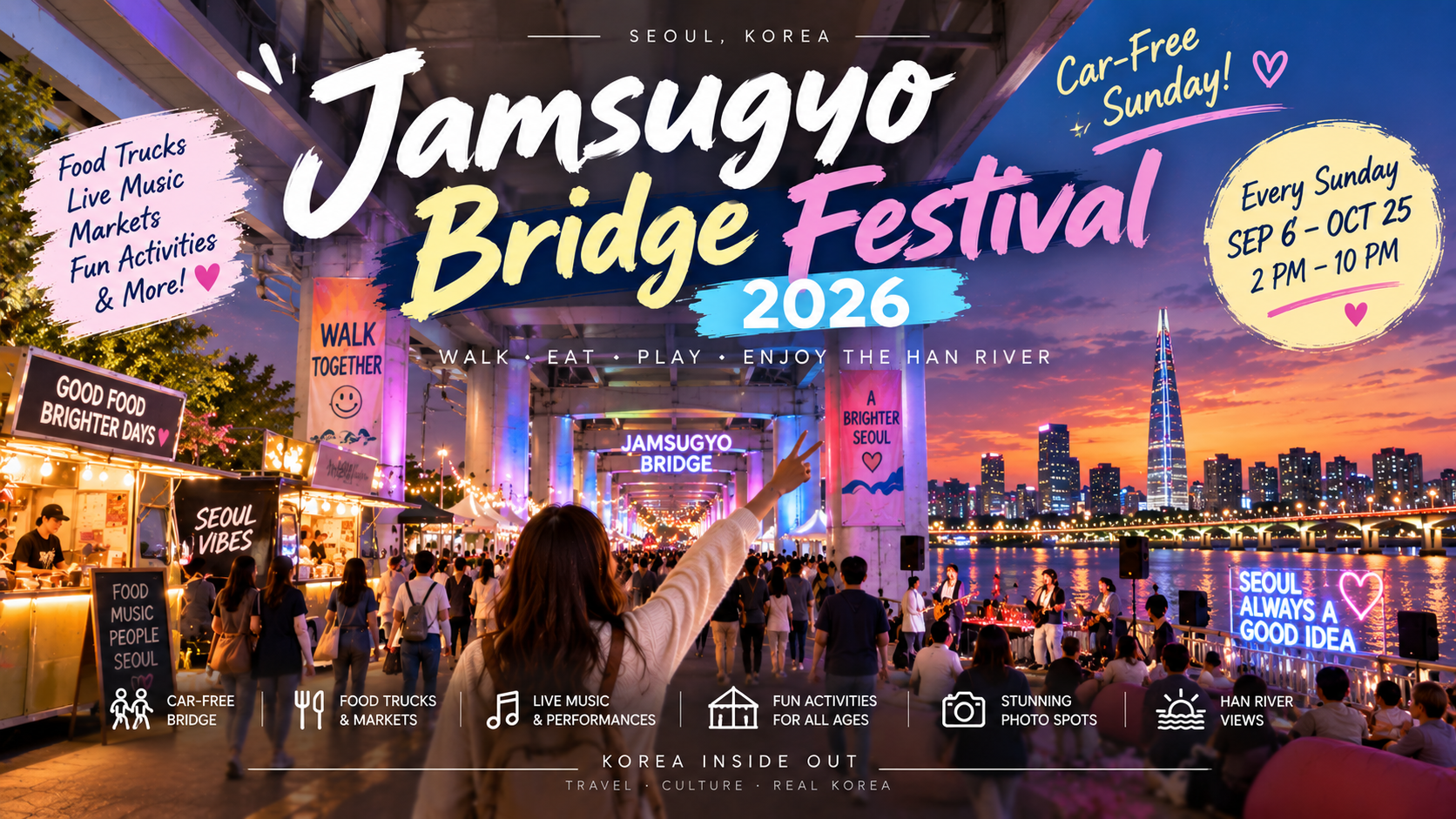
    The autumn Car-Free Jamsugyo Bridge Festival runs every Sunday from September 6 through October 25.

    September 27 has a special Moonlight Hangawi Madang program tied to the Chuseok season.

    The festival runs around Jamsugyo and Banpo Hangang Park, with the main autumn event hours from 2 PM to 10 PM.

    This is especially relevant for Korea Inside Out readers because the Jamsugyo guide is already one of the site’s strongest Google entry pages.

    Rather than treating Chuseok only as a traditional-palace experience, you can combine tradition during the day with contemporary Seoul by the river at night.

    7. What About Restaurants?

    This is where Chuseok requires flexibility.

    Large shopping malls, chain cafés, convenience stores and tourist-oriented areas are generally easier to navigate than small independent businesses.

    But an individual restaurant may decide to close.

    Do not travel 45 minutes across Seoul for one restaurant without checking its latest information.

    Use Naver Map and look for:

    추석 휴무 — closed for Chuseok

    추석 영업 — open during Chuseok

    영업시간 — opening hours

    If you see recent Korean reviews or a notice posted by the business, trust those over an old blog post.

    8. Convenience Stores Are Your Safety Net

    One of the easiest things about traveling in Korea is the density of convenience stores.

    CU, GS25, 7-Eleven and emart24 are everywhere.

    Even if a restaurant plan fails, you are unlikely to be stranded without food.

    That doesn’t mean you should spend Chuseok eating convenience-store ramyeon.

    It simply means you don’t need to panic if a restaurant closes unexpectedly.

    9. Shopping During Chuseok

    Major department stores and shopping centers may operate special holiday hours, and individual branches can differ.

    Check the exact branch before visiting.

    If shopping is a major part of your trip, I would avoid building an entire Chuseok day around a single store.

    Instead combine shopping with an area where you have alternatives.

    For example:

    Myeongdong
    Hongdae
    Seongsu
    Jamsil

    all give you multiple backup options.

    10. The Biggest Chuseok Problem Is Not Seoul

    It is transportation between cities.

    Korea Tourism Organization specifically warns travelers that trains and express buses can sell out quickly during major holidays.

    Millions of Koreans travel to visit family.

    So if your itinerary says:

    September 24 — Seoul
    September 25 — Busan
    September 26 — Gyeongju

    you need to take transportation availability seriously.

    If tickets are unavailable, staying in Seoul during the peak holiday and moving afterward may be much less stressful.

    A Simple Chuseok Itinerary

    September 24

    Jongno
    Changdeokgung
    Ikseon-dong
    Yeoyujak traditional music concert

    September 25 — Chuseok Day

    Gyeongbokgung area
    Namsangol Hanok Village
    Traditional games and cultural programs

    September 26

    Seongsu or Hongdae
    Cafés and shopping
    Relaxed evening

    September 27

    Morning sightseeing
    Banpo Hangang Park
    Jamsugyo Chuseok program in the afternoon/evening

    This itinerary avoids unnecessary long-distance travel and still gives you both traditional and modern Seoul.

    Korean Search Terms to Save

    추석 — Chuseok

    추석 행사 — Chuseok events

    추석 서울 행사 — Chuseok events in Seoul

    남산골한옥마을 — Namsangol Hanok Village

    남한산성 — Namhansanseong

    추석 휴무 — Chuseok closure

    추석 영업 — open during Chuseok

    Is Chuseok a Bad Time to Visit Seoul?

    No.

    It is simply a different time to visit.

    If your priority is visiting a long list of specific independent restaurants and shops, Chuseok can complicate your plans.

    But if you want to experience Korean culture, traditional performances, palaces, hanok villages and holiday atmosphere, it can be an unusually memorable time to be here.

    The smartest approach is not to fight the holiday.

    Build your itinerary around it.

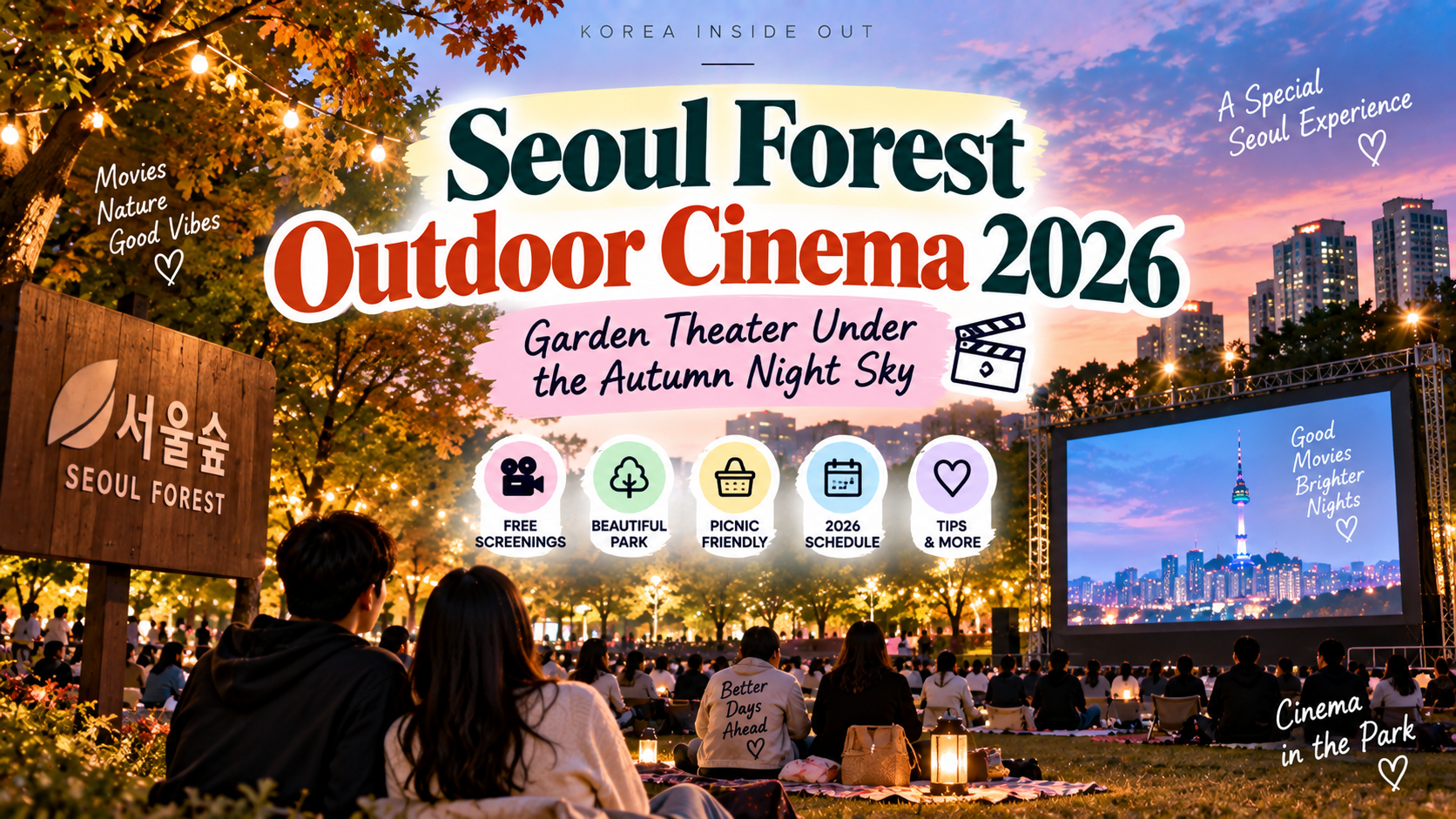
  • Seoul Forest Outdoor Cinema 2026: Garden Theater Under the Autumn Night Sky

    Seoul Forest Outdoor Cinema 2026: Garden Theater Under the Autumn Night Sky

    What if you could visit an art exhibition in Seoul without entering a museum?

    In Seoul this autumn, you can.

    The Seoul Sculpture Festival 2026 has turned some of the city’s parks and public spaces into an open-air gallery, with sculptures displayed among trees, lawns, riverside paths and historic surroundings.

    The main festival program took place from late August to early September, but the outdoor sculpture exhibitions continue through November 30, 2026.

    Best of all, they are free to visit.

    For travelers, this is an easy way to combine contemporary Korean art with a normal day of sightseeing. You can look at sculptures while walking through Seoul, stop for coffee, visit a palace or traditional neighborhood, and continue exploring without buying a museum ticket.

    Seoul Sculpture Festival 2026 at a Glance

    Details
    Outdoor exhibitionAugust 29 – November 30, 2026
    Main locationsOpen Songhyeon Green Plaza, Ttukseom Hangang Park, Seoul Forest, Seoul Children’s Grand Park, Pungnaptoseong
    AdmissionFree
    Best forArt lovers, photographers, couples, families and casual travelers
    FormatOutdoor sculpture exhibition
    Best seasonAutumn
    Recommended time1–3 hours per location

    The 2026 festival presents works connected with the Seoul Sculpture Prize as well as invited artists and related sculpture projects around the city. The main festival exhibition at Open Songhyeon Green Plaza includes 15 Seoul Sculpture Prize finalists and 21 invited works.

    But the most interesting part for visitors is that the exhibition does not stop at one location.

    Several different parts of Seoul become part of the experience.


    What Is the Seoul Sculpture Festival?

    The Seoul Sculpture Festival is part of Seoul’s broader “Sculpture City Seoul” project.

    The city’s goal is to place high-quality sculpture in public spaces rather than keeping contemporary art inside conventional galleries and museums.

    That means you don’t have to be an art expert to enjoy it.

    You might see a large abstract sculpture while walking through a park.

    Another work might look like an oversized animal or human figure.

    Others use metal, stone or unusual forms that change depending on where you stand.

    The surrounding environment becomes part of the artwork.

    A sculpture against a white museum wall is one thing.

    A sculpture surrounded by autumn trees and blue sky is something completely different.


    1. Open Songhyeon Green Plaza: The Main Exhibition

    If you only have time for one location, start here.

    Open Songhyeon Green Plaza is located in central Seoul, between major sightseeing areas such as Anguk, Bukchon and Gyeongbokgung.

    The exhibition features:

    • 15 Seoul Sculpture Prize finalist works
    • 21 invited works
    • A dedicated sculpture village
    • Outdoor public art
    • Open lawns and walking paths

    In total, the 2026 Seoul Sculpture Festival places 36 major works at the main Songhyeon site.

    The open setting is what makes this location especially attractive.

    Instead of walking through a series of white rooms, you can move between sculptures at your own pace.

    There is no fixed route.

    You can stop for five minutes or stay for an hour.

    And because the exhibition is outdoors, you can photograph the works from different angles.

    Why Visit Songhyeon in Autumn?

    Autumn is arguably the best time to visit.

    The large grassy plaza is framed by trees, and the changing foliage creates a completely different background as the season progresses.

    This makes the exhibition particularly appealing to photographers.

    The sculptures also work surprisingly well as landmarks for a Seoul walking route.

    Try this route:

    Anguk Station

    ↓

    Open Songhyeon Green Plaza

    ↓

    Bukchon Hanok Village

    ↓

    Insadong

    ↓

    Gwanghwamun

    ↓

    Gyeongbokgung Palace

    You can easily turn the sculpture exhibition into part of a half-day central Seoul itinerary.


    2. Seoul Forest: Art Among the Trees

    The second location is Seoul Forest.

    This is where the concept of an outdoor sculpture exhibition becomes especially interesting.

    Instead of placing every work in an open plaza, the sculptures are integrated into a much greener environment.

    The “Sculpture Exhibition + Seoul Forest” project runs through October 27, 2026, featuring works by 13 participating artists.

    Here, the best approach is not to rush.

    Walk through the park.

    Look around.

    And keep an eye out for sculptures along the way.

    This makes Seoul Forest a particularly good choice if you are traveling with someone who isn’t particularly interested in contemporary art.

    They can enjoy the park while you explore the artworks.

    And everyone gets a break from Seoul’s busy streets.


    3. Ttukseom Hangang Park: Art by the River

    Another exhibition location is Ttukseom Hangang Park.

    This gives you a completely different backdrop.

    Instead of historic buildings or forests, sculptures are displayed around one of Seoul’s most iconic modern landscapes: the Han River.

    The river, bridges, skyline and open sky become part of the visual experience.

    This is also a particularly convenient stop if you are already visiting Ttukseom for other events.

    For example, the area is hosting several major autumn programs, including the Seoul Street Arts Festival and the Hangang Drone Light Show.

    That means you can combine contemporary sculpture with an evening by the Han River.


    4. Seoul Children’s Grand Park: Sculpture You Can Touch and Explore

    Traveling with children?

    Don’t overlook Seoul Children’s Grand Park.

    The sculpture project here is called:

    “Sculpture Playground Seoul: Touch, Play and Imagine.”

    The exhibition runs through November 30 and includes works by 20 participating artists.

    The idea is different from a traditional sculpture exhibition.

    Instead of simply asking children to stand back and look at art, the project encourages them to experience sculpture more actively.

    That makes this location particularly useful for families.

    You can combine:

    • Sculpture
    • Playground time
    • Green space
    • Walking
    • Children’s activities

    into one easy afternoon.


    5. Pungnaptoseong: Sculpture Meets Ancient Seoul

    The fifth exhibition area is around Pungnaptoseong, the ancient earthen fortress associated with the Baekje period.

    This is perhaps the most unusual setting of the five.

    Here, contemporary sculpture is displayed alongside one of Seoul’s important archaeological landscapes.

    The contrast is fascinating.

    On one side, you have an ancient defensive structure connected with Korean history.

    On the other, you have contemporary artists experimenting with form, materials and ideas.

    For travelers who enjoy combining history and contemporary culture, this is one of the most interesting locations.


    You Don’t Need to Know Anything About Art

    One of the best things about the Seoul Sculpture Festival is that you don’t need an art-history background.

    You don’t need to know the names of famous Korean sculptors.

    You don’t even need to understand the artist’s statement perfectly.

    Start with a simple question:

    Do I like it?

    Then look at it from another angle.

    Walk around it.

    Notice the material.

    Look at how the sunlight changes it.

    See how the sculpture interacts with the trees, buildings or people around it.

    That is part of the fun of outdoor sculpture.


    The Seoul Sculpture Prize

    The main exhibition also introduces visitors to the Seoul Sculpture Prize, a relatively new award established by Seoul in 2024.

    The project aims to discover sculptors and place their works in major public locations around the city.

    The winning and selected works are then given opportunities to be displayed in Seoul’s public spaces.

    For international visitors, this offers an interesting way to discover Korean contemporary artists without having to search through individual galleries.

    Instead, the city has essentially created a large public-art trail.


    How to Turn It Into a Seoul Art Walk

    You don’t need to visit all five locations in one day.

    In fact, you shouldn’t.

    The locations are spread across Seoul, so trying to see everything would turn a relaxing art walk into a transportation challenge.

    Instead, choose one area.

    Route 1: Central Seoul Art & History

    Best for first-time visitors

    Morning

    Gyeongbokgung Palace

    ↓

    Bukchon Hanok Village

    ↓

    Open Songhyeon Green Plaza

    ↓

    Insadong

    ↓

    Cheonggyecheon

    This is the easiest route if you want to combine contemporary art with Seoul’s traditional side.


    Route 2: Seoul Forest + Seongsu

    Best for couples and younger travelers

    Afternoon

    Seoul Forest

    ↓

    Sculpture exhibition

    ↓

    Seongsu cafés

    ↓

    Seongsu shopping

    ↓

    Dinner

    This is one of the easiest ways to turn the exhibition into a relaxed afternoon.

    If you like Seoul’s café and design culture, this is probably the route I would choose.


    Route 3: Han River Art Day

    Best for a sunny autumn day

    Ttukseom Hangang Park

    ↓

    Sculpture exhibition

    ↓

    Han River picnic

    ↓

    Seongsu

    ↓

    Evening performance or drone show

    This route works particularly well in September and October.


    Why the Festival Is Great for Photographers

    Outdoor sculpture is naturally photogenic.

    You don’t have to photograph the sculpture by itself.

    Instead, use Seoul as part of the composition.

    Try:

    • Sculpture + autumn foliage
    • Sculpture + Seoul skyline
    • Sculpture + Han River
    • Sculpture + people walking past
    • Sculpture + sunset
    • Sculpture + traditional Korean architecture

    The same sculpture can look completely different depending on the time of day.

    Morning: softer light and fewer people.

    Afternoon: stronger colors and clearer details.

    Golden hour: warm light and long shadows.

    Evening: atmospheric city lighting.

    If you’re looking for something to photograph in Seoul that isn’t another palace or café, this is an easy alternative.


    How Long Should You Spend There?

    You don’t need an entire day.

    Open Songhyeon Green Plaza

    About 45–90 minutes

    Add more time if you’re combining it with Bukchon and Insadong.

    Seoul Forest

    About 1–2 hours

    You will probably spend additional time walking around the park.

    Ttukseom Hangang Park

    About 1–2 hours

    Stay longer if you’re having a picnic or waiting for an evening event.

    Seoul Children’s Grand Park

    2–4 hours

    Families will naturally spend much longer because of the other attractions in the park.

    Pungnaptoseong

    About 1 hour

    Best combined with other Songpa-area attractions.


    Is the Seoul Sculpture Festival Free?

    Yes.

    The outdoor sculpture exhibitions are free to visit.

    You don’t need a museum ticket or festival pass.

    This is one reason the exhibition works particularly well for travelers.

    You can simply add it to a day of sightseeing.

    If you walk past one of the exhibition locations, stop and take a look.

    There is no need to make a major commitment.


    When Is the Best Time to Go?

    The outdoor exhibition runs until November 30, 2026, so you have plenty of time.

    September

    Warm but increasingly comfortable.

    Good for combining the sculptures with other outdoor events.

    October

    Probably the best overall month.

    Cooler temperatures and autumn colors make the parks particularly attractive.

    November

    Quieter and more atmospheric.

    The foliage will gradually disappear, but the sculptures themselves remain.

    If you are visiting Seoul in autumn, October is probably the sweet spot.


    Seoul Sculpture Festival vs. a Traditional Museum

    So which should you choose?

    Outdoor Sculpture FestivalTraditional Museum
    FreeOften paid
    OutdoorsIndoors
    CasualMore structured
    Easy to combine with sightseeingUsually requires dedicated time
    Great for photographyBetter for detailed viewing
    Works well with childrenDepends on museum
    Parks and city landscapesGalleries and exhibition halls

    The answer doesn’t have to be one or the other.

    You can visit a museum in the morning and see outdoor sculpture in the afternoon.

    But if you’re short on time, the outdoor festival is an easy cultural experience to add without changing your entire itinerary.


    Practical Tips for International Visitors

    Wear comfortable shoes

    The exhibition locations involve walking, especially if you combine them with nearby attractions.

    Check the weather

    There is no roof over most of the exhibition.

    A rainy day can change the experience significantly.

    Go during daylight

    You will see the materials and details of the sculptures much more clearly.

    Return at sunset

    If you are photographing the works, golden hour can be particularly beautiful.

    Don’t rush

    The best part is often discovering a sculpture unexpectedly while walking.

    Combine art with food

    The exhibition locations are surrounded by very different food neighborhoods.

    Songhyeon works well with Insadong and Jongno.

    Seoul Forest works with Seongsu.

    Ttukseom works with the Han River and Seongsu.


    A Free Art Experience in the Middle of Seoul

    The Seoul Sculpture Festival is a good example of something that makes Seoul different from many other major cities.

    You don’t always have to enter a cultural institution to experience art.

    Sometimes you simply walk through a park.

    A sculpture appears between the trees.

    You stop.

    You look.

    You take a photograph.

    Then you continue walking.

    For travelers, that makes the Seoul Sculpture Festival 2026 one of the easiest cultural experiences to add to an autumn itinerary.

    You can combine it with palaces, traditional neighborhoods, cafés, the Han River or Seoul’s modern shopping districts.

    And because the outdoor exhibitions continue until November 30, you don’t have to squeeze the experience into one particular festival weekend.

    Final Thoughts

    Seoul is often described through its palaces, skyscrapers, cafés and nightlife.

    But there is another side of the city worth discovering.

    Art is increasingly appearing in the spaces between those attractions.

    A historic neighborhood can become an outdoor gallery.

    A forest can become a sculpture park.

    A riverside can become an art space.

    And a normal walk through Seoul can unexpectedly turn into an exhibition visit.

    If you’re looking for a free, flexible and photogenic cultural experience in Seoul this autumn, the Seoul Sculpture Festival is worth adding to your itinerary.

    You don’t need to be an art expert.

    Just bring comfortable shoes and take a walk.

    Seoul Sculpture Festival 2026

    Outdoor exhibition: August 29 – November 30, 2026
    Locations: Open Songhyeon Green Plaza, Ttukseom Hangang Park, Seoul Forest, Seoul Children’s Grand Park & Pungnaptoseong
    Admission: Free
    Best for: Art, photography, autumn walks and a different side of Seoul

    For more ideas on planning your Seoul trip, see our guide to How Many Days Do You Need in Seoul: 3, 5 or 7 Days?

  • Do You Need a SIM Card in Korea? eSIM, SIM, Roaming & Wi-Fi Explained

    Do You Need a SIM Card in Korea? eSIM, SIM, Roaming & Wi-Fi Explained

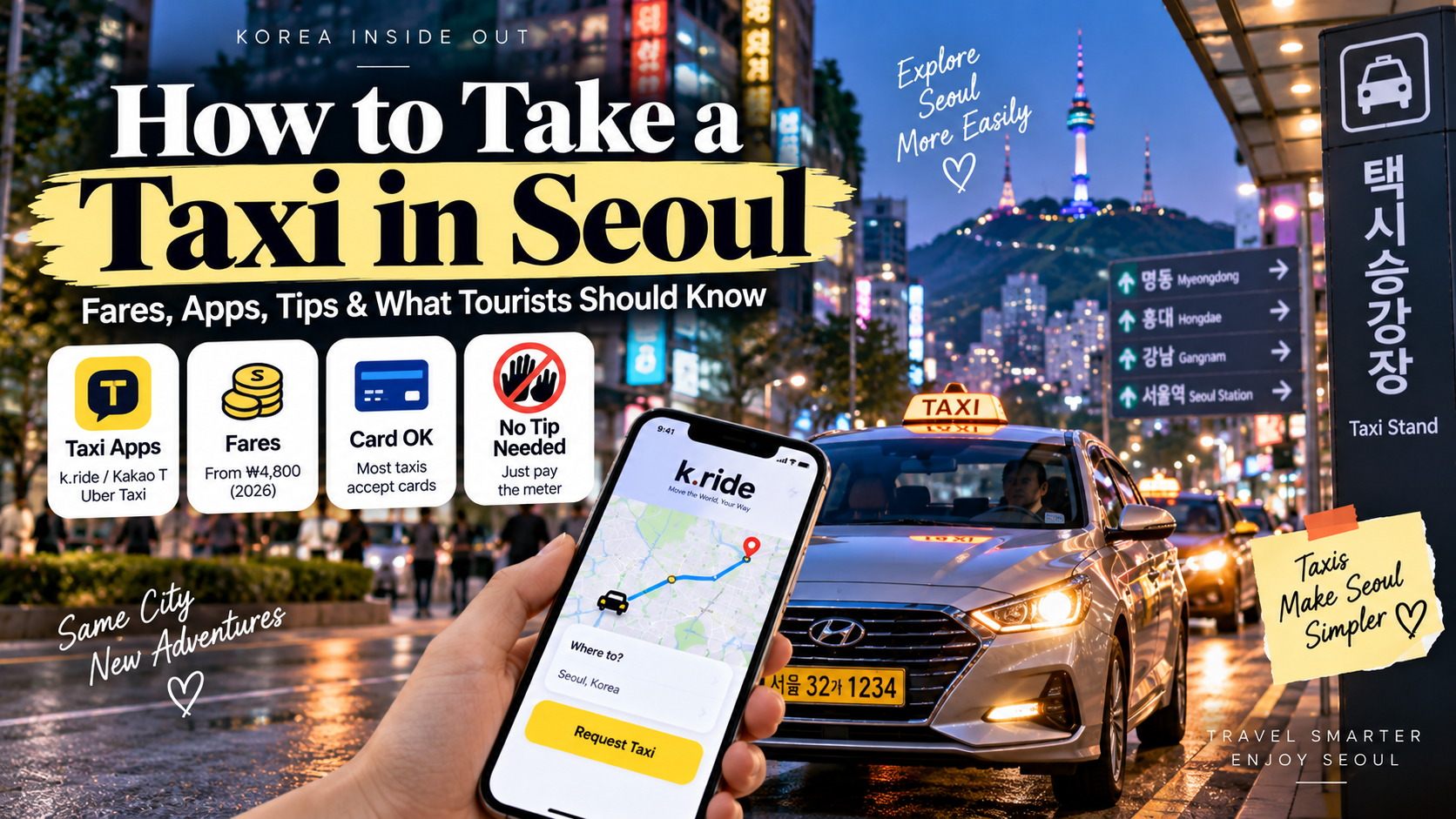
    Taking a taxi in Seoul is easier than many first-time visitors expect.

    You don’t need to speak Korean fluently.

    You don’t need to negotiate with the driver.

    And you usually don’t need to worry about tipping.

    But there are a few things that are useful to know before getting into a Seoul taxi.

    How do you call one?

    Which app should you use?

    How much should a taxi cost?

    What happens late at night?

    Can you pay by card?

    And how do you make sure you’re getting into the right vehicle?

    Here’s a practical guide to taking taxis in Seoul as a foreign visitor.


    Quick Answer: Are Taxis in Seoul Easy for Tourists?

    Yes.

    For most visitors, taxis are one of the easiest ways to get around Seoul when the subway isn’t convenient.

    The basic process is:

    Choose a taxi → enter your destination → check the meter or app fare → ride → pay

    You generally don’t need to negotiate the fare for a regular metered taxi.

    Seoul’s official tourism information also advises visitors to make sure the meter is being used and to pay the amount shown on the meter, with tolls handled separately when applicable.

    And unlike in some countries, tipping is not expected in Korean taxis.


    When Should You Take a Taxi in Seoul?

    I wouldn’t recommend taking taxis everywhere.

    Seoul’s subway is often faster and cheaper for sightseeing.

    But there are situations when a taxi makes much more sense.

    Take a taxi when:

    • You’re carrying heavy luggage
    • You’re traveling with children
    • It’s raining heavily
    • You’re traveling with several people
    • You’re tired after a long day
    • Your destination is awkward to reach by subway
    • You’re returning to your hotel late
    • You have limited time
    • You’re going somewhere with several transfers

    For example:

    Myeongdong → Gangnam

    The subway is usually a sensible choice.

    But:

    Hotel → restaurant with luggage → late-night hotel

    A taxi may be much more convenient.


    How Much Does a Taxi Cost in Seoul?

    Seoul taxis use a meter for regular rides.

    As of 2026, the standard taxi fare in Seoul starts at a ₩4,800 base fare, covering the initial distance before additional distance-based charges apply.

    Your final fare depends on:

    • Distance
    • Traffic
    • Time
    • Taxi type
    • Late-night surcharge
    • Tolls, where applicable

    This means you shouldn’t expect every trip to cost the same amount even if the destinations are similar.

    Traffic can make a difference.


    What About Late-Night Taxi Fares?

    This is important if you plan to explore Seoul’s nightlife.

    Late-night surcharges generally apply during the nighttime period, and the highest surcharge period is typically 11 p.m. to 2 a.m.

    So a taxi that seems reasonably priced at 9 p.m. may cost noticeably more after midnight.

    If you’re traveling on a budget, keep this in mind when planning your evening.

    A simple rule

    The later you take a taxi, the more carefully you should check the fare.

    Your taxi app can help you see an estimated price before you request the ride.


    Do You Need to Tip a Taxi Driver in Korea?

    No.

    Tipping is not a normal part of taxi culture in Korea.

    You simply pay the fare.

    If the driver has been especially helpful, you can choose to let them keep a small amount of change, but there is no need to add a standard percentage tip.

    So if your meter says:

    ₩18,700

    You don’t need to calculate:

    10% tip?

    15% tip?

    20% tip?

    Just pay the fare.


    Can You Pay by Credit Card?

    Generally, yes.

    Korean taxis commonly accept card payments, and taxi-hailing apps can also offer cashless payment options.

    For international visitors, app-based taxi services can be particularly convenient because you can register an overseas card and see the ride information digitally.

    If you’re using a physical taxi, you can simply ask:

    “Card?”

    or show your payment card.


    Should You Use a Taxi App?

    For first-time visitors, I generally recommend using an app when possible.

    Why?

    Because you don’t have to explain your destination verbally.

    You can enter the destination into the app.

    You can also see information about the vehicle and, depending on the service, an estimated fare before the ride.

    This is especially useful if:

    • You don’t speak Korean
    • Your destination has a complicated name
    • You have a hotel address
    • You’re traveling late at night
    • You’re nervous about getting into the wrong taxi

    1. k.ride: A Good Option for Foreign Visitors

    One of the most useful options for international visitors is k.ride, operated by Kakao Mobility.

    It is designed specifically with foreign visitors in mind.

    According to VISITKOREA, k.ride supports English, Chinese and Japanese, allows Google or Apple social login, and can accept overseas credit cards.

    That can remove several of the small barriers that tourists sometimes face when trying to use local transportation apps.

    Why k.ride can be useful

    You can:

    • Enter destinations in a supported language
    • Request a taxi
    • Check estimated fares
    • Register an international card
    • Communicate with the driver through the service

    For an English-speaking visitor, this can be much easier than trying to navigate an unfamiliar Korean-only interface.


    2. Kakao T

    Kakao T is one of the major taxi and mobility platforms used in Korea.

    It’s widely used locally and can be useful for travelers as well, although the setup and features available to visitors can differ from those designed specifically for Korean residents.

    If you’re already comfortable with Kakao’s services, it may be worth using.

    If you’re a first-time visitor looking for the simplest foreigner-oriented option, k.ride may be easier to start with.


    3. Uber Taxi

    If you already use Uber at home, there’s another option.

    VISITKOREA notes that Uber users can use Uber Taxi in Korea, with the existing app and payment information, and the service also provides automatic message translation.

    This can be convenient because you don’t necessarily need to learn an entirely new taxi app.

    My simple recommendation

    If you already use Uber:

    Check Uber Taxi first.

    If you want a Korea-focused app:

    Try k.ride.


    Can You Just Wave Down a Taxi?

    Yes.

    You can still get a taxi directly from the street.

    You’ll see taxis throughout central Seoul, particularly around:

    • Major subway stations
    • Shopping districts
    • Hotels
    • Tourist areas
    • Business districts
    • Nightlife areas

    You don’t always need an app.

    However, I prefer an app when I’m traveling because I can confirm the destination and ride information before getting in.


    How Do You Know Which Taxi to Take?

    For a normal taxi ride, look for an official passenger taxi.

    Seoul has several taxi types.

    Regular Taxi

    These are the most common taxis.

    They are generally the most affordable option for everyday travel.

    Deluxe Taxi

    These are generally more expensive and offer a more premium experience.

    They are commonly black with distinctive markings.

    Large Taxi

    These can accommodate larger groups and more luggage.

    International Taxi

    Seoul also has officially designated international taxis intended for foreign visitors, with drivers who may speak English, Chinese or Japanese depending on the vehicle.

    For most travelers:

    Regular taxi = perfectly fine.

    You don’t need a premium taxi unless you specifically want one.


    Be Careful With Vans

    This is one thing first-time visitors should know.

    Not every large black vehicle you see is a normal taxi.

    Some vans operate differently and may not use a meter.

    Seoul’s official tourism guidance specifically advises visitors to check the fare in advance when using a call van because these vehicles do not use standard taxi meters.

    So if someone approaches you at a tourist area and offers a ride:

    Don’t automatically get in.

    If you haven’t requested the vehicle, take a moment to confirm:

    • What type of vehicle is it?
    • What is the price?
    • Is it a regular taxi?
    • Is there a meter?
    • Where exactly are you going?

    Using an official taxi stand or a reputable app removes much of this uncertainty.


    What Should You Tell the Driver?

    You don’t need to speak Korean.

    The easiest approach is to show the destination on your phone.

    For example:

    Hotel name

    or

    Restaurant name + address

    This is much better than trying to pronounce a complicated Korean address.

    Even better

    Have the destination displayed in Korean as well as English.

    Some Korean businesses have similar English names, while the Korean address is much more specific.


    What If the Driver Doesn’t Speak English?

    Don’t panic.

    This is normal.

    You can simply:

    1. Open your map
    2. Show the destination
    3. Show the address
    4. Confirm with the driver
    5. Follow the route

    You don’t need to have a long conversation.

    A taxi ride in Seoul is usually a very simple interaction.


    A Useful Korean Phrase

    If you want to say:

    “Please take me here.”

    You can say:

    여기로 가 주세요.

    Pronounced roughly:

    yeo-gi-ro ga ju-se-yo

    But honestly, showing the destination on your phone is often easier.


    What If You Have a Hotel?

    Hotels are easy because the name and address are usually available online.

    Before leaving your hotel, save:

    Hotel name

    Hotel address

    Hotel phone number

    You can also ask the front desk to write the destination in Korean.

    That can be useful if you’re going somewhere with a complicated name.


    What If You Don’t Know the Exact Address?

    This happens all the time.

    Maybe you want to visit:

    • A café
    • A restaurant
    • A small shop
    • A pop-up store
    • A beauty salon

    Search for the location in your map app and show the result.

    If possible, use the Korean listing rather than relying only on an English translation.


    Should You Use a Taxi or Subway?

    This is the question I get most often.

    My answer:

    Use both.

    You don’t have to choose one transportation method for your entire trip.

    Use the subway for:

    • Long cross-city trips
    • Major tourist areas
    • Rush-hour travel
    • Budget travel
    • Trips with predictable travel times

    Use taxis for:

    • Short awkward journeys
    • Heavy luggage
    • Rain
    • Late nights
    • Families
    • Multiple passengers
    • Places far from a subway station

    That’s the combination I would recommend to most first-time visitors.

    If you’re still unsure about the subway, see:

    How to Use the Seoul Subway: A First-Time Visitor’s Guide


    Four People: Is a Taxi Worth It?

    Sometimes.

    Suppose four people are traveling together.

    The subway might be cheaper per person.

    But if you’re making a short trip, the difference may not be huge.

    And there’s another factor:

    Convenience.

    Instead of:

    Subway entrance → stairs → platform → train → transfer → exit → walk

    you might simply:

    Get into taxi → arrive at restaurant

    For four people, especially with shopping bags or tired children, that can be worth it.


    Taxi vs. Subway in the Rain

    This is another situation where taxis make sense.

    Seoul’s subway is excellent.

    But walking to and from the stations in heavy rain can be miserable.

    If your destination is only 10 minutes away by car, a taxi can turn a frustrating journey into a simple one.

    You can also combine both.

    For example:

    Subway most of the way → short taxi ride at the end

    This can be a very efficient strategy.


    What About Traffic?

    Here’s the biggest downside to taxis in Seoul.

    Traffic.

    Seoul is a huge city.

    During busy periods, a journey that looks short on a map can take much longer by car.

    That’s why I don’t automatically recommend taxis for every journey.

    If you’re crossing Seoul during rush hour, the subway may be significantly more predictable.

    My rule

    If the subway route is simple, take the subway.

    If the subway route is annoying, take a taxi.

    That’s usually enough.


    How to Avoid Getting the Wrong Taxi

    This is particularly important if you’re tired or leaving a busy nightlife area.

    If you’re using an app:

    Check:

    • Vehicle type
    • License plate
    • Driver information
    • Pickup location

    Then make sure the car matches.

    Don’t simply get into the first taxi that pulls up.

    If you’re taking a street taxi, use an official taxi stand when possible.


    What If the Taxi Driver Takes a Different Route?

    Don’t immediately assume something is wrong.

    Seoul traffic can be complicated.

    The driver may choose a different route because:

    • Traffic is heavy
    • A road is restricted
    • The navigation system suggests another route
    • There is an accident
    • A faster route is available

    If you’re concerned, simply open your map and check the destination.

    If something genuinely seems wrong, you can ask:

    여기 맞아요?

    Meaning:

    “Is this the right place?”


    What If the Meter Seems Wrong?

    For a normal metered taxi, the meter should be running.

    Seoul’s official tourist guidance specifically tells visitors to check that the driver is using the meter and to pay the fare shown on it.

    If something seems unusual:

    • Take a photo of the vehicle/license plate
    • Keep the receipt if available
    • Note the time and location
    • Contact the appropriate tourist assistance service

    The 1330 Korea Travel Helpline provides tourist information, interpretation and complaint support.


    What If You Leave Something in the Taxi?

    This is one reason to use an app whenever possible.

    If you accidentally leave your phone, wallet or shopping bag behind, having the ride record can make it easier to identify the vehicle.

    If you used a street taxi, remember as much information as possible:

    • Approximate time
    • Pickup location
    • Drop-off location
    • Taxi color/type
    • License plate
    • Receipt information

    The faster you act, the better.


    What About Tolls?

    If your taxi route uses a toll road, the toll may be charged separately from the taxi fare.

    This is normal.

    For example, airport taxi journeys can include highway tolls in addition to the metered fare. Seoul’s official airport transportation information lists tolls separately from the meter fare.

    So don’t be surprised if the final payment is slightly higher than the fare you expected from the route alone.


    What About Taxi Safety at Night?

    Seoul is generally a safe city, but the usual travel precautions still apply.

    At night:

    • Use a reputable taxi app
    • Check the vehicle information
    • Share your trip if the app allows it
    • Confirm your destination
    • Don’t accept unsolicited rides
    • Keep your belongings with you

    If you are traveling alone, an app-based ride can provide extra peace of mind because you have a record of the vehicle and trip.


    Can You Take a Taxi Alone?

    Absolutely.

    Solo travelers use taxis throughout Seoul.

    In fact, for one person traveling late at night, a taxi can sometimes be more comfortable than walking a long distance from a subway station.

    You don’t need to feel strange about taking a taxi alone.


    What If You Have a Lot of Luggage?

    This is where choosing the right vehicle matters.

    If you have:

    • Two large suitcases
    • Multiple carry-ons
    • Several shopping bags

    a regular sedan may not be ideal.

    Consider a larger taxi or another pre-booked transportation option.

    Don’t wait until the taxi arrives to discover that your luggage doesn’t fit comfortably.


    A Simple Taxi Routine for First-Time Visitors

    Here’s the process I’d recommend.

    Before leaving

    Open your map.

    Find your destination.

    Check the approximate route.

    When calling the taxi

    Confirm:

    • Vehicle
    • License plate
    • Pickup location

    When entering

    Show your destination if necessary.

    During the ride

    Follow the route on your phone if you want.

    When arriving

    Check the meter.

    Pay the fare.

    Collect all your belongings.

    That’s it.

    You don’t need to overthink it.


    Five Mistakes Tourists Make With Seoul Taxis

    1. Taking taxis everywhere

    The subway is often faster.


    2. Forgetting about late-night surcharges

    A late-night ride can cost more than you expect.


    3. Getting into an unverified vehicle

    Use a reputable taxi or app.


    4. Not checking the destination

    Show the driver the exact location.


    5. Expecting to tip

    You generally don’t need to.


    My Recommended Taxi Strategy for Seoul

    If I were visiting Seoul for the first time, this is what I’d do:

    Daytime

    Use the subway for most major sightseeing.

    Short inconvenient trips

    Take a taxi.

    Heavy rain

    Use taxis more often.

    Late evening

    Use an app rather than randomly accepting a ride.

    With children or lots of luggage

    Use taxis when the convenience is worth it.

    Four travelers

    Compare the taxi fare with the time and effort of public transportation.

    That’s enough.


    Is Taking a Taxi in Seoul Worth It?

    Yes.

    But don’t think of taxis as a replacement for the subway.

    Think of them as the missing piece.

    The subway is your main transportation system.

    The taxi is what you use when the subway isn’t the easiest answer.

    That combination gives you the best of Seoul.


    Final Thoughts

    Taking a taxi in Seoul can feel intimidating before your first ride.

    You may wonder:

    Will the driver speak English?

    Will I be overcharged?

    How do I explain my destination?

    Do I need to tip?

    Can I pay by card?

    In practice, it’s usually much simpler.

    Use a reputable taxi.

    Show your destination.

    Check the meter or app fare.

    Pay the fare.

    Take your belongings.

    Done.

    And if you want to make things even easier, use a taxi app such as k.ride or a service you’re already familiar with, such as Uber Taxi.

    The goal isn’t to become an expert in Korean taxis.

    It’s simply to know enough to get from Point A to Point B without stress.


    Seoul Taxi Checklist

    Before getting into a taxi:

    ☐ Confirm the vehicle
    ☐ Check the license plate if using an app
    ☐ Confirm the destination
    ☐ Check that a regular taxi is using the meter
    ☐ Remember that tolls may be separate
    ☐ Don’t worry about tipping
    ☐ Take all your belongings when you leave

    And if something goes wrong:

    1330 Korea Travel Helpline can provide tourist information, interpretation and complaint support.


    Have You Taken a Taxi in Seoul?

    If you’ve already visited Korea, did you use taxis or mostly take the subway?

    And if you’re visiting Seoul for the first time, what worries you most about taking a taxi in Korea — the language, the price, or finding the right car?

    Share your experience in the comments. It may help another first-time visitor.


    More Seoul Travel Guides

    How to Use the Seoul Subway: A First-Time Visitor’s Guide

    Where to Stay in Seoul: 7 Best Areas for First-Time Visitors

    Do You Need Cash in Korea? Cards, ATMs & T-money Explained

    Is Seoul Safe for Tourists? What First-Time Visitors Should Know

    How Much Does Food Cost in Seoul? A Realistic 2026 Guide

  • Seoul Welcome Week 2026: Free Traveler Perks, K-Culture Experiences and What to Know This Autumn

    Seoul Welcome Week 2026: Free Traveler Perks, K-Culture Experiences and What to Know This Autumn

    If you are arriving in Seoul between late September and early October 2026, your timing is unusually good.

    From September 19 to October 11, 2026, Seoul is running SEOUL WELCOME WEEK: Autumn Edition, a 23-day program designed specifically around the autumn peak season for international visitors.

    And unlike many Seoul festivals, this is not one event happening in one park or plaza. The idea is much broader: Seoul is creating a welcome network that begins around major arrival points and continues into major tourist districts such as Myeongdong, tourist information centers and the Han River.

    The timing is deliberate. Seoul Metropolitan Government says the program coincides with several major East Asian holiday periods, including Japan’s Silver Week, Korea’s Chuseok holiday, China’s Mid-Autumn Festival and National Day holiday, and Taiwan’s National Day period. You can read the latest details in the official Seoul Metropolitan Government announcement.

    For travelers, that means late September and early October will be one of the busiest — but also one of the most event-filled — periods to visit Seoul in 2026.

    Seoul Welcome Week 2026 at a Glance

    Dates: September 19–October 11, 2026
    City: Seoul
    Main audience: International visitors
    Key areas: Airports and major visitor gateways, Myeongdong, Seoul Culture Lounge, tourist information centers and selected Han River programs
    Theme: Visitor services, K-culture experiences, traditional culture, travel information and special benefits

    The city says the autumn program expands beyond the traditional Myeongdong-centered welcome campaign, connecting the experience from arrival points to central Seoul.

    That makes this particularly useful for first-time visitors.

    Why Seoul Is Doing This Now

    Autumn is already one of the most attractive seasons for visiting Korea. September brings cooler evenings after summer, while October gradually introduces autumn foliage.

    But 2026 has another factor: a sequence of major holidays across East Asia.

    Seoul specifically identifies Japan’s Silver Week from September 19 to 23, followed by Korea’s Chuseok period, Chinese holiday periods and Taiwan’s National Day holiday as major travel windows.

    That also means travelers should expect popular neighborhoods to feel busier than usual.

    If you have not booked accommodation yet, it is worth doing so sooner rather than later. Our guide to where to stay in Seoul can help you choose a neighborhood based on your itinerary rather than simply choosing the cheapest hotel.

    Start at the Airport

    One of the most interesting changes this year is that Welcome Week begins closer to the actual arrival experience.

    Seoul says its autumn welcome campaign is expanding from central tourist districts to airports and tourist information centers, creating a more continuous visitor experience from arrival to the city.

    If this is your first Korea trip, take advantage of staffed tourist information desks whenever you see one. They can be surprisingly useful for confirming temporary events, closures and transportation changes.

    For general travel assistance, Seoul’s official 2026 tourist guide also lists the Korea Travel Hotline 1330, which operates 24 hours.

    If you are still planning your airport transfer, read our guide to getting from Incheon Airport to Seoul before landing.

    Myeongdong Becomes One of the Main Welcome Hubs

    Myeongdong is one of the central locations for Seoul Welcome Week.

    The city says visitors can find K-content and traditional cultural experiences around Myeongdong and Seoul Culture Lounge during the campaign.

    This makes Myeongdong particularly easy to combine with a first-day itinerary.

    You could arrive in central Seoul, check into your hotel, explore Myeongdong in the late afternoon, have dinner and then move toward Namsan or another evening attraction.

    If you only have a short trip, our Seoul in Your First 24 Hours guide is designed for exactly this situation.

    Don’t Ignore the Han River

    Welcome Week also extends to the Han River.

    Seoul says the campaign will include Seoul Cruise ticket discounts and K-culture experiences connected with the river. Exact benefits may differ by program and date, so check the current official information before making a special trip solely for a promotion.

    But even without a promotion, September is already an excellent month for the river.

    Korea Inside Out’s What’s On Along the Han River This September brings several river activities together in one place.

    And on Sundays, the Jamsugyo Bridge Festival turns part of the river area into one of Seoul’s most unusual pedestrian experiences.

    This is exactly how I would use Welcome Week: not as a standalone attraction, but as an extra layer of benefits around a Seoul itinerary you already wanted to do.

    What Else Is Happening in Seoul?

    A lot.

    Seoul’s official September festival calendar shows that the weekend of September 19–20 is particularly busy. Current listings include Seoul Autumn Festa, Seoul Street Arts Festival, Seocho-related cultural events, concerts and walking festivals.

    The official Visit Seoul events calendar is also worth checking immediately before your trip because exhibitions and smaller events are added throughout the month.

    One of the biggest advantages of visiting Seoul during this period is therefore not necessarily one blockbuster festival.

    It is density.

    You can visit Seoul for food, shopping and palaces and repeatedly encounter temporary cultural programming along the way.

    A Smart One-Day Route During Welcome Week

    For a first-time visitor, I would keep the route simple.

    Start around Gyeongbokgung or Bukchon in the morning.

    Move toward central Seoul for lunch.

    Spend the afternoon around Myeongdong, where you can check the current Welcome Week programs and visitor services.

    Around sunset, head toward the Han River.

    Finish with a riverside walk, picnic or cruise depending on the day’s schedule.

    This avoids crossing Seoul repeatedly and gives you a mix of traditional Seoul, shopping, K-culture and the river.

    Will Seoul Be Crowded?

    Probably more than on an ordinary September week.

    The city is explicitly preparing for increased international arrivals during overlapping East Asian holiday periods.

    That doesn’t mean you should avoid Seoul.

    It means you should reserve the things that actually require reservations while keeping the rest of the itinerary flexible.

    Restaurants, outdoor festivals and shopping neighborhoods can be adjusted on the day. A specific hotel, timed attraction or intercity train cannot always be.

    What to Search in Korean

    These Korean search terms are useful in Naver Map or Korean search engines:

    서울환대주간 — Seoul Welcome Week
    명동 관광정보센터 — Myeongdong Tourist Information Center
    한강공원 — Hangang Park
    잠수교 뚜벅뚜벅 축제 — Jamsugyo pedestrian festival
    서울 가볼만한 곳 — places to visit in Seoul

    For navigation, do not rely exclusively on Google Maps in Korea. Our best apps for traveling in Seoul guide explains why Naver Map and Papago are useful additions.

    Is Seoul Welcome Week Worth Planning Around?

    I would not book a flight solely for Welcome Week.

    But if you are already visiting Seoul between September 19 and October 11, it is absolutely worth checking what is available during your dates.

    The bigger advantage is that Welcome Week overlaps with an unusually rich autumn event calendar.

    That makes it easy to build a trip around Seoul’s permanent attractions while adding temporary experiences that travelers visiting a few weeks earlier or later simply won’t get.

    And if you are coming this autumn, bookmark both the official Seoul event calendar and Korea Inside Out’s September guides before you arrive.

    FAQ

    When is Seoul Welcome Week 2026?
    September 19 through October 11, 2026.

    Is it one festival in one location?
    No. It is a citywide visitor-welcome program involving several tourist touchpoints.

    Is it aimed at foreign tourists?
    Yes. Seoul explicitly describes the campaign as a welcome program for international visitors during the autumn travel season.

    Where should I start?
    For most travelers, Myeongdong is the easiest central location to combine with sightseeing.

  • Reading by the Han River: Seoul’s Outdoor Library in 2026

    Reading by the Han River: Seoul’s Outdoor Library in 2026

    What if your Seoul itinerary included an afternoon with no sightseeing at all?

    No palace. No shopping. No crowded attraction.

    Just a book, a comfortable seat, the Han River, and the sound of Seoul around you.

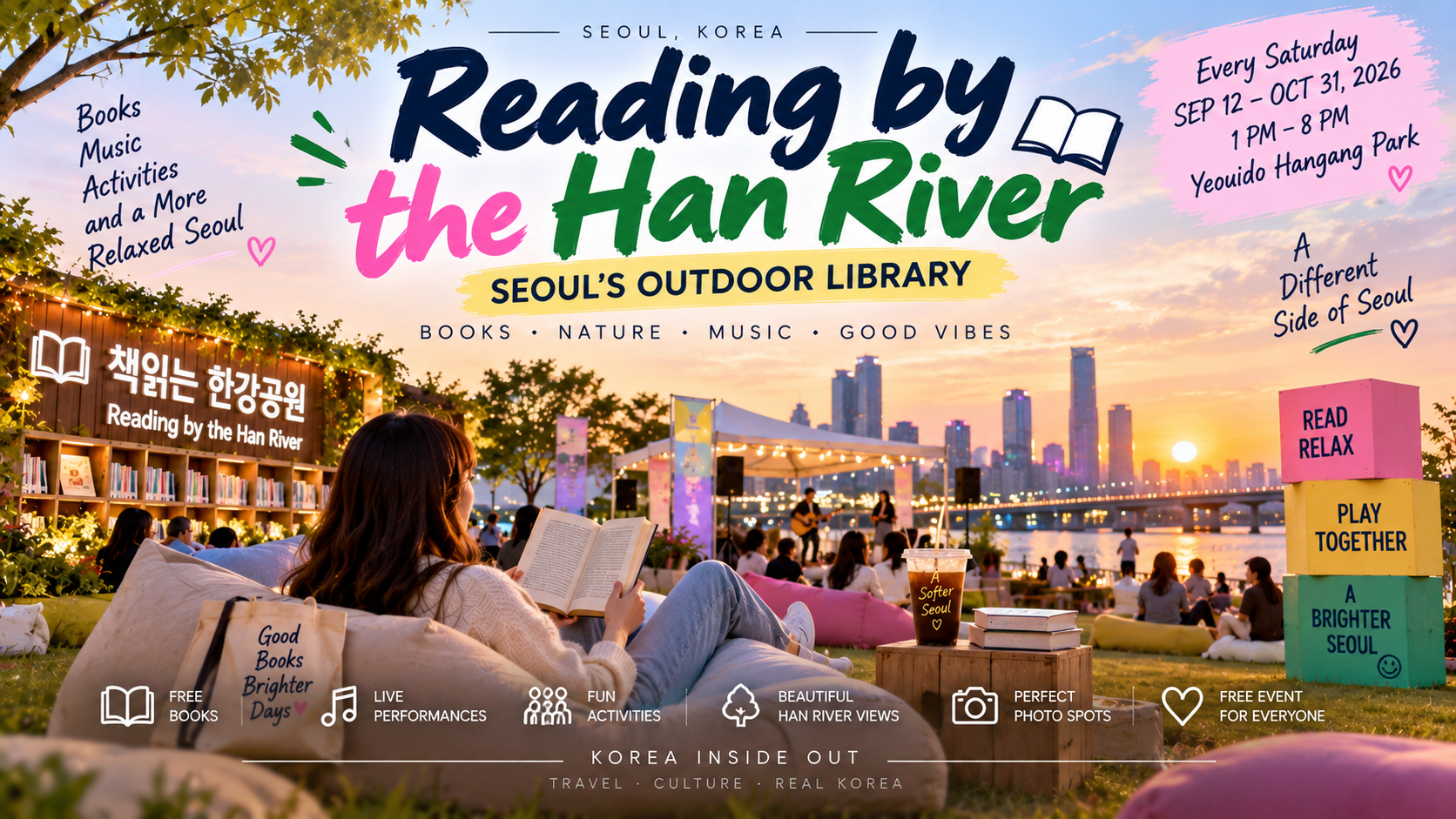
    That is the idea behind Chaekneunghan Hangang Park (책읽는 한강공원), Seoul’s outdoor library by the Han River.

    During the fall 2026 season, the outdoor library returns to Yeouido Hangang Park every Saturday from September 12 to October 31.

    You can browse books, sit by the river, join activities, watch performances, and simply slow down for a few hours.

    And unlike many organized activities in Seoul, the main outdoor library is free.

    For travelers, it is a surprisingly good way to experience a quieter side of Seoul.


    What Is “Reading by the Han River”?

    The name literally means “a Han River park where you read books.”

    It is an outdoor library and cultural space created by Seoul Metropolitan Government, combining:

    • 📚 Books and reading spaces
    • 🌿 The Han River and outdoor scenery
    • 🎵 Live performances
    • 🎨 Hands-on activities
    • 🎲 Games and family activities
    • 🧘 Relaxation programs
    • 🧺 Picnic-style seating

    It is not a traditional library.

    There are no quiet indoor rooms or strict library rules.

    Instead, you pick a book, find a comfortable spot, and read while looking out toward the river.

    The program is designed for families, young adults, local residents and tourists.


    2026 Fall Season: Quick Facts

    Details
    EventReading by the Han River / Chaekneunghan Hangang Park
    Fall datesSeptember 12–October 31, 2026
    DayEvery Saturday
    Time1 PM–8 PM
    LocationYeouido Hangang Park Multi Plaza & nearby riverside lawn
    AdmissionFree
    ProgramsReading, performances, games, workshops & special events
    Some activitiesAdvance reservation or on-site participation
    Best time to visitLate afternoon to sunset

    The official schedule lists the fall program as running from 1 PM to 8 PM, with individual programs generally lasting 60–120 minutes.


    Why Visit an Outdoor Library in Seoul?

    Seoul has no shortage of famous attractions.

    But after several days of palaces, markets, museums and shopping streets, you may eventually want to do something that feels less like sightseeing.

    That’s where this outdoor library works particularly well.

    You can spend an afternoon doing very little.

    Read for 30 minutes.

    Walk along the river.

    Listen to live music.

    Grab something to eat.

    Sit on the grass.

    Watch the sunset.

    Then continue your evening somewhere else in Seoul.

    It is also a good opportunity to experience how locals use the Han River as a place to relax rather than simply as a tourist attraction.


    What Can You Do There?

    1. Borrow a Book and Find a Spot

    The main attraction is, obviously, the books.

    The 2026 fall season has refreshed the collection, replacing around 1,000 worn-out books and adding new titles, including bestsellers and books organized by different interests.

    The organizers are also introducing tactile books for young children and Braille books for visually impaired readers for the first time in 2026.

    So this isn’t simply a photo-friendly reading area.

    It is designed as a functioning outdoor reading space.


    2. Relax in the Reading Zone

    You don’t have to sit on the ground.

    The reading area includes approximately 500 seats, including:

    • Reading benches
    • Large picnic mats
    • Quiet reflection areas
    • Comfortable outdoor seating

    The idea is to make the space somewhere you can stay for a while rather than somewhere you simply visit for a photo.

    Our tip

    Don’t worry about bringing a book from home.

    One of the easiest ways to enjoy the experience is simply to arrive, browse the available books and choose something that catches your attention.


    3. Enjoy the Han River Without a Busy Itinerary

    This may actually be the best reason to visit.

    The reading area is located at Yeouido Hangang Park, one of Seoul’s most popular riverside parks.

    Instead of treating the park as another attraction you need to “see,” use it as a place to slow down.

    Bring a coffee.

    Find a seat.

    Read a few pages.

    Watch bicycles go past.

    Look at the river.

    That is the experience.

    And you don’t need to speak Korean to enjoy it.


    4. Join the Special Programs

    The outdoor library isn’t only about reading.

    Every Saturday has a different theme or special activity.

    The fall 2026 schedule includes everything from yoga and traditional Korean games to crafts and jazz.


    September 12 — Opening Day

    The fall season opened on September 12 with a special Fantasy Book Land theme.

    The opening program included:

    • Children’s puppet theater
    • A cookie-house-making activity
    • Bubble magic
    • Live performances
    • An opening concert

    The afternoon and evening lineup included performances by ZK DOU, Another Me, Samdonaegi, Soneta Classic, Lee Won and Gift Band.

    The opening day has already passed, but the outdoor library continues every Saturday through October 31.


    September 19 — Sunset Healing Yoga

    If you want something more relaxing than a traditional sightseeing activity, September 19 is a good date.

    Sunset Healing Yoga lets participants practice yoga while enjoying the autumn breeze and sunset over the Han River.

    This is one of the programs where the location really matters.

    Doing yoga indoors is one thing.

    Doing it beside the Han River as the sky changes color is another.


    September 27 — Korean Chuseok Festival

    The Chuseok holiday gets its own special program.

    The Generations Together Chuseok Festival introduces visitors to traditional Korean games and activities, including:

    • Rice-cake pounding
    • Giant yutnori
    • Jegichagi
    • Tuho
    • Traditional paper crafts

    This could be particularly interesting for international visitors because it offers a more hands-on introduction to Korean traditional culture.

    The 2026 program is scheduled for Sunday, September 27, rather than the usual Saturday, because of the Chuseok holiday period.


    October 3 — Book-Kku Day

    What happens when reading meets crafts?

    Book-Kku Day.

    The Korean word kku-mi-da means “to decorate,” and this program turns books into a creative activity by using embroidery techniques to decorate them.

    It is a good example of how the outdoor library goes beyond simply sitting down and reading.


    October 10 — Han Seok-bong Challenge

    This is probably one of the most unusual programs of the season.

    The Han Seok-bong Challenge is a survival-style competition inspired by the legendary Korean calligrapher Han Seok-bong.

    Participants face challenges such as:

    • Making songpyeon while blindfolded
    • Writing with a traditional brush
    • Drawing given subjects
    • Guessing book titles

    There is even a costume competition for participants who come dressed as Han Seok-bong.

    For travelers interested in Korean culture, this is a fun way to encounter traditional themes in a very modern, playful format.


    October 17 — Han River Autumn Jazz Festa

    If you’re more interested in music than books, save October 17.

    The Han River Autumn Jazz Festa features jazz performances ranging from swing to bossa nova.

    The combination of live music, autumn weather and the Han River at night makes this one of the most atmospheric dates in the fall program.

    Our pick

    If you are visiting Seoul as a couple, October 17 would be one of our top choices.

    Come in the afternoon, read for a while, walk along the river, then stay for the jazz as the sun goes down.


    October 24 — Han River Book Sharing

    This is a particularly nice idea for book lovers.

    Visitors can bring a book that has meaning to them and exchange it with another person’s favorite book.

    The idea is simple:

    Share a book → receive another book → take home someone else’s story.

    For a traveler, it is also a more personal souvenir than buying something from a typical gift shop.


    October 31 — Closing Ceremony

    The fall season ends on October 31.

    The closing ceremony is scheduled to include performances by the Korean Navy Promotional Band, including music, musical theater, traditional percussion, magic and band performances, along with live band and crossover performances.

    If you’re visiting Seoul at the end of October, this could be a fun way to finish an autumn trip.


    There’s More Than Just Reading

    One reason the program works for travelers who aren’t particularly interested in books is that the space is designed as a family-friendly outdoor cultural playground.

    The event includes separate areas for:

    Reading Zone

    Books, benches, mats and quiet spaces.

    Play Zone

    Games and activities for children and families.

    Experience Zone

    Hands-on workshops and special programs.

    The official program describes the fall edition as a family-oriented outdoor library where visitors can combine reading, play, performances and hands-on activities.

    So you don’t need to be a serious reader to enjoy it.


    How Long Should You Stay?

    I’d allow 2–4 hours.

    You could easily spend an entire afternoon there, but you don’t need to.

    A relaxed 3-hour visit

    4:00 PM
    Arrive at Yeouido Hangang Park

    ↓

    4:10 PM
    Browse the books

    ↓

    4:30 PM
    Read by the river

    ↓

    5:30 PM
    Walk around the park / try an activity

    ↓

    6:00 PM
    Watch a performance

    ↓

    6:30 PM
    Enjoy the sunset

    ↓

    7:00 PM
    Dinner or continue your Seoul evening

    This also makes it easy to combine the outdoor library with another Yeouido attraction.


    How to Get There

    The main 2026 fall location is:

    Yeouido Hangang Park Multi Plaza and the nearby riverside lawn.

    The easiest subway option is:

    Yeouinaru Station — Line 5

    Take Exit 2, then walk approximately 5–7 minutes toward Yeouido Hangang Park.

    Another option is:

    National Assembly Station — Line 9

    Take Exit 1 and walk approximately 10 minutes.

    For most visitors, Yeouinaru Station is the simplest option.


    Is It Free?

    Yes.

    The outdoor library itself is free to visit. The official 2026 fall listing confirms that admission is free.

    However, some individual activities may require advance registration.

    So think of it this way:

    Come and read → free.

    Join a specific special program → check the program details first.

    The official event listing says participation is either on-site or by advance reservation depending on the individual program.


    Do You Need to Bring Your Own Book?

    No.

    The whole point is that books are provided at the outdoor library.

    Of course, you can bring your own book if you prefer.

    But if you’re traveling light, don’t worry about carrying one around Seoul all day.


    What Should You Bring?

    You don’t need much.

    Comfortable clothes

    You’ll probably sit outside for a while.

    A light jacket

    Autumn evenings beside the Han River can feel cooler than the city streets.

    Sunglasses

    If you arrive in the afternoon, the riverside can be quite bright.

    Portable charger

    Especially useful if you’re taking photos or using maps throughout the day.

    A picnic mat — optional

    There are already designated reading and seating areas, so this isn’t essential.


    Is It Good for Families?

    Very much so.

    The program is specifically designed to accommodate families as well as younger visitors and tourists.

    The combination of books, outdoor games, workshops, performances and open space means children don’t have to sit quietly and read for hours.

    They can move between the reading, play and activity areas.

    For families traveling with children, this can be a useful break from Seoul’s more crowded attractions.


    Is It Good for Couples?

    Also yes.

    In fact, the late-afternoon schedule makes it particularly appealing for a relaxed date.

    Try this:

    Read together → coffee → Han River walk → sunset → live music → dinner

    It’s a very different experience from spending another evening in a busy shopping district.


    The Best Dates to Visit

    If you’re deciding which Saturday to visit, here’s our quick guide:

    DateSpecial ProgramBest For
    Sep 19Sunset Healing YogaRelaxation & couples
    Sep 27Chuseok FestivalKorean culture
    Oct 3Book-Kku DayCrafts & creativity
    Oct 10Han Seok-bong ChallengeUnique Korean experience
    Oct 17Autumn Jazz FestaMusic & evening atmosphere
    Oct 24Book SharingBook lovers
    Oct 31Closing CeremonyPerformances

    The exact program schedule can change because of weather or performer circumstances, so check the official site before visiting.


    Our Favorite Way to Experience It

    Don’t treat Reading by the Han River like a normal tourist attraction.

    You don’t need to arrive exactly when something starts.

    Instead, come in the late afternoon.

    Pick a book.

    Sit down.

    Read a few pages.

    Get up and walk.

    Watch the river.

    Listen to the music.

    Then stay until sunset.

    That is probably the closest you’ll get to experiencing the program the way it is intended.


    Reading by the Han River vs. a Regular Han River Picnic

    You might be wondering why you need an organized event when you can simply visit the Han River yourself.

    Both are good — but they’re different.

    Regular Han River PicnicReading by the Han River
    Bring your own thingsBooks and seating provided
    Very flexibleScheduled programs
    Mostly quietPerformances & activities
    DIY experienceOrganized cultural experience
    Any daySelected Saturdays
    Great for relaxingGreat for relaxing + exploring

    If you only want to sit beside the river, you don’t need the event.

    But if you want books, activities, performances and a ready-made outdoor space, the outdoor library is worth visiting.


    Final Thoughts

    One of the best things about traveling is discovering that a city can be interesting even when you’re not rushing around trying to see everything.

    Reading by the Han River is exactly that kind of experience.

    It’s free.

    It’s relaxed.

    It’s easy to reach.

    And it gives you a chance to experience Seoul the way many locals do — outdoors, beside the Han River, with plenty of time to simply sit and enjoy the view.

    If you’re visiting Seoul during the 2026 fall season, consider leaving one Saturday afternoon completely open.

    Bring your curiosity, choose a book, and let the Han River do the rest.

    Sometimes the best Seoul experience is the one where you don’t have to hurry anywhere.


    2026 Fall Schedule at a Glance

    September 12 – October 31, 2026

    Every Saturday, 1 PM–8 PM

    📍 Yeouido Hangang Park Multi Plaza & riverside lawn

    🎟️ Free admission

    📚 Books + reading spaces + performances + activities

    Some special programs require advance registration, while others are available on site. Check the official schedule before visiting.

    For more seasonal events during your Seoul trip, you can also check our What’s On in Korea: September 2026 guide.

  • GES & Entertech Seoul 2026: K-Pop, Gaming, AI and XR Take Over DDP This Weekend

    GES & Entertech Seoul 2026: K-Pop, Gaming, AI and XR Take Over DDP This Weekend

    If you are in Seoul from September 18 to 20, 2026, Dongdaemun Design Plaza is about to become much more than an architecture stop.

    For three days, DDP will turn into a giant playground for K-pop, gaming, artificial intelligence, XR, e-sports and future entertainment as two major Seoul events come together for GES & Entertech Seoul 2026.

    For international travelers, this is particularly interesting because you do not need to be attending an industry conference to enjoy it.

    Most of the exhibitions and public experience programs can be visited without a reservation, making this one of the easiest major Seoul events to add to a trip this weekend.

    Here is what you need to know.

    GES & Entertech Seoul 2026 at a Glance

    Dates: September 18–20, 2026

    Location: Dongdaemun Design Plaza (DDP)

    Korean: 동대문디자인플라자

    Main themes: K-pop, gaming, e-sports, AI, XR, mobility and entertainment technology

    General exhibitions and experiences: Walk-in participation available

    Some opening ceremonies and forums: Advance registration required

    Seoul Metropolitan Government says the event combines the previously separate Entertech Seoul and GES — Game E-sports Seoul — into a larger integrated festival.

    The result is less like a conventional technology exhibition and more like a glimpse at how Seoul sees the future of entertainment.

    Why This Event Is Interesting for Travelers

    There are plenty of gaming conventions and technology exhibitions around the world.

    What makes this one particularly Seoul-like is the mixture.

    K-pop isn’t presented separately from technology. Gaming isn’t isolated from entertainment. AI, XR, music, performance and digital content are all being treated as parts of the same cultural ecosystem.

    That reflects something visitors already see throughout Seoul.

    A K-pop pop-up may use interactive screens. A beauty store may incorporate AI. A museum exhibition may rely heavily on projection mapping. A gaming event may look almost like a live concert.

    GES & Entertech Seoul puts those worlds in one place.

    What Can You See?

    The program combines exhibitions with participatory experiences.

    According to Seoul’s official event information, visitors can expect areas connected with:

    K-pop

    Music and performance are one of the central pillars of this year’s event.

    Gaming and e-sports

    GES brings competitive gaming and game-related experiences into the DDP program.

    AI and entertainment technology

    The event explores how artificial intelligence is being used in content and entertainment.

    XR and immersive experiences

    Visitors can encounter interactive and extended-reality technology rather than simply looking at product displays.

    Mobility

    Future mobility also forms part of the technology side of the program.

    Seoul says the event includes everything from exhibitions and e-sports competitions to busking, random-play dance and game arcades.

    That makes it much more accessible to ordinary travelers than the word “technology exhibition” might suggest.

    Do You Need a Reservation?

    For most travelers, no.

    Seoul states that most exhibitions and experience programs are open for on-site participation without advance booking.

    Some programs with limited seating — particularly the opening ceremony and forums — require advance registration.

    If you’re mainly interested in walking around DDP, seeing the exhibitions, trying interactive experiences and soaking up the atmosphere, you can visit much more casually.

    For program changes and registration-only sessions, check the official event information linked from Seoul Metropolitan Government’s GES & Entertech Seoul guide before visiting.

    Where Is DDP?

    Dongdaemun Design Plaza is one of Seoul’s most recognizable contemporary buildings.

    Designed by Zaha Hadid, the enormous curved structure sits in the heart of Dongdaemun.

    Search:

    동대문디자인플라자

    The easiest subway station is:

    Dongdaemun History & Culture Park Station (동대문역사문화공원역)

    Lines 2, 4 and 5 all stop here.

    That makes DDP exceptionally easy to reach from most major Seoul neighborhoods.

    How Much Time Should You Allow?

    If you’re casually visiting, allow around two to three hours.

    Gaming or K-pop fans could easily stay longer.

    I wouldn’t recommend planning your day as:

    hotel → DDP → hotel.

    Dongdaemun works much better as part of a larger itinerary.

    A Good Half-Day Dongdaemun Route

    Start in the afternoon around DDP.

    Explore the event for a few hours, then walk around the exterior of the building as daylight begins to fade.

    DDP is particularly photogenic after dark.

    From there, continue into the Dongdaemun shopping district.

    Depending on your interests, you can explore fashion malls, street food or nearby markets before dinner.

    That gives you a combination of futuristic Seoul and one of the city’s classic commercial neighborhoods.

    What Is SPP?

    Another reason the event is larger than it initially appears is its connection with SPP, Seoul’s international content-industry marketplace.

    Seoul says participants from around 30 countries and approximately 870 companies are connected with the wider business program.

    Ordinary travelers don’t need to understand the business side to enjoy GES.

    But it helps explain why the event covers so many different areas of entertainment.

    Is It Good for Children?

    Potentially, yes — especially older children interested in games, VR or technology.

    Because the event combines exhibitions, gaming and interactive content, it can be more engaging for children and teenagers than a traditional museum.

    However, individual programs can have their own participation conditions.

    Check on site before promising a child a particular VR or gaming experience.

    What Should K-Pop Fans Expect?

    Don’t think of this as a conventional K-pop concert.

    K-pop is one part of a much broader entertainment-tech event.

    That’s actually why it could be interesting for international fans.

    Instead of simply seeing performers on a stage, the event places Korean pop culture alongside the technology increasingly used to produce, distribute and experience it.

    There are also more casual public programs such as random-play dance and busking.

    What to Do Nearby

    One of the biggest advantages of this event is location.

    You’re already in Dongdaemun.

    Nearby possibilities include:

    Dongdaemun shopping

    Some malls stay open much later than conventional Seoul shopping centers.

    Gwangjang Market

    A popular stop for Korean street food and traditional market atmosphere.

    Cheonggyecheon

    The stream provides an easy evening walk toward central Seoul.

    Naksan / Ihwa area

    If you have more time and don’t mind hills, head north for elevated city views.

    Korean Search Terms

    GES 2026

    엔터테크 서울 2026 — Entertech Seoul 2026

    동대문디자인플라자 — Dongdaemun Design Plaza

    동대문역사문화공원역 — Dongdaemun History & Culture Park Station

    랜덤플레이댄스 — Random Play Dance

    Copying the Korean names into Naver Map or Kakao Map usually gives better navigation results.

    Is It Worth Adding to a First Seoul Trip?

    If you are in Seoul between September 18 and 20 and have even a casual interest in K-pop, gaming or technology, yes.

    The reason isn’t that you need to spend an entire day there.

    It’s the opposite.

    DDP is already a worthwhile Seoul destination, and this event gives you an additional reason to visit it now.

    You can spend a few hours exploring the event, photograph DDP after sunset, eat nearby and continue into Dongdaemun at night.

    That’s exactly the kind of temporary Seoul experience worth adding to an itinerary.

    For planning the rest of your trip, see How Many Days Do You Need in Seoul? 3, 5 or 7 Days.

    And if you’re looking for more things happening right now, What’s On in Korea: September 2026 is a useful starting point.

  • Banpo Jamsugyo Bridge Festival 2026: Seoul’s Car-Free Sunday by the Han River

    Banpo Jamsugyo Bridge Festival 2026: Seoul’s Car-Free Sunday by the Han River

    Imagine walking across one of Seoul’s busiest bridges with no cars around you.

    Instead of traffic, you find food trucks, live music, pop-up markets, outdoor games, photo spots, and people relaxing by the Han River.

    That is the idea behind the Banpo Jamsugyo Bridge Festival, one of Seoul’s most popular seasonal Han River events.

    In fall 2026, the Car-Free Jamsugyo Ttoek-Ttoek Festival returns every Sunday from September 6 to October 25, transforming Jamsugyo Bridge and the surrounding Banpo Hangang Park into a pedestrian-friendly festival space.

    The fall season runs from 2 PM to 10 PM, giving visitors plenty of time to enjoy the festival during the day and stay for the sunset and evening atmosphere.

    Best of all, the main festival is free to visit.


    What Is the Jamsugyo Bridge Festival?

    Jamsugyo Bridge is the lower bridge running beneath Banpodaegyo Bridge across the Han River.

    On normal days, it is a busy road.

    During the festival, however, approximately 1.1 km of the bridge is closed to vehicles every Sunday, creating a temporary pedestrian space where people can walk, eat, listen to music, shop, and enjoy activities with the Han River all around them.

    The 2026 fall festival runs under the theme:

    “Walking Together Along the Han River, Together as One.”

    Each Sunday has a different theme, while a range of permanent programs continues throughout the festival.


    Jamsugyo Bridge Festival 2026: Quick Facts

    Details
    EventCar-Free Jamsugyo Ttoek-Ttoek Festival
    DatesSeptember 6–October 25, 2026
    DaysEvery Sunday
    Festival hours2 PM–10 PM
    LocationJamsugyo Bridge & Banpo Hangang Park
    AdmissionFree
    Main attractionsFood trucks, markets, live music, games, workshops, photo spots
    Best time to visitLate afternoon through sunset
    Car restrictionSundays, 12 PM–midnight

    The festival itself runs from 2 PM to 10 PM, while vehicle restrictions begin earlier at noon and continue until midnight.


    What Happens Every Sunday?

    You don’t have to visit on a particular themed day to enjoy the festival.

    Several programs operate throughout the festival period.

    1. Moonlight Playground

    If you’re traveling with children, head toward the Moonlight Playground.

    It includes activities such as:

    • Large inflatable slides
    • Interactive games
    • A giant claw-machine-style experience
    • Bowling activities
    • An evening LED play zone

    Some activities are available on a first-come, on-site basis, while certain programs require advance registration.


    2. Food Trucks and Moonlight Restaurant

    Food is a major part of the Jamsugyo experience.

    The festival has a permanent food-truck area known as Moonlight Restaurant, where you can grab something to eat while enjoying the Han River.

    There are also market-style food and shopping areas throughout the festival.

    And if you visit on October 4, the food experience gets much bigger.


    3. Moonlight Market

    The festival also includes several shopping and market areas.

    You can find:

    • Handmade products
    • Local produce
    • Small independent vendors
    • Crafts
    • Souvenirs
    • Local goods

    One of the nice things about the festival is that it feels less like a conventional tourist attraction and more like a large Seoul weekend gathering.


    4. Live Music

    Street performances are another regular feature.

    Guseokguseok Live brings Seoul street artists and musicians to different parts of the festival.

    You can simply walk around the bridge and stop whenever you hear a performance you like.

    There is also a silent DJ party, where participants listen to music through wireless headphones instead of blasting music through speakers.

    It’s a fun experience if you’ve never tried a silent disco before.


    5. Moonlight Rainbow Fountain

    One of the easiest ways to extend your evening is to stay for the Moonlight Rainbow Fountain at Banpo Bridge.

    The famous fountain combines water, lights, and music above the Han River.

    During the fall festival period, it operates regularly in the evening, although the exact schedule can vary by season and operating conditions.

    This is one reason we recommend visiting the festival later in the afternoon rather than arriving right at 2 PM.


    Special Programs in September

    Each Sunday has its own theme.

    September 6 — Jamsugyo Water Wars

    The fall season opened with Jamsugyo Water Wars, a giant water-gun event at Banpo Hangang Park.

    This program required advance registration and is already over.


    September 13 — Tto-Tto-Gather × Seoul Club ON

    On September 13, university clubs take over the festival with performances and hands-on activities.

    Expect:

    • Busking
    • K-pop dance
    • Traditional Korean percussion
    • Magic experiences
    • Polaroid photo events
    • Citizen participation activities

    This day’s program is particularly interesting for visitors who want to see what young Seoulites are doing beyond the usual tourist attractions.

    The program is available through on-site participation.


    September 20 — Jamsugyo Fall Field Day

    This is basically a giant outdoor Korean-style field day.

    Activities include classic games such as:

    • Tug of war
    • Hoop activities
    • Mugunghwa kkoci pieotseumnida (“Red Light, Green Light”)
    • Other group games

    The program is designed so that ordinary visitors can participate rather than simply watch.

    Advance registration is planned.


    September 27 — Moonlight Chuseok Festival

    For travelers visiting Seoul around Chuseok, this could be one of the most interesting dates.

    The festival celebrates Chuseok with traditional performances from Korea, Argentina, Bulgaria, Russia, Panama, and Kazakhstan.

    There are also traditional Korean games such as yutnori.

    The program takes place at the Banpo Hangang Park waterfront stage from 3 PM to 6 PM.

    No advance reservation is required for general viewing and participation.


    Special Programs in October

    October brings a different atmosphere, with more emphasis on food, lights, and relaxation.

    October 4 — Jamsugyo Gourmet Road

    If you’re a foodie, this may be the Sunday to choose.

    More than 100 food trucks will gather for a giant outdoor food festival from 2 PM to 10 PM.

    There will also be dining space for up to approximately 800 people.

    That’s roughly three times the scale of the festival’s regular food-truck operation.

    You can expect international dishes as well as Korean favorites.


    October 11 — Moonlight Jamsugyo

    This is probably the most atmospheric evening of the fall season.

    From 7 PM to 10 PM, Jamsugyo and Banpodaegyo become part of a large-scale media art and lighting experience.

    The program combines:

    • Bridge lighting
    • Media art
    • Music
    • Nighttime views of the Han River
    • A galaxy-inspired visual concept

    If you’re looking for a romantic Seoul evening, this is one of the dates we’d put at the top of the list.


    October 18 — Jamsugyo Refresh Day

    This Sunday focuses on wellness.

    From 5 PM to 8 PM, visitors can join activities such as:

    • Yoga
    • Stretching
    • Meditation
    • Relaxation programs

    Advance registration will be available for the relevant programs.


    October 25 — Final Sunday

    The final special program of the 2026 fall season is currently listed as “to be announced.”

    So if you’re visiting Seoul in late October, it’s worth checking the official festival schedule before heading to Jamsugyo.


    What Makes the Festival Special for Tourists?

    There are plenty of organized festivals in Seoul, but Jamsugyo has something different.

    The attraction isn’t a single performance or exhibition.

    The bridge itself becomes the attraction.

    You can walk directly across a normally busy Seoul road, look out over the Han River, stop for food, listen to street musicians, browse local markets, and watch the city change from afternoon to evening.

    It’s a very easy way to experience Seoul’s Han River lifestyle without needing to plan a complicated itinerary.


    The Best Time to Visit

    Our recommendation is around 4:30–5 PM.

    This gives you enough time to explore the festival during daylight.

    Then you can stay through:

    Late afternoon → sunset → evening lights → Han River night view

    That’s much more interesting than arriving at 2 PM and leaving before sunset.

    A simple itinerary

    4:30 PM
    Arrive at Jamsugyo

    ↓

    4:45 PM
    Walk across the bridge and explore the festival

    ↓

    5:30 PM
    Grab food from a food truck

    ↓

    6:00 PM
    Browse the market and watch live performances

    ↓

    6:30 PM
    Watch the sunset over the Han River

    ↓

    7:00 PM
    Enjoy the evening programs

    ↓

    8:00 PM onward
    Silent DJ, lights, fountain and nighttime Han River views

    You don’t need to follow this schedule exactly. The beauty of the festival is that you can simply wander.


    Do You Need a Reservation?

    Not for the main festival.

    You can visit the bridge, walk around, eat, shop, watch performances, and enjoy many of the permanent programs without making a reservation.

    However, some special activities require advance registration.

    Examples include:

    • Selected sports activities
    • Water Wars
    • Certain children’s activities
    • Moonlight Picnic Shelter
    • Selected wellness programs

    The official festival website clearly distinguishes between on-site participation and advance-registration programs.

    Our tip

    If you see a program you really want to join, check the official schedule before visiting.

    Don’t assume that everything is first-come, first-served.


    Moonlight Picnic Shelter

    One of the more relaxing options is the Moonlight Picnic Shelter.

    Tents are set up along the Han River, allowing visitors to sit down and enjoy the river view.

    Reservations open through the festival’s official website.

    This can be a particularly nice option for couples, families, or anyone who wants a break from walking around the festival.


    How to Get to Jamsugyo Bridge

    Public transportation is strongly recommended.

    The festival attracts large crowds, and parking around Banpo Hangang Park is limited.

    During the festival, Jamsugyo is closed to vehicle traffic from noon until midnight every Sunday.

    The two bus routes that normally use Jamsugyo, 405 and 740, are temporarily diverted via Banpodaegyo.

    For visitors, the easiest approach is therefore to use the subway and walk toward Banpo Hangang Park.

    If you’re already exploring the southern side of Seoul, Jamsugyo can also be combined with a walk along the Han River.


    Important Traffic Information

    This is particularly important if you’re taking a taxi or driving.

    Every Sunday during the festival:

    12 PM–midnight

    approximately 1.1 km of Jamsugyo is closed to vehicles.

    The affected section runs between the northern end of Jamsugyo and the southern end near Moonlight Square.

    The southern roundabout remains operational, but traffic around Banpo can still become congested.

    Seoul recommends public transportation during the festival period.


    What Should You Bring?

    You don’t need much, but a few things can make the experience better.

    Comfortable shoes

    You’ll probably walk much more than you expect.

    A light jacket

    The Han River can feel noticeably cooler after sunset, especially in autumn.

    Portable battery

    You’ll probably take plenty of photos and videos.

    Cash or a payment card

    Useful for food trucks and market purchases, although payment methods can vary by vendor.

    A picnic mat

    If you want to sit by the river, bringing your own small mat can be useful.


    Is the Jamsugyo Festival Good for Families?

    Yes.

    The festival has plenty of child-friendly activities, especially around the Moonlight Playground.

    Kids can participate in games, outdoor activities, and interactive experiences while parents enjoy the Han River atmosphere.

    The festival is also stroller-friendly in many areas, although crowds can make movement slower during peak times.

    For families, arriving in the late afternoon is a good strategy: you can enjoy the children’s activities while there is still daylight and then stay for the evening atmosphere.


    Is It Worth Visiting Without a Special Program?

    Definitely.

    This is actually one of the festival’s biggest strengths.

    You don’t need to attend a particular event.

    You can simply:

    Walk → Eat → Shop → Listen to music → Watch the sunset → Enjoy the Han River at night

    And because admission to the main festival is free, there is very little downside to stopping by for an hour or two.


    Jamsugyo Festival vs. a Typical Han River Picnic

    A normal Han River picnic is quiet and relaxed.

    Jamsugyo is more lively.

    Han River PicnicJamsugyo Festival
    RelaxedLively
    Bring your own foodFood trucks available
    Mostly free-formScheduled programs
    Quiet river viewsMusic and performances
    Best for relaxingBest for activities
    Any daySundays during festival

    If you’re visiting Seoul for the first time, we’d actually recommend doing both.

    Spend one evening having a quiet Han River picnic, then visit Jamsugyo on a Sunday to experience the more social side of Seoul’s river culture.


    Our Recommended Sunday

    If we had to choose just one Sunday during the 2026 fall season, we’d pick October 11 — Moonlight Jamsugyo.

    Why?

    Because it combines many of the things that make Seoul especially fun at night:

    • The Han River
    • A car-free bridge
    • Contemporary media art
    • Music
    • City lights
    • Night photography
    • A relaxed outdoor atmosphere

    If food is more important to you, choose October 4 instead.

    If you want traditional culture around Chuseok, choose September 27.

    And if you are traveling with kids, the September 20 Fall Field Day is worth considering.


    Final Thoughts

    The Car-Free Jamsugyo Ttoek-Ttoek Festival is one of the easiest Seoul festivals to recommend to first-time visitors.

    You don’t need to understand Korean, book an expensive tour, or spend the entire day there.

    Just arrive on a Sunday afternoon, walk onto the bridge, and see Seoul from a completely different perspective.

    A road normally filled with cars becomes a place for people.

    And as the sun sets, the Han River, Banpodaegyo Bridge, city skyline, food trucks, music, and festival lights create one of the most enjoyable free evenings you can have in Seoul.

    Our tip

    Don’t rush home when the sun goes down.

    The fall festival runs until 10 PM, and the atmosphere changes dramatically after sunset.

    For the best experience, come in the late afternoon and stay into the evening.

    That’s when Jamsugyo really comes alive.


    2026 Fall Schedule at a Glance

    DateSpecial ProgramTime
    Sep 6Jamsugyo Water Wars2–5:30 PM
    Sep 13Tto-Tto-Gather × Seoul Club ON2–8 PM
    Sep 20Jamsugyo Fall Field Day2–10 PM
    Sep 27Moonlight Chuseok Festival3–6 PM
    Oct 4Jamsugyo Gourmet Road2–10 PM
    Oct 11Moonlight Jamsugyo7–10 PM
    Oct 18Jamsugyo Refresh Day5–8 PM
    Oct 25Special program TBATBA

    The festival itself runs every Sunday from 2 PM to 10 PM, from September 6 through October 25.

    If you’re planning a September trip, you can also see our What’s On in Korea: September 2026 guide for more seasonal events around the country.

  • Seoul Light DDP 2026 Fall: A Free Nighttime Media Art Show in Seoul

    Seoul Light DDP 2026 Fall: A Free Nighttime Media Art Show in Seoul

    If you are looking for something to do in Seoul after dark, Seoul Light DDP is one of the city’s most impressive free nighttime experiences.

    For its 2026 fall season, the event transforms the huge curved exterior of Dongdaemun Design Plaza (DDP) into a giant canvas for light, video, laser art, and live music.

    The 2026 fall edition runs from September 3 to September 13, with programs taking place every evening from 7:30 PM to 10:30 PM. Admission is free.

    This year’s theme, “K-Original Light,” explores Korean culture and creativity through contemporary media art, featuring works inspired by artists such as Nam June Paik and Yoo Youngkuk, as well as the historic Korean poetry collection Cheonggu Yeongeon.

    If you are already planning to visit DDP, it is worth staying until after sunset.


    What Is Seoul Light DDP?

    Seoul Light DDP is a large-scale outdoor media art festival held at Dongdaemun Design Plaza, one of Seoul’s most recognizable pieces of contemporary architecture.

    The curved 222-meter exterior of DDP becomes the screen for large-scale projections and light installations. Instead of simply watching a video on a screen, you are surrounded by the architecture, lights, music, and movement.

    The result is particularly impressive after dark.

    The 2026 fall program combines:

    • Large-scale media facade shows
    • Laser art
    • Live music performances
    • Real-time responsive media art
    • Outdoor nighttime activities

    The entire event is free to watch, and you do not need to purchase a separate ticket to see the main shows.


    Seoul Light DDP 2026 Fall: Quick Facts

    Details
    EventSeoul Light DDP 2026 Fall
    DatesSeptember 3–13, 2026
    Time7:30 PM–10:30 PM
    LocationDongdaemun Design Plaza (DDP)
    AdmissionFree
    Main programsMedia facade, laser art, live performances
    Nearest subwayDongdaemun History & Culture Park Station
    Recommended timeAround 7:20–7:30 PM

    The event is held around the DDP exterior and Eoullim Square, making it easy to combine with an evening around Dongdaemun.


    What Can You See?

    The 2026 fall edition is particularly interesting because it connects contemporary digital art with some of Korea’s most important modern and traditional cultural works.

    1. The Break Point — Nam June Paik

    One of the highlights is a media art piece inspired by Nam June Paik, the Korean-American artist widely regarded as a pioneer of video art.

    The work, titled “The Break Point,” draws inspiration from Paik’s video synthesizer and combines media art with a live performance.

    Unlike a conventional prerecorded projection, the visuals can respond to the live performance in real time.

    This is one of the most distinctive elements of Seoul Light DDP 2026.


    2. Finding the Mountain Within Me — Yoo Youngkuk

    Another major work is inspired by Korean abstract painter Yoo Youngkuk.

    His paintings are famous for their simplified mountains, geometric forms, and strong colors.

    For Seoul Light DDP, these ideas are transformed into moving light and digital imagery across the building’s enormous curved surface.

    If you have never encountered Yoo Youngkuk’s work before, seeing his colorful abstract landscapes projected onto DDP is a particularly memorable introduction.


    3. A Night When Words Shine

    The third major media facade work takes inspiration from Cheonggu Yeongeon, an important collection of Korean sijo poetry.

    Instead of presenting the old Korean text as a traditional literary exhibit, the work transforms Korean letters, poetry, and natural imagery into contemporary digital patterns and light.

    For international visitors, this is an interesting way to experience an aspect of Korean culture that goes beyond the usual palace-and-K-pop itinerary.


    4. DDP 365 Light

    The festival also introduces DDP 365 Light, a new laser and lighting work created by artist Yoon Jeho.

    It uses lasers and lighting to interact with DDP’s unusual architecture.

    One interesting thing about this program is that it is not intended to disappear completely when Seoul Light DDP ends.

    The Seoul Design Foundation plans to operate DDP 365 Light as an ongoing nighttime content program, with regular screenings gradually expanded after the festival.

    So even if you miss the September festival, DDP will continue to have nighttime light programming.


    When Should You Visit Seoul Light DDP?

    The easiest option is to arrive around 7:20–7:30 PM.

    The first program begins at 7:30 PM, and you can then stay for the later screenings.

    Weekday schedule

    From Monday to Thursday, the main program starts at:

    • 7:30 PM
    • 8:00 PM
    • 8:30 PM
    • 9:00 PM
    • 9:30 PM
    • 10:00 PM

    The media facade and laser art are repeated throughout the evening.

    Weekend schedule

    On Friday through Sunday, the main programs are also scheduled at 7:30 PM, 8:00 PM, 9:30 PM, and 10:00 PM.

    The 8:00 PM session includes live performances on selected dates.

    For example, the 2026 fall lineup includes performances by SION, HYPNOSIS THERAPY, and SOULSCAPE.

    If you are interested in the live music, check the specific date before visiting because the performance schedule changes by day.


    Is Seoul Light DDP Free?

    Yes.

    Seoul Light DDP is a free outdoor event, and you do not need to buy a ticket for the main media facade, laser art, or live performances.

    This makes it particularly good for travelers who want an interesting Seoul night activity without adding another expensive attraction to their itinerary.

    You can simply walk to DDP, find a good viewing area, and enjoy the show.


    How to Get to Seoul Light DDP

    The easiest way to reach DDP is by subway.

    Dongdaemun History & Culture Park Station

    DDP is directly connected to Dongdaemun History & Culture Park Station, served by:

    • Line 2
    • Line 4
    • Line 5

    Exit 1 is a convenient choice for reaching DDP.

    If you are unfamiliar with Seoul’s subway system, see our guide:

    How to Use the Seoul Subway: A First-Time Visitor’s Guide


    What to Do Before or After Seoul Light DDP

    One of the best things about Seoul Light DDP is that you don’t need to make it your entire evening.

    DDP sits in the middle of one of Seoul’s busiest shopping and food districts, so you can easily combine the light show with dinner, shopping, or an evening walk.

    Option 1: Dongdaemun evening

    6:00 PM — Dinner around Dongdaemun
    ↓
    7:20 PM — Arrive at DDP
    ↓
    7:30 PM — Seoul Light DDP
    ↓
    8:30–9:00 PM — Explore DDP and nearby streets
    ↓
    9:00 PM onward — Shopping or late-night food

    Option 2: DDP + local neighborhood

    The 2026 festival also introduces the DDP × Dongdaemun Super Pass, connecting the event with restaurants, cafés, shops, and local attractions around Dongdaemun.

    More than 140 participating businesses are organized into six themed walking courses, including areas around Sindang-dong, Jangchung-dong, and Gwanghui-dong.

    This is a nice option if you want to experience more than the typical tourist side of Dongdaemun.


    A Tip for Photographers

    DDP is already one of the most photogenic buildings in Seoul, but the projections completely change its appearance at night.

    For photos, don’t only photograph the projection itself.

    Try including:

    • The full curve of the DDP building
    • People watching the show
    • The surrounding city lights
    • The projection together with DDP’s architecture
    • A wide-angle view from Eoullim Square

    Because the media art covers such a large surface, a wider shot often works better than trying to capture the entire projection up close.


    Is Seoul Light DDP Worth Visiting?

    Yes, especially if you’re already visiting Dongdaemun.

    The biggest advantage is that there is very little commitment involved.

    You don’t need a ticket, reservation, or several hours of your evening. You can simply arrive after dinner, watch a few rounds of the projection, take some photos, and continue exploring Seoul.

    The 2026 edition is also more culturally interesting than a typical light show because it combines Korean modern art, traditional literature, digital technology, music, and DDP’s futuristic architecture.

    Our tip

    If you’re visiting Seoul during the September 2026 event period, put DDP after sunset on your itinerary rather than visiting only during the day.

    The building looks completely different at night.

    And if you are looking for more seasonal events during your trip, check our guide to What’s On in Korea: September 2026.


    Seoul Light DDP 2026 Fall FAQ

    When is Seoul Light DDP 2026?

    The fall edition runs from September 3 to September 13, 2026.

    How much does it cost?

    It is free.

    What time does it start?

    The first program begins at 7:30 PM, with programs continuing until 10:30 PM.

    Where is Seoul Light DDP held?

    At Dongdaemun Design Plaza (DDP) in Seoul, primarily around the exterior media facade and Eoullim Square.

    Do I need a reservation?

    No reservation is required for the main free outdoor program.

    Is it good for tourists?

    Absolutely. It is easy to reach by subway, free, visually impressive, and can be combined with dinner, shopping, and sightseeing around Dongdaemun.

    What makes the 2026 edition different?

    The 2026 fall season focuses on “K-Original Light,” bringing works inspired by Nam June Paik, Yoo Youngkuk, and Cheonggu Yeongeon together with laser art and live performances.


    Final Thoughts

    Seoul Light DDP is one of those Seoul experiences that is difficult to appreciate fully from photographs.

    You need to stand in front of DDP and watch the building itself become part of the artwork.

    The combination of Korean art, traditional culture, electronic music, lasers, and DDP’s futuristic architecture makes this more than just another nighttime light show.

    And because it is free, it’s an easy addition to almost any Seoul itinerary.

    If you’re in Seoul on a September evening, don’t just visit DDP during the day. Come back after dark.

  • Seoul Museum of Craft Art at Night: 2026 Evening Programs & How to Book

    Seoul Museum of Craft Art at Night: 2026 Evening Programs & How to Book

    Looking for something different to do in Seoul after the usual palaces, shopping streets and night markets?

    Here’s an idea that many international visitors don’t know about:

    Visit the Seoul Museum of Craft Art after dark.

    Located in the heart of central Seoul, near Anguk Station and Insadong, the Seoul Museum of Craft Art (SeMoCA) offers more than exhibitions.

    Throughout the year, the museum runs special evening programs where visitors can experience Korean crafts, join creative workshops, or simply slow down with yoga and meditation in the museum’s beautiful outdoor spaces.

    And many of these programs are free.

    The catch?

    You usually need to reserve a spot in advance through Seoul Public Service Reservation, the reservation platform operated by the Seoul Metropolitan Government.

    Here’s what to know before you go.


    What Is the Seoul Museum of Craft Art?

    The Seoul Museum of Craft Art, often called SeMoCA, is one of Seoul’s most interesting museums for visitors who want to understand Korean culture through objects and craftsmanship.

    Rather than focusing only on paintings or contemporary art, the museum explores the world of Korean craft — including ceramics, textiles, metalwork, woodwork, lacquerware and other traditional and contemporary crafts.

    The museum is located in Anguk, one of the most historic and walkable parts of central Seoul.

    That makes it particularly easy to combine with other popular areas such as:

    • Insadong
    • Bukchon Hanok Village
    • Gyeongbokgung Palace
    • Changdeokgung Palace
    • Ikseon-dong
    • Insa-dong’s traditional craft shops

    And there’s another reason to put it on your Seoul itinerary:

    The museum stays open late on Fridays.


    Seoul Museum of Craft Art at Night

    The museum’s regular exhibition hours are generally 10 AM–6 PM, but since April 2024, the exhibition galleries have remained open until 9 PM every Friday.

    Admission to the museum is free, although some special exhibitions may have separate admission arrangements.

    This makes Friday evening a particularly good time to visit.

    But the more interesting option is to look for one of SeMoCA’s special evening programs.

    These programs can take place after normal museum hours and may include hands-on craft workshops, wellness activities and special cultural experiences.


    Why Visit SeMoCA at Night?

    For travelers, the evening programs offer something that a normal museum visit doesn’t.

    Instead of simply walking through exhibition galleries, you can actually do something.

    Depending on the program, you might:

    🎨 Make your own craft
    🪵 Work with traditional materials
    ✨ Create a decorative object
    🧘 Practice yoga and meditation
    🎵 Experience sound-based meditation
    🌙 Relax in the museum’s outdoor spaces

    It’s also a nice way to experience a quieter side of Seoul.

    After a full day of sightseeing, an evening craft or wellness program can be a welcome change from another crowded tourist attraction.


    2026 Evening Programs at Seoul Museum of Craft Art

    There are several different evening programs during September and October 2026.

    The exact schedule changes throughout the year, so it’s important to check the current reservation listing before planning your visit.

    Here are some of the most interesting programs currently scheduled.


    1. Craft Night: Yoga × Meditation

    September–October 2026

    One of the most unusual new programs is “Craft Night, Yoga × Meditation.”

    Instead of spending the evening indoors, participants use the museum’s outdoor spaces for yoga and meditation.

    The museum describes it as an opportunity to enjoy the evening atmosphere of the museum while focusing on relaxation and mindfulness.

    The program runs across several evenings from September 19 through October 14, excluding the Chuseok holiday week.

    There are several different themes.

    September 19 Opening Night

    The opening night includes three different programs:

    Wind Yoga × Meditation
    5:00–6:00 PM

    Singing Bowl Yoga × Meditation
    5:00–5:30 PM

    Headset Yoga × Meditation
    6:30–7:30 PM

    The programs take place in different outdoor areas of the museum.

    The headset yoga session, for example, takes place in the museum’s outdoor craft yard and uses headphones so participants can follow the instructor in a more immersive setting.

    Later sessions include:

    • Gayageum Meditation — September 30
    • Voice Yoga Meditation — October 3
    • Sound Bath Meditation — October 7
    • Singing Bowl Yoga Meditation — October 10
    • Life Movement — October 14

    The later sessions are scheduled for 6:30–7:30 PM.

    How much does it cost?

    Free.

    Who can participate?

    The program is open to the general public.

    Children aged 5th grade and above may participate with a guardian, subject to the individual program’s rules.


    2. Night Workshop: Autumn Glass Art

    If yoga isn’t your thing, this may be even more interesting for travelers.

    The “Night Workshop: Autumn Glass Art” is a hands-on craft program inspired by stained glass.

    Participants make their own glass-art mood lamp while enjoying the museum after its normal operating hours.

    The program is part of SeMoCA’s broader Night Craft (夜金) series.

    Unlike a traditional class, this is designed as a self-directed craft experience.

    You’ll receive instructions and work at your own pace, with museum staff available to help when needed.

    2026 Autumn Glass Art

    Dates: September 18–October 30
    Location: Education Room, Exhibition Building 3, 1st floor
    Participants: Adults; children in 5th grade or older may participate with a guardian
    Capacity: 30 people per session
    Fee: Free
    Reservation: Seoul Public Service Reservation

    The program is scheduled as part of the museum’s monthly Friday evening craft series.

    The autumn version focuses on glass art, while the larger annual series rotates through different craft materials by season.


    3. Night Craft: Mother-of-Pearl Box Making

    Another evening program at SeMoCA is “Najeonham, Crafting with Mother-of-Pearl.”

    Najeon is the traditional Korean craft technique of decorating objects with delicate pieces of mother-of-pearl.

    This is a particularly interesting option for international visitors because it combines:

    Korean traditional craft + museum collection + hands-on making.

    Participants first look at representative mother-of-pearl objects from the museum’s collection before using traditional techniques to create their own decorated box.

    The September sessions are scheduled for:

    • September 8
    • September 15
    • September 22
    • September 29

    Each session runs from 6:00–7:30 PM.

    The program is designed for adults and has a maximum of 20 participants per session.

    It is also free.

    One important point: this is a real hands-on class, not a kit pickup. Participants are expected to complete the craft during the session.


    Do You Need to Pay?

    One of the best things about these programs is the price.

    Many SeMoCA evening programs are free.

    The programs above are currently listed as free on Seoul’s reservation system.

    That doesn’t mean you can always just walk in.

    Free does not mean no reservation.

    Popular programs can fill their limited places quickly.


    How to Book a Seoul Museum of Craft Art Evening Program

    This is the part international visitors should know.

    Seoul operates an official reservation platform called Seoul Public Service Reservation.

    The site allows users to reserve a wide range of city-run services and programs, including:

    • Cultural events
    • Museum programs
    • Craft workshops
    • Classes
    • Sports facilities
    • Tours
    • Parks and leisure programs
    • Other public services

    The English version of the reservation platform is also available.

    For SeMoCA programs, the museum’s own program pages repeatedly direct visitors to Seoul Public Service Reservation rather than accepting applications directly through the museum website.

    How to search

    Go to Seoul Public Service Reservation and search for:

    “Seoul Museum of Craft Art”

    or

    “SeMoCA”

    You can also search for the name of a specific program.

    The reservation system allows users to browse by categories such as activities, lessons and cultural programs.


    A Very Important Reservation Tip

    Don’t assume that the museum’s website and the reservation site always show exactly the same availability status.

    The museum specifically warns that its own website may show a program as accepting applications while the Seoul Public Service Reservation site may already be full — or vice versa.

    The reservation platform is the place to check the actual application status.

    This is especially important for popular evening programs with limited places.


    Can Foreign Tourists Use Seoul Public Service Reservation?

    This is where things can be slightly less straightforward.

    The Seoul Public Service Reservation website has an English interface, which is helpful for international visitors.

    However, individual program listings and application requirements can vary, and some programs may be presented primarily in Korean.

    If you’re a foreign visitor, check the individual reservation page carefully before assuming that a program is suitable for you.

    The good news is that the platform itself is designed to handle reservations for a wide range of Seoul’s public programs and services.


    How Early Should You Book?

    As soon as reservations open.

    Many SeMoCA programs are limited to just a few dozen participants.

    For example:

    • Autumn Glass Art: 30 participants per session
    • Mother-of-Pearl Box: 20 participants per session
    • Headset Yoga × Meditation: 100 advance reservations, plus limited on-site places

    The programs are free, which makes them particularly attractive — and also means popular sessions can fill quickly.

    Our tip

    If you see a program you want to join, don’t wait until the day before.

    Check the opening time for reservations and apply as soon as the booking window begins.


    What If the Program Is Full?

    Don’t give up immediately.

    Some Seoul Public Service Reservation programs allow canceled spots to become available again.

    For example, the SeMoCA yoga program notes that when a cancellation occurs, the reservation can automatically become available again.

    So if your preferred session is full:

    Check again later.

    Someone may cancel.


    What Should You Wear?

    This depends on the program.

    For yoga and meditation

    Wear comfortable clothing.

    For outdoor programs, the museum recommends bringing a light jacket or windbreaker because evening temperatures can feel cooler outdoors.

    For craft workshops

    Comfortable casual clothing is best.

    You’re going to be making something with your hands, so don’t wear an outfit you’re worried about getting dirty or damaged.


    What If It Rains?

    This is important because several evening programs take place outdoors.

    The museum notes that the schedule for outdoor programs may change in bad weather.

    If you’re attending an outdoor yoga or meditation session:

    Check the program notice on the day of your visit if rain is forecast.

    Don’t assume the program will operate exactly as scheduled.


    Where Is the Seoul Museum of Craft Art?

    The museum is located at:

    4 Yulgok-ro 3-gil, Jongno-gu, Seoul

    The easiest way to get there is by subway.

    🚇 Anguk Station — Line 3

    Take Seoul Subway Line 3 to Anguk Station.

    The museum is approximately one minute from Exit 1, making it exceptionally convenient for visitors exploring central Seoul.

    This is another reason we like the museum for travelers.

    You don’t need to make a special trip to an out-of-the-way neighborhood.


    What to Do Before Your Evening Program

    The location makes it easy to turn this into a full afternoon and evening itinerary.

    Option 1: Traditional Seoul

    Gyeongbokgung Palace
    ↓
    Bukchon Hanok Village
    ↓
    Insadong
    ↓
    Seoul Museum of Craft Art
    ↓
    🌙 Evening program

    Option 2: Art + Cafés

    Changdeokgung Palace
    ↓
    Ikseon-dong
    ↓
    Coffee break
    ↓
    SeMoCA
    ↓
    🌙 Craft workshop

    Option 3: Slow Seoul Evening

    Insadong
    ↓
    Traditional tea house
    ↓
    SeMoCA exhibition
    ↓
    🌙 Yoga, meditation or craft workshop
    ↓
    Dinner in Jongno

    This is one of those itineraries that feels much more relaxed than trying to visit ten attractions in one day.


    What Makes SeMoCA Different From a Normal Museum Visit?

    For travelers, the biggest attraction isn’t necessarily the collection.

    It’s the experience.

    You aren’t just looking at Korean craft behind glass.

    You can actually:

    • Learn about a traditional technique
    • Make something yourself
    • Meet other participants
    • Spend an evening in a historic part of Seoul
    • Experience a quieter side of Korean culture

    And because many programs are free, there’s very little downside to trying one if your schedule lines up.


    Is the Seoul Museum of Craft Art Worth Visiting at Night?

    Yes — especially if you’ve already seen Seoul’s major tourist attractions.

    If you’ve spent several days visiting palaces, markets and shopping districts, an evening at SeMoCA offers something completely different.

    It’s slower.

    It’s more hands-on.

    And it gives you a chance to experience Korean culture rather than simply photograph it.

    For travelers interested in Korean design, traditional crafts, wellness or creative activities, this is an especially good option.


    Our Favorite 2026 Options

    If we were choosing from the current evening programs, we’d shortlist them like this:

    🥇 For a uniquely Korean experience

    Mother-of-Pearl Box Making

    You learn about najeon, one of Korea’s most recognizable traditional decorative crafts, and make your own piece.

    🥈 For something creative

    Autumn Glass Art

    A great choice if you want to make something you can actually take home.

    🥉 For relaxation

    Headset Yoga × Meditation

    Ideal after a long day of sightseeing.

    🌙 For something unusual

    Sound Bath Meditation

    A very different experience from the typical Seoul tourist itinerary.


    Seoul Public Service Reservation: A Hidden Travel Resource

    Here’s the bigger tip we’d give international visitors:

    Don’t think of Seoul Public Service Reservation as just a booking website for Koreans.

    It can be a useful source for finding things to do in Seoul.

    The platform covers a surprisingly broad range of activities, including cultural programs, exhibitions, classes, sports facilities, park programs and other city-run experiences.

    So if you’re looking for something to do beyond the usual tourist attractions, it’s worth checking.

    You may find:

    • Free workshops
    • Cultural experiences
    • Walking tours
    • Museum programs
    • Outdoor activities
    • Seasonal events
    • Craft classes

    Some programs are free, while others have fees.

    And availability changes constantly.


    A Perfect Evening at SeMoCA

    Here’s how we’d plan it.

    3:00 PM

    Explore Insadong.

    4:00 PM

    Walk toward SeMoCA and visit the museum exhibitions.

    5:30 PM

    Have an early dinner or coffee nearby.

    6:00 PM

    Return to the museum for your evening program.

    6:30–7:30 PM

    🌙 Craft, yoga or meditation.

    7:30 PM onward

    Walk through the historic streets around Anguk and Insadong.

    It’s a simple itinerary, but it gives you something that many Seoul trips lack:

    time to slow down.


    Seoul Museum of Craft Art at Night: Quick Facts

    Information
    MuseumSeoul Museum of Craft Art (SeMoCA)
    LocationJongno-gu, Seoul
    Nearest subwayAnguk Station, Line 3
    Regular hours10 AM–6 PM
    Friday night openingUntil 9 PM
    Evening programsSelected dates
    Many programsFree
    ReservationSeoul Public Service Reservation
    Best forCulture, crafts, wellness & creative experiences
    Popular 2026 programsYoga × Meditation, Glass Art, Mother-of-Pearl Craft
    Advance bookingStrongly recommended

    Final Tip

    If you’re visiting Seoul, don’t only search for the city’s biggest attractions.

    Some of the most memorable experiences are hidden in places that locals use too.

    Seoul Museum of Craft Art’s evening programs are a perfect example.

    You can spend the day exploring palaces and traditional neighborhoods, then finish the evening making Korean craft, listening to a sound bath, or practicing yoga beneath an old gingko tree.

    And because many programs are free, it’s one of those Seoul experiences that’s worth checking even if you don’t normally plan museum activities.

    Check Seoul Public Service Reservation before your trip. You might find something you didn’t know Seoul offered.

    Booking Platform :
    Seoul Public Service Reservation