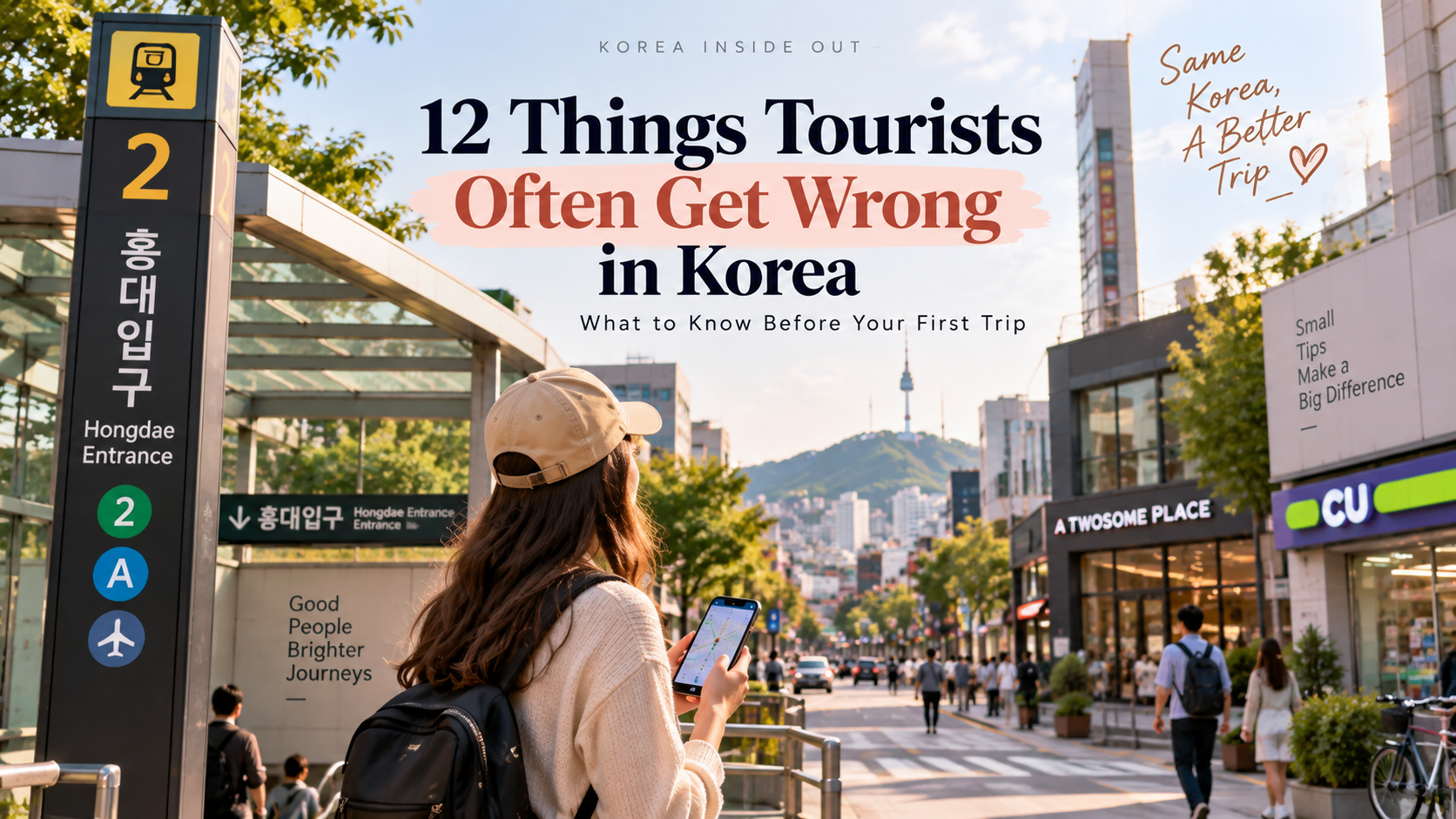
Planning your first trip to Korea?
You’ve probably already researched where to stay, what to eat, and what to see in Seoul.
But some of the things that surprise visitors have nothing to do with the major tourist attractions.
It’s the small things.
Why can’t I find a trash can?
Why doesn’t Google Maps work the way I expected?
Do I need to tip?
Why is everyone using their phone on the subway?
Why did the restaurant staff leave my water on the table?
Why did the café give me a buzzer?
Korea is easy to travel around once you understand a few local habits, but knowing them beforehand can make your first few days much smoother.
Here are 12 things I wish every first-time visitor knew before coming to Korea.
1. Google Maps Isn’t Always the Best Map for Korea
This is probably one of the biggest surprises for first-time visitors.
You may arrive in Korea assuming you’ll use Google Maps for everything, just as you would in many other countries.
But navigation in Korea can work differently.
For detailed local navigation, many travelers find Naver Map or KakaoMap more useful, particularly for walking routes, local businesses, public transportation, and Korean addresses.
That doesn’t mean you need to abandon Google Maps completely.
Use it for familiar places, saved locations, reviews, and general planning if you like.
But before your trip, it’s a good idea to install at least one Korean mapping app and become familiar with it.
A simple strategy
Use:
Google Maps → general trip planning
Naver Map or KakaoMap → detailed navigation in Korea
You’ll thank yourself when you’re standing outside a subway station trying to find a tiny restaurant hidden down a side street.
2. Korean Addresses Can Look Very Different From What You’re Used To
Finding an address in Korea can initially feel confusing.
You may see an address written in English, Korean, or a combination of both.
Some places also have names that are easier to find in Korean than in English.
This is especially common with:
- Small restaurants
- Independent cafés
- Apartment buildings
- Local shops
- Businesses inside larger buildings
The easiest solution
Save the location on your map before leaving your hotel.
Don’t rely only on remembering the name.
If possible, save:
- The Korean name
- The English name
- The map location
- The building name
- The nearest subway station
This becomes especially useful when you’re visiting a small restaurant that doesn’t have an obvious English sign.
3. Don’t Expect Trash Cans on Every Street
This surprises many visitors.
You can walk around a busy Seoul neighborhood for quite a while without seeing a public trash can.
That doesn’t mean Seoul is dirty.
Quite the opposite.
You’ll often notice that streets are remarkably clean despite the relatively limited number of public bins.
So what should you do with your empty coffee cup or snack wrapper?
Keep it with you for a while.
You can usually find disposal points at:
- Convenience stores
- Subway stations
- Shopping malls
- Tourist facilities
- Public buildings
But don’t assume there’s going to be a trash can on the next street corner.
If you’re spending the day sightseeing, carrying a small bag for your trash is surprisingly useful.
4. Tipping Isn’t a Normal Part of Everyday Dining
If you’re coming from the United States or another country where tipping is expected, this is important.
You generally don’t need to add a percentage tip to an ordinary Korean restaurant bill.
In most everyday situations, you simply pay the amount shown on the bill.
That doesn’t mean every business in Korea has exactly the same policy, especially in hotels, luxury services, or businesses catering to international visitors.
But you should not assume that a 15–20% restaurant tip is expected.
If you’re unsure, check the bill or ask.
For most ordinary meals:
Pay the bill. Say thank you. You’re done.
5. Restaurant Service Can Feel Different
A Korean restaurant may not operate exactly like a restaurant you’re used to at home.
For example, staff may not come to your table repeatedly to ask whether everything is okay.
That’s normal.
If you need something, you may need to get the staff’s attention.
You may also encounter:
- Water that you pour yourself
- Side dishes that are refilled
- Self-service areas
- A button on the table to call staff
- Digital ordering systems
- Payment at the table or near the entrance
Don’t interpret a less-interactive style of service as unfriendly.
It’s simply a different restaurant culture.
A useful Korean phrase
“Excuse me.”
저기요 (Jeogiyo)
This is commonly used to get someone’s attention.
6. Don’t Be Surprised If You Have to Take Your Shoes Off
In Korea, taking your shoes off indoors is normal in many situations.
You’ll most obviously encounter this at:
- Traditional Korean homes
- Some restaurants
- Certain cafés
- Guesthouses
- Some traditional accommodations
- Homes of Korean friends
If you see a raised floor or a clear shoe-removal area, look around before walking inside with your shoes on.
When in doubt, follow what everyone else is doing.
A simple rule
If there’s a shoe rack near the entrance, pay attention.
You probably aren’t supposed to walk inside wearing your outdoor shoes.
7. Personal Space and Public Behavior Can Feel Different
Seoul is a huge, busy city.
The subway can be crowded.
Restaurants can be packed.
Shopping districts can feel overwhelming.
You may notice that people move quickly, especially around busy transportation hubs.
But there is also a strong expectation that people should avoid disturbing others in public spaces.
For example, you’ll often notice relatively quiet behavior on public transportation.
This doesn’t mean everyone is silent.
People talk, laugh, and use their phones.
But extremely loud conversations, speakerphone calls, or disruptive behavior may attract unwanted attention.
On public transportation
A good rule is:
Keep your voice down and be aware of the people around you.
It’s simple, and it will make your journey much more comfortable.
8. Don’t Block the Subway Doors
This sounds obvious.
But when you’re visiting a new country, it’s easy to become distracted while looking at your phone or checking your map.
When the subway arrives, let people get off before you get on.
Once you’re inside, move away from the doorway when possible.
And if the train is crowded, don’t stop immediately inside the doors.
Move in.
It makes things easier for everyone.
If you’re still nervous about using the Seoul subway, our complete beginner’s guide explains the basics:
How to Use the Seoul Subway: A First-Time Visitor’s Guide
9. Convenience Stores Are More Useful Than You Might Expect
Korean convenience stores aren’t just places to buy snacks.
They can be surprisingly useful during a trip.
You can find things such as:
- Drinks
- Snacks
- Breakfast items
- Ready-to-eat meals
- Coffee
- Desserts
- Basic toiletries
- Chargers and small travel items
- Sometimes ATMs and other services
Some convenience stores also have seating areas where you can eat.
This makes them particularly useful when you arrive late at night, need a quick breakfast, or simply want something inexpensive between sightseeing stops.
But one important point
Don’t assume every convenience store is open 24 hours.
Many are, but opening hours can vary.
Check the specific location if you need one late at night.
10. Cafés Are Part of Seoul’s Everyday Culture
Seoul has an enormous café culture.
You’ll find cafés everywhere:
- Near subway stations
- In shopping districts
- Inside department stores
- Along residential streets
- In converted traditional buildings
- In trendy neighborhoods
And cafés aren’t necessarily just places to grab a coffee and leave.
People often sit for quite a while working, studying, talking, or simply relaxing.
That’s why café hopping can be a fun activity in itself.
But don’t underestimate the choice
A café in Seoul might be:
tiny and traditional
or
huge and ultra-modern
or
a themed café with an elaborate interior
or
a quiet neighborhood coffee shop
Don’t feel like you have to visit only the famous Instagram cafés.
Sometimes the small café around the corner is the more memorable one.
11. Korean Public Bathrooms May Work Differently
Don’t panic if you enter a public bathroom and don’t immediately see a trash bin next to the toilet.
In many Korean bathrooms, toilet paper is designed to be flushed.
However, older or specific facilities may have different instructions.
The best rule
Follow the signs in the bathroom.
If there is a notice telling you to put toilet paper in a bin rather than flush it, follow that instruction.
You may also encounter:
- Bidet toilet seats
- Electronic controls
- Heated seats
- Automatic flushing
- Squat-style toilets in some older facilities
Modern Korean bathrooms can be surprisingly high-tech.
If you don’t know what a button does, don’t press everything just to find out.
12. You Don’t Need to Speak Korean — But a Few Words Help
You can absolutely travel around Seoul without speaking Korean.
English signs are common in major tourist areas, transportation hubs, and many hotels.
But learning a few simple Korean phrases can make everyday interactions easier.
Hello
안녕하세요
Annyeonghaseyo
Thank you
감사합니다
Gamsahamnida
This one, please
이거 주세요
Igeo juseyo
How much is it?
얼마예요?
Eolmayeyo?
Is it spicy?
매워요?
Maewoyo?
You don’t need perfect pronunciation.
A friendly attempt is usually enough to show that you’re trying.
And if communication gets difficult, a translation app can help bridge the gap.
5 More Small Things That Make Korea Easier
The 12 points above are the big ones, but these smaller observations can also make your trip smoother.
Water Is Usually Easy to Get
Many restaurants provide water automatically or have a water dispenser.
You may not always have someone bring a bottle of water to your table.
Look around before asking.
You may discover a self-service water station nearby.
Recycling Can Be More Complicated Than Expected
Korea has detailed recycling systems, and you’ll encounter different disposal categories in public places and buildings.
Don’t worry if you don’t understand everything immediately.
When you’re unsure, follow the labels or ask someone nearby.
The rules can differ depending on the location.
Restaurants May Have Waiting Systems
Popular Korean restaurants can have queues.
You may encounter:
- A paper waiting list
- A digital queue
- A number system
- A staff member taking names
Don’t assume that standing outside the restaurant means you simply wait for someone to wave you in.
Look for a sign, ticket machine, or waiting list.
Many Buildings Have Businesses on Several Floors
A restaurant might not be on the ground floor.
You may see signs such as:
B1
2F
3F
5F
This is particularly common in Seoul’s dense commercial neighborhoods.
Always check the floor number when you’re searching for a restaurant or café.
A tiny sign next to an elevator may be the only indication that your destination is upstairs.
Seoul Can Feel Bigger Than It Looks on a Map
When planning your itinerary, don’t assume that two attractions that look close together are automatically convenient to visit one after another.
Seoul is huge.
Walking between neighborhoods can take much longer than expected, and hills can make a short-looking route surprisingly tiring.
That’s why grouping nearby attractions together is one of the simplest ways to improve your itinerary.
If you’re still deciding how long to stay, our guide compares 3, 5, and 7 days in Seoul:
How Many Days Do You Need in Seoul? 3, 5, or 7 Days
What About Cash?
You don’t need to arrive in Korea carrying a huge amount of Korean won.
Cards are widely useful, but keeping some cash as a backup is sensible.
A combination of:
Card + some Korean won + transportation card
works well for many visitors.
If you want the full explanation of ATMs, cards, cash, and T-money, see:
Do You Need Cash in Korea? Cards, ATMs & T-money Explained
What About Safety?
For most visitors, ordinary travel in Seoul is straightforward.
But you should still use the same basic awareness you would anywhere else.
Keep an eye on your belongings in crowded places.
Be careful when crossing roads.
Pay attention when walking near traffic.
And don’t let the city’s reputation for being convenient make you careless.
If something serious happens, Korea’s emergency numbers are:
112 — Police
119 — Fire and ambulance
The Korea Tourism Organization also provides travel assistance for international visitors.
What About Travel Requirements?
Don’t leave visa or entry requirements until the day before your flight.
Requirements can depend on:
- Your nationality
- Passport type
- Length of stay
- Purpose of travel
- Current Korean immigration policy
And these rules can change.
Always check the current official Korean immigration or tourism information for your own passport before departure.
Don’t rely on a blog post from two years ago — including this one — for your final immigration decision.
The Biggest Mistake First-Time Visitors Make
It’s not using the wrong map.
It’s not forgetting cash.
It’s not even ordering the wrong food.
It’s trying to make Seoul work exactly like the city they’re used to.
Korea has its own rhythm.
Restaurants work differently.
Navigation works differently.
Public transportation has its own etiquette.
Shopping works differently.
Even something as simple as throwing away a coffee cup can be different.
Once you stop comparing everything to home, those differences become part of the fun.
A Simple First-Day Checklist
If you’re arriving in Korea for the first time, here’s what I’d do.
Before leaving home
- Install a Korean map app
- Save your hotel location
- Download a translation app
- Check your entry requirements
- Save your accommodation address in English and Korean
- Have one backup payment method
At the airport
- Get connected to mobile data
- Have your hotel address ready
- Decide how you’ll get to Seoul
- Get your transportation setup sorted
Once you’re in Seoul
- Learn your nearest subway station
- Save your hotel on your map
- Try a convenience store
- Don’t worry if you make a small cultural mistake
- Observe what locals do
- Ask questions when you’re unsure
You don’t have to understand everything on your first day.
You’ll learn surprisingly quickly.
Final Thoughts
Korea is one of those destinations where a little preparation can make a big difference.
You don’t need to memorize Korean etiquette.
You don’t need to learn the entire subway system.
You don’t need to understand every Korean custom before stepping off the plane.
Just know a few basics.
Use a good map.
Keep some backup cash.
Respect shared spaces.
Watch what locals do.
Learn a handful of Korean phrases.
And most importantly, don’t be afraid of getting something slightly wrong.
People know you’re a visitor.
A smile, a little patience, and a willingness to learn will take you a long way.
That’s also the best way to experience Korea.
Not as someone trying to perfectly follow a tourist checklist, but as a curious visitor learning how everyday life works.
What Surprised You Most About Korea?
If you’ve already visited Korea, what was the one thing that surprised you when you first arrived?
And if you’re planning your first trip, what are you most unsure about?
Leave a comment — your experience might help another first-time visitor.
Planning Your First Trip to Seoul?
You may also find these Korea Inside Out guides useful:
Is Seoul Expensive? A Realistic Seoul Travel Budget for 2026
Where to Stay in Seoul: 7 Best Areas for First-Time Visitors
How to Use the Seoul Subway: A First-Time Visitor’s Guide
How Much Does Food Cost in Seoul? A Realistic 2026 Guide
Do You Need Cash in Korea? Cards, ATMs & T-money Explained
How Many Days Do You Need in Seoul? 3, 5, or 7 Days
Leave a Reply