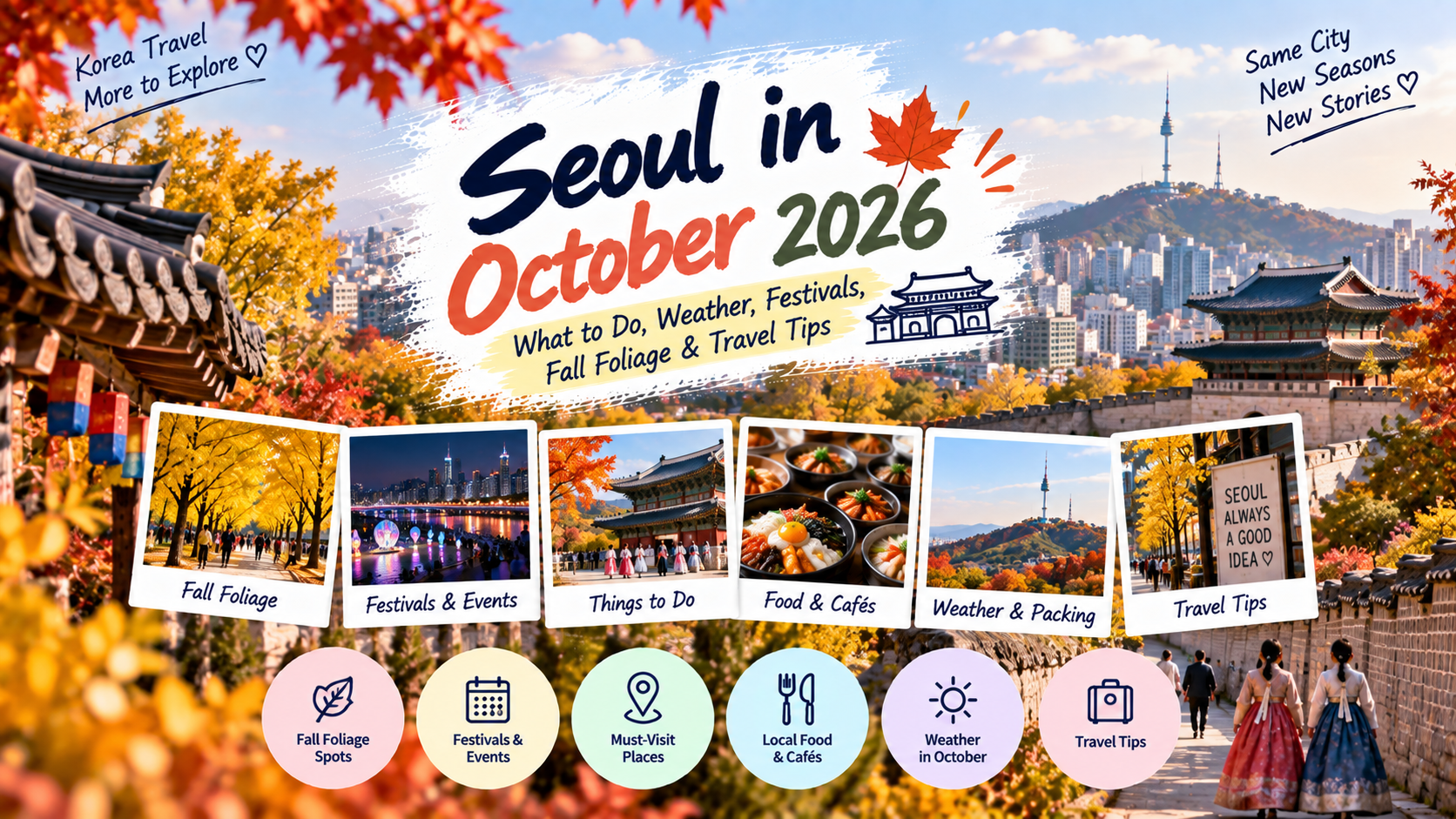
October is one of the best months to visit Seoul.
The heavy humidity of summer has usually eased, outdoor sightseeing becomes much more comfortable, and the city gradually changes from early-autumn green to the red and gold colors travelers associate with fall in Korea.
It is also a busy month for festivals, performances, Han River events and seasonal activities.
But there is one important thing to understand before planning an October trip:
“October in Seoul” does not automatically mean “peak fall foliage.”
Early October and late October can look completely different.
If you are visiting at the beginning of the month, plan around comfortable weather, outdoor events and neighborhoods. If you are coming later, autumn foliage becomes a much bigger part of the itinerary.
This guide explains how to plan both.
Is October a Good Time to Visit Seoul?
For most travelers, yes.
October solves one of the biggest problems with summer sightseeing in Seoul: walking outside becomes much easier.
A typical first-time Seoul itinerary involves much more walking than people expect.
You walk through palace grounds.
You walk around Bukchon.
You walk between cafés in Seongsu.
You walk along the Han River.
You walk through huge subway stations.
You walk around markets.
In July or August, that can become exhausting.
October is much better suited to this kind of trip.
Seoul Weather in October
October is a transition month.
Early October can still feel pleasantly mild during the day, while late October generally feels much more like autumn.
Evenings can be noticeably cooler than afternoons, especially around the Han River.
The practical answer is simple:
bring layers.
A light jacket or cardigan that fits into your bag is more useful than dressing for one fixed temperature all day.
Comfortable shoes are essential.
If your itinerary includes palaces, Seoul Forest, the Han River and traditional neighborhoods, you may easily walk 15,000–20,000 steps without intentionally planning a “walking day.”
Early October vs Late October
This distinction matters more than the average monthly temperature.
Early October
Think:
comfortable outdoor weather,
Han River evenings,
festivals,
Seongsu,
palaces,
markets,
and long neighborhood walks.
Mid-October
Autumn becomes more visible, although foliage conditions depend on the year’s weather.
Late October
This is when foliage becomes a much stronger reason to visit parks, palace grounds and mountain areas around Seoul.
Do not use a photograph taken on October 30 to predict what Seoul will look like on October 3.
When Is Fall Foliage in Seoul?
There is no single guaranteed “peak foliage day.”
Temperature, rainfall and other weather conditions affect timing every year.
Also, different places change at different speeds.
Trees on a mountain do not necessarily peak at exactly the same time as trees in a palace courtyard or city park.
If fall colors are the main reason for your trip, check current foliage information shortly before arrival.
For broader current travel information and seasonal events, the official Visit Seoul website is worth checking immediately before your trip.
Where to See Autumn Colors in Seoul
You do not need to leave Seoul to enjoy autumn scenery.
Several of the city’s standard attractions become particularly attractive once the leaves begin changing.
1. Gyeongbokgung Palace
Gyeongbokgung is already one of the essential first-time Seoul attractions.
Autumn gives you another reason to slow down rather than rushing through the main courtyard.
Walk deeper into the palace grounds.
The contrast between traditional Korean architecture and autumn trees makes this one of the easiest places to combine sightseeing and seasonal scenery.
If you plan to rent hanbok, allow at least half a day for the whole experience.
The rental process, changing clothes, photographs and palace visit take longer than many first-time travelers expect.
Korean search term:
경복궁
2. Changdeokgung Palace
For travelers especially interested in seasonal scenery, Changdeokgung is another important palace to consider.
Its historic setting and garden areas make it particularly appealing in autumn.
Some garden access and tour arrangements can differ from simply entering the main palace grounds, so check current official information before planning your visit around one specific section.
Korean search term:
창덕궁
3. Deoksugung and Jeongdong-gil
Deoksugung is one of the easiest autumn stops to combine with central Seoul.
You can visit the palace and then walk around Jeongdong-gil.
This is useful if you want autumn atmosphere without spending an entire day in a park.
A simple route is:
City Hall → Deoksugung → Jeongdong-gil → central Seoul café or museum
Korean search terms:
덕수궁
정동길
4. Seoul Forest
Seoul Forest works especially well for travelers already planning to visit Seongsu.
Instead of treating the park as a separate attraction, combine them.
A good autumn day could be:
Seongsu café
→ shops and pop-ups
→ lunch
→ Seoul Forest
→ sunset or dinner
This is one of the easiest ways to experience contemporary Seoul and seasonal outdoor scenery in one neighborhood.
Search:
서울숲
5. Namsan
Namsan offers a different kind of autumn experience because elevation gives you wider views over the city.
You do not necessarily need to build the day around Seoul Tower.
Walking routes around Namsan can be the main attraction.
If you’re staying around Myeongdong, this is particularly easy to incorporate.
Search:
남산
6. Olympic Park
Travelers who want wide open spaces rather than traditional architecture can consider Olympic Park.
It works particularly well for a slower day and can be combined with Jamsil.
Because the park is large, decide what you actually want to see rather than arriving without checking the map.
Search:
올림픽공원
7. The Han River
The Han River is not usually the first place people mention for “fall foliage,” but October is one of the best months to actually spend time there.
The biggest advantage is the weather.
You can walk, cycle, picnic or simply sit beside the river without dealing with the most intense summer heat.
If you’re visiting on a Sunday during the autumn festival season, check whether the Car-Free Jamsugyo Bridge Festival is operating on your date.
Korea Inside Out has a full guide to Jamsugyo Bridge Festival with practical information for international visitors.
Jamsugyo in October 2026
The autumn Jamsugyo program continues into October, making it particularly useful for travelers who missed the September dates.
Jamsugyo sits beneath Banpo Bridge and becomes a pedestrian-oriented public space during the festival.
The appeal is not just the programmed event.
It is the combination of:
Han River,
sunset,
walking,
temporary food and market elements,
and the atmosphere of Seoul residents spending a Sunday outside.
Arrive before sunset rather than treating it only as a night attraction.
A Good Banpo Evening
Try:
4:30 PM
Arrive around Banpo Hangang Park.
5:00 PM
Walk the river.
6:00 PM
Eat or pick up picnic food.
Sunset
Stay beside the river.
Evening
Explore Jamsugyo if the festival is operating.
Then go back to your hotel.
Do not add Hongdae or Gangnam afterward simply because you still have a few hours left.
October evenings are much better when you occasionally stop moving.
Seoul Welcome Week Continues Into October
Travelers arriving in early October can also catch the final part of Seoul Welcome Week: Autumn Edition, which runs through October 11, 2026.
The program is designed around international visitors during the autumn travel season.
Because individual activities and visitor benefits can vary, check current information through Seoul’s official tourism channels rather than relying on an older social-media post.
This is particularly useful if you are staying around major tourist areas such as Myeongdong.
Seongsu in October
Seongsu deserves a place in an October itinerary even without foliage.
This is one of Seoul’s most dynamic neighborhoods for:
cafés,
fashion,
design,
pop-ups,
and brand experiences.
But Seongsu changes quickly.
A viral pop-up you saw online two months before your trip may no longer exist.
Search close to your travel date.
Useful Korean searches:
성수 팝업 — Seongsu pop-ups
성수 카페 — Seongsu cafés
성수 가볼만한 곳 — things to do in Seongsu
This is one area where current Korean search results are often more useful than a static “Top 10 Seongsu” article.
Hongdae and Yeonnam-dong
Hongdae is another neighborhood that works particularly well from afternoon into evening.
Shop around Hongdae, then walk toward Yeonnam-dong.
Have dinner.
Stay for nightlife if that interests you.
There is little reason to arrive at 8 AM.
October’s comfortable weather also makes walking around Yeonnam much more enjoyable than during the hottest part of summer.
Traditional Seoul in October
For a first trip, don’t let seasonal content distract you from Seoul’s core attractions.
A strong historic-day itinerary remains:
Gyeongbokgung → Bukchon → Insadong → Ikseon-dong
The difference in October is that walking between them becomes easier.
This route also avoids one of the most common Seoul planning mistakes: crossing the entire city several times in one day.
Bukchon Etiquette
Remember that Bukchon is a residential neighborhood.
People actually live there.
Observe local signs and visitor restrictions, keep noise down and avoid blocking entrances for photographs.
Autumn can bring larger visitor numbers to scenic areas, making respectful behavior even more important.
October Markets
October is also a good month for Seoul’s traditional markets.
For food-focused visitors, Gwangjang Market is an obvious choice.
For shopping, everyday market atmosphere and proximity to Myeongdong, Namdaemun Market can make more sense.
Do not automatically visit both because they appear on every travel list.
Choose based on what you want.
Gwangjang:
food,
bindaetteok,
yukhoe,
market atmosphere.
Namdaemun:
shopping,
children’s clothing,
household goods,
kalguksu,
and easy combination with Myeongdong.
Is October Good for Café Hopping?
Yes.
In fact, the weather makes café neighborhoods more enjoyable because you can walk between places rather than taking transportation for every stop.
But avoid spending the entire trip traveling to cafés you saw on Instagram.
Choose cafés within neighborhoods you already want to visit.
For example:
Seongsu day → Seongsu café
Bukchon day → Anguk café
Hongdae day → Yeonnam café
This saves enormous amounts of travel time.
What About Day Trips?
October is one of the better months for day trips from Seoul.
Possible options include:
Suwon,
Namhansanseong,
Incheon,
and other destinations in Gyeonggi-do.
If autumn scenery is important, mountain and fortress destinations become more interesting as the month progresses.
But if you only have three days in Seoul, you do not need a day trip.
Seoul itself can easily fill the entire visit.
Namhansanseong
Namhansanseong is particularly appealing for travelers who want history plus hiking and mountain scenery.
The fortress is outside central Seoul, so allow a substantial part of the day.
Do not schedule it as:
“Morning Namhansanseong, lunch Gangnam, afternoon Bukchon, sunset Han River.”
That is too much.
Give the destination room.
Search:
남한산성
Suwon
Suwon’s Hwaseong Fortress is another useful autumn day-trip option.
It offers a different city experience without requiring a flight or long-distance train.
Again, think of it as a day rather than a quick detour.
Transportation from your hotel to the station, the journey itself, local movement and meals all add time.
What If It Rains?
October is not guaranteed to be sunny.
Keep one flexible indoor plan.
Good rainy-day categories include:
museums,
shopping malls,
indoor exhibitions,
large cafés,
aquariums,
and indoor attractions around Jamsil.
Do not force your carefully planned foliage day during heavy rain.
Swap days if your itinerary allows it.
Lotte World on a Rainy Day
Families often consider Lotte World because much of the experience can continue indoors.
Its Jamsil location also makes it easier to combine with shopping and other indoor attractions than a more distant outdoor theme park.
If you’re deciding between Korea’s major theme parks, weather and travel time should be part of the decision — not just the rides.
What to Eat in October
There is no single “October food” that every traveler must eat.
Instead, cooler weather makes certain Korean meals feel particularly satisfying.
Try:
kalguksu,
gukbap,
jeon,
grilled meat,
soups and stews,
market food,
and seasonal café desserts.
If you’re planning your overall food budget, Korea Inside Out’s How Much Does Food Cost in Seoul? explains how different travel styles affect daily spending.
Do You Need Cash?
Seoul is highly card-friendly, but I still wouldn’t travel with absolutely no Korean won.
Traditional markets, transportation-related situations and small purchases can make cash useful.
For a more detailed breakdown, see Do You Need Cash in Korea?.
The practical combination for most visitors is:
credit card,
some Korean won,
and a transportation solution such as T-money.
Getting Around Seoul
The subway will probably be your main transportation method.
But remember that “25 minutes by subway” does not necessarily mean 25 minutes from hotel door to attraction.
You also need to account for:
walking to the station,
large station transfers,
finding the correct exit,
and walking from the exit to your destination.
Use Naver Map for actual route planning.
If you’re preparing for your first trip, How to Use Seoul Subway covers the basics.
A 3-Day Seoul October Itinerary
Day 1 — Traditional Seoul
Gyeongbokgung
Bukchon
Insadong
Ikseon-dong
Stay around Jongno rather than crossing the city.
Day 2 — Contemporary Seoul
Seongsu
Seoul Forest
café
shopping or pop-up
dinner nearby
Day 3 — Shopping + Han River
Myeongdong or Hongdae
hotel break
Banpo Hangang Park
Jamsugyo if operating
This gives you traditional Seoul, contemporary neighborhoods and the river without turning the trip into a transportation marathon.
A 5-Day Seoul October Itinerary
With five days, you can slow down.
Day 1
Historic Seoul
Day 2
Seongsu + Seoul Forest
Day 3
Hongdae + Yeonnam
Day 4
Day trip or Jamsil/Gangnam
Day 5
Market + Myeongdong + Han River
The biggest advantage is flexibility.
If rain is forecast on Day 2, swap it with your indoor-heavy day.
If Peak Foliage Is Your Priority
Do not plan only from historical averages.
As your travel date approaches, check current conditions.
If foliage is late, focus on neighborhoods and festivals first.
If colors are developing quickly, move your palace, Seoul Forest or mountain day earlier.
This is a better strategy than rigidly assigning “foliage day” months before your flight.
Korean Search Terms for October Travelers
Save these:
서울 10월 가볼만한 곳 — places to visit in Seoul in October
서울 10월 축제 — Seoul October festivals
서울 단풍 — Seoul fall foliage
서울 단풍 명소 — Seoul foliage spots
한강공원 — Hangang Park
서울숲 — Seoul Forest
성수 팝업 — Seongsu pop-ups
남한산성 단풍 — Namhansanseong foliage
서울 이번 주말 행사 — Seoul events this weekend
These are especially useful for finding very recent local information.
Is October Crowded?
Popular attractions can certainly be busy.
Good weather brings both international visitors and local residents outside.
Instead of trying to avoid every crowd, adjust the timing.
Visit palaces earlier.
Eat outside peak lunch time when possible.
Go to the Han River before sunset rather than arriving at the busiest moment.
Explore popular neighborhoods on weekdays if your schedule allows it.
Small timing changes can make a bigger difference than trying to discover a supposedly “secret” version of Seoul.
Where Should You Stay?
For a first October trip:
Myeongdong works well for central sightseeing and convenience.
Hongdae is useful for nightlife and airport access.
Jongno/Insadong is excellent for traditional sightseeing.
Gangnam makes sense if your priorities are beauty, shopping and southern Seoul.
Choose based on itinerary, not simply hotel price.
A slightly more expensive hotel in the right location can save hours of transportation across a short trip.
How Many Days Do You Need?
For a first trip, 3–5 days is a useful range.
Three days lets you see the essentials.
Five days gives you time for neighborhoods, a slower pace and perhaps a day trip.
If you’re still deciding, see How Many Days Do You Need in Seoul?.
Final Thoughts
October is not great because Seoul turns into one giant red-and-gold postcard on October 1.
It doesn’t.
October is great because the city becomes easier to experience outdoors.
You can spend longer in palace grounds.
Walk between cafés.
Sit beside the Han River.
Explore Seongsu without immediately searching for air conditioning.
And as the month progresses, autumn color gradually adds another layer to places that were already worth visiting.
So don’t build your October trip around one predicted foliage date.
Build a strong Seoul itinerary first.
Then use the weather, current events and actual autumn conditions to decide what to move around.
That’s the advantage of Seoul in October: the season gives you more options, not just more leaves.
Leave a Reply