Category: Seoul

  • Bukhansan Dream Forest: A Peaceful Escape in Seoul

    Bukhansan Dream Forest: A Peaceful Escape in Seoul

    Looking for a quieter side of Seoul?

    You don’t always have to leave the city to find forests, open lawns, traditional Korean architecture, and beautiful views.

    Just head north.

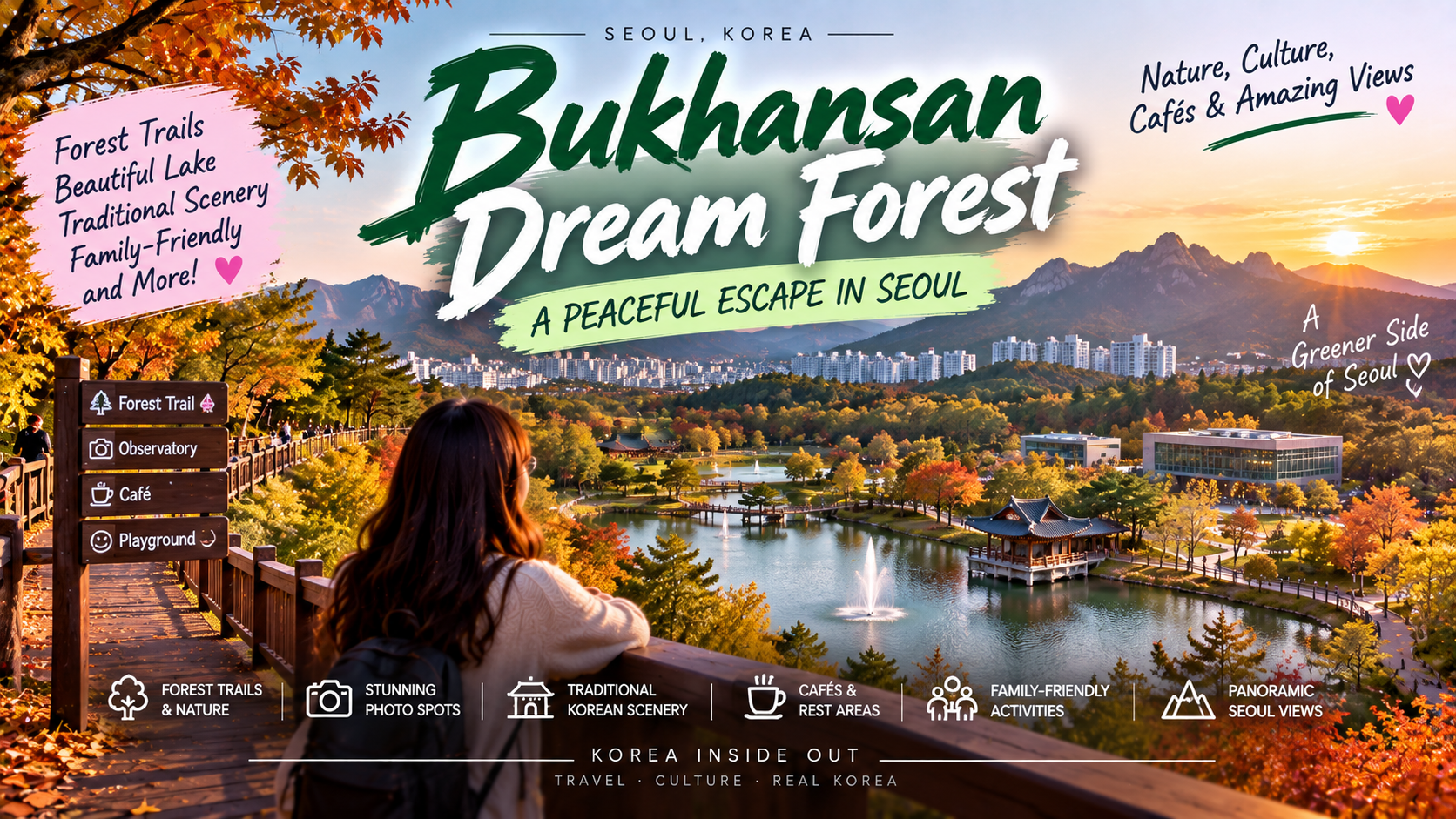
    Bukhansan Dream Forest (북서울꿈의숲) is one of Seoul’s largest urban parks, covering approximately 684,000 square meters on the former site of Dream Land amusement park.

    With forest trails, a large pond, waterfalls, traditional architecture, gardens, cafés, playgrounds, an art center, and a panoramic observation deck, it is the kind of place where you can easily spend half a day without feeling like you’re following a typical tourist itinerary.

    And in September 2026, the park became even more enjoyable.

    After 17 years, several older areas were renovated, including a new 500-meter forest deck trail and a large outdoor café deck.

    So if you’re visiting Seoul this autumn, this is a particularly good time to discover Bukhansan Dream Forest.


    What Is Bukhansan Dream Forest?

    Despite its name, Bukhansan Dream Forest isn’t located inside Bukhansan National Park.

    It is a huge urban park in Gangbuk-gu, in northeastern Seoul.

    The park opened in 2009 on the former site of Dream Land, once one of Seoul’s amusement parks.

    Today, the amusement rides are gone and the area has been transformed into a green public park with forests, gardens, water features, cultural facilities, and walking trails.

    The park is especially popular with local residents looking for somewhere to:

    • Walk through the forest
    • Have a picnic
    • Enjoy autumn foliage
    • Visit a café
    • Bring children
    • See traditional Korean architecture
    • Watch performances or exhibitions
    • Take photos
    • Enjoy Seoul from above

    Unlike some of Seoul’s more famous attractions, you won’t feel as though you are moving from one tourist landmark to another.

    You can simply slow down and enjoy the park.


    Bukhansan Dream Forest: Quick Facts

    Details
    Korean name북서울꿈의숲
    LocationGangbuk-gu, Seoul
    SizeApprox. 684,157㎡
    AdmissionFree
    Opening2009
    Main highlightsForest trails, Wolyeongji Pond, lawns, observation deck, traditional buildings
    Best seasonSpring & autumn
    Best forWalking, families, photography, picnics, relaxing
    Opening hoursOpen year-round
    Main address173 Wolgye-ro, Gangbuk-gu, Seoul

    The park itself is open around the clock, although individual facilities such as cafés, exhibitions, and cultural venues have their own operating hours.


    Why Visit Bukhansan Dream Forest?

    If you’ve already visited Gyeongbokgung, Myeongdong, Bukchon and the Han River, Bukhansan Dream Forest offers something different.

    It’s less about seeing a famous attraction and more about spending time in Seoul.

    You can walk beneath the trees in the morning, sit beside a pond in the afternoon, have coffee at an outdoor café, and finish with a view of the mountains.

    And because the park is large, you can choose how active you want to be.

    Want a short walk?

    Easy.

    Want to spend several hours exploring?

    Also easy.

    Traveling with children?

    There are playgrounds and family-friendly spaces.

    Looking for somewhere to read or relax?

    There are plenty of quiet spots.


    1. Walk the New Byeogosan Forest Deck Trail

    One of the biggest changes to the park in 2026 is the new Byeogosan Forest Deck Trail.

    A new approximately 500-meter wooden deck trail was created around Byeogosan, making it much easier to explore an area where steep slopes had previously made walking more difficult.

    The new route was designed to preserve the existing forest while making the trail more accessible.

    The relatively gentle design also makes it easier for children and older visitors to enjoy the area.

    This is probably the first place we’d recommend visiting if you’re coming to Bukhansan Dream Forest this autumn.

    Why?

    Because you get the feeling of being in a forest without having to commit to a serious mountain hike.

    It’s a very Seoul experience:

    city → park → forest → mountain views

    all within one afternoon.


    2. Stop at the New Outdoor Café Deck

    Another major 2026 improvement is the renovated outdoor café area near Cheongundapwon.

    A new approximately 1,500㎡ deck has been created around the café area, with tables and chairs surrounded by trees and seasonal plants.

    The area includes flowering trees and landscaped gardens, creating a space where you can sit outside rather than simply grabbing a coffee and leaving.

    Our tip

    This is one of those places where you should slow down.

    Get a coffee.

    Find a table.

    Stay for 30 minutes.

    Watch people walk through the park.

    You don’t need to turn every stop on your Seoul itinerary into a sightseeing mission.


    3. See Wolyeongji Pond

    One of the most beautiful areas of Bukhansan Dream Forest is Wolyeongji Pond.

    The pond sits in the middle of the park and creates a calm landscape surrounded by trees and open spaces.

    Nearby Cheongundapwon is a huge lawn area where visitors can relax.

    The Seoul Parks Service describes Cheongundapwon as a large grass field roughly twice the size of Seoul Plaza, with the pond and surrounding landscape creating one of the park’s main resting areas.

    This is an especially nice area for:

    • Picnics
    • Family time
    • Photography
    • Reading
    • Watching the seasons change

    4. Discover a Traditional Korean Landscape

    One of the more surprising things about Bukhansan Dream Forest is that it isn’t just a modern city park.

    The Story Garden recreates elements of traditional Korean landscapes.

    You’ll find:

    • Changnyeongwi Palace Shrine
    • Bamboo groves
    • Wolgwangdae Pavilion
    • Aewoljeong Pavilion
    • A traditional stone bridge

    The combination of traditional architecture and forest makes this part of the park feel very different from the surrounding city.

    Changnyeongwi Palace Shrine

    The historic Changnyeongwi Palace Shrine is registered as a cultural heritage site and adds a historical layer to the park.

    If you’re interested in Korean architecture but don’t want to spend another afternoon visiting a palace in the center of Seoul, this is an interesting alternative.


    5. Look for the Deer

    Yes, there are deer.

    The park has a deer enclosure near the Byeogosan area.

    It is one of the spots that tends to be especially popular with families.

    In 2026, a new children’s play area called Olmangjolmang Playground was also added near the deer enclosure, making this part of the park particularly appealing for families.

    Don’t expect a wildlife safari.

    The deer enclosure is a small park attraction.

    But for children, it’s a fun addition to an afternoon in the park.


    6. Climb to the Observation Deck

    If you want a view of Seoul, don’t skip the park’s observation deck.

    The observation tower rises approximately 49.7 meters and offers views toward the surrounding mountains, including:

    • Bukhansan
    • Dobongsan
    • Suraksan

    The view is particularly beautiful around sunset when the mountains become silhouettes against the city.

    Best time to go

    Come approximately one hour before sunset.

    That gives you enough time to explore the park, reach the observation deck, and watch the landscape change from daylight to evening.


    7. Visit Dream Forest Art Center

    Bukhansan Dream Forest isn’t only a nature park.

    The Dream Forest Art Center contains performance spaces, galleries, restaurants and cafés.

    The center hosts cultural performances and exhibitions throughout the year.

    So if the weather changes or you simply want to add some culture to your park visit, you have an indoor option nearby.


    8. Let the Kids Play

    Families will find plenty to do here.

    The park has children’s playgrounds as well as the newer Olmangjolmang Playground.

    There is also a children’s forest experience area.

    The park’s large open lawns mean children have more space to move around than they would in many of Seoul’s smaller neighborhood parks.

    Our tip for families

    Don’t try to cover the entire park.

    Pick two or three things:

    playground → deer → pond → café

    and let the rest happen naturally.

    That’s much more enjoyable with younger children.


    9. Enjoy Autumn Foliage

    If you’re visiting Seoul in autumn, this is where Bukhansan Dream Forest becomes especially attractive.

    The park has extensive wooded areas and seasonal landscaping, making it one of the places where you can enjoy fall colors without leaving Seoul.

    The combination of:

    red and yellow leaves + traditional architecture + pond + mountain views

    makes for some excellent photographs.

    And unlike some of Seoul’s famous autumn destinations, you don’t have to make a full-day trip out of it.


    A Perfect Half-Day at Bukhansan Dream Forest

    If you’re wondering how to actually spend your time here, here’s the route we’d recommend.

    1:00 PM — Enter through the main entrance

    Start near the visitor center and get a feel for the park.

    1:20 PM — Walk toward Wolyeongji

    Take your time around the pond and Cheongundapwon.

    2:00 PM — Explore the traditional garden

    Visit the Changnyeongwi Palace Shrine, bamboo grove and surrounding traditional landscape.

    2:40 PM — Walk the Byeogosan Forest Deck Trail

    Enjoy the new 500-meter forest route.

    3:30 PM — Coffee break

    Stop at the outdoor café area and enjoy the new deck.

    4:15 PM — Deer & playground

    A good stop if you’re traveling with children.

    5:00 PM — Observation deck

    Finish your visit with views toward Seoul’s surrounding mountains.

    6:00 PM — Dinner

    Continue to another neighborhood for dinner.

    You could easily spend longer than this, but 3–5 hours is enough to get a good feel for the park.


    How to Get to Bukhansan Dream Forest

    Bukhansan Dream Forest is not directly beside a subway station, so you’ll usually combine the subway with a short bus or local-bus ride.

    There are several approaches depending on which entrance you want to use.

    For the Main Entrance / Visitor Center

    Useful subway options include:

    • Wolgye Station — Line 1
    • Seokgye Station — Line 1 / Line 6
    • Miasageori Station — Line 4
    • Dolgoji Station — Line 6
    • Hagye Station — Line 7

    From these stations, local or regular buses connect to the park.

    For the West Entrance / Observation Deck

    Miasageori Station — Line 4 is particularly useful.

    From Exit 2, a local bus can take you toward the west entrance and the observation deck area.

    Our tip

    If your main goal is the observation deck, use the west entrance.

    If you want to explore the pond, visitor center and family facilities, the main/east entrance is more convenient.


    Should You Drive?

    You can, but we wouldn’t recommend it on a weekend.

    The park has two parking areas with a total of 386 spaces:

    • East entrance: 312 spaces
    • West entrance: 74 spaces

    However, Seoul specifically warns that parking can become extremely difficult on weekends and public holidays, particularly during the spring-to-autumn outing season.

    Our tip

    Take public transportation if possible.

    It may take a little longer than driving directly there, but you’ll avoid spending part of your afternoon waiting for a parking space.


    Is Bukhansan Dream Forest Free?

    Yes.

    The park itself is free to enter.

    You can walk around the forest, visit the pond, enjoy the lawns, explore the outdoor areas and take in the views without paying an admission fee.

    Some performances, exhibitions, workshops, cafés or other facilities may have separate fees or booking requirements.


    Is Bukhansan Dream Forest Good for Tourists?

    Absolutely — but for a slightly different kind of traveler.

    If your Seoul itinerary is only three days long and this is your first visit, you may want to prioritize Seoul’s major historic and central attractions.

    But if you’re staying for 5–7 days, returning to Seoul, traveling with children, or simply want to experience a quieter side of the city, Bukhansan Dream Forest is an excellent addition.

    It also works particularly well if you enjoy:

    • Nature
    • Photography
    • Walking
    • Cafés
    • Autumn scenery
    • Korean architecture
    • Family activities
    • Less touristy places

    Bukhansan Dream Forest vs. Seoul’s Famous Parks

    Wondering how it compares with other green spaces?

    Bukhansan Dream ForestSeoul ForestNamsan
    AtmosphereQuiet & spaciousUrban & trendyTourist-friendly
    Forest⭐⭐⭐⭐⭐⭐⭐⭐⭐⭐⭐⭐
    Mountain views⭐⭐⭐⭐⭐⭐⭐⭐⭐⭐⭐⭐
    Traditional scenery⭐⭐⭐⭐⭐⭐⭐⭐⭐⭐
    Families⭐⭐⭐⭐⭐⭐⭐⭐⭐⭐⭐⭐⭐
    Cafés⭐⭐⭐⭐⭐⭐⭐⭐⭐⭐
    CrowdsUsually lowerModerateHigher
    AutumnExcellentExcellentExcellent

    Bukhansan Dream Forest’s biggest advantage is that it feels more spacious and less urban than many of Seoul’s other major parks.


    What Should You Bring?

    You don’t need hiking equipment.

    Comfortable shoes

    You’ll be walking through a large park and some forest trails.

    Water

    Especially if you’re exploring the new deck trail.

    A light jacket

    Autumn temperatures can drop quickly after sunset.

    Picnic mat

    Optional, but useful if you want to sit on the lawn.

    Camera

    The pond, traditional buildings, forest trails and observation deck all offer good photo opportunities.


    One Important Thing to Know

    Bukhansan Dream Forest is large.

    Don’t make the mistake of assuming you can see everything in 30 minutes.

    At nearly 684,000㎡, it is one of Seoul’s major urban parks, with multiple entrances and separate areas.

    If you only have one hour, choose one area.

    If you have half a day, explore more.

    And if you have children, don’t underestimate how long they may want to stay at the playground or deer enclosure.


    A Few Different Ways to Enjoy the Park

    For couples

    Forest walk → traditional garden → café → sunset viewpoint

    For families

    Playground → deer → pond → picnic → café

    For photographers

    Traditional architecture → Wolyeongji → autumn forest → observation deck

    For a quiet afternoon

    Forest trail → coffee → lawn → pond → sunset

    For first-time visitors

    Wolyeongji → Cheongundapwon → Byeogosan Deck Trail → observation deck


    Our Favorite Time to Visit

    If we had to choose just one time of day, we’d pick late afternoon.

    Arrive around 3–4 PM.

    The light is softer.

    The park is still bright enough for walking.

    You can enjoy the café and gardens.

    Then head toward the observation deck around sunset.

    Instead of rushing from attraction to attraction, you get:

    forest → coffee → sunset → Seoul skyline

    in one afternoon.

    That’s exactly the kind of slower Seoul experience that is easy to miss if you only follow the usual tourist itinerary.


    Final Thoughts

    Bukhansan Dream Forest may not be the first place that appears on a list of Seoul’s must-see attractions.

    And that’s exactly why we like it.

    It gives you a chance to experience a quieter, greener side of the city.

    You can walk through a forest, sit beside a pond, see traditional Korean architecture, drink coffee on a new outdoor deck, watch children play, and finish with a panoramic view of the mountains.

    And in 2026, the park has another reason to visit.

    After a major renovation, the new Byeogosan Forest Deck Trail and 1,500㎡ outdoor café deck make it easier and more comfortable to spend an entire afternoon here.

    Our tip

    If you’re visiting Seoul this autumn, don’t think of Bukhansan Dream Forest as a place you need to “check off.”

    Go there when you want a break from sightseeing.

    Take a walk.

    Get a coffee.

    Sit by the pond.

    Watch the leaves move in the wind.

    Then look out over Seoul from the observation deck.

    Sometimes, the best way to experience a city is to stop trying to see everything.


    Bukhansan Dream Forest at a Glance

    📍 Location: Gangbuk-gu, Seoul

    🎟️ Admission: Free

    🌳 Size: Approx. 684,157㎡

    🍂 Best season: Spring and autumn

    ☕ Highlights: Forest trails, outdoor café, Wolyeongji Pond, traditional garden, observation deck

    👨‍👩‍👧‍👦 Best for: Families, couples, photographers, nature lovers and travelers looking for a quieter Seoul

    🚇 Subway: Line 1, 4, 6 or 7 + local bus

    ⏰ Park: Open year-round

    If you’re planning a longer Seoul trip, you can also see our guide to How Many Days Do You Need in Seoul? 3, 5, or 7 Days for ideas on how to fit quieter places like this into your itinerary.
  • Seoul Night Walking Tours: 10 Free Guided Routes to Explore Seoul After Dark

    Seoul Night Walking Tours: 10 Free Guided Routes to Explore Seoul After Dark

    Seoul is a completely different city after sunset.

    Palaces glow under soft lights, the old city walls become silhouettes against the skyline, and neighborhoods like Insadong and Jongno take on a completely different atmosphere at night.

    But instead of exploring Seoul on your own, what if you could walk through the city with a local cultural guide and hear the stories behind what you are seeing?

    That’s exactly what Seoul Night Walking Tours offer.

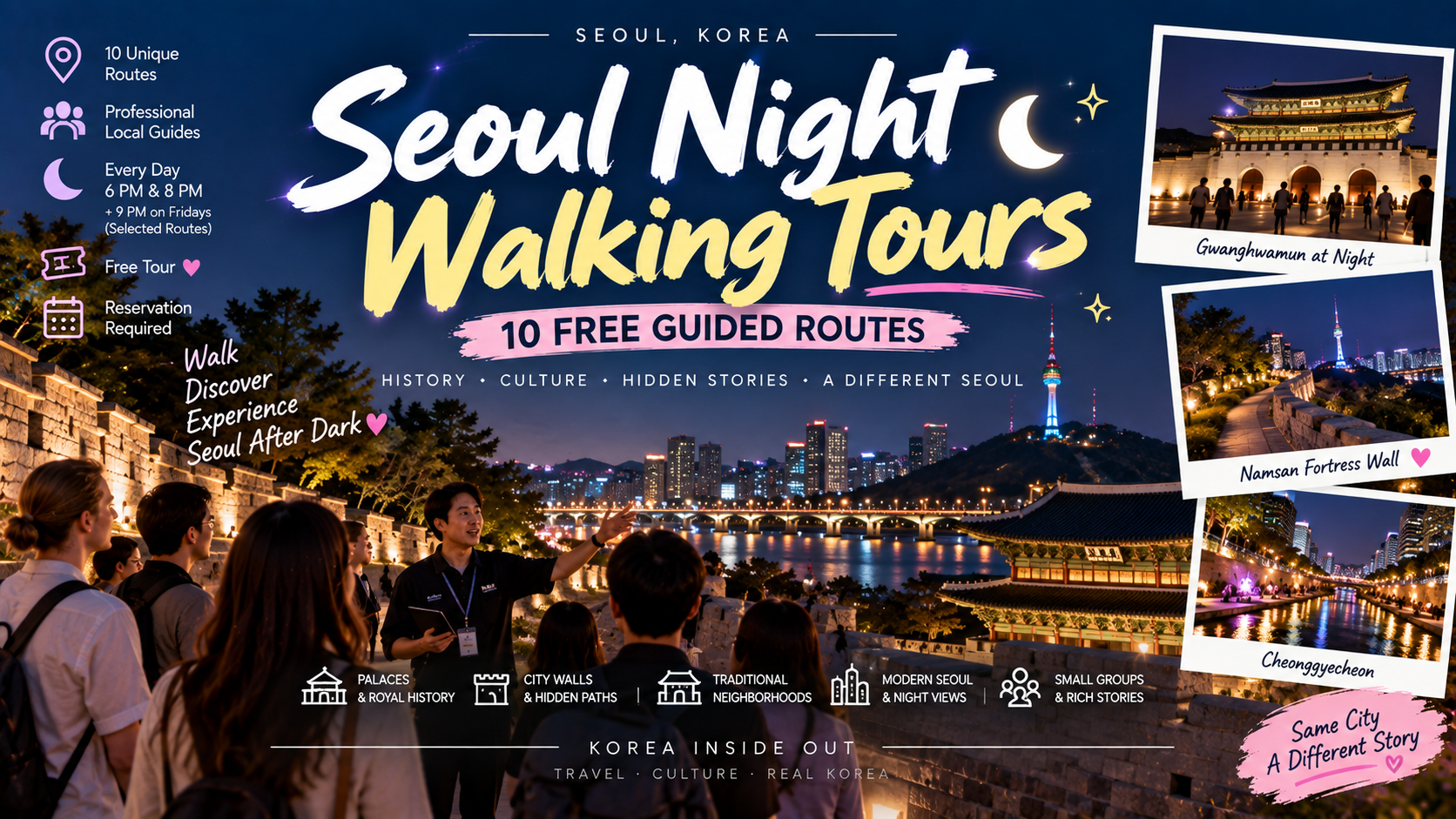
    From September 2026, Seoul has expanded its official nighttime walking tour program to 10 routes, including a brand-new Namsan Fortress Wall route.

    The tours are available every day at 6 PM and 8 PM, with special 9 PM Friday tours on three routes.

    And the best part?

    The guided walking tours are free.


    What Are Seoul Night Walking Tours?

    Seoul Walking Tours are guided walks led by official Seoul Cultural Tourism Interpreters.

    Rather than simply visiting a landmark and taking photos, you walk through the area while a guide explains its:

    • History
    • Architecture
    • Culture
    • Legends and stories
    • Local neighborhoods
    • Historical figures
    • Changes over time

    The nighttime routes are designed specifically to show Seoul from a different perspective.

    The same palace, city wall, or traditional neighborhood can feel completely different after dark.

    According to the Seoul Metropolitan Government, the nighttime program has expanded from 9 to 10 routes with the addition of the Namsan Fortress Wall course.


    Seoul Night Walking Tours 2026: Quick Facts

    Details
    ProgramSeoul Night Walking Tours
    Number of routes10
    Operating seasonMid-March–mid-November
    Regular times6 PM & 8 PM daily
    Friday special9 PM on selected routes
    AdmissionFree
    Who can join?Residents and tourists
    ReservationRequired
    Reservation deadlineAt least 3 days before the tour
    Official bookingVisit Seoul Walking Tours

    The nighttime tours are scheduled to operate from mid-March through mid-November, avoiding the coldest part of winter.


    The 10 Seoul Night Walking Tour Routes

    There are now ten different routes, so you can choose one based on the part of Seoul you are most interested in.

    1. Seoul-ro at Night

    Distance: 2.0 km
    Duration: About 2 hours

    This route explores Seoul’s transformation from old city to modern metropolis.

    The route includes:

    Seoul 7017 → Namdaemun Church → Seoul City Wall → Baekbeom Square → Namsan Overpass → Sungnyemun Gate

    It’s a particularly good choice if you want a combination of:

    • Seoul history
    • City views
    • Modern architecture
    • Old city walls
    • Night photography

    Because it is longer than most of the other routes, allow plenty of time.


    2. Naksan Fortress Wall

    Distance: 1.0 km
    Duration: About 1 hour

    Theme: Midnight in Hanyang

    This route follows part of Seoul’s historic fortress landscape.

    The route includes:

    Heunginjimun Gate → Naksan Fortress Wall → Naksan Fortress Wall West 1-gil → Nori Madang

    The stone walls, narrow streets and nighttime views make this one of the more atmospheric walks.

    And there is an additional reason to choose this route on a Friday.

    It is one of the three routes offering the new 9 PM Friday special tour.

    After the tour, you can continue your evening around Daehangno, the nearby theater and nightlife district. Seoul has specifically adjusted some nighttime walking routes to connect with nearby commercial areas.


    3. Cheonggyecheon

    Distance: 1.0 km
    Duration: About 1 hour

    Theme: An Emotional Recharge in Everyday Seoul

    This is probably one of the easiest nighttime walks for first-time visitors.

    The route follows:

    Cheonggye Plaza → Gwangtonggyo Bridge → Samilgyo Bridge → Jeon Tae-il Memorial Hall

    Cheonggyecheon is particularly beautiful after sunset when the stream, bridges and surrounding buildings are illuminated.

    This route also has the 9 PM Friday special tour.

    Afterward, you can continue toward Ikseon-dong, one of Jongno’s most popular areas for restaurants, cafés and traditional-meets-modern streets.


    4. Deoksugung Palace

    Distance: 1.0 km
    Duration: About 1 hour

    Theme: The King’s Love Story

    The route explores:

    Daehanmun Gate → Junghwajeon → Junghwajeon Hall → Seogeodang → Deokhongjeon → Hamnyeongjeon → Jeonggwanheon

    Deoksugung is particularly atmospheric in the evening because of its combination of traditional palace architecture and the modern city surrounding it.

    If you have already visited Seoul’s major palaces during the day, seeing the area after dark offers a completely different experience.


    5. Jeongdong

    Distance: 1.0 km
    Duration: About 1 hour

    Theme: Jeongdong Club

    The route includes:

    • Seoul Hall of Urbanism & Architecture
    • Deoksugung-gil
    • Seoul Museum of Art
    • Pai Chai Hakdang History Museum
    • Jeongdong First Methodist Church
    • Jeongdong Theater
    • Former site of Son Tak Hotel

    This route is especially interesting for travelers who want to explore the history of Seoul’s modernization and foreign communities.

    It is also easy to combine with Deoksugung or downtown Seoul.


    6. Changgyeonggung Palace

    Distance: 1.0 km
    Duration: About 1 hour

    Theme: The Queen’s Night Walk

    The route includes:

    Honghwamun Gate → Myeongjeongmun Gate → Myeongjeongjeon Hall → Munjeongjeon → Gyeongchunjeon → Tongmyeongjeon → Chundangji Pond → Grand Greenhouse

    The palace gardens and pond give this route a quieter atmosphere than some of the downtown walks.

    If you’re interested in royal history but prefer a more relaxed evening, this could be a good choice.


    7. Gwanghwamun Square

    Distance: 1.0 km
    Duration: About 1 hour

    Theme: Beautiful Seoul at Night

    The route includes:

    Yukjo Madang → former site of the Office of the Inspector-General → Garden of Gratitude → King Sejong statue → Sejong Center → Haechi Madang → Admiral Yi Sun-sin statue → Gwangjang Forest

    This is another route with the special 9 PM Friday tour.

    It’s a good choice if you want to see one of central Seoul’s most recognizable public spaces after dark.

    You can easily combine the walk with:

    • Gwanghwamun
    • Gyeongbokgung area
    • Insadong
    • Cheonggyecheon
    • Jongno

    8. Insadong

    Distance: 1.2 km
    Duration: About 1 hour

    Theme: An Art Walk Through Korea

    The route includes:

    North Insadong Tourist Information Center → Insadong Culture Street → Jogyesa Temple → March 1st Independence Declaration Square → Tongin Store → Gyeongin Museum of Fine Art → Ssamzie-gil

    This is one of the most convenient routes for international visitors.

    Insadong is already popular with tourists, but having a guide explain the history and cultural significance of the neighborhood can make the experience much more meaningful.

    Instead of simply walking through souvenir shops, you get to understand why this area became associated with Korean traditional arts and culture.


    9. Namsangol Hanok Village

    Distance: 1.0 km
    Duration: About 1 hour

    Theme: A Night of Joseon Houses

    The route explores:

    • Namsangol Hanok Village entrance
    • Cheonghakji Pond
    • Cheonwoogak Pavilion
    • Yi Seung-eop’s traditional house
    • Kim Chun-young’s house
    • Min family house
    • Yun Taek-young’s residence
    • Yun family residence

    If you’re interested in traditional Korean houses and Joseon-era life, this is a fascinating nighttime option.

    You can also combine it with the surrounding Jung-gu and Myeongdong areas.


    10. New: Namsan Fortress Wall

    The newest route is the Namsan Fortress Wall Night Tour.

    Distance: 2.06 km
    Duration: About 1 hour

    This is the new route added in September 2026.

    The walk combines:

    nature + history + Seoul skyline views

    The route begins near the entrance to Namsan Sky Forest Road, close to the Sowol Poetry Monument Garden, and continues through:

    • Zelkova Tree Observatory
    • Sunset Observatory
    • Wellness Garden
    • N Seoul Tower
    • Namsan Observatory
    • Love Lock Deck
    • Palgakjeong Pavilion

    The course finishes at Palgakjeong, where visitors can continue downhill toward Namdaemun Market.

    This makes it particularly useful for travelers because the tour doesn’t simply end at a landmark.

    You can continue your evening with Korean food and shopping at Namdaemun Market.


    Which Night Tour Should You Choose?

    With ten options, choosing a route can be difficult.

    Here’s our quick guide.

    If you want…Choose
    Seoul skyline & city wallsSeoul-ro at Night
    Fortress walls & nightlifeNaksan Fortress Wall
    Easy riverside city walkCheonggyecheon
    Royal historyDeoksugung
    Old Seoul & modernizationJeongdong
    Palace gardensChanggyeonggung
    Iconic central SeoulGwanghwamun Square
    Korean art & cultureInsadong
    Traditional Korean housesNamsangol Hanok Village
    Nature + history + skylineNamsan Fortress Wall

    Our pick for first-time visitors

    If this is your first trip to Seoul, we’d shortlist:

    Insadong
    or
    Namsan Fortress Wall

    Insadong is easy and culturally accessible.

    Namsan Fortress Wall offers more of the “Seoul at night” experience, with nature, history and panoramic views.


    The New Namsan Route Is Especially Interesting

    The new Namsan Fortress Wall course deserves special attention.

    Most tourists know N Seoul Tower as a viewpoint.

    But this walking tour adds the history of the mountain itself.

    You’ll learn about Mokmyeoksan, the historical name associated with Namsan, the city’s old defensive system, the changes that took place during the Japanese colonial period and after liberation, and the development of modern Seoul.

    The route also deliberately includes several viewpoints.

    At the Sunset Observatory, you can look toward the city as the sky changes color.

    At the Namsan summit, you get views toward the old city and Seoul’s historic gates.

    Then the route finishes at Palgakjeong.

    It’s a much richer experience than simply taking a cable car up to N Seoul Tower.


    When Do the Night Tours Run?

    From 2026, the regular nighttime tours run:

    Every day

    6 PM
    8 PM

    There is also a new 9 PM Friday special tour on:

    • Gwanghwamun Square
    • Cheonggyecheon
    • Naksan Fortress Wall

    The operating season has also been extended.

    Instead of operating only during the warmer part of the year, nighttime tours now run from approximately mid-March through mid-November.

    That means travelers visiting Seoul in spring, summer or autumn have a much longer window to join.


    How Much Does It Cost?

    The guided walking tour itself is free.

    That’s one of the biggest advantages for travelers.

    However, you may have to pay separately for:

    • Palace admission
    • Cultural experiences
    • Transportation
    • Food and drinks
    • Other attractions visited before or after the tour

    The Seoul Metropolitan Government specifically states that the guided tour is free, while entrance fees and other personal expenses are not included.


    Do You Need to Reserve?

    Yes.

    Although the tour itself is free, you need to reserve a place.

    Reservations are made through the official Seoul Walking Tour service on Visit Seoul.

    The standard rule is to book at least three days before your desired tour date.

    For tours in the following month, reservations become available after the 15th of the previous month.

    Because these are guided tours with limited group sizes, don’t wait until the day before if you already know which route you want.


    How Long Are the Tours?

    Most routes are approximately one hour.

    The exception is Seoul-ro at Night, which is around two hours.

    The new Namsan Fortress Wall course is approximately 60 minutes, despite being just over 2 km long.

    That makes the program relatively easy to fit into a travel itinerary.

    You could join an 8 PM tour and still have plenty of time for dinner or drinks afterward.


    Can Foreign Tourists Join?

    Yes.

    The program is open to both residents and tourists.

    That makes it particularly useful for international visitors who want more context than they would get from simply visiting a landmark independently.

    The key thing to check when making a reservation is the available language and specific tour details for your chosen date.

    Our tip

    Don’t assume every tour operates in English simply because it is designed for tourists.

    When booking, check the language information for the specific tour.


    A Great Way to Plan a Seoul Evening

    One of the best things about the program is that you can build an entire evening around it.

    For example:

    Option 1: Insadong Night

    4:30 PM — Explore Insadong

    6:00 PM — Insadong guided night tour

    7:15 PM — Traditional Korean dinner

    8:30 PM — Walk through Ikseon-dong


    Option 2: Namsan Night

    4:30 PM — Explore Namsan area

    6:00 PM — Namsan Fortress Wall tour

    7:15 PM — Continue toward Namdaemun Market

    8:00 PM — Korean street food and shopping


    Option 3: Friday Night in Central Seoul

    7:00 PM — Dinner near Jongno

    9:00 PM — Cheonggyecheon special Friday tour

    10:00 PM — Walk toward Ikseon-dong

    Late evening — Café or drinks

    This is one of the easiest ways to turn the official walking tour into a complete Seoul night itinerary.


    Why Take a Guided Tour Instead of Walking Alone?

    You could obviously walk around these neighborhoods yourself.

    And you should.

    But the difference is context.

    When you’re walking past an old stone wall, a traditional house or a palace building, it’s easy to see it as simply a beautiful photo opportunity.

    A cultural tourism guide can explain:

    Why is it here?
    Who used it?
    What happened here?
    How has Seoul changed?
    What does this place mean to Koreans today?

    That extra layer can completely change the way you experience the city.


    What Should You Wear?

    These are walking tours, so comfort matters.

    Wear comfortable shoes

    Even a one-hour route can involve stairs, slopes or uneven surfaces.

    This is especially important for the Namsan and fortress-wall routes.

    Bring a light jacket

    Seoul evenings can become noticeably cooler after sunset in autumn.

    Bring water

    You may be walking for an hour or more.

    Check the weather

    Outdoor tours can be affected by bad weather, so check the latest tour information before heading out.


    One Important Tip for the Namsan Route

    Don’t think of the new Namsan Fortress Wall tour as simply another way to get to N Seoul Tower.

    It’s better to think of it as a history-and-night-view walking experience.

    The N Seoul Tower is one stop along the route.

    The real experience is the combination of:

    forest → fortress history → sunset → city skyline → N Seoul Tower → traditional stories

    And once the tour ends at Palgakjeong, you can continue downhill toward Namdaemun Market.


    Seoul Night Walking Tours vs. Exploring Alone

    Guided Night TourExploring Alone
    FreeFree
    Local cultural guideSelf-guided
    Historical explanationsNeed to research yourself
    Fixed routeCompletely flexible
    Reservation requiredNo reservation
    Around 1 hourWhatever length you want
    Great for first-time visitorsGreat for repeat visitors

    If this is your first trip to Seoul, we’d recommend doing at least one guided route.

    You can always explore the rest of the city independently afterward.


    Final Thoughts

    Seoul has plenty of spectacular nighttime attractions.

    You can see the Han River, visit a night market, watch a light show, or admire the city from N Seoul Tower.

    But Seoul Night Walking Tours offer something different.

    They let you slow down and understand the city while you walk through it.

    And with ten routes now available, you can choose between palaces, fortress walls, traditional neighborhoods, modern Seoul and panoramic viewpoints.

    Best of all, the guided tours are free.

    Our tip

    If you’re visiting Seoul in autumn 2026, book one of the night tours before planning your evening around it.

    Our personal picks would be:

    Namsan Fortress Wall for the best combination of history, nature and night views.

    Insadong for Korean art and traditional culture.

    Cheonggyecheon on Friday at 9 PM for an easy central-Seoul night.

    Sometimes the best way to see Seoul isn’t from a tour bus or observation deck.

    It’s simply to walk through it with someone who knows its stories.


    Seoul Night Walking Tours 2026 at a Glance

    10 routes

    Mid-March – Mid-November

    6 PM & 8 PM daily

    9 PM Friday special tours: Gwanghwamun Square, Cheonggyecheon, Naksan Fortress Wall

    Free guided tours

    Reservation required

    Book at least 3 days in advance

    Open to tourists and residents

    For reservations, use the official Seoul Walking Tour service on Visit Seoul.

    And if you’re looking for more free and seasonal things to do during your Seoul trip, check our What’s On in Korea: September 2026 guide.

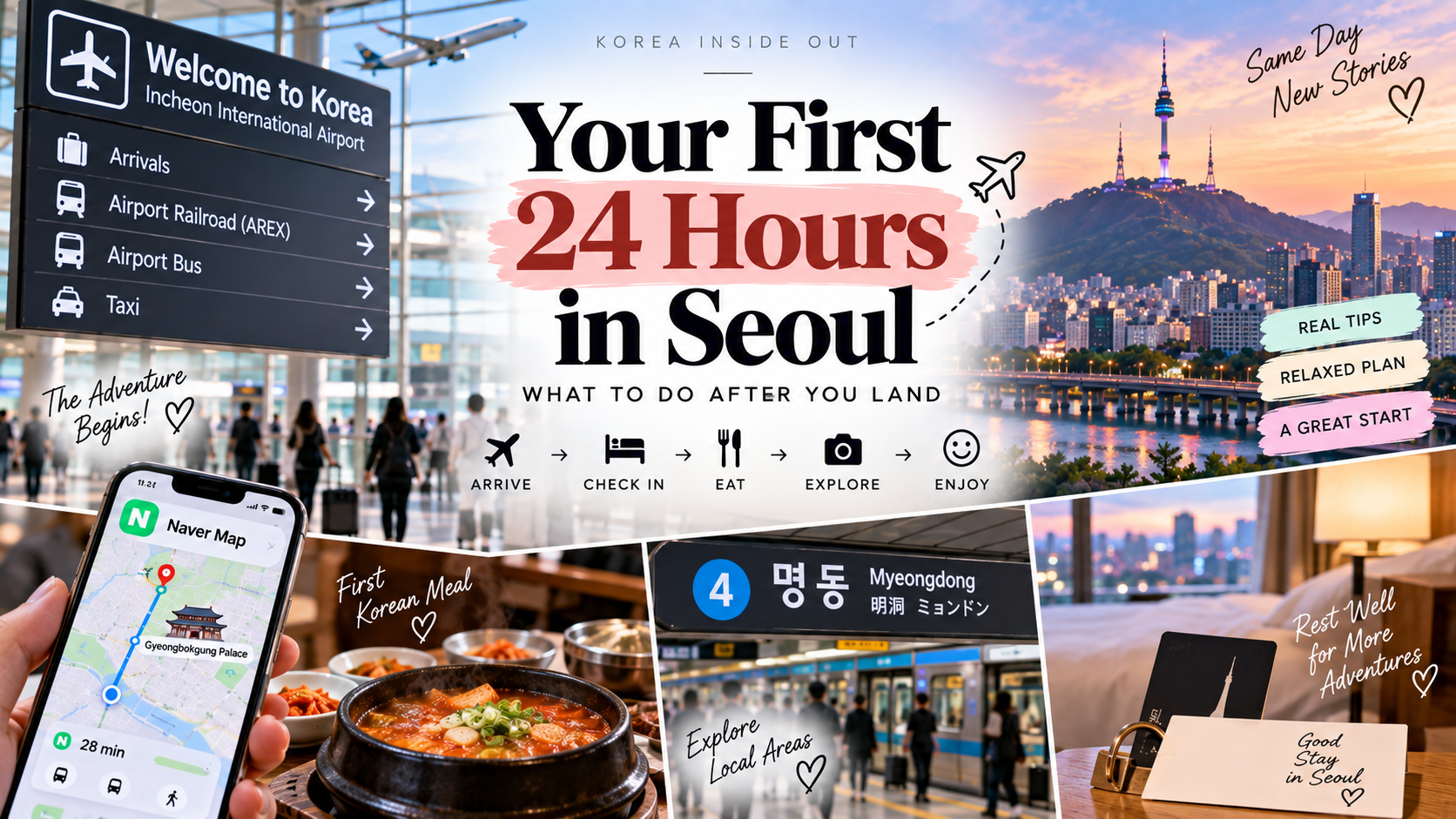
  • Seoul in Your First 24 Hours: What to Do After You Land

    Seoul in Your First 24 Hours: What to Do After You Land

    Arriving in Seoul for the first time can feel exciting — and slightly overwhelming.

    You’ve just spent hours on a plane.

    You have luggage.

    You’re probably tired.

    And suddenly you’re standing in a huge airport wondering:

    Where should I go first?

    Should you go straight to your hotel?

    Should you start sightseeing immediately?

    Should you exchange money?

    Should you get a transportation card?

    And how much can you realistically see on your first day?

    The good news is that you don’t need to rush.

    Your first 24 hours in Seoul should be about getting comfortable with the city, not trying to complete a sightseeing checklist.

    Here’s how I would approach your first day.


    Your First 24 Hours in Seoul at a Glance

    If you arrive in Seoul in the morning or early afternoon, a comfortable first day could look like this:

    TimeWhat to do
    ArrivalImmigration, luggage, mobile data
    NextGet to your hotel
    AfternoonCheck in or leave luggage
    Late afternoonExplore your neighborhood
    Early eveningFirst Korean meal
    EveningOne major attraction or neighborhood
    NightCafé, convenience store or relaxed walk
    Before bedPrepare for tomorrow

    The key is to keep your first day flexible.

    Flight delays, immigration, luggage, transportation and hotel check-in can all take longer than expected.


    1. Don’t Plan a Major Attraction Immediately After Landing

    This is probably my biggest recommendation.

    If your flight lands at 8 a.m., don’t automatically book a 10 a.m. attraction across Seoul.

    It looks possible on a map.

    But international travel doesn’t always go according to schedule.

    You need time for:

    • Immigration
    • Baggage claim
    • Getting connected to mobile data
    • Finding transportation
    • Traveling into Seoul
    • Finding your hotel
    • Leaving your luggage
    • Eating
    • Recovering from the flight

    Even if everything goes smoothly, you’ll probably feel more tired than you expect.

    Give yourself some breathing room.

    Your first day is not the day to prove how much of Seoul you can see.

    It’s the day to get comfortable.


    2. Get Connected Before You Leave the Airport

    Before heading into Seoul, make sure your phone works.

    Depending on your travel setup, this could mean:

    • Activating an eSIM
    • Using a Korean SIM
    • Connecting to airport Wi-Fi
    • Turning on your international roaming

    You want to be able to access:

    • Your hotel information
    • Maps
    • Transportation information
    • Translation
    • Taxi services
    • Your reservations

    A working phone makes your first day dramatically easier.

    One simple backup

    Take a screenshot of your hotel information before leaving the airport.

    Save:

    Hotel name + address + phone number

    Ideally, have the address in both English and Korean.

    If your internet connection suddenly stops working, you still have the information you need.


    3. Get to Your Hotel First

    Unless you have a very late arrival, I would generally make the hotel your first destination.

    You don’t necessarily need to check in immediately.

    Many hotels will allow you to leave your luggage before your room is ready.

    That means you can arrive, drop your bags, freshen up if possible, and start exploring without dragging a suitcase around Seoul.

    This makes a huge difference.


    Where Should You Stay?

    If you’re still deciding where to stay, your neighborhood can change how your first day feels.

    For a first trip:

    Myeongdong

    Best for convenience, shopping and easy access to many major tourist areas.

    Hongdae

    Best for cafés, restaurants, nightlife and a younger atmosphere.

    Jongno / Insadong

    Best if you’re interested in palaces, traditional neighborhoods and historic Seoul.

    Gangnam

    Best for modern Seoul, shopping, beauty and a very different side of the city.

    If you’re still choosing accommodation, see our guide:

    Where to Stay in Seoul: 7 Best Areas for First-Time Visitors

    The most important thing isn’t choosing the “best” neighborhood.

    It’s choosing a neighborhood that makes your trip easier.


    4. Don’t Exchange All Your Money at the Airport

    You may want Korean won immediately after landing.

    That’s fine.

    But you don’t need to exchange your entire travel budget at the airport.

    Airport exchange counters are convenient, but convenience doesn’t necessarily mean the best exchange rate.

    A small amount of Korean cash can be enough to get started.

    For example, you may want some cash for:

    • Small purchases
    • Markets
    • Street food
    • Transportation-related expenses
    • Backup spending

    For everyday purchases, cards are widely useful.

    If you’re unsure about how much cash to carry, read:

    Do You Need Cash in Korea? Cards, ATMs & T-money Explained


    5. Have Your First Korean Meal Nearby

    Once your luggage is safely at the hotel, eat.

    Seriously.

    Don’t underestimate how much better Seoul feels when you’re no longer hungry and exhausted.

    And your first meal doesn’t need to be at a famous restaurant.

    In fact, I would argue that your first meal is a good time to keep things simple.

    Look for a restaurant close to your hotel.

    You could try:

    • Gimbap
    • Bibimbap
    • Kalguksu
    • Kimchi jjigae
    • Mandu
    • Naengmyeon
    • Korean barbecue

    If you want something quick and inexpensive, a neighborhood restaurant can be a better choice than spending an hour traveling across the city for a famous restaurant.

    You can always do that tomorrow.


    6. Your First Afternoon: Explore Where You Are

    This is where I would resist the temptation to cross Seoul.

    Instead of immediately going from Myeongdong to Gangnam to Hongdae, spend a couple of hours getting to know your own neighborhood.

    Walk around.

    Find:

    • Your nearest subway station
    • A convenience store
    • A café
    • A pharmacy
    • A restaurant
    • An ATM
    • A bus stop

    This sounds boring.

    It isn’t.

    Knowing where everything is around your hotel makes the rest of your trip much easier.


    7. Visit One Major Attraction — Not Five

    If you still have energy, choose one major attraction.

    That’s enough for your first day.

    Depending on where you’re staying, you could choose:

    Gyeongbokgung Palace

    A good choice if you want your first impression of Seoul to include traditional Korean architecture and history.

    N Seoul Tower

    Good if you’d rather see the city from above.

    Han River

    Great if the weather is pleasant and you want a relaxed introduction to everyday Seoul.

    Insadong / Ikseon-dong

    Good for traditional streets, cafés and an easy evening walk.

    Hongdae

    A good choice if you want restaurants, shops, street performances and nightlife.

    The important word here is:

    One.

    You don’t need to see everything.


    8. Use the Subway — But Don’t Make Your First Ride Complicated

    If you’re feeling reasonably energetic, your first subway trip is a good opportunity to learn how Seoul transportation works.

    Don’t choose a route with three transfers.

    Choose something simple.

    For example:

    Hotel → one destination → hotel

    That gives you a chance to understand:

    • Your transportation card
    • Subway signs
    • Line numbers
    • Directions
    • Station exits

    Seoul’s subway system can look intimidating on a map, but once you’ve taken a few trips, it becomes much easier.

    If you haven’t used it before, our guide walks through the process:

    How to Use the Seoul Subway: A First-Time Visitor’s Guide


    9. Your First Korean Convenience Store Visit Is Part of the Experience

    Here’s one of my favorite easy first-day activities.

    Go into a Korean convenience store.

    You don’t need a shopping list.

    Just look around.

    You’ll find things such as:

    • Drinks
    • Snacks
    • Instant noodles
    • Gimbap
    • Desserts
    • Coffee
    • Breakfast items
    • Travel necessities

    Convenience stores are extremely useful during a trip.

    You might even find yourself buying breakfast there the next morning.

    And don’t worry if you can’t understand every label.

    That’s part of the experience.

    Use a translation app when you need it.


    10. Have a Slow Evening

    If you’ve traveled a long way to Korea, your body may not know what time it is.

    That’s why I wouldn’t recommend planning an enormous night out on your first evening.

    Instead, try something simple.

    Option 1: Café

    Find a café near your hotel.

    Have coffee or tea.

    Sit down.

    Watch people.

    Option 2: Neighborhood walk

    Walk around your area after dinner.

    Seoul feels very different after dark.

    Option 3: Convenience-store snack

    Buy a few Korean snacks and take them back to your hotel.

    Option 4: Han River

    If you’re staying near the river and the weather is good, spend some time outside.

    You don’t need an elaborate plan.

    Sometimes simply sitting beside the Han River while the city lights come on is a better first-night experience than checking another attraction off a list.


    11. Don’t Stay Out Too Late on Your First Night

    There is a temptation to think:

    “I’m only in Seoul for five days, so I have to use every hour.”

    I understand the feeling.

    But here’s what usually happens.

    You stay out until midnight.

    You wake up exhausted.

    The next morning you have no energy.

    Your carefully planned itinerary starts slipping.

    And suddenly you’re spending your second day looking for coffee instead of sightseeing.

    Your first day should set you up for the rest of your trip.

    Go to bed.

    Tomorrow will be better.


    A Realistic First 24-Hour Seoul Itinerary

    Here’s what I would actually recommend.

    Morning Arrival

    8:00–10:00 AM

    Arrive at Incheon Airport.

    • Immigration
    • Collect luggage
    • Get mobile data
    • Use the restroom
    • Get some Korean won if necessary
    • Get your transportation sorted

    Don’t rush.


    Late Morning / Early Afternoon

    10:00 AM–1:00 PM

    Travel to Seoul.

    Go to your hotel.

    Leave your luggage if your room isn’t ready.

    Have lunch nearby.


    Afternoon

    1:00–4:00 PM

    Explore your neighborhood.

    Walk around.

    Find a café.

    Visit a convenience store.

    Get familiar with your nearest subway station.


    Late Afternoon

    4:00–6:00 PM

    Visit one major attraction.

    Choose something relatively close to where you’re staying.

    Don’t try to cross the entire city.


    Evening

    6:00–8:00 PM

    Have your first proper Korean dinner.

    This is a good time to try something you’ve been looking forward to.

    Korean barbecue, noodles, fried chicken, bibimbap or another local specialty are all good choices.

    If you’re wondering what food prices look like, our Seoul food guide covers everything from inexpensive local meals to Korean barbecue:

    How Much Does Food Cost in Seoul? A Realistic 2026 Guide


    Night

    8:00–10:00 PM

    Take a relaxed walk.

    Visit a café.

    Or simply return to your hotel.

    Then prepare for tomorrow.


    What If Your Flight Arrives at Night?

    This changes everything.

    If you arrive in Seoul at 9 or 10 p.m., don’t try to force the daytime itinerary.

    Your first 24 hours might simply be:

    Airport → hotel → check-in → food → sleep

    That’s perfectly fine.

    In fact, it’s probably the better choice.

    Your Seoul trip doesn’t start the moment you leave the airplane.

    It starts when you’re rested enough to enjoy it.


    What If You Arrive Very Early in the Morning?

    This is another common situation.

    Your hotel room may not be ready yet.

    In that case:

    Step 1

    Leave your luggage at the hotel if possible.

    Step 2

    Find breakfast.

    Step 3

    Have coffee.

    Step 4

    Take a gentle walk.

    Step 5

    Visit one easy attraction.

    Step 6

    Return for check-in when your room is ready.

    Don’t schedule a full sightseeing day immediately after an overnight flight.

    Your energy level matters more than your itinerary.

    What Not to Do on Your First Day in Seoul

    ❌ Don’t schedule six attractions

    Seoul is much bigger than it looks.

    Moving between neighborhoods takes time.


    ❌ Don’t change hotels

    If you’re staying three to five nights, there’s usually little reason to move hotels during your trip.

    Pack once.

    Stay put.

    Explore from your base.


    ❌ Don’t take a taxi everywhere

    Taxis are useful.

    But Seoul’s subway can get you around much more efficiently for many sightseeing trips.

    Once you understand the system, you’ll probably use it much more than you expected.


    ❌ Don’t spend your first evening shopping for hours

    You may be tempted.

    Especially in Myeongdong.

    But remember that the stores aren’t going anywhere tomorrow.


    ❌ Don’t worry about doing everything perfectly

    You will probably:

    • Take the wrong subway exit
    • Walk the wrong direction
    • Order something you didn’t expect
    • Mispronounce a Korean word
    • Get confused by a sign

    That’s normal.

    You’re traveling.


    Your First 24 Hours Should Answer Five Questions

    By the end of your first day, you should ideally know:

    1. Where is my hotel?

    Obvious, but important.

    2. Where is the nearest subway station?

    This becomes your transportation anchor.

    3. Where can I get food?

    Find at least two nearby options.

    4. Where is the nearest convenience store?

    You’ll probably use it more than once.

    5. How do I get back to my hotel?

    Especially important after a late night.

    Once you know these five things, Seoul will already feel much less foreign.


    The Best First-Day Mindset

    There is a difference between seeing Seoul and experiencing Seoul.

    If you spend your first day running from one famous attraction to another, you’ll see a lot.

    But you may not remember much.

    Instead, try this:

    Have breakfast.

    Walk.

    Take the subway.

    Eat something Korean.

    Sit in a café.

    Watch people.

    Explore a side street.

    Look at the buildings.

    Notice how people move through the city.

    Go to a convenience store.

    Watch Seoul become busy.

    Then watch it become quiet again.

    Those little moments are often what make a trip memorable.


    What I Would Actually Do

    If a friend were visiting Seoul for the first time and asked me what to do during their first 24 hours, I wouldn’t give them a list of 15 attractions.

    I’d say:

    Get to your hotel.

    Eat something.

    Walk around your neighborhood.

    Take one subway ride.

    Visit one major attraction.

    Have a good Korean dinner.

    Go somewhere for coffee or a night walk.

    Sleep.

    Then start the real sightseeing tomorrow.

    That gives you enough structure to avoid wasting your first day without turning your arrival into a race.


    Your First 24 Hours in Seoul: Quick Checklist

    Before leaving the airport:

    ☐ Phone connected
    ☐ Hotel address saved
    ☐ Transportation sorted
    ☐ Some Korean won available if needed
    ☐ Hotel directions ready

    After reaching Seoul:

    ☐ Leave luggage at hotel
    ☐ Eat lunch
    ☐ Find nearest subway station
    ☐ Find convenience store
    ☐ Explore your neighborhood
    ☐ Visit one major attraction
    ☐ Have Korean dinner
    ☐ Take a relaxed evening walk
    ☐ Get enough sleep

    That’s enough.

    Really.


    Final Thoughts

    Your first day in Seoul doesn’t need to be spectacular.

    It needs to be comfortable.

    Once you know how to get around, where to eat, where your hotel is and how the city works, the rest of your trip becomes much easier.

    And that’s why I think the best first 24 hours in Seoul are not about checking off the most famous attractions.

    They’re about getting your bearings.

    By tomorrow morning, you’ll already know a little more about Seoul.

    You’ll understand the subway.

    You’ll recognize a few Korean words.

    You’ll know where the convenience store is.

    You’ll have tried your first Korean meal.

    And you’ll probably feel much more confident stepping out to explore.

    That’s when the real Seoul trip begins.


    What Was Your First Day in Seoul Like?

    If you’ve already visited Seoul, what did you do on your first day?

    Did you go sightseeing immediately, or did you take it slow after arriving?

    And if you’re planning your first trip, what are you most worried about on your first day in Korea?

    Share your experience or question in the comments — it might help another first-time visitor.


    Planning Your First Trip to Seoul?

    You may also find these guides useful:

    Is Seoul Expensive? A Realistic Seoul Travel Budget for 2026

    Where to Stay in Seoul: 7 Best Areas for First-Time Visitors

    How to Use the Seoul Subway: A First-Time Visitor’s Guide

    How Much Does Food Cost in Seoul? A Realistic 2026 Guide

    Do You Need Cash in Korea? Cards, ATMs & T-money Explained

    How Many Days Do You Need in Seoul? 3, 5, or 7 Days

  • How to Get From Incheon Airport to Seoul: AREX, Airport Bus, Taxi & More

    How to Get From Incheon Airport to Seoul: AREX, Airport Bus, Taxi & More

    Landing at Incheon International Airport for the first time?

    One of the first questions you’ll probably have is:

    How do I actually get from the airport to my hotel in Seoul?

    Fortunately, getting from Incheon Airport to Seoul is relatively straightforward once you understand your options.

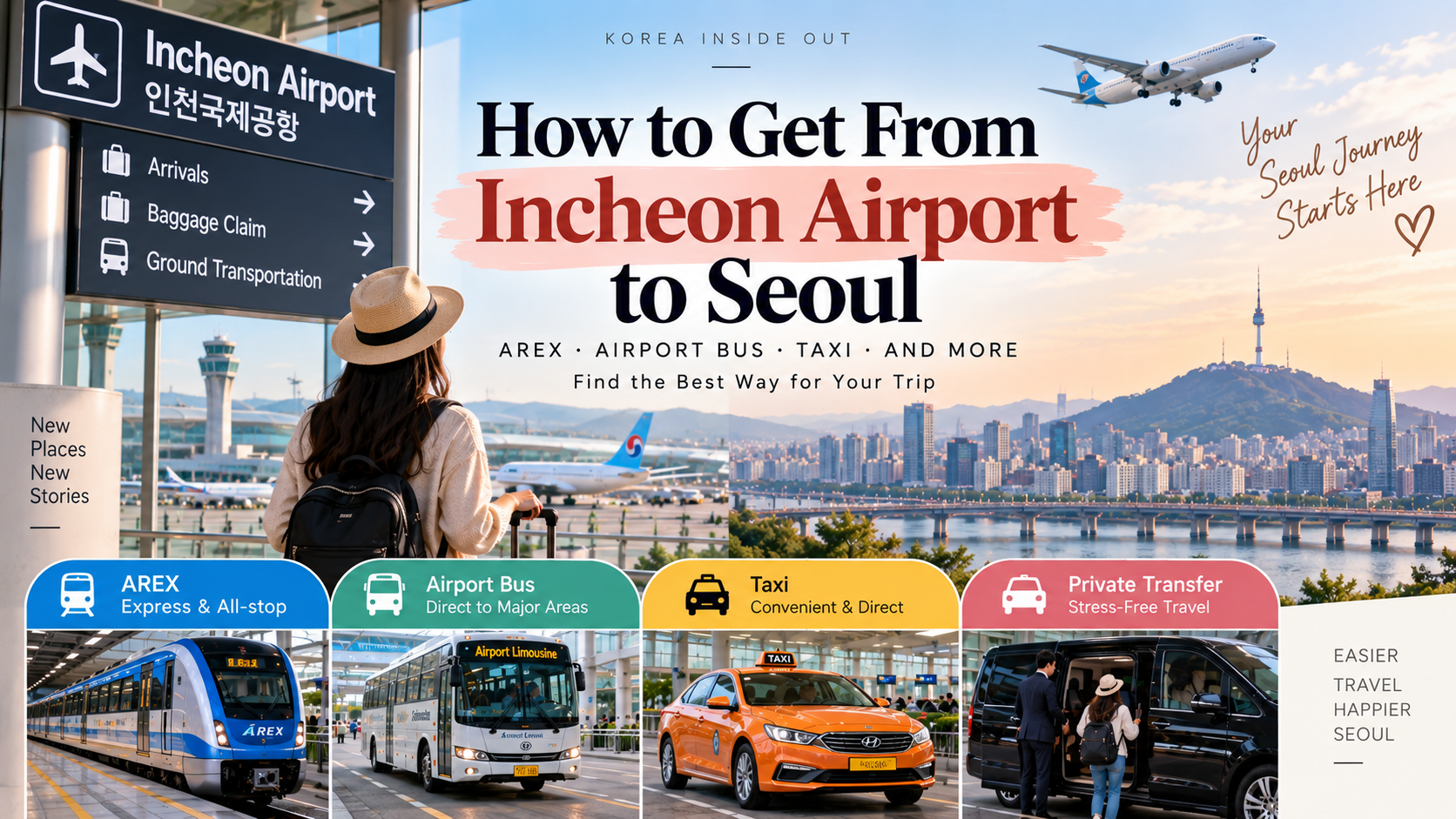
    You can take the AREX airport train, an airport limousine bus, a regular taxi, or a private transfer.

    The best choice depends on where you’re staying, how much luggage you have, what time you arrive, and whether you want to save money or minimize hassle.

    For most first-time visitors, I’d narrow it down to three choices:

    • AREX if you want a predictable and affordable journey
    • Airport limousine bus if you want to get closer to your hotel without changing trains
    • Taxi or private transfer if you have lots of luggage or simply want the easiest arrival

    Here’s how to choose.


    Incheon Airport to Seoul: Quick Comparison

    OptionBest ForApprox. TimeMain Advantage
    AREX All-Stop TrainBudget travelersAbout 1 hourAffordable and reliable
    AREX Express TrainSeoul Station areaAbout 40–50 minNon-stop and comfortable
    Airport Limousine BusHotel-area convenienceAbout 1–2 hours*Less luggage handling
    TaxiFamilies / lots of luggageVariesDoor-to-door
    Private TransferFirst-time visitors / groupsVariesPre-arranged and easy

    *Travel time varies significantly depending on the destination and traffic.

    There isn’t one “best” option for everyone.

    The most important thing is to choose based on where you’re staying, not simply which transportation method sounds fastest.


    First: Which Incheon Airport Terminal Are You Using?

    Incheon International Airport has Terminal 1 and Terminal 2.

    Your airline determines which terminal you use, so check your flight information before arriving.

    This matters because:

    • Train locations are different
    • Bus boarding areas are different
    • Taxi pickup areas are different
    • Travel times can differ slightly

    If you’re not sure, check your airline information before leaving home.

    Don’t wait until you land.


    Option 1: AREX All-Stop Train

    For many independent travelers, the AREX All-Stop Train is the easiest balance between price and convenience.

    It connects Incheon Airport with Seoul and stops at several stations along the way.

    You can eventually reach areas such as:

    • Hongdae
    • Gongdeok
    • Seoul Station
    • Digital Media City
    • Gimpo Airport

    The journey from Terminal 1 to Seoul Station is roughly one hour, while Terminal 2 takes longer. The trains run frequently during operating hours.

    Why I like it for first-time visitors

    It’s:

    • Predictable
    • Relatively inexpensive
    • Not affected by road traffic
    • Easy to connect with Seoul’s subway system

    And once you’ve used it once, you’ll probably find it very straightforward.

    Current fare

    The adult fare to Seoul Station is currently around ₩4,750 from Terminal 1 and ₩5,350 from Terminal 2 on the all-stop service, based on current 2026 fare information.

    Fares can change, so check the current AREX fare before your trip.

    Where do you board?

    The airport railway station is located in the Transportation Center on the basement level of the airport.

    Follow the signs for:

    Airport Railroad / AREX

    You don’t need to go outside the airport to find the train.


    Who Should Take the All-Stop Train?

    I’d choose it if:

    • You’re staying near an AREX station
    • You’re comfortable using public transportation
    • You want to keep transportation costs low
    • You don’t mind carrying your luggage
    • You arrive during normal train operating hours

    It’s especially convenient if you’re staying around Hongdae.

    Instead of going all the way to Seoul Station and then transferring, you can get off at Hongik University Station.

    That’s an important detail.

    Staying in Hongdae?

    Take the AREX All-Stop Train and get off at:

    Hongik University Station

    This can save you an unnecessary trip into Seoul Station.

    If you’re staying elsewhere, check your hotel location before deciding where to get off.


    Option 2: AREX Express Train

    The AREX Express Train takes you directly from Incheon Airport to Seoul Station without intermediate stops.

    The journey is approximately 40–50 minutes, depending on the terminal and current timetable.

    The major advantage is simplicity.

    You board the train.

    You sit down.

    And you get off at Seoul Station.

    No intermediate stops.

    No worrying about where to transfer.

    Who should take the Express?

    I’d consider it if:

    • You’re staying near Seoul Station
    • You have a large suitcase
    • You want a guaranteed seat
    • You prefer a quieter, more straightforward journey
    • You’re traveling after a long flight and don’t want to think too much

    But there’s one important catch:

    It only takes you to Seoul Station.

    If your hotel is in Hongdae, Myeongdong, Gangnam, or another neighborhood, you still need to continue from Seoul Station.

    So don’t automatically assume the Express is the fastest option for your actual hotel.

    The train may be faster to Seoul Station but slower overall once you add another transfer.


    AREX Express vs. All-Stop: Which One Should You Choose?

    Here’s the simple version:

    Choose All-Stop if:

    You want to save money or your hotel is near an AREX station.

    Choose Express if:

    You want a reserved-seat, non-stop ride to Seoul Station and don’t mind paying more.

    For many first-time visitors, I actually think the All-Stop train is perfectly good.

    You don’t necessarily need to pay extra simply because the train has “Express” in its name.

    Think about your final destination.


    Option 3: Airport Limousine Bus

    The airport limousine bus is another very useful option, particularly if you’re staying in a hotel district that has a convenient airport bus stop.

    Unlike the train, you don’t have to carry your luggage through subway corridors and up and down stairs while transferring.

    You get on the bus at the airport and get off somewhere much closer to your destination.

    Why travelers like airport buses

    They’re particularly useful when:

    • You have large suitcases
    • You’re traveling with children
    • You’re staying far from Seoul Station
    • You don’t want to transfer
    • You’re arriving tired after a long flight

    Airport buses serve Seoul and surrounding areas, but routes, fares, and operating schedules vary, so you should check the current route for your hotel rather than assuming there is a bus to every neighborhood.


    Where Do You Catch the Airport Bus?

    At Terminal 1, airport buses use the transportation area around the first-floor arrival level.

    At Terminal 2, bus services are accessed through the transportation center on the basement level.

    Follow the airport signs for:

    Airport Bus / Limousine Bus

    Because routes can change, check the destination and route number on the official airport information before boarding.

    Don’t simply get on a bus because the neighborhood name looks familiar.


    Is the Airport Bus Better Than AREX?

    It depends.

    Imagine you’re staying at a hotel in Myeongdong.

    The AREX train can get you toward central Seoul, but you’ll then need another subway journey or taxi to reach your hotel.

    If an airport limousine bus stops conveniently near your hotel, the bus may be easier even if the total journey takes longer.

    That’s the key distinction:

    Fastest transportation isn’t always the easiest transportation.

    Especially when you’re carrying two suitcases.


    Option 4: Taxi From Incheon Airport to Seoul

    If you want to go directly from the airport to your hotel, a taxi is the simplest option.

    You leave the terminal.

    Find the official taxi stand.

    Give the driver your destination.

    And you’re on your way.

    Taxi is particularly useful if:

    • You’re traveling with three or four people
    • You have lots of luggage
    • You’re arriving late
    • Your hotel is far from a subway station
    • You’re traveling with young children
    • You simply don’t want to navigate public transportation after a long flight

    The downside is cost.

    A taxi from Incheon Airport to Seoul can be substantially more expensive than public transportation, and the final fare depends on your destination, traffic, tolls, and applicable surcharges.

    One important safety tip

    Use the official designated taxi stand.

    Incheon Airport specifically warns travelers about illegal solicitation and overcharging involving unauthorized vehicles.

    If someone approaches you inside the arrival area asking whether you need a taxi, you don’t need to accept.

    Simply follow the airport signs to the official taxi area.


    Option 5: Private Airport Transfer

    A private transfer is the most straightforward option if you don’t want to figure anything out after landing.

    You book the vehicle in advance.

    A driver meets you at the airport.

    You get in.

    And you go directly to your hotel.

    This can be particularly attractive for:

    • Families
    • Groups
    • Travelers with lots of luggage
    • Late arrivals
    • First-time visitors who are nervous about navigating Seoul
    • Travelers staying somewhere difficult to reach by public transportation

    It’s more expensive than taking the train or bus, but you’re paying for convenience.

    For a group, the difference in cost per person may also be smaller than you expect.


    What If You Arrive Late at Night?

    This is one situation where you should plan ahead.

    Don’t assume that the transportation you want will still be running when your flight lands.

    AREX and regular airport buses have operating hours, and the final departure depends on the service and terminal.

    Incheon Airport also operates late-night buses on selected routes, including services toward areas such as Gangnam and Dongdaemun, but routes and times vary.

    If your flight arrives late

    Before you fly, check:

    1. Your actual landing time
    2. Immigration and baggage time
    3. Last train
    4. Last airport bus
    5. Night bus options
    6. Taxi availability

    Don’t plan around your scheduled arrival time alone.

    A flight scheduled to land at 10:30 PM may not actually get you out of the airport until much later.


    What If You Have a Lot of Luggage?

    This changes my recommendation.

    If you have:

    One small suitcase + backpack

    → AREX is easy.

    If you have:

    Two large suitcases + carry-ons

    → An airport bus or taxi may be much more comfortable.

    Remember that getting from the airport to Seoul isn’t just about the vehicle.

    You also have to:

    • Find the station
    • Carry your luggage
    • Transfer
    • Find your hotel
    • Walk from the station
    • Possibly climb stairs

    A route that looks cheap and efficient on a map can feel very different when you’re exhausted and carrying 30 kg of luggage.


    Which Airport Transportation Is Best for Different Seoul Neighborhoods?

    Here’s a simple way to think about it.

    Staying in Hongdae

    AREX All-Stop

    This is one of the easiest neighborhoods to reach by airport train because Hongik University Station is directly on the AREX route.


    Staying near Seoul Station

    AREX Express or All-Stop

    Both work well.

    If convenience and a reserved seat matter to you, consider the Express.


    Staying in Myeongdong

    AREX + subway/taxi

    or

    Airport limousine bus, depending on the current route and your hotel’s location.

    Don’t assume that Seoul Station is automatically your final destination.


    Staying in Gangnam

    An airport bus or taxi can sometimes be more convenient because Seoul Station is not necessarily on your way to Gangnam.

    Late-night travelers should also check night bus options.


    Staying in Itaewon

    You’ll likely need another connection after arriving in Seoul.

    An airport bus or taxi may be worth considering if you have heavy luggage.


    The Most Important Question: Where Is Your Hotel?

    Before choosing transportation, open your hotel location on a map.

    Then ask:

    Where will I actually get off?

    This sounds obvious, but it’s one of the easiest mistakes to make.

    For example:

    “AREX goes to Seoul Station.”

    That’s true.

    But if your hotel is in Hongdae, you may not want to go to Seoul Station at all.

    Likewise, if you’re staying in Gangnam, getting off at Seoul Station isn’t necessarily the most convenient solution.

    Your hotel location should determine your route.


    A Simple Arrival Strategy for First-Time Visitors

    If I were planning a first trip to Seoul, I’d do this before leaving home.

    Step 1: Save your hotel

    Save the hotel location in your map app.

    Also save the address in both English and Korean if available.

    Step 2: Identify the nearest subway station

    Know the station name before you land.

    Step 3: Check the airport route

    Look at:

    Incheon Airport → hotel

    rather than:

    Incheon Airport → Seoul

    That small difference can completely change which option is best.

    Step 4: Have a backup plan

    If your flight is delayed, know what you’ll do if you miss the last train.

    Step 5: Don’t rush

    You just arrived in a new country.

    You don’t need to prove that you can navigate the airport in five minutes.

    Take your time.

    Follow the signs.

    Ask airport staff if you’re unsure.


    Do You Need a T-money Card at the Airport?

    A transportation card such as T-money can be useful during your Seoul trip, particularly if you’ll be using the subway and buses.

    However, don’t feel that you need to solve every transportation problem immediately after landing.

    Your first priority is simply getting to your accommodation.

    Once you’re settled, you can sort out the rest.

    If you want to understand T-money and other payment options in more detail, see:

    Do You Need Cash in Korea? Cards, ATMs & T-money Explained

    And once you’re ready to use the Seoul subway:

    How to Use the Seoul Subway: A First-Time Visitor’s Guide


    What I Would Choose

    If I were traveling alone with one suitcase:

    AREX All-Stop

    I’d keep it simple and inexpensive.

    If I were staying near Seoul Station and wanted the easiest train journey:

    AREX Express

    If I were traveling with children and several suitcases:

    Airport limousine bus or taxi

    If I were arriving very late:

    Check night bus options first, then use a taxi if necessary

    If I were traveling with a group:

    Compare the total cost of a private transfer or taxi with multiple train tickets

    The “best” option isn’t necessarily the cheapest one.

    It’s the one that gets you from the airport to your hotel with the least unnecessary stress.


    One Mistake to Avoid

    Don’t choose your airport transportation based only on the travel time shown online.

    A 43-minute train ride sounds fantastic.

    But imagine:

    **43 minutes on the train

    • 15 minutes waiting
    • 10 minutes finding your hotel
    • 15 minutes transferring**

    versus:

    75 minutes on a direct airport bus that stops near your hotel.

    The second option may actually be easier.

    When you’re traveling, door-to-door time matters more than vehicle travel time.


    Before You Fly: Your Incheon Airport Checklist

    Save this section.

    Before leaving home:

    ☐ Check whether you’re arriving at Terminal 1 or Terminal 2

    ☐ Save your hotel location

    ☐ Save your hotel’s Korean name/address

    ☐ Find the nearest subway station

    ☐ Check the current AREX timetable

    ☐ Check the airport bus route if you’re considering one

    ☐ Check late-night transportation if your flight arrives late

    ☐ Have a backup payment method

    ☐ Keep your hotel information accessible offline

    That last one is especially important.

    You don’t want your first task in Korea to be:

    “Why isn’t my phone connecting to the internet?”

    while standing outside an airport at midnight.


    Final Thoughts

    Getting from Incheon Airport to Seoul isn’t difficult.

    The trick is simply understanding that the fastest option isn’t always the best option for your particular hotel.

    For many travelers, AREX is the easiest starting point.

    For others, an airport bus is more convenient.

    And if you’re traveling with family, lots of luggage, or a very late arrival, paying more for a taxi or private transfer can be completely worth it.

    Before your trip, spend five minutes checking your hotel’s exact location and planning your airport route.

    That small amount of preparation can make your first hour in Korea much easier.

    And once you arrive in Seoul, the real trip can begin.


    Planning Your First Trip to Seoul?

    Once you know how to get from the airport, these guides can help with the rest of your trip:

    Where to Stay in Seoul: 7 Best Areas for First-Time Visitors

    How to Use the Seoul Subway: A First-Time Visitor’s Guide

    Do You Need Cash in Korea? Cards, ATMs & T-money Explained

    How Many Days Do You Need in Seoul? 3, 5, or 7 Days

    Is Seoul Expensive? A Realistic Seoul Travel Budget for 2026


    What About You?

    How are you planning to get from Incheon Airport to Seoul?

    Are you leaning toward AREX, the airport bus, a taxi, or a private transfer?

    If you’ve already made the trip, which option worked best for you?

    Share your experience in the comments — it may help another first-time visitor.

  • Is Seoul Safe for Tourists? What First-Time Visitors Should Know

    Is Seoul Safe for Tourists? What First-Time Visitors Should Know

    If you’re planning your first trip to Seoul, you may have an important question before you book your flight:

    Is Seoul safe for tourists?

    The short answer is yes, Seoul is generally considered a safe city for visitors, including people traveling alone.

    But “safe” doesn’t mean you should switch off your common sense.

    Like any major city, Seoul has crowded areas, busy roads, nightlife districts, occasional scams, and situations where travelers should pay attention to their surroundings.

    The good news is that most visitors won’t experience serious problems.

    For a first trip, you mainly need to understand what to watch out for, what is actually worth worrying about, and what to do if something goes wrong.

    Here’s what you should know before visiting Seoul.


    Is Seoul Safe for Tourists?

    For most visitors, yes.

    The official Seoul tourism guide describes Seoul as a safe destination for both group and solo travelers and recommends the usual precautions, such as avoiding isolated or poorly lit areas and staying aware of your surroundings.

    Seoul is also a city where many people regularly use public transportation late into the evening, and major neighborhoods remain active well after dark.

    That doesn’t mean every street is equally comfortable at every hour.

    The same basic rule applies here as anywhere else:

    Busy and well-lit areas are generally a better choice than isolated streets late at night.

    If you’re visiting Seoul for the first time, you don’t need to be constantly worried about safety.

    You just need to travel intelligently.


    Is Seoul Safe at Night?

    This is one of the most common questions first-time visitors ask.

    In general, many parts of Seoul remain active late into the evening.

    Neighborhoods such as Myeongdong, Hongdae, Gangnam, Itaewon, and Jongno can stay busy well after dinner.

    You may see people walking around, using public transportation, shopping, eating, and meeting friends late at night.

    That can feel very different from cities where streets become quiet soon after sunset.

    But don’t confuse “busy” with “risk-free.”

    If you’re walking alone late at night:

    • Stay on well-lit streets
    • Avoid isolated alleys
    • Keep your phone and wallet secure
    • Don’t walk while completely distracted by your phone
    • Use a taxi if you feel uncomfortable
    • Avoid getting heavily intoxicated
    • Pay attention to traffic

    You don’t need to avoid Seoul at night.

    Just use the same judgment you would use in any large city.


    Is Seoul Safe for Solo Travelers?

    Generally, yes.

    Seoul is particularly convenient for solo travelers because public transportation is extensive and many neighborhoods remain active throughout the day and evening.

    Eating alone is also relatively common, although some restaurants—especially certain Korean BBQ restaurants—may be more comfortable for groups.

    If you’re traveling alone

    I’d recommend:

    During the day

    Explore freely, use public transportation, and walk around neighborhoods.

    At night

    Stay in active areas and use transportation rather than walking through unfamiliar isolated streets for long distances.

    When drinking

    Keep your alcohol consumption moderate and make sure you know how you’ll get back to your accommodation.

    When meeting strangers

    Use the same caution you would anywhere else.

    Being in Seoul doesn’t mean you need to be suspicious of everyone.

    It simply means you should maintain normal travel awareness.


    Is Seoul Safe for Women Traveling Alone?

    For many solo female travelers, Seoul can be a comfortable destination.

    The official Seoul tourism guide specifically notes that many parts of the city can be freely explored day and night with basic precautions, including by women traveling alone.

    But no city should be treated as completely risk-free.

    If you’re traveling alone, simple habits can make your trip more comfortable:

    • Keep your accommodation address saved
    • Share your itinerary with someone you trust
    • Avoid isolated areas late at night
    • Keep your phone charged
    • Have a backup payment method
    • Know how to call a taxi
    • Keep your passport secure
    • Don’t accept drinks from strangers
    • If a situation feels uncomfortable, leave

    The most important point is this:

    You don’t need to be frightened, but you should trust your instincts.

    If somewhere feels wrong, you don’t need to stay just because you planned to visit it.


    What About Pickpocketing?

    Seoul is not a city where most tourists spend their entire trip worrying about pickpockets.

    But crowded places are still crowded places.

    Use extra awareness in:

    • Subway stations
    • Packed subway trains
    • Major shopping streets
    • Festivals
    • Markets
    • Tourist attractions
    • Crowded nightlife areas

    Keep your phone and wallet somewhere secure.

    A crossbody bag worn toward the front can be useful in crowded areas.

    And don’t leave your phone or wallet sitting openly on a café table while you walk away.

    A good travel habit

    Think:

    Secure, not paranoid.

    You don’t need to hold your bag with both hands all day.

    Just don’t make it unnecessarily easy for someone to take something.


    Is the Seoul Subway Safe?

    For ordinary travel, the subway is generally a straightforward way to get around Seoul.

    But crowded trains require the same awareness as public transportation anywhere.

    Keep your belongings close.

    Don’t leave your phone unattended.

    Be careful when entering and leaving trains.

    And stand behind the platform safety line while waiting.

    One important safety issue: escalators and stairs

    Seoul’s subway stations can be large.

    You’ll encounter:

    • Long escalators
    • Stairs
    • Busy passageways
    • Crowded platforms
    • Multiple exits

    If you’re carrying large luggage, don’t rush.

    Let people pass when necessary and pay attention to where you’re walking.

    If you haven’t used the subway in Korea before, our beginner’s guide explains how the system works:

    How to Use the Seoul Subway: A First-Time Visitor’s Guide

    How to Use the Seoul Subway: A First-Time Visitor’s Guide


    Be Careful Around Seoul Traffic

    This is something I would actually put higher on a first-time visitor’s safety checklist than many people expect.

    Seoul is a pedestrian-friendly city in many areas, but it is also a huge, busy metropolis.

    Cars, buses, motorcycles, bicycles, and electric mobility devices share the roads.

    Don’t assume a pedestrian crossing means you can stop paying attention.

    Especially watch for:

    • Turning vehicles
    • Buses
    • Motorcycles
    • Bicycles
    • Electric scooters
    • Cars entering or leaving side streets

    Look both ways even when you have the right of way.

    And don’t walk into the road while staring at your phone.

    This sounds obvious.

    But when you’re navigating an unfamiliar city, it’s surprisingly easy to do.


    Is Seoul Safe for Nightlife?

    Seoul has a huge nightlife scene.

    Hongdae, Itaewon, Gangnam, Euljiro, and other areas can be extremely lively at night.

    If nightlife is part of your trip, there is no reason to avoid it simply because you’re visiting Korea.

    But nightlife creates a different set of risks.

    Keep these habits in mind:

    Watch your drink.

    Don’t leave it unattended.

    Know how you’re getting home.

    Don’t wait until you’re exhausted to figure out transportation.

    Don’t drink beyond your limits.

    Being unfamiliar with the city makes getting lost or separated from your group more difficult.

    Stay with your friends.

    If you’re traveling as a group, decide what you’ll do if someone gets separated.

    And if you’re traveling alone, make sure someone knows where you’re going.


    Are There Scams in Seoul?

    Most visitors won’t encounter serious scams.

    But tourists can occasionally be targeted by overcharging or questionable sales practices, particularly in busy tourist areas.

    The official Seoul tourism guide recommends checking prices before ordering at restaurants and street-food stalls, particularly when prices aren’t clearly displayed.

    A simple rule

    If the price isn’t clear, ask before ordering.

    This is especially useful at:

    • Street food stalls
    • Small shops
    • Markets
    • Tourist-oriented businesses
    • Services where the final price isn’t obvious

    Don’t feel embarrassed about asking.

    You can simply say:

    “How much is this?”

    Or:

    얼마예요?

    Eolmayeyo?

    Knowing the price beforehand prevents an awkward conversation later.


    What About Taxis?

    Taxis are a convenient way to get around Seoul, particularly at night or when you’re carrying luggage.

    But as a tourist, you should still use common sense.

    Use official taxi services or a reputable taxi-hailing app.

    Don’t accept unsolicited offers from strangers approaching you and offering a ride.

    If you’re unsure, go to the designated taxi area or use an app.

    The official Seoul tourism guide also advises visitors to check that the meter is being used for regular taxis.

    Before getting in

    Check:

    • Vehicle identification
    • Destination
    • Meter
    • Approximate route

    And if you’re using an app, confirm that the vehicle information matches what appears on your phone.


    What If You Lose Your Phone or Wallet?

    This is one of the situations worth planning for before your trip.

    You don’t want to figure everything out after losing your phone.

    Before leaving home

    Save:

    • Your hotel address
    • Your passport information
    • Emergency contacts
    • Your credit card company’s phone number
    • Your travel insurance information
    • A backup payment method

    Keep a copy of your important documents somewhere separate from the originals.

    If you lose your phone

    If you can, use another device to:

    • Lock the phone
    • Track the phone
    • Contact your mobile provider
    • Secure important accounts

    If you lose your wallet

    Contact your card issuer as soon as possible.

    If you think the wallet was stolen, report it to the police.

    For lost property in Korea, the official Lost112 system can also be useful.


    What If You Lose Your Passport?

    If your passport disappears during your trip, don’t panic.

    First, retrace your steps and check with the places you visited.

    If you believe it was stolen, report it to the police.

    Then contact your country’s embassy or consulate in Korea.

    They can explain the process for replacing your travel document or obtaining emergency travel documentation.

    One important tip

    Don’t keep your passport in an easily accessible outside pocket of your backpack while sightseeing.

    Keep it secure.

    And carry a copy or digital backup of the identification page separately.


    What Should You Do in a Medical Emergency?

    If you have a serious medical emergency in Korea, call:

    119

    This is the emergency number for fire and ambulance services.

    The Seoul tourism guide states that English-language assistance is available through the emergency system, and the official VisitKorea guidance also advises non-Korean speakers to say “English please” or “Interpreter please” when connected.

    For a police emergency:

    112

    For tourist information and interpretation assistance:

    1330

    The 1330 Korea Travel Helpline provides tourist information, interpretation, and assistance with tourism-related problems.

    Save these numbers now

    112 — Police

    119 — Fire / Ambulance

    1330 — Korea Travel Helpline

    You may never need them.

    But knowing where they are before an emergency happens is much better than searching for them during one.


    What If There Is a Natural Disaster?

    Korea can experience heavy rain, typhoons, heat waves, earthquakes, and other weather-related or natural events.

    You don’t need to spend your vacation worrying about disasters.

    But it is worth knowing how emergency information works.

    The Korean government provides multilingual emergency information for international visitors, including the Emergency Ready app and the Baro Emergency Reporting App. The government recommends these resources for foreign visitors who may need emergency information or reporting assistance.

    During severe weather

    Check official alerts.

    Follow instructions from local authorities.

    Avoid flooded roads.

    Don’t enter restricted areas.

    And if you’re told to move somewhere safer, do it promptly.


    What About Earthquakes?

    Korea isn’t generally associated with major earthquakes in the way some neighboring countries are.

    But earthquakes can occur.

    If you feel significant shaking:

    • Stay calm
    • Move away from windows
    • Protect your head
    • Follow local instructions
    • Don’t rush into elevators

    If you’re staying in a hotel, familiarize yourself with the emergency exits when you arrive.

    You probably won’t need this information.

    But knowing where the exits are takes less than a minute.


    What About Drinking Tap Water?

    For travelers, bottled water is an easy option if you’re uncomfortable drinking tap water.

    You can also use filtered water where available.

    The bigger issue is usually not safety but personal preference.

    Korean restaurants commonly provide drinking water, and convenience stores are everywhere if you’d rather buy bottled water.


    What About Food Safety?

    For most travelers, eating in Seoul is straightforward.

    Use normal precautions:

    • Choose busy restaurants when possible
    • Check food before eating
    • Be careful with foods that have been sitting unrefrigerated for long periods
    • Wash your hands
    • Stay hydrated
    • Don’t suddenly eat enormous amounts of unfamiliar spicy food

    And if you have food allergies, don’t assume that a dish is safe simply because the ingredient isn’t obvious.

    Korean cooking can use ingredients such as seafood, fish sauce, shrimp, or broth that may not be immediately visible.


    What About Drinking and Getting Lost?

    This deserves its own section because it’s one of the easiest ways to turn a safe trip into an unnecessarily difficult night.

    Seoul’s nightlife can be very social.

    If you drink, know how you’re getting back to your hotel before you become too tired or intoxicated to think clearly.

    Before going out

    Save:

    • Hotel name
    • Hotel address
    • Hotel phone number
    • Map location

    And if you’re with friends, make sure everyone knows the meeting point.

    If you’re alone, consider sharing your location or plans with someone you trust.


    Are Tourist Areas Safe?

    Generally, busy tourist areas are exactly where many visitors feel most comfortable.

    Places such as Myeongdong, Hongdae, Insadong, and major shopping and sightseeing districts are accustomed to international visitors.

    But popularity doesn’t eliminate the need for awareness.

    Crowded places can increase the chance of:

    • Lost belongings
    • Accidental separation from friends
    • Pickpocketing
    • Getting on the wrong train
    • Getting distracted

    The official Seoul tourism guide notes that tourist police services are available in major tourist areas and that visitors can seek assistance when needed.


    What About Political Protests or Large Crowds?

    Seoul occasionally hosts demonstrations, rallies, festivals, concerts, and large public events.

    If you encounter a large crowd or demonstration:

    Don’t assume something dangerous is happening.

    But don’t push your way into the middle of an unfamiliar crowd either.

    Instead:

    • Check local news or official notices
    • Follow police instructions
    • Take another route if necessary
    • Allow extra time for transportation
    • Avoid confrontations

    Large events can also cause subway stations to close temporarily or buses to change routes.

    If you’re visiting a major event area, check current transportation information before leaving your hotel.


    A Simple Seoul Safety Checklist

    Before leaving your hotel each morning:

    ☐ Phone charged

    ☐ Hotel address saved

    ☐ Some backup payment available

    ☐ Passport secured

    ☐ Important documents backed up

    ☐ Weather checked

    ☐ Transportation route checked

    ☐ Emergency numbers saved

    At night:

    ☐ Stay aware of your surroundings

    ☐ Avoid isolated areas

    ☐ Keep valuables secure

    ☐ Know how you’re getting back

    ☐ Don’t drink beyond your limits

    ☐ Trust your instincts

    That’s really all most visitors need.


    What I Would Actually Worry About in Seoul

    If you’re coming from a country where you’ve heard that Seoul is exceptionally safe, you may wonder:

    “So what should I actually be careful about?”

    My answer would be:

    1. Traffic

    Look before crossing.

    2. Crowds

    Keep your belongings secure.

    3. Nightlife

    Don’t get so drunk that you can’t navigate safely.

    4. Weather

    Check forecasts during periods of extreme heat, heavy rain, or typhoons.

    5. Getting lost

    Keep your hotel location and a reliable map available.

    6. Unclear prices

    Ask before ordering when a price isn’t obvious.

    That’s a much more realistic safety checklist than spending your entire trip worrying about serious crime.


    Is Seoul Safe for First-Time Visitors?

    Yes.

    For most travelers, Seoul is a city where you can comfortably explore neighborhoods, use public transportation, eat out, shop, and stay out into the evening while using ordinary precautions.

    The important thing is not to confuse “safe” with “nothing can ever happen.”

    Things can go wrong anywhere.

    Your phone can disappear.

    You can get lost.

    You can get sick.

    You can take the wrong train.

    You can encounter a difficult situation.

    The advantage of preparing is that these problems become manageable rather than disastrous.


    Final Thoughts

    If you’re nervous about visiting Seoul for the first time, I wouldn’t let safety concerns stop you from going.

    Seoul is a huge, busy city, but it is also highly organized and very accustomed to international visitors.

    You don’t need to spend your trip looking over your shoulder.

    Instead:

    Stay aware.

    Keep your belongings secure.

    Be careful around traffic.

    Use official transportation.

    Know your emergency numbers.

    Trust your instincts.

    And if something does go wrong, ask for help.

    You don’t have to speak perfect Korean to get assistance.

    That’s one of the most useful things to remember as a first-time visitor.

    The goal isn’t to travel without taking any risks at all.

    It’s to understand the city well enough that you can relax and enjoy it.


    Planning Your First Trip to Seoul?

    Before you arrive, you may also want to read:

    How to Get From Incheon Airport to Seoul: AREX, Airport Bus, Taxi & More

    How to Get From Incheon Airport to Seoul

    How to Use the Seoul Subway: A First-Time Visitor’s Guide

    How to Use the Seoul Subway: A First-Time Visitor’s Guide

    Where to Stay in Seoul: 7 Best Areas for First-Time Visitors

    Where to Stay in Seoul: 7 Best Areas for First-Time Visitors

    Do You Need Cash in Korea? Cards, ATMs & T-money Explained

    Do You Need Cash in Korea? Cards, ATMs & T-money Explained

    How Many Days Do You Need in Seoul? 3, 5, or 7 Days

    How Many Days Do You Need in Seoul? 3, 5, or 7 Days


    What About You?

    If you’ve visited Seoul before, what made you feel safest—or what surprised you most about safety in Korea?

    And if this is your first trip, what safety question are you still wondering about?

    Share it in the comments. Your question might help another first-time visitor too.

  • Jamsugyo Bridge Festival: Seoul’s Car-Free Sunday by the Han River

    Jamsugyo Bridge Festival: Seoul’s Car-Free Sunday by the Han River

    Walk, Eat, Listen & Experience Seoul by the Water

    Imagine walking across a bridge in the middle of Seoul with no cars around you.

    Instead, there are food stalls, live music, small markets, people sitting by the river, street performances and the Seoul skyline glowing in the distance.

    That’s the idea behind the Jamsugyo Bridge Festival.

    Every Sunday this autumn, Seoul closes Jamsugyo Bridge to vehicle traffic and turns it into a giant riverside playground.

    And if you’re visiting Seoul in September or October 2026, there’s an extra reason to go:

    This is the final season of the festival in its current car-free format.

    Jamsugyo Bridge is scheduled to become a fully pedestrianized bridge in 2027.


    🌉 What Is the Jamsugyo Bridge Festival?

    The Car-Free Jamsugyo Bridge Festival is one of Seoul’s signature Hangang events.

    It takes place around Jamsugyo Bridge and Banpo Hangang Park, turning approximately 1.1 km of the riverside area into a pedestrian-friendly festival zone.

    The fall 2026 season runs for eight Sundays from September 6 through October 25.

    📅 September 6 – October 25, 2026

    Every Sunday

    2:00 PM – 10:00 PM

    📍 Jamsugyo Bridge & Banpo Hangang Park

    💰 Free admission

    Most of the festival is free to enter, although food, crafts and some special programs may cost extra.


    🚗 What Does “Car-Free” Actually Mean?

    Jamsugyo is a two-level bridge underneath Banpodaegyo Bridge.

    During the festival, vehicles are restricted from using Jamsugyo, allowing people to walk across the bridge and enjoy the river without normal traffic.

    For the fall season, vehicle restrictions run from 12:00 PM to midnight every Sunday.

    That means the bridge becomes a completely different place.

    Instead of watching Seoul pass by through a car window, you can actually walk through it.

    And because the festival continues until 10 PM, you can stay into the evening and experience the Hangang skyline after sunset.


    🎉 What’s Happening This Fall?

    One of the best things about the Jamsugyo Bridge Festival is that the program changes every week.

    So if you’re in Seoul for several Sundays, you could visit more than once and have a completely different experience.

    💦 September 6 — Jamsugyo Water Wars

    The fall season kicked off with a giant water-gun battle.

    Around 800 participants took part in two rounds of water battles at Banpo Hangang Park.

    Advance registration was required for the water-gun activity, although the surrounding festival area was open to visitors.

    If you missed it, don’t worry.

    There are still seven more Sundays.


    🎤 September 13 — Walk Together × Student Club ON

    On September 13, university student clubs take over Jamsugyo Bridge.

    Expect:

    • 🎵 Busking
    • 💃 K-pop dance
    • 🥁 Traditional Korean performances
    • 🎩 Magic shows
    • 📸 Polaroid photo activities
    • 🎨 Hands-on experiences

    Many of these activities are designed for visitors to participate in rather than simply watch.

    This is a particularly good weekend if you want to see young Seoul beyond the usual tourist attractions.


    🏃 September 20 — Jamsugyo Fall Field Day

    Remember school sports days?

    Seoul is bringing that feeling to the Han River.

    The Jamsugyo Fall Field Day features easy activities that visitors of different ages can join, including:

    • 🚦 Red Light, Green Light
    • 🤝 Tug-of-war
    • ⭕ Hula hoop
    • 🏃 Other simple team activities

    The program runs from 2 PM to 10 PM, with advance registration required for participation.


    🌙 September 27 — Moonlight Chuseok Festival

    This is one of the most interesting weekends for international visitors.

    To celebrate Chuseok, Korea’s major autumn harvest holiday, the festival will feature traditional performances from:

    🇰🇷 Korea
    🇦🇷 Argentina
    🇧🇬 Bulgaria
    🇷🇺 Russia
    🇵🇦 Panama
    🇰🇿 Kazakhstan

    Visitors can also try traditional Korean games such as yut nori.

    The program takes place from 3 PM to 6 PM.

    If you’re interested in Korean culture, this is probably one of the best Sundays to visit.


    🍜 October Is All About Food & Night Views

    September focuses more on activities, performances and cultural experiences.

    October changes the mood.

    The theme becomes:

    Taste. Light. Relax.


    🍽️ October 4 — Jamsugyo Gourmet Road

    This could be one of the biggest highlights of the entire festival.

    For one day, Jamsugyo Bridge becomes a huge international food street with more than 100 food trucks.

    You’ll be able to try food from Korea and around the world while sitting beside the Han River.

    The event runs from 2 PM to 10 PM.

    Dining areas can accommodate up to 800 people at a time.

    And the festival plans to use reusable containers rather than single-use items as part of its eco-friendly approach.

    Our tip

    If you’re a food lover, October 4 should be on your Seoul itinerary.

    It’s not just a food festival.

    You’re eating dinner on a bridge over the Han River with Seoul’s skyline around you.


    ✨ October 11 — Moonlight Jamsugyo

    Want to see Seoul after dark?

    On October 11, the bridge becomes an enormous outdoor media-art canvas.

    From 7 PM to 10 PM, light and music will transform Jamsugyo and Banpodaegyo into a nighttime art experience inspired by the Milky Way.

    This could be one of the most photogenic evenings of the festival.

    And because the festival takes place in October, you’ll also get that cool autumn-night atmosphere.


    🧘 October 18 — Jamsugyo Refresh Day

    Not everything at the festival is loud and energetic.

    On October 18, visitors can slow down with programs including:

    • Yoga
    • Stretching
    • Meditation
    • Relaxation activities

    The program runs from 5 PM to 8 PM and requires advance registration for participation.

    It’s a surprisingly nice way to experience the Han River.

    Instead of rushing from one tourist attraction to another, you simply stop.

    Breathe.

    Look at the river.

    And let Seoul happen around you.


    🎧 Don’t Miss the Silent DJ Party

    One of the festival’s ongoing attractions is the Silent DJ Party.

    Participants wear wireless headphones and listen to music while dancing together.

    From the outside, it looks slightly strange.

    A group of people dancing beside the Han River…

    with almost no music coming from speakers.

    Put on the headphones, though, and suddenly you’re part of the party.

    It’s one of those experiences that is difficult to understand until you try it.


    🌈 Stay for the Moonlight Rainbow Fountain

    The Jamsugyo Festival is also a great opportunity to see one of Seoul’s most famous nighttime attractions:

    Banpo Bridge’s Moonlight Rainbow Fountain.

    The fountain shoots illuminated streams of water from Banpodaegyo Bridge while music plays below.

    During the festival season, performances are scheduled multiple times throughout the evening.

    So you can easily build an evening around:

    Festival → Dinner → Han River walk → Rainbow Fountain → Seoul skyline

    No expensive rooftop bar required.


    📸 Best Things to Photograph

    Bring your camera.

    There are plenty of good photo opportunities around Jamsugyo.

    🌉 The bridge itself

    Walk toward the middle of Jamsugyo for views of the Han River in both directions.

    🌆 Seoul skyline

    On clear evenings, the skyline becomes particularly beautiful around sunset.

    🌈 Rainbow Fountain

    If the fountain is operating, stay until after dark.

    🌙 The river at night

    The reflections of Banpodaegyo Bridge and the surrounding lights make a great nighttime backdrop.

    🍜 Food on the bridge

    A plate of Korean street food with the Han River behind you is about as Seoul as it gets.


    🚇 How to Get There

    The easiest way to visit is by public transportation.

    Because vehicle access is restricted during the festival and parking around Banpo Hangang Park is limited, Seoul strongly recommends using public transportation.

    The exact route depends on which part of the festival you want to visit, but Express Bus Terminal Station and Sinbanpo Station are useful subway access points for the Banpo area.

    Once you reach the riverside, simply follow signs toward Banpo Hangang Park and Jamsugyo Bridge.


    🕐 When Is the Best Time to Go?

    If this is your first visit, we’d recommend arriving around 4–5 PM.

    Why?

    4:00 PM

    Explore the festival and browse food stalls.

    5:30 PM

    Walk across Jamsugyo and take photos.

    6:30 PM

    Find a place by the river and watch the sunset.

    7:00 PM+

    Enjoy performances, food and evening activities.

    After dark

    Stay for the lights and Moonlight Rainbow Fountain.

    This gives you both sides of the festival:

    daytime energy + Seoul after dark.


    ⚠️ A Few Things to Know Before You Go

    Bring comfortable shoes

    You’ll be walking.

    A lot.

    Check the weather

    Some outdoor programs may change because of rain or other weather conditions.

    Public transportation is your friend

    Parking is limited and traffic restrictions are in place.

    Check registration requirements

    Some special activities require advance registration even though the main festival is free.

    Expect crowds

    The festival has attracted millions of visitors over the years, so popular Sundays can get busy.


    ⭐ Why 2026 Is a Special Year

    Here’s the part we think international visitors should know.

    2026 is the final season of the Jamsugyo Bridge Festival in its current “car-free bridge” format.

    Seoul plans to fully pedestrianize Jamsugyo Bridge in the second half of 2027.

    That means the bridge will eventually become a permanent pedestrian space.

    The festival itself isn’t disappearing.

    Instead, Seoul plans to create a new version of the festival once the bridge becomes fully pedestrianized.

    So if you’re visiting Seoul this autumn, you’re seeing a small piece of the city’s transformation in real time.


    🌊 Jamsugyo Is More Than a Festival

    One of our favorite things about the Jamsugyo Festival is that you don’t have to treat it like a traditional tourist attraction.

    You don’t need to arrive with a checklist.

    You can simply:

    Walk.

    Eat.

    Listen to music.

    Take photos.

    Sit beside the river.

    Watch people.

    Watch the sunset.

    And stay until the city lights come on.

    That’s one of the best ways to experience the Han River.

    If you’re looking for more seasonal events across Korea, check out our What’s On in Korea: September 2026 guide.

    And for more ideas around the river, keep an eye on our What’s On Along the Han River series.


    📅 Jamsugyo Bridge Festival 2026 at a Glance

    DateThemeHighlights
    Sep. 6Water WarsWater-gun battle
    Sep. 13Student Club ONK-pop, busking, magic
    Sep. 20Fall Field DayGames & activities
    Sep. 27Moonlight ChuseokInternational traditional performances
    Oct. 4Gourmet Road100+ food trucks
    Oct. 11Moonlight JamsugyoMedia art & music
    Oct. 18Refresh DayYoga & meditation
    Oct. 25Final SundayFinal fall-season programs

    Every Sunday: September 6 – October 25, 2026
    Festival hours: 2 PM – 10 PM
    Location: Jamsugyo Bridge & Banpo Hangang Park
    Admission: Free


    💙 Our Take

    There are plenty of famous things to do in Seoul.

    Visit a palace.

    Shop in Myeongdong.

    Take photos at N Seoul Tower.

    Eat Korean barbecue.

    They’re all worth doing.

    But if you want to see how Seoul’s residents actually spend a Sunday, go to the Han River.

    And if you can walk across a bridge without cars while eating Korean street food, listening to live music and watching the skyline turn pink at sunset…

    even better.

    That’s Seoul from the inside out.

  • What’s On Along the Han River This September

    What’s On Along the Han River This September

    Night Views, Festivals, Drone Shows & More

    If you’re visiting Seoul, there’s one place you shouldn’t overlook:

    the Han River.

    The Han River runs through the heart of Seoul, but it’s much more than a beautiful backdrop for photos. Throughout the year, the riverside parks host festivals, outdoor performances, night tours, markets, sports activities and special events.

    And September is a particularly good time to visit.

    The summer heat is beginning to fade, the evenings are getting cooler, and Seoul’s Han River comes alive after sunset.

    Here are some of the best things happening along the Han River this September.


    🌉 1. Walk Across the Car-Free Jamsugyo Bridge

    📍 Banpo Hangang Park & Jamsugyo Bridge
    📅 September 6 – October 25, 2026
    🕑 Every Sunday, 2:00 PM–10:00 PM
    💰 Free

    One of the most interesting ways to experience the Han River this autumn is the Car-Free Jamsugyo Bridge Festival.

    Every Sunday, Jamsugyo Bridge is closed to cars, turning the bridge into a pedestrian-friendly riverside festival.

    You can walk across the bridge, enjoy street performances, browse small markets, grab something from food trucks and take in the view of the river.

    This autumn season also runs later into the evening, until 10 PM, making it a great option for experiencing Seoul after dark.

    There’s an extra reason to visit this year:

    This is the final season of the festival in its current “car-free bridge” format.

    Jamsugyo is scheduled to become a fully pedestrian bridge from 2027, so this year’s festival is a chance to experience the bridge before that transformation.

    Why we recommend it

    If you’ve already visited the major tourist attractions in Seoul, this is a great way to see how locals enjoy the city.

    It’s casual, inexpensive and very Korean.


    ✨ 2. Take a Han River Night View Tour

    📍 Banpo & Yeouido Hangang Parks
    📅 August 28 – October 3, 2026
    🗓️ Fridays & Saturdays
    🕖 7:00 PM–8:30 PM
    🎟️ Advance reservation required

    Want to experience the Han River after sunset?

    The Han River Night View Tour offers guided evening walks around two of Seoul’s most scenic riverside areas.

    🌙 Banpo Moonlight Road

    The Banpo course takes you along:

    Banpo Information Center → Seoraeseom Island → Sebitseom → Moonlight Rainbow Fountain → Jamsugyo Bridge

    You’ll see the illuminated islands, the river at night and the famous Banpo Bridge Moonlight Rainbow Fountain.

    ✨ Yeouido Starlight Road

    The Yeouido course includes outdoor art installations, the Han River Bus terminal, Water Light Stage and riverside night views.

    For visitors who want to understand Seoul beyond the usual palaces and shopping districts, this is a particularly interesting experience.


    🌈 3. See the Moonlight Rainbow Fountain

    📍 Banpo Hangang Park
    📅 September
    💰 Free

    One of Seoul’s most famous nighttime attractions is the Banpo Bridge Moonlight Rainbow Fountain.

    Water shoots from the bridge while lights and music create a colorful nighttime show over the Han River.

    During June–September, regular fountain performances are scheduled throughout the evening, although the schedule can change because of weather and river conditions.

    The easiest way to enjoy it?

    Come to Banpo Hangang Park around sunset, have a picnic by the river and stay until the fountain starts.


    🚁 4. Han River Drone Light Show Returns

    📍 Ttukseom Hangang Park
    📅 September 12 – October 31, 2026
    🗓️ Saturdays
    💰 Free

    One of Seoul’s most spectacular free nighttime events returns this fall.

    The Han River Light Show uses drones equipped with LED lights — along with other special effects depending on the program — to create large-scale images and stories in the night sky.

    The show takes place at Ttukseom Hangang Park and runs from September 12 through October 31.

    If you’ve never seen a Korean drone light show before, this is definitely worth adding to your Seoul itinerary.

    Tip: Arrive early. Popular Han River events can attract very large crowds.


    🚲 5. Explore the Han River by Bicycle

    One of the best ways to experience the Han River isn’t an organized event at all.

    It’s simply cycling along the river.

    Seoul has an extensive riverside cycling network, with routes connecting many of the major Hangang parks.

    You can rent a bicycle and ride along the river, stopping whenever you find a nice view, café or convenience store.

    For first-time visitors, a route around Yeouido, Mangwon or Ttukseom is an easy way to experience the river without committing to a full-day activity.

    And yes, stopping at a Korean convenience store for ramen or snacks is part of the experience.


    🧺 6. Have a Han River Picnic

    Sometimes the best Han River activity is doing absolutely nothing.

    Buy some snacks, drinks and Korean convenience-store food, find a spot on the grass and watch Seoul’s skyline change as the sun goes down.

    You don’t need an expensive restaurant or rooftop bar to enjoy one of the best views in Seoul.

    The river is the view.


    📅 What’s Happening at the Han River in September?

    ExperienceDatesLocationCost
    🚶 Car-Free Jamsugyo FestivalSep. 6–Oct. 25BanpoFree
    🌙 Han River Night View TourAug. 28–Oct. 3Banpo & YeouidoReservation
    🌈 Moonlight Rainbow FountainSeptemberBanpoFree
    🚁 Han River Drone Light ShowSep. 12–Oct. 31TtukseomFree
    🚲 Riverside CyclingYear-roundMultiple parksRental fee
    🧺 Han River PicnicYear-roundMultiple parksFree

    🌃 The Han River After Dark

    There’s something special about the Han River at night.

    During the day, you’ll see people cycling, exercising, having picnics and relaxing by the water.

    After sunset, the atmosphere changes.

    The bridges light up.

    The Seoul skyline reflects on the river.

    Music and performances appear along the waterfront.

    And on certain nights, the sky itself becomes part of the show.

    That’s why we think the Han River deserves more than a quick photo stop.

    Give it an evening.

    Bring some snacks, find a spot by the water and stay until the city lights come on.

    You may discover a completely different side of Seoul.


    📌 Planning a Seoul Trip?

    If you’re visiting Seoul in September, keep an eye on this page.

    We’ll continue updating it with new Han River festivals, drone shows, markets, outdoor performances and seasonal events.

    The Han River isn’t just something you see in Seoul.
    It’s somewhere you experience Seoul.

  • How Much Does Food Cost in Seoul? A Realistic 2026 Guide

    How Much Does Food Cost in Seoul? A Realistic 2026 Guide

    One of the best things about visiting Seoul is the food.

    From a quick bowl of noodles to Korean barbecue, street food, cafés, and traditional restaurants, you can eat very well in Seoul at a wide range of prices.

    But if you’re planning your first trip to Korea, you may be wondering:

    How much does food actually cost in Seoul?

    The answer depends heavily on how and where you eat.

    You can have a simple meal for less than ₩10,000, but a Korean barbecue dinner or a trendy restaurant can easily cost several times more.

    In this guide, I’ll break down realistic Seoul food prices for 2026, including cheap meals, restaurants, Korean barbecue, street food, cafés, convenience stores, and a realistic daily food budget for travelers.


    Quick Answer: How Much Should You Budget for Food in Seoul?

    For most travelers, a reasonable food budget in Seoul is around:

    Travel styleDaily food budget per person
    Budget₩20,000–₩30,000
    Comfortable₩30,000–₩50,000
    Food-focused₩50,000–₩80,000+

    These are practical planning ranges rather than fixed prices.

    A budget traveler can spend less by eating at kimbap restaurants, convenience stores, markets, and inexpensive local restaurants.

    On the other hand, Korean barbecue, seafood, premium restaurants, cocktails, and café hopping can push your daily spending considerably higher.

    The good news is that you don’t need a huge food budget to eat well in Seoul.


    Typical Food Prices in Seoul in 2026

    Here is a useful starting point for planning your trip.

    Food or drinkTypical price
    Convenience store snack/meal₩2,000–₩6,000
    Kimbap₩3,000–₩6,000
    Simple Korean meal₩8,000–₩13,000
    Noodles₩8,000–₩13,000
    Gukbap₩9,000–₩13,000
    Korean fried chicken₩20,000–₩30,000+
    Korean barbecue₩15,000–₩30,000+ per person
    Street food snack₩2,000–₩6,000
    Coffee₩3,000–₩7,000
    Dessert₩4,000–₩10,000+

    These prices are approximate because Seoul restaurant prices vary significantly by neighborhood, restaurant type, portion size, and ingredients.

    Tourist-heavy areas and trendy neighborhoods can also be more expensive than local residential areas.


    Is Food Expensive in Seoul?

    Compared with many major cities in the United States, Seoul can still offer good value for everyday meals.

    But Seoul is not uniformly cheap.

    This is an important distinction.

    A simple local meal can be surprisingly affordable, while a popular restaurant in a trendy neighborhood can be quite expensive.

    For example, an ordinary Korean lunch might cost around ₩8,000–₩13,000, while a meal centered around grilled meat can cost much more.

    Recent Seoul restaurant listings also show individual dishes and set meals in the ₩10,000–₩18,000 range at some restaurants.

    So instead of asking whether “Seoul food is cheap,” it is better to think of Seoul as a city where you have a very wide range of choices.


    How Much Does a Cheap Meal Cost in Seoul?

    If you’re trying to keep your travel budget low, you have plenty of options.

    Kimbap

    Kimbap is one of the easiest budget-friendly meals for travelers.

    A basic roll can often be found for a few thousand won, while more elaborate versions cost more.

    It’s convenient, filling, and easy to take with you.

    Fresh Korean kimbap at a restaurant in Seoul

    Gukbap

    Gukbap literally refers to soup served with rice and is a popular everyday Korean meal.

    Depending on the restaurant and type of soup, you can often find it in the ₩9,000–₩13,000 range.

    It’s especially useful on a cold day when you want something warm and filling.

    Noodles

    Korean noodle dishes are another good-value option.

    Naengmyeon, kalguksu, jjolmyeon, and other noodle dishes can make an affordable lunch or dinner.

    Recent official Seoul tourism listings include traditional cold noodles at ₩10,000 at one established restaurant, although prices vary considerably between restaurants.


    How Much Does Korean Barbecue Cost?

    Korean barbecue is one of the meals many international visitors most want to try.

    It’s also one of the meals where your food budget can increase quickly.

    A typical barbecue restaurant may charge around ₩15,000–₩30,000 or more per person, depending on the type and quality of meat.

    Premium beef can cost substantially more.

    Why Is Korean BBQ More Expensive?

    There are several reasons.

    Meat is generally more expensive than a simple bowl of noodles or soup.

    In addition, barbecue is usually a social meal, and people often order several portions, side dishes, drinks, and sometimes rice or noodles afterward.

    Some restaurants also have minimum ordering requirements or expect customers to order more than one portion.

    A Tip for Solo Travelers

    If you’re traveling alone, check the restaurant’s ordering policy before sitting down.

    Some barbecue restaurants are designed for groups and may be less convenient for solo diners.

    For two or more people, however, Korean barbecue can be one of the most enjoyable meals of a Seoul trip.

    Korean barbecue grilling at a restaurant in Seoul


    How Much Does Korean Fried Chicken Cost?

    Korean fried chicken is another popular choice for visitors.

    A whole order commonly costs around ₩20,000–₩30,000 or more, depending on the restaurant and size.

    The important thing to remember is that one order can be large enough to share.

    If you’re traveling with two or three people, Korean fried chicken can actually be reasonably priced per person.

    And yes, ordering fried chicken in Seoul is absolutely worth trying at least once.


    How Much Does Street Food Cost in Seoul?

    Street food can be one of the easiest ways to try different Korean foods without spending a lot.

    Popular options include:

    • Tteokbokki
    • Eomuk (fish cake)
    • Hotteok
    • Gimbap
    • Twigim (fried snacks)
    • Mandu
    • Roasted sweet potatoes
    • Korean-style corn dogs

    Prices vary by location and vendor, but a small street-food purchase can often cost only a few thousand won.

    Korean street food stall in Seoul

    Where Can You Try Street Food?

    You may find street food around traditional markets, busy shopping areas, and popular tourist districts.

    However, don’t assume that every street-food market is equally cheap.

    Some famous tourist areas charge noticeably more than neighborhood markets.


    How Much Does Coffee Cost in Seoul?

    If you love cafés, this is where your daily food budget can quietly increase.

    A typical coffee may cost roughly ₩3,000–₩7,000, although specialty coffee and trendy cafés can cost more.

    And Seoul has an enormous café culture.

    You can find:

    • Independent coffee shops
    • Dessert cafés
    • Traditional tea houses
    • Large Korean café chains
    • Specialty coffee shops
    • Themed cafés
    • Rooftop cafés

    If you’re visiting Seoul for the cafés as much as the food, consider adding another ₩5,000–₩15,000 per day to your food budget.

    Coffee and dessert at a Seoul café


    How Much Does Food Cost at a Convenience Store?

    Korean convenience stores are extremely useful for travelers.

    You can find inexpensive food and drinks at places such as convenience stores throughout Seoul.

    Depending on what you buy, a simple combination of kimbap, snacks, noodles, or a prepared meal can be considerably cheaper than eating at a sit-down restaurant.

    A convenience-store meal can be a useful option when:

    • You arrive late at night
    • You need a quick breakfast
    • You’re trying to save money
    • You don’t want a full restaurant meal
    • You’re tired after a long day of sightseeing

    But I wouldn’t recommend eating every meal this way.

    One of the best parts of visiting Korea is trying local restaurants and different Korean dishes.


    How Much Does Breakfast Cost in Seoul?

    Breakfast is where you can save money easily.

    Many Korean travelers don’t necessarily eat a large Western-style breakfast every morning.

    For tourists, practical options include:

    Option 1: Convenience Store

    Budget: ₩3,000–₩7,000

    You can pick up coffee, fruit, yogurt, kimbap, bread, or a prepared meal.

    Option 2: Café

    Budget: ₩5,000–₩10,000

    Coffee plus a pastry or simple breakfast item.

    Option 3: Hotel Breakfast

    Budget: ₩10,000–₩30,000+

    This varies greatly depending on the hotel.

    If breakfast is included with your hotel room, take advantage of it.


    How Much Does Lunch Cost in Seoul?

    Lunch is often one of the easiest meals to keep affordable.

    A typical local Korean lunch can fall around ₩8,000–₩13,000.

    Good options include:

    • Kimchi jjigae
    • Doenjang jjigae
    • Bibimbap
    • Gukbap
    • Kalguksu
    • Naengmyeon
    • Kimbap
    • Dumplings

    If you avoid premium restaurants and tourist-heavy locations, you can have a satisfying lunch without spending much.


    How Much Does Dinner Cost in Seoul?

    Dinner has a much wider range.

    Budget Dinner

    ₩8,000–₩15,000

    Think noodles, soup, rice dishes, dumplings, or casual Korean restaurants.

    Mid-Range Dinner

    ₩15,000–₩30,000

    This could include barbecue, chicken, seafood, or a nicer Korean restaurant.

    Special Dinner

    ₩30,000–₩70,000+

    Premium barbecue, seafood, tasting menus, high-end restaurants, or drinks can push the cost much higher.

    This is why your daily food budget depends so much on what you plan to eat for dinner.


    A Realistic Seoul Food Budget for One Day

    Let’s imagine a typical sightseeing day.

    Budget Traveler

    Breakfast: ₩4,000
    Lunch: ₩9,000
    Street food/snack: ₩4,000
    Dinner: ₩12,000

    Total: about ₩29,000

    This is a realistic target if you’re deliberately choosing affordable meals.


    Comfortable Traveler

    Breakfast: ₩7,000
    Lunch: ₩12,000
    Coffee: ₩5,000
    Dinner: ₩20,000

    Total: about ₩44,000

    For many visitors, this is a comfortable middle ground.

    You can eat at regular restaurants, enjoy a café, and still keep your spending under control.


    Food-Focused Traveler

    Breakfast: ₩10,000
    Lunch: ₩15,000
    Coffee/dessert: ₩10,000
    Dinner: ₩35,000

    Total: about ₩70,000

    If trying restaurants is one of the main reasons you’re visiting Seoul, this is a much more realistic budget.


    7 Ways to Save Money on Food in Seoul

    1. Eat Like a Local at Lunch

    Lunch menus can offer good value.

    Look for neighborhood restaurants filled with local office workers or students.

    A busy restaurant at lunchtime can often be a better value than a restaurant designed primarily for tourists.

    2. Don’t Eat Every Meal in a Tourist Area

    Myeongdong, Hongdae, Gangnam, and other popular areas have plenty of great restaurants.

    But prices can vary significantly.

    Walking a few streets away from the busiest tourist zone can sometimes give you more choices at better prices.

    3. Use Convenience Stores Strategically

    You don’t need to live on convenience-store food.

    But they’re excellent for breakfast, snacks, drinks, and emergency meals.

    4. Share Larger Dishes

    If you’re traveling with friends or family, sharing can make dishes such as fried chicken and barbecue more economical.

    5. Drink Water Instead of Ordering Every Drink

    At many Korean restaurants, drinking water is not something you need to budget heavily for.

    If you don’t need soda or another drink, simply stick with water.

    6. Watch Your Café Spending

    A ₩5,000 coffee doesn’t feel expensive.

    But one coffee every day for a week adds up to ₩35,000.

    If you’re on a tight budget, choose your café stops intentionally.

    7. Mix Expensive and Cheap Meals

    You don’t have to choose between eating cheaply all the time and spending a fortune.

    A better strategy is to mix them.

    For example:

    Cheap lunch → café → Korean barbecue dinner

    You can enjoy an expensive meal without making every meal expensive.


    Do You Need Cash to Eat in Seoul?

    Not necessarily.

    Cards are widely useful in Seoul, but having some cash can still be convenient for certain small purchases and situations.

    If you’re visiting Korea for the first time, I’d recommend having a combination of:

    • A credit/debit card
    • A transportation card
    • Some Korean won in cash

    If you’re wondering how much cash to bring and how T-money works, see our guide:

    Do You Need Cash in Korea? Cards, ATMs & T-Money Explained


    Should You Tip at Restaurants in Seoul?

    Traditional tipping is not generally expected at ordinary Korean restaurants.

    You don’t need to automatically add a percentage to your restaurant bill in the way you might in the United States.

    However, individual businesses may have their own policies or service charges, so always check the bill if you’re unsure.

    For most everyday dining, simply paying the stated amount is normal.


    How Much Should You Budget for Food on a 3-Day Seoul Trip?

    Here’s a simple example.

    Budget Trip

    ₩25,000 per day × 3 days = ₩75,000

    Comfortable Trip

    ₩45,000 per day × 3 days = ₩135,000

    Food-Focused Trip

    ₩70,000 per day × 3 days = ₩210,000

    These figures are for food and drinks only.

    They don’t include accommodation, transportation, shopping, attractions, or alcohol.


    How Much Should You Budget for Food on a 7-Day Seoul Trip?

    For a week in Seoul:

    Budget

    ₩25,000 × 7 = ₩175,000

    Comfortable

    ₩45,000 × 7 = ₩315,000

    Food-Focused

    ₩70,000 × 7 = ₩490,000

    If you’re planning a longer trip, you can save money by alternating restaurant meals with cheaper breakfasts, convenience-store food, markets, and casual local restaurants.


    What Should You Eat in Seoul?

    If this is your first trip to Korea, don’t leave Seoul without trying at least a few of these:

    • Korean barbecue
    • Kimchi jjigae
    • Bibimbap
    • Gimbap
    • Tteokbokki
    • Korean fried chicken
    • Naengmyeon
    • Mandu
    • Bulgogi
    • Samgyetang
    • Korean street food
    • Korean desserts and café drinks

    You don’t need to visit expensive restaurants to try Korean food.

    Some of the most memorable meals can be simple dishes at ordinary neighborhood restaurants.


    My Recommendation for First-Time Visitors

    If you’re visiting Seoul for the first time, I’d personally plan around ₩30,000–₩50,000 per person per day for food.

    That gives you enough flexibility to eat at normal restaurants, grab snacks, enjoy a coffee, and occasionally spend more on something special.

    You can spend less, especially if you’re careful.

    You can also spend much more if food is one of the main priorities of your trip.

    The important thing is not to underestimate how much small purchases can add up.

    A coffee here, a dessert there, a street-food snack in the afternoon, and drinks with dinner can turn a ₩30,000 food day into ₩50,000 surprisingly quickly.


    Final Thoughts

    So, how much does food cost in Seoul?

    For most travelers, a realistic food budget is around ₩30,000–₩50,000 per person per day.

    If you’re traveling on a tight budget, you can eat for around ₩20,000–₩30,000 a day by choosing inexpensive restaurants and convenience stores.

    If you’re a serious food lover, budget ₩50,000–₩80,000 or more and give yourself room to enjoy Korean barbecue, cafés, desserts, seafood, and nicer restaurants.

    My biggest tip is simple:

    Don’t try to make every meal cheap.

    Instead, mix inexpensive local meals with a few memorable meals that are worth spending more on.

    That’s usually the best way to experience Seoul’s food culture without letting your travel budget get out of control.

    What About You?

    What Korean food are you most excited to try in Seoul?

    Are you planning to focus on Korean barbecue, street food, traditional Korean dishes, or Seoul’s famous café scene? Let me know in the comments!


    Related Korea Inside Out Guides

  • How to Use the Seoul Subway: A First-Time Visitor’s Guide

    How to Use the Seoul Subway: A First-Time Visitor’s Guide

    If you’re visiting Seoul for the first time, the subway will probably become one of your best travel tools.

    Seoul is a huge city, and many of the places you want to visit are spread across different neighborhoods. The good news is that the Seoul subway is relatively easy to use once you understand a few basics.

    You don’t need to speak Korean to use it. Station signs are available in Korean and English, subway lines are color-coded, and route-planning apps make it much easier to find your way around.

    This guide explains how to use the Seoul subway step by step, including fares, T-money cards, transfers, subway signs, and the mistakes first-time visitors should avoid.

    Seoul subway station in Seoul, South Korea


    Is the Seoul Subway Easy to Use?

    Yes — especially once you understand how the system is organized.

    Seoul’s subway has an extensive network connecting major tourist areas, shopping districts, neighborhoods, and attractions throughout the city.

    Stations use numbered exits, and signs are displayed in Korean and English. Different subway lines are also identified by colors, making it easier to recognize your route.

    For a first-time visitor, the most confusing part is usually not actually riding the train. It’s understanding which line to take, where to transfer, and which station exit to use.

    Once you get used to those three things, traveling around Seoul becomes much easier.


    Seoul Subway Basics at a Glance

    What you need to knowQuick answer
    Subway fareFrom ₩1,550 with a transportation card
    Single-use ticketFrom ₩1,650
    PaymentT-money or other accepted transportation cards, or a single-use ticket
    SignsKorean and English
    LinesColor-coded and numbered
    TransfersUsually made inside the subway system
    Best for touristsT-money + a subway/navigation app
    Operating hoursApproximately 5:30 AM to midnight, depending on the station

    The current Seoul Metropolitan Government fare table lists the adult base fare at ₩1,550 with a card and ₩1,650 for a single-use ticket, effective June 28, 2025. Additional charges can apply depending on distance and certain routes.


    Step 1: Get a Transportation Card

    For most travelers, using a transportation card is easier than buying a ticket for every subway ride.

    One common option is T-money, a rechargeable transportation card that can be used on Seoul’s public transportation system.

    You can generally purchase and recharge a T-money card at convenience stores and subway-related locations.

    Why Use T-money?

    A transportation card is convenient because you simply tap it when entering and exiting the subway.

    It can also be used for buses, and transportation-card users can receive transfer benefits when transferring between buses and subways under the applicable rules.

    For a short Seoul trip, you don’t need to overthink it.

    Get a transportation card, add some money, and use it throughout your trip.

    T-money transportation card for Seoul public transportation


    Step 2: Plan Your Route Before Entering the Station

    Before going into the subway, check your route.

    This is one of the easiest ways to avoid confusion.

    A route-planning app can show you:

    • Which subway line to take
    • Where to transfer
    • How many stops you need to travel
    • Which station to get off at
    • Estimated travel time
    • Which exit is closest to your destination

    The Seoul Metropolitan Government also provides a Seoul Subway app designed to help international visitors with routes, directions inside stations, and nearby attractions.

    My Tip: Check the Exit Before You Leave

    This is especially important in Seoul.

    A station may have many exits, and choosing the wrong one can add a surprisingly long walk to your journey.

    If your destination is a hotel, restaurant, shopping area, or tourist attraction, check the recommended exit number before leaving the station.


    Step 3: Find the Correct Subway Line

    Seoul subway lines are identified by both numbers and colors.

    For example, Line 2 is represented by a green color, while Line 3 is orange.

    When you enter a station, look for signs showing:

    • Your line number
    • Your destination
    • Transfer lines
    • Exit numbers

    You don’t necessarily need to memorize the subway map.

    Instead, focus on your current station → your destination → your transfer station.

    This makes the system much less intimidating.


    Step 4: Tap Your Transportation Card at the Gate

    Once you reach the subway gate, you’ll see a card reader.

    Simply place your transportation card on the reader.

    Wait for the gate to open and walk through.

    When you arrive at your destination, you must tap your card again when exiting.

    Don’t Forget to Tap Out

    This is especially important when using a transportation card.

    Your fare is calculated based on your journey, and transportation-card transfer benefits depend on correctly tapping your card.

    If you are transferring between transportation modes, follow the instructions and tap your card when required.


    Step 5: Follow the Signs to Your Platform

    After passing through the gate, follow the signs for your subway line.

    You’ll usually see signs showing:

    Line number → Direction → Destination

    The most important word to understand is the direction.

    For example, you may see the name of a major station at the end of the line. This tells you which direction the train is traveling.

    If you’re unsure, check your route on your phone before boarding.

    A Simple Rule

    Don’t just look for the line number.

    Look for:

    Line + Direction + Destination

    This will help you avoid getting on a train going in the opposite direction.


    Step 6: Get Off at the Correct Station

    When your train approaches your destination, check the station name.

    Station names are displayed in Korean and English, making it easier for international travelers to recognize their stop.

    If you’re worried about missing your station, keep your route app open and check the upcoming stops.

    Once you get off the train, follow the signs for your exit or transfer.


    How Do Subway Transfers Work in Seoul?

    Transfers are one of the things that can look complicated at first.

    But they are usually straightforward.

    When you need to change lines, follow the signs marked with the number and color of your next line.

    In many cases, you do not need to leave the subway station to transfer.

    You simply walk through the station following the transfer signs.

    For example:

    Line 2 → Transfer → Line 4 → Destination

    You may have to walk quite a distance between platforms at some large stations.

    Don’t be surprised if a transfer takes several minutes.

    Give Yourself Extra Time

    Seoul subway stations can be much larger than they look on a map.

    Some transfers involve long underground corridors, stairs, escalators, or multiple levels.

    If you’re catching a train or meeting someone at a specific time, don’t assume that a “5-minute transfer” means you’ll be standing next to the next platform immediately.


    How Much Does the Seoul Subway Cost?

    As of the current Seoul Metropolitan Government fare information, the adult base fare is:

    Payment methodAdult base fare
    Transportation card₩1,550
    Single-use ticket₩1,650

    Additional fares can apply based on distance and certain routes.

    For most tourists making several subway trips per day, individual rides are still relatively inexpensive compared with taking taxis everywhere.

    This is one reason the subway is such a useful option for exploring Seoul on a travel budget.

    If you’re planning your overall Seoul budget, you can also read our guide:

    Is Seoul Expensive? A Realistic Seoul Travel Budget for 2026


    Should You Buy a Single-Use Ticket or T-money?

    For most first-time visitors, I recommend a rechargeable transportation card if you’re going to use public transportation several times.

    Choose a Transportation Card If:

    • You’re staying in Seoul for several days
    • You’ll use the subway and buses
    • You don’t want to buy a ticket for every trip
    • You want a simpler experience

    A Single-Use Ticket May Make Sense If:

    • You’re only taking the subway once or twice
    • You don’t want to purchase a transportation card
    • You prefer to pay for individual journeys

    Single-use subway tickets are available from ticket machines in stations. The official Seoul travel guide explains that these machines provide foreign-language options, and a refundable deposit applies to single-use cards.

    For a typical tourist trip, however, I find a transportation card more convenient.


    How to Buy a Single-Use Subway Ticket

    If you decide not to use T-money, buying a single-use ticket is fairly simple.

    At the ticket machine:

    1. Select the English language option.
    2. Choose the single-use ticket option.
    3. Select your destination.
    4. Choose the number of passengers.
    5. Pay the required fare and deposit.
    6. Take your ticket.
    7. Use the ticket at the subway gate.
    8. Return the ticket at the destination station to receive the refundable deposit.

    The Seoul Metropolitan Government currently states that a ₩500 deposit is refunded through the deposit refund machine after the journey.


    What Are the Subway Signs Like?

    One thing that makes Seoul relatively easy for international visitors is the multilingual signage.

    Major subway signs include English alongside Korean, and stations use numbered exits.

    You’ll commonly see signs for:

    • Subway lines
    • Transfer directions
    • Station names
    • Exit numbers
    • Nearby attractions
    • Facilities such as restrooms and elevators

    You don’t need to know Korean to navigate the subway.

    However, knowing a few basic Korean place names can still be helpful.

    For example, your navigation app might display both the English and Korean names of a station. Being familiar with both can help you confirm that you’re looking at the right sign.


    Which Subway Apps Should Tourists Use?

    You don’t need to download ten different transportation apps.

    One reliable route-planning app is usually enough.

    The Seoul Metropolitan Government provides a subway app with route information, location-based recommendations, directions inside stations, and information about nearby tourist attractions.

    You can also use other popular navigation apps that provide Seoul subway routes and transfer information.

    My Recommendation

    Before leaving your hotel each morning:

    1. Enter your destination.
    2. Check the subway line.
    3. Check the transfer station.
    4. Check the destination station.
    5. Check the exit number.

    Then save or remember the route.

    This takes less than a minute and can save you a lot of confusion later.


    7 Seoul Subway Tips for First-Time Visitors

    1. Always Check the Exit Number

    This is one of the most useful Seoul travel tips.

    The subway station may get you to the right neighborhood, but the wrong exit can leave you facing a long walk.

    Check the exit before you leave the station.

    2. Don’t Panic If You See a Huge Subway Map

    The map can look overwhelming.

    You don’t need to understand the entire network.

    Just identify:

    Where you are → where you’re going → where you transfer.

    That’s enough.

    3. Watch the Direction

    Make sure the train is traveling in the direction you need.

    Check the final destination displayed on signs or your navigation app.

    4. Allow Extra Time for Transfers

    Large stations can involve considerable walking.

    Don’t plan your itinerary with extremely tight transfer times.

    5. Keep Your Transportation Card Separate

    It’s much easier to tap a card that you can reach quickly.

    You don’t want to hold up a line while searching through your wallet at every gate.

    6. Avoid Rush Hour When Possible

    The subway can become very crowded during weekday commuting hours.

    If you’re traveling for sightseeing rather than work, shifting your schedule slightly can make the journey much more comfortable.

    7. Don’t Forget Your Exit

    Before leaving the train station, check the exit number again.

    This small habit can save you from unnecessary walking.


    What If You Get on the Wrong Train?

    Don’t worry.

    It happens.

    If you realize you’re going in the wrong direction, simply get off at the next appropriate station and check your route again.

    In many cases, you can change to the opposite direction without leaving the subway system.

    The important thing is not to panic.

    Seoul’s subway network is large, but it is also highly connected. One wrong train usually doesn’t ruin your day.


    Is the Seoul Subway Safe for Tourists?

    For normal sightseeing, the Seoul subway is a practical way to get around the city.

    As with any crowded public transportation system, however, you should take normal precautions with your belongings, especially during busy periods.

    Keep your phone, wallet, passport, and other valuables secure.

    If you are carrying large luggage, also consider the station layout and whether your route involves many stairs or long transfers.


    Can You Take Luggage on the Seoul Subway?

    Yes, but the experience depends heavily on the size of your luggage and the time of day.

    A small suitcase is generally much easier to manage than a large piece of luggage.

    If you’re traveling from the airport to your hotel, consider whether a direct airport transportation option or taxi would be more convenient, especially if you have several large bags.

    Once you’ve checked into your hotel, the subway becomes much easier for everyday sightseeing.

    If you’re still choosing where to stay, our guide to Seoul neighborhoods can help:

    Where to Stay in Seoul: 7 Best Areas for First-Time Visitors


    The Easiest Way to Use the Seoul Subway

    If you’re feeling overwhelmed, remember this simple process:

    1. Get a transportation card.

    2. Enter your destination into a navigation app.

    3. Check your line and direction.

    4. Follow the signs.

    5. Tap your card at the entrance.

    6. Follow the transfer signs if necessary.

    7. Get off at your destination.

    8. Check your exit number.

    That’s really all you need to know.

    After your first few rides, the Seoul subway will probably feel much easier than it did when you first arrived.


    Final Thoughts

    The Seoul subway may look complicated when you first see the map, but you don’t need to understand the entire system to use it confidently.

    For most visitors, the combination of a transportation card, a good navigation app, and a little preparation is enough.

    The biggest tip I’d give a first-time visitor is simple:

    Don’t just check which station you’re going to. Check the exit number too.

    That one detail can make a surprisingly big difference to your day.

    And once you get comfortable with the subway, you’ll be able to explore much more of Seoul without spending a large part of your travel budget on taxis.

    What About You?

    Are you planning to use the Seoul subway on your first trip to Korea, or does the subway map look a little intimidating?

    If you’ve already used the Seoul subway, what’s the one tip you would give to a first-time visitor? Share it in the comments below.


    Related Korea Inside Out Guides

  • Where to Stay in Seoul: 7 Best Areas for First-Time Visitors

    Where to Stay in Seoul: 7 Best Areas for First-Time Visitors

    Choosing where to stay in Seoul can have a bigger impact on your trip than choosing between two similar hotels.

    Seoul is huge, and each neighborhood feels different. The best place to stay for nightlife may not be the best place for sightseeing. A neighborhood that looks close on a map can also take much longer to reach once you factor in subway transfers and walking.

    So, where should you stay in Seoul?

    For most first-time visitors, Myeongdong, Hongdae, and Jongno/Insadong are the easiest places to start. But the right neighborhood really depends on what you want to do.

    Here’s how I’d choose.


    Quick Answer: Where Should You Stay in Seoul?

    AreaBest ForPrice LevelMain AdvantageMain Drawback
    MyeongdongFirst-time visitors & shopping$$–$$$Convenient for classic sightseeingBusy and touristy
    HongdaeNightlife & younger travelers$–$$Great atmosphere and airport rail accessCan be noisy
    Jongno / InsadongHistory & traditional Seoul$$Close to palaces and historic areasQuieter at night
    GangnamModern Seoul & shopping$$–$$$Great for southern SeoulFarther from historic sights
    ItaewonInternational food & nightlife$$–$$$Diverse restaurants and barsLess convenient for classic sightseeing
    SeongsuCafés, fashion & trends$$–$$$Trendy, modern SeoulNot ideal for first-time sightseeing
    JamsilFamilies & Lotte World$$–$$$Excellent for family attractionsFarther from central Seoul

    My simple recommendation:

    • First trip → Myeongdong
    • Nightlife & cafés → Hongdae
    • Palaces & traditional Seoul → Jongno / Insadong
    • Modern Seoul & shopping → Gangnam
    • International nightlife → Itaewon
    • Trendy cafés & fashion → Seongsu
    • Lotte World & families → Jamsil

    There isn’t one universally “best” neighborhood. The best area is the one that makes your daily itinerary easier.


    1. Myeongdong — Best Overall for First-Time Visitors

    Best for: First-time visitors, shopping, sightseeing and convenience

    If you’ve never been to Seoul before and don’t know where to start, Myeongdong is probably the safest choice.

    Myeongdong is one of Seoul’s best-known shopping districts and is particularly popular with international visitors. The official Seoul tourism guide describes it as a major shopping destination with fashion stores, street stalls and Korean cosmetics shops.

    You’ll also find plenty of:

    • Hotels
    • Restaurants
    • Cafés
    • Convenience stores
    • Korean skincare shops
    • Shopping
    • Public transportation

    The biggest advantage is convenience.

    From Myeongdong, you can relatively easily reach many of the places first-time visitors want to see, including the palaces, traditional neighborhoods, markets and N Seoul Tower.

    Why stay in Myeongdong?

    Pros

    • Excellent location for first-time visitors
    • Lots of hotels at different price points
    • Great shopping
    • Plenty of restaurants
    • Easy access to public transportation
    • Convenient for short trips

    Cons

    • Very touristy
    • Crowded during busy periods
    • Some streets become quieter after shops close
    • Not the best choice if you want a quiet residential atmosphere

    My take

    If you have 3–5 days in Seoul and this is your first visit, Myeongdong is hard to beat for convenience.

    You may find a more interesting neighborhood elsewhere, but Myeongdong makes the logistics of your first Seoul trip relatively simple.

    Best for: ⭐⭐⭐⭐⭐ first-time visitors


    2. Hongdae — Best for Nightlife, Cafés and Younger Travelers

    Best for: Nightlife, cafés, music, shopping and younger travelers

    Hongdae has a completely different personality from Myeongdong.

    It’s energetic, youthful and busy, especially in the evening.

    The area around Hongik University is known for its cafés, restaurants, shops, street performances and nightlife.

    It’s also particularly convenient for travelers arriving from Incheon Airport because Hongik University Station connects to the Airport Railroad.

    Why stay in Hongdae?

    Pros

    • Excellent nightlife
    • Lots of cafés and restaurants
    • Younger, energetic atmosphere
    • Good choice for solo travelers
    • Convenient airport rail access
    • Plenty of budget and mid-range accommodation

    Cons

    • Can be noisy at night
    • Less convenient for some traditional attractions
    • The area can feel extremely busy on weekends

    My take

    If your ideal Seoul evening involves Korean barbecue, cafés, drinks, live music and walking around busy streets, I’d choose Hongdae over Myeongdong.

    It’s also a particularly good choice if you want to experience a more youthful side of Seoul.

    Best for: ⭐⭐⭐⭐⭐ nightlife


    3. Jongno & Insadong — Best for Traditional Seoul

    Best for: Palaces, history, traditional architecture and culture

    If your idea of Korea involves palaces, hanok houses, traditional tea houses and historic neighborhoods, look at Jongno or Insadong.

    This is where I’d stay if I wanted to wake up and immediately feel like I was exploring historic Seoul.

    You’ll be close to attractions such as:

    • Gyeongbokgung Palace
    • Changdeokgung Palace
    • Bukchon Hanok Village
    • Insadong
    • Gwanghwamun
    • Traditional markets

    You can also walk between several attractions instead of taking the subway for every journey.

    Why stay here?

    Pros

    • Excellent for historic sightseeing
    • Traditional Korean atmosphere
    • Close to major palaces
    • Great location for walking
    • Lots of restaurants and cafés

    Cons

    • Quieter nightlife
    • Some streets are very quiet at night
    • Certain areas have hills and narrow streets
    • Hotel choices can vary significantly by exact location

    My take

    For travelers who want to understand old Seoul as well as modern Seoul, Jongno is one of my favorite choices.

    If you’re particularly interested in Korean history and culture, I would seriously consider staying here instead of Myeongdong.

    Best for: ⭐⭐⭐⭐⭐ history & culture


    4. Gangnam — Best for Modern Seoul, Shopping and Business

    Best for: Modern Seoul, shopping, beauty, business and upscale hotels

    Yes, that Gangnam.

    Located south of the Han River, Gangnam feels very different from Jongno.

    You’ll find:

    • Modern shopping
    • Large office districts
    • Upscale restaurants
    • Beauty clinics
    • Fashion
    • COEX
    • Apgujeong
    • Cheongdam

    Gangnam makes the most sense when a significant part of your itinerary is in southern Seoul.

    Why stay in Gangnam?

    Pros

    • Modern Seoul experience
    • Excellent shopping
    • Lots of restaurants
    • Strong hotel selection
    • Convenient for southern Seoul
    • Good for business travelers

    Cons

    • Farther from many historic attractions
    • Can be more expensive
    • Less traditional Korean atmosphere

    My take

    I wouldn’t automatically recommend Gangnam to someone visiting Seoul for the first time.

    But if you’re interested in K-beauty, shopping, luxury, business or southern Seoul, Gangnam can be an excellent base.

    Best for: ⭐⭐⭐⭐ modern Seoul


    5. Itaewon — Best for International Food and Nightlife

    Best for: International travelers, restaurants, bars and nightlife

    Itaewon is one of Seoul’s most internationally oriented neighborhoods.

    You’ll find restaurants serving food from around the world, bars, cafés and a diverse nightlife scene.

    It’s a particularly good option if you don’t want your trip to revolve entirely around traditional tourist attractions.

    Why stay in Itaewon?

    Pros

    • International atmosphere
    • Excellent variety of restaurants
    • Strong nightlife
    • Lots of bars and cafés
    • Good choice for travelers who want something different

    Cons

    • Not the most convenient base for classic sightseeing
    • Some streets are hilly
    • Can be busy at night

    My take

    Itaewon is a neighborhood I’d recommend because you specifically want Itaewon, rather than simply because you’re looking for the best general base in Seoul.

    For a classic first trip, I’d choose Myeongdong, Hongdae or Jongno first.

    Best for: ⭐⭐⭐⭐ nightlife & international food


    6. Seongsu — Best for Trendy Cafés and Modern Seoul

    Best for: Cafés, fashion, pop-ups and contemporary Seoul

    If you’ve already seen the traditional side of Seoul and want to experience what’s happening right now, Seongsu is worth considering.

    Seongsu has become particularly known for cafés, fashion, pop-up stores and converted industrial spaces.

    It’s a great neighborhood for travelers who enjoy:

    • Specialty coffee
    • Fashion
    • Design
    • Pop-up stores
    • Photography
    • Trendy restaurants

    Why stay in Seongsu?

    Pros

    • Trendy atmosphere
    • Excellent cafés
    • Fashion and shopping
    • Great for exploring contemporary Seoul
    • Interesting for repeat visitors

    Cons

    • Not the easiest base for classic first-time sightseeing
    • Farther from the main palace area
    • Neighborhood attractions can change quickly

    My take

    For a first trip of only three or four days, I’d probably visit Seongsu rather than stay there.

    For a longer trip—or a second visit—it becomes much more interesting.

    Best for: ⭐⭐⭐⭐ cafés & trends


    7. Jamsil — Best for Families and Lotte World

    Best for: Families, theme parks and southeastern Seoul

    If Lotte World is one of the main reasons you’re coming to Seoul, Jamsil is an obvious choice.

    Jamsil is also useful for travelers interested in the broader Songpa area.

    Why stay in Jamsil?

    Pros

    • Excellent for Lotte World
    • Good for families
    • Large shopping and entertainment complexes
    • Modern hotels
    • Easy access to southeastern Seoul

    Cons

    • Far from many historic attractions
    • Less convenient if most of your itinerary is north of the Han River

    My take

    I wouldn’t choose Jamsil simply because it’s a popular Seoul neighborhood.

    But if you’re traveling with children and planning a day or more around Lotte World, it can save you a lot of travel time.

    Best for: ⭐⭐⭐⭐⭐ families


    Which Seoul Neighborhood Is Best for You?

    Still not sure?

    Use this simple guide.

    “It’s my first time in Seoul and I want everything to be easy.”

    Myeongdong

    “I want nightlife, cafés and a younger atmosphere.”

    Hongdae

    “I care most about palaces, history and traditional Korea.”

    Jongno / Insadong

    “I’m interested in shopping, beauty and modern Seoul.”

    Gangnam

    “I want international restaurants and nightlife.”

    Itaewon

    “I love cafés, fashion and trendy neighborhoods.”

    Seongsu

    “I’m traveling with kids and want to visit Lotte World.”

    Jamsil


    Myeongdong vs. Hongdae vs. Jongno

    For many first-time visitors, the real decision comes down to these three.

    MyeongdongHongdaeJongno
    First-time visitors⭐⭐⭐⭐⭐⭐⭐⭐⭐⭐⭐⭐⭐
    Nightlife⭐⭐⭐⭐⭐⭐⭐⭐⭐⭐
    Shopping⭐⭐⭐⭐⭐⭐⭐⭐⭐⭐⭐⭐
    Historic attractions⭐⭐⭐⭐⭐⭐⭐⭐⭐⭐⭐
    Cafés⭐⭐⭐⭐⭐⭐⭐⭐⭐⭐⭐⭐
    Airport access⭐⭐⭐⭐⭐⭐⭐⭐⭐⭐⭐⭐
    Quiet atmosphere⭐⭐⭐⭐⭐⭐⭐⭐
    Traditional Seoul⭐⭐⭐⭐⭐⭐⭐⭐⭐⭐

    My personal rule:

    Choose Myeongdong if convenience is your priority.

    Choose Hongdae if your evenings matter most.

    Choose Jongno if experiencing historic Seoul matters most.


    How Many Nights Should You Stay in One Area?

    For a 3–5 day Seoul trip, I’d stay in one neighborhood.

    Moving hotels may sound exciting, but it often isn’t worth the hassle.

    Every hotel change means:

    • Packing
    • Checking out
    • Carrying luggage
    • Waiting for check-in
    • Finding the new hotel
    • Losing sightseeing time

    Seoul’s subway system makes it easier to stay in one good location and explore other neighborhoods during the day.

    For a 6–7 day trip, splitting your stay can make sense if your itinerary is heavily divided between northern and southern Seoul.

    But even then, I wouldn’t move unless there’s a good reason.

    One good base is usually better than two mediocre ones.


    One Important Tip Before Booking Your Hotel

    Don’t choose a hotel based only on the neighborhood name.

    Look at the exact location on the map.

    Two hotels both advertised as being “in Myeongdong” can have very different experiences.

    Check:

    1. Walking distance to the nearest subway station
    2. Which subway lines are nearby
    3. Distance from the main streets
    4. Restaurants and convenience stores nearby
    5. Whether the route involves hills
    6. How you’ll get there with luggage
    7. Recent guest reviews

    The subway station matters more than you think.

    A hotel that’s technically in a great neighborhood but requires a 12-minute uphill walk every morning may be less convenient than a hotel in a slightly less famous area located two minutes from a subway entrance.


    Should You Stay Near Seoul Station?

    Seoul Station can be a good choice if transportation is your priority.

    It’s particularly useful if you’re planning:

    • KTX trips
    • Day trips outside Seoul
    • An early departure
    • An arrival with heavy luggage

    But I wouldn’t automatically choose Seoul Station for an entire vacation.

    For most first-time visitors, Myeongdong, Hongdae or Jongno may offer a more enjoyable neighborhood experience.


    My Final Recommendations

    If I were helping a friend choose a hotel for their first trip to Seoul, I’d ask one question:

    “What do you want your evenings to feel like?”

    If they said:

    “I want convenience and classic sightseeing.”

    Myeongdong

    “I want restaurants, cafés and nightlife.”

    Hongdae

    “I want palaces, traditional streets and Korean history.”

    Jongno / Insadong

    “I want shopping, beauty and modern Seoul.”

    Gangnam

    “I want a more international nightlife scene.”

    Itaewon

    “I want cafés, fashion and what’s trendy right now.”

    Seongsu

    “I’m traveling with kids and going to Lotte World.”

    Jamsil

    There is no single best neighborhood in Seoul.

    The best place to stay is the neighborhood that makes your particular itinerary easier.

    And for a first-time visitor who simply wants the safest all-around choice, I’d start with Myeongdong.


    Planning Your Seoul Trip?

    Start with these guides:

    Is Seoul Expensive? A Realistic Seoul Travel Budget for 2026

    Learn how much you should budget for hotels, food, transportation and activities.

    How to Use the Seoul Subway: A First-Time Visitor’s Guide

    Everything you need to know about getting around Seoul.

    How Much Does Food Cost in Seoul?

    A practical guide to restaurant, café and convenience-store prices.

    Do You Need Cash in Korea?

    Cards, ATMs, transportation cards and everyday payments explained.

    More practical Korea travel guides are coming soon.

    Welcome to Korea.