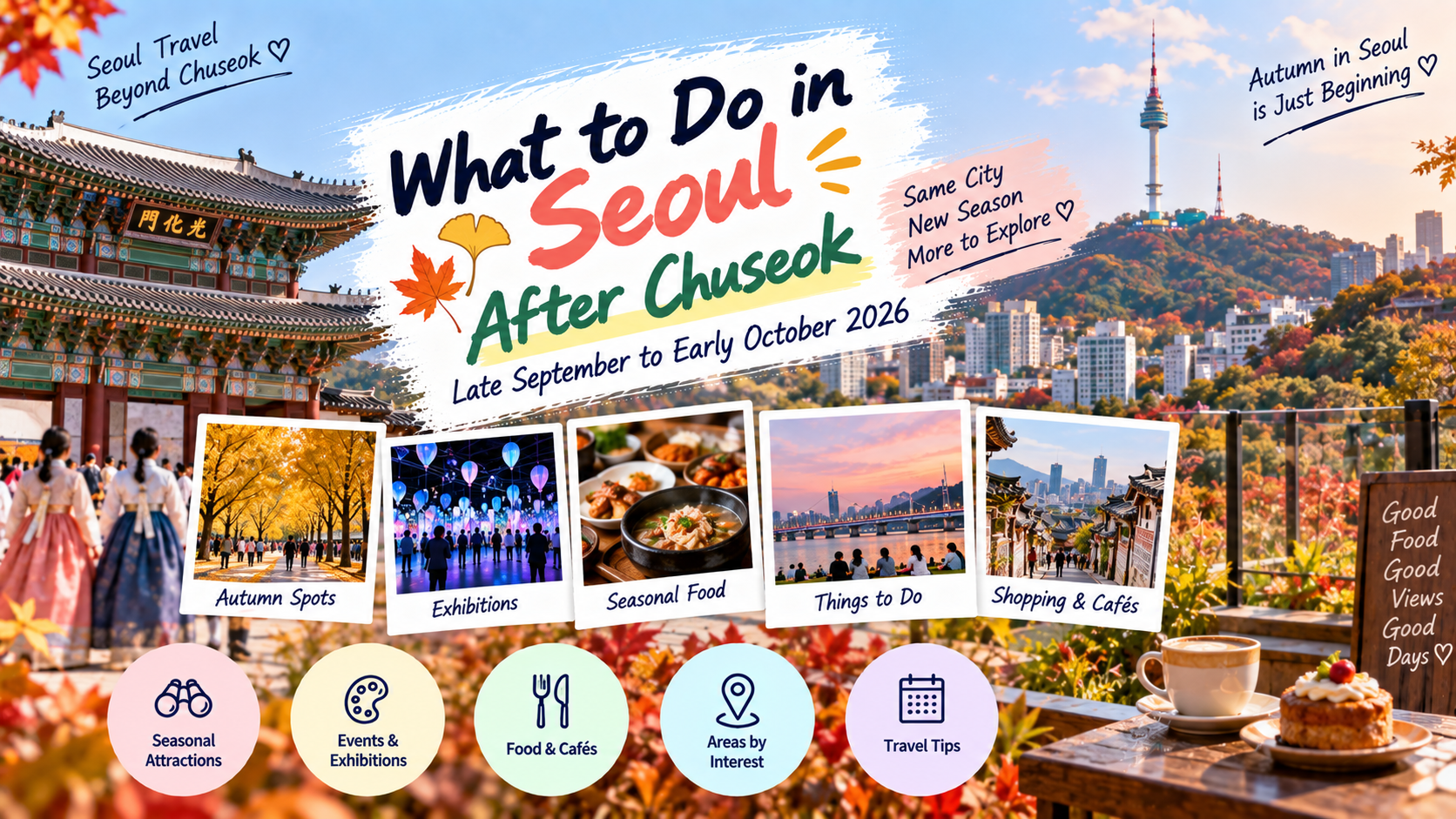
If you’re arriving in Seoul just after Chuseok 2026, you may actually have picked one of the most convenient times to visit the city.
Chuseok falls on September 25, 2026, and the holiday period around it can temporarily affect restaurant hours, domestic transportation and some independent businesses.
But once the main holiday period ends, Seoul does not suddenly become quiet.
Quite the opposite.
Several autumn events continue into October, the Han River becomes much more comfortable in the cooler weather, temporary visitor programs remain active, and many businesses return to their normal schedules.
For travelers arriving around September 28 through early October, the question is no longer:
“What is open during Chuseok?”
It becomes:
“What should I do in Seoul now that Chuseok is over?”
Here is how I would plan that trip.
Is Seoul Back to Normal After Chuseok?
Mostly, yes — but don’t assume every independent business follows exactly the same schedule.
During Chuseok, many Koreans travel to visit family, which can make intercity transportation unusually busy. Some small restaurants, cafés and shops also close or shorten their hours.
After the main holiday period, transportation and commercial activity gradually return to their normal patterns.
That makes the days immediately after Chuseok easier for international travelers who want to combine sightseeing, shopping, cafés and restaurants without organizing the entire itinerary around holiday closures.
Still, if there is one specific restaurant or shop you are traveling across Seoul to visit, check its latest notice first.
Useful Korean search terms are:
추석 휴무 — Chuseok closure
정상 영업 — normal opening hours
영업시간 — opening hours
임시 휴무 — temporary closure
Naver Map is particularly useful for checking recent Korean-language notices.
1. Spend an Afternoon at the Han River
Late September and early October are some of the easiest times of year to actually enjoy the Han River.
In midsummer, a riverside afternoon can be hot and humid.
By early autumn, the river becomes much easier to build into a normal sightseeing day.
You don’t need an elaborate plan.
Pick a Hangang park, arrive in the late afternoon, walk, get something to eat and stay through sunset.
If your dates still fall in September, Korea Inside Out’s What’s On Along the Han River This September is a useful starting point because it brings several temporary river programs together instead of treating each one as an isolated attraction.
The important idea is this:
Don’t think of the Han River as something you have to “see.” Think of it as somewhere to spend time.
That’s when it starts to make sense.
2. Go to Jamsugyo on a Sunday
One of Korea Inside Out’s strongest current Seoul searches is the Car-Free Jamsugyo Bridge Festival, and the useful thing for post-Chuseok travelers is that the autumn season continues into October.
On festival Sundays, Jamsugyo becomes a pedestrian-oriented space beside Banpo Hangang Park, with changing seasonal programs.
That gives visitors a very different experience from simply photographing Banpo Bridge from the riverbank.
You can read the full practical guide in Jamsugyo Bridge Festival: Seoul’s Car-Free Sunday by the Han River.
Because individual Sunday themes and operating details can vary, check the latest city information before making a special trip.
If your Seoul dates include a Sunday, however, I would seriously consider keeping that afternoon or evening open for Banpo.
3. Arrive Before Sunset, Not After Dark
This applies to almost every Han River itinerary.
Many travelers think:
“Banpo is a night-view attraction, so I’ll go after dinner.”
You can.
But you miss half the experience.
Arrive before sunset and you get:
daylight on the river,
the transition into evening,
people picnicking,
the skyline changing,
and finally the bridge and city lights after dark.
That progression is much more memorable than arriving at 9 PM, taking three photographs and leaving.
A simple itinerary could be:
4:30 PM — arrive around Banpo
5:00 PM — walk along the river
6:00 PM — food or picnic
sunset — stay by the river
evening — Jamsugyo/Banpo atmosphere
Then head back to your hotel without adding another major neighborhood.
4. Seoul Welcome Week Continues Beyond Chuseok
Another reason late September and early October work well is Seoul Welcome Week: Autumn Edition.
The 2026 autumn program runs from September 19 through October 11, so it does not end when Chuseok ends.
The program was designed for the autumn peak travel period and international visitors, with visitor services and K-culture experiences connected with major tourism areas.
Check the official Visit Seoul website during your trip for current programs and other events happening on your exact dates.
This is particularly useful because small exhibitions and temporary programs often change faster than general travel guides can keep up.
If you’re staying around Myeongdong, it is especially easy to see what is happening without reorganizing your entire itinerary around one event.
5. Use the Week After Chuseok for a Classic Palace Day
Not every day needs to chase a temporary festival.
If this is your first Seoul trip, the historic center still deserves a full day.
A very practical route is:
Gyeongbokgung → Bukchon → Insadong → Ikseon-dong
These places fit together geographically.
That matters.
One of the most common first-time Seoul mistakes is creating an itinerary from a list of famous attractions without looking at where they actually are.
For example:
Gyeongbokgung
→ Gangnam
→ Hongdae
→ Jamsil
may technically be possible.
It is not a pleasant sightseeing day.
Keep neighborhoods together.
6. Gyeongbokgung Is Easier When the Weather Cools
Gyeongbokgung Palace involves more walking than many visitors expect.
There are large open courtyards and multiple areas to explore.
That can be tiring during Korea’s hottest summer weather.
Late September and early October are generally much more comfortable for this kind of outdoor sightseeing.
If you want to rent hanbok, add extra time.
The process includes:
choosing an outfit,
changing,
hair styling if you want it,
walking to the palace,
taking photographs,
and returning the clothes.
A “quick palace visit” can easily turn into half a day.
That’s perfectly fine.
Just don’t schedule five other neighborhoods afterward.
7. Continue to Bukchon — But Remember People Live There
Bukchon Hanok Village is beautiful, but it is not a theme park.
It is also a residential neighborhood.
Walk quietly, respect signs and restrictions, and avoid blocking entrances for photographs.
This matters especially when visitor numbers are high.
The attraction is not one single “photo spot.”
It is the experience of walking through an older part of Seoul where traditional architecture remains woven into the modern city.
8. Finish the Day Around Insadong or Ikseon-dong
After Gyeongbokgung and Bukchon, don’t automatically jump on the subway for another distant neighborhood.
Stay nearby.
Insadong is useful for traditional crafts, tea and souvenirs.
Ikseon-dong has a very different feel: narrow alleys, cafés, restaurants and renovated hanok spaces.
It can become crowded, especially in the evening, but it works naturally as the final part of a Jongno day.
This is a much more efficient itinerary than crossing Seoul again just because a restaurant went viral on social media.
9. Spend Another Half-Day in Seongsu
If the palace district represents historical Seoul, Seongsu represents a very different side of the city.
The neighborhood has become known for:
cafés,
fashion,
design,
brand pop-ups,
and constantly changing commercial spaces.
The word “constantly” matters.
A pop-up mentioned in an old travel article may already be gone.
For current information, try Korean searches such as:
성수 팝업 — Seongsu pop-up
성수 카페 — Seongsu café
성수 가볼만한 곳 — things to do in Seongsu
Search close to your actual travel date rather than building the entire day around something you saw months earlier.
10. Combine Seongsu With Seoul Forest
Seongsu and Seoul Forest are an easy combination.
You could do:
Morning
Slow breakfast or café.
Late morning
Browse Seongsu shops and pop-ups.
Lunch
Stay in the neighborhood.
Afternoon
Walk through Seoul Forest.
Late afternoon
Continue toward the river or stay in Seongsu.
Evening
Dinner nearby.
This kind of day works particularly well after several days of intensive sightseeing.
You are still exploring Seoul, but you are not racing between landmarks.
11. Is Late September Already Peak Fall Foliage?
Usually, you should not assume so.
This distinction is important for international travelers.
Autumn weather is not the same thing as peak autumn foliage.
Late September and early October can feel much more autumnal than August, but central Seoul may not yet have the dramatic red-and-gold foliage you see in promotional photographs.
Foliage timing changes with weather and location.
If colorful leaves are the main reason for your trip, check current official foliage information closer to your dates.
Don’t choose a hotel or book a flight solely because an old article says “October = peak fall.”
Korea’s autumn colors develop progressively.
12. But Early Autumn Is Still Great for Walking
You don’t need peak foliage to enjoy Seoul in autumn.
This period works because you can spend more time outside.
A walking-oriented day might include:
Cheonggyecheon,
Deoksugung,
Jeongdong-gil,
Gwanghwamun,
Seoul Forest,
or the Han River.
The city starts to feel different when you stop using the subway for every two-stop journey.
13. Shop After the Holiday Rush
If shopping is important to your trip, the post-Chuseok period can be more straightforward than the holiday itself because businesses return toward their regular schedules.
Different neighborhoods serve different purposes.
Myeongdong
Best for an easy first-time mix of cosmetics, tourist-friendly shopping and food.
Hongdae
Fashion, youth culture, restaurants and nightlife.
Seongsu
Pop-ups, design and trend-focused shopping.
Gangnam
Department stores, beauty and modern commercial Seoul.
Jamsil
Large-scale shopping and attractions around Lotte World Mall.
You do not need to visit all five.
Choose one or two based on what you actually want to buy.
14. Myeongdong Is Still Useful for First-Time Visitors
Myeongdong is sometimes dismissed as “too touristy.”
It is touristy.
That’s also why it is convenient.
For a first Korea trip, the concentration of:
cosmetics,
restaurants,
shops,
currency exchange,
hotels,
and visitor services
can be extremely useful.
If you’re staying nearby, use that convenience rather than spending an hour traveling somewhere else for every meal.
15. Hongdae Works Better Later in the Day
Hongdae doesn’t need to be an early-morning destination.
For most travelers, afternoon into evening makes more sense.
You can combine:
shopping,
cafés,
Yeonnam-dong,
dinner,
and nightlife
without rushing.
If you’re staying around Hongdae, it also has the advantage of direct AREX access to Incheon Airport via the all-stop train.
That makes it a particularly practical neighborhood at the beginning or end of a Korea trip.
16. Take a Slow Day After Chuseok
This is especially useful if you’ve already spent several days in Korea.
Not every day needs:
20,000 steps,
three subway transfers,
two palaces,
a market,
a tower,
and a night view.
A slow Seoul day can be:
late breakfast,
one neighborhood,
one café,
a park,
dinner,
and the Han River.
You’ll probably remember more of it.
17. What About Day Trips?
Once the Chuseok transportation rush settles, day trips become easier to consider again.
Options from Seoul include places such as:
Suwon,
Incheon,
and parts of Gyeonggi-do.
But ask yourself whether you actually need one.
If you only have three days in Seoul, you don’t need to leave the city just because a “best Korea itinerary” says you should.
If you have five to seven days, a day trip becomes much more reasonable.
18. Suwon for History Without Going Too Far
Suwon can work well if you want a historical destination outside Seoul without committing to a long-distance trip.
Hwaseong Fortress is the main draw.
The trip is manageable from Seoul and gives you a different urban atmosphere from the capital.
Still, allow most of a day.
A “half-day trip” often becomes a full day once you include hotel-to-station travel, waiting and meals.
19. Incheon for a Different Urban Day
Many travelers only associate Incheon with the airport.
But the city itself can work as a day trip depending on your interests.
The important thing is not to confuse:
Incheon International Airport
with
Incheon sightseeing areas.
They are not the same destination.
Check your exact route before deciding something is “near the airport.”
20. What If It Rains?
Early autumn is not guaranteed sunshine.
Keep at least one flexible indoor day.
Possible choices include:
museums,
shopping malls,
large cafés,
indoor exhibitions,
and attractions around Jamsil or central Seoul.
Don’t force an outdoor Han River evening during heavy rain simply because your itinerary says Tuesday is “Han River Day.”
Move things around.
Flexibility is one of the biggest advantages of staying several nights in one city.
21. What to Wear in Seoul After Chuseok
Layers are useful.
Daytime can still feel mild or warm, while evenings may feel cooler — particularly beside the river.
Comfortable shoes matter much more than travelers sometimes expect.
Seoul trips involve a lot of walking even when you use the subway.
Also remember that subway stations themselves can involve long underground transfers.
“Ten minutes by subway” does not necessarily mean “ten minutes door to door.”
22. Use Naver Map for Actual Navigation
Google Maps is useful for saving places before your trip.
For day-to-day transportation in Korea, I recommend also having Naver Map available.
It is particularly useful for:
subway routes,
bus routes,
walking directions,
station exits,
and Korean place names.
If you’re new to Korean travel apps, Korea Inside Out’s guide to the best apps for traveling in Seoul explains the practical differences.
23. Useful Korean Search Terms
Save these:
서울 가볼만한 곳 — things to do in Seoul
서울 이번 주말 행사 — Seoul events this weekend
한강공원 — Hangang Park
잠수교 — Jamsugyo
성수 팝업 — Seongsu pop-ups
서울숲 — Seoul Forest
추석 휴무 — Chuseok closure
정상 영업 — normal opening
서울 10월 축제 — Seoul October festivals
These are particularly useful when you want information that has appeared too recently to be well covered in English.
A 4-Day Post-Chuseok Seoul Itinerary
If you have four full days, this is how I would structure them.
Day 1 — Historic Seoul
Gyeongbokgung
Bukchon
Insadong
Ikseon-dong
Keep the whole day around Jongno.
Day 2 — Contemporary Seoul
Seongsu
Seoul Forest
café or shopping
relaxed dinner
Day 3 — Shopping + Han River
Myeongdong or Hongdae
rest at hotel
Banpo Hangang Park before sunset
Jamsugyo if your date matches a festival Sunday
Day 4 — Choose Your Interest
Either:
Gangnam/Jamsil,
a museum day,
a day trip,
or simply return to the neighborhood you liked most.
This final flexible day is important.
Trips are often better when you have time to revisit somewhere rather than constantly seeing new places.
If You Only Have 2 Days
Don’t try to copy the four-day itinerary.
Do this instead.
Day 1
Gyeongbokgung
Bukchon
Insadong
Myeongdong
Day 2
Seongsu
Seoul Forest
Han River
That’s enough.
You will not “finish” Seoul in two days.
You don’t need to.
If You Have 5–7 Days
Then start adding:
Hongdae,
Gangnam,
Jamsil,
a day trip,
museums,
markets,
and slower neighborhood exploration.
This is where Korea Inside Out’s broader planning guides become useful.
If you’re still deciding the length of your stay, see How Many Days Do You Need in Seoul?.
Should You Visit Seoul Immediately After Chuseok?
Yes.
There is no reason to avoid Seoul simply because your trip begins just after Korea’s major autumn holiday.
In some ways, the timing is easier.
You can still catch the autumn atmosphere and ongoing seasonal programming while many businesses return to normal operations.
The biggest mistake would be treating “after Chuseok” as a dead period between the holiday and peak fall foliage.
It isn’t.
Final Thoughts
Late September and early October are a transition period in Seoul.
Chuseok is ending.
The weather is changing.
Autumn events are continuing.
The Han River becomes easier to enjoy.
Neighborhood walking becomes more pleasant.
And the city gradually moves toward the foliage season that will come later.
That transition is exactly what makes the period interesting.
Don’t spend the entire trip chasing whichever temporary event appears first in Google.
Leave a Reply