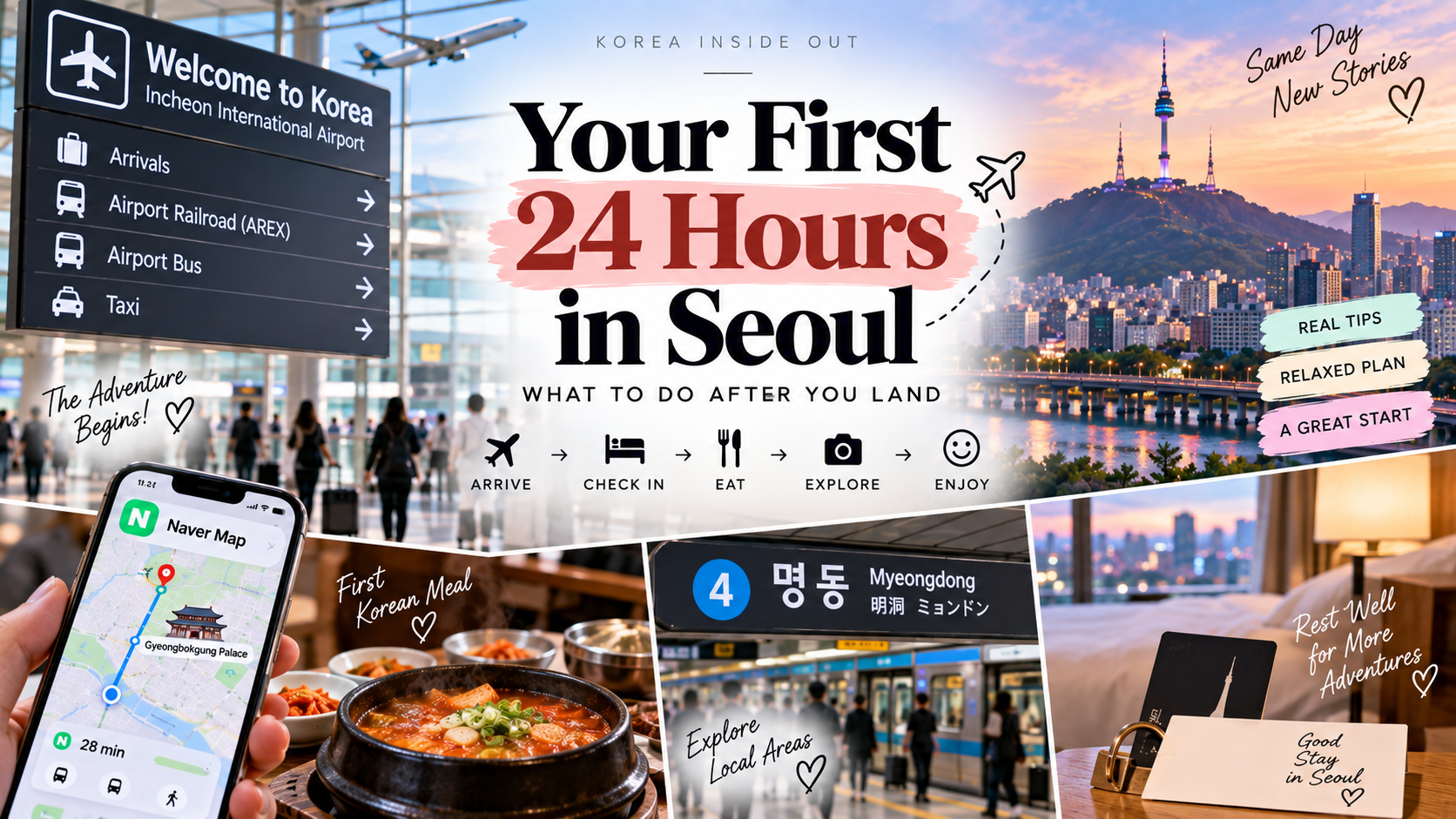
Arriving in Seoul for the first time can feel exciting — and slightly overwhelming.
You’ve just spent hours on a plane.
You have luggage.
You’re probably tired.
And suddenly you’re standing in a huge airport wondering:
Where should I go first?
Should you go straight to your hotel?
Should you start sightseeing immediately?
Should you exchange money?
Should you get a transportation card?
And how much can you realistically see on your first day?
The good news is that you don’t need to rush.
Your first 24 hours in Seoul should be about getting comfortable with the city, not trying to complete a sightseeing checklist.
Here’s how I would approach your first day.
Your First 24 Hours in Seoul at a Glance
If you arrive in Seoul in the morning or early afternoon, a comfortable first day could look like this:
| Time | What to do |
|---|---|
| Arrival | Immigration, luggage, mobile data |
| Next | Get to your hotel |
| Afternoon | Check in or leave luggage |
| Late afternoon | Explore your neighborhood |
| Early evening | First Korean meal |
| Evening | One major attraction or neighborhood |
| Night | Café, convenience store or relaxed walk |
| Before bed | Prepare for tomorrow |
The key is to keep your first day flexible.
Flight delays, immigration, luggage, transportation and hotel check-in can all take longer than expected.
1. Don’t Plan a Major Attraction Immediately After Landing
This is probably my biggest recommendation.
If your flight lands at 8 a.m., don’t automatically book a 10 a.m. attraction across Seoul.
It looks possible on a map.
But international travel doesn’t always go according to schedule.
You need time for:
- Immigration
- Baggage claim
- Getting connected to mobile data
- Finding transportation
- Traveling into Seoul
- Finding your hotel
- Leaving your luggage
- Eating
- Recovering from the flight
Even if everything goes smoothly, you’ll probably feel more tired than you expect.
Give yourself some breathing room.
Your first day is not the day to prove how much of Seoul you can see.
It’s the day to get comfortable.
2. Get Connected Before You Leave the Airport
Before heading into Seoul, make sure your phone works.
Depending on your travel setup, this could mean:
- Activating an eSIM
- Using a Korean SIM
- Connecting to airport Wi-Fi
- Turning on your international roaming
You want to be able to access:
- Your hotel information
- Maps
- Transportation information
- Translation
- Taxi services
- Your reservations
A working phone makes your first day dramatically easier.
One simple backup
Take a screenshot of your hotel information before leaving the airport.
Save:
Hotel name + address + phone number
Ideally, have the address in both English and Korean.
If your internet connection suddenly stops working, you still have the information you need.
3. Get to Your Hotel First
Unless you have a very late arrival, I would generally make the hotel your first destination.
You don’t necessarily need to check in immediately.
Many hotels will allow you to leave your luggage before your room is ready.
That means you can arrive, drop your bags, freshen up if possible, and start exploring without dragging a suitcase around Seoul.
This makes a huge difference.
Where Should You Stay?
If you’re still deciding where to stay, your neighborhood can change how your first day feels.
For a first trip:
Myeongdong
Best for convenience, shopping and easy access to many major tourist areas.
Hongdae
Best for cafés, restaurants, nightlife and a younger atmosphere.
Jongno / Insadong
Best if you’re interested in palaces, traditional neighborhoods and historic Seoul.
Gangnam
Best for modern Seoul, shopping, beauty and a very different side of the city.
If you’re still choosing accommodation, see our guide:
Where to Stay in Seoul: 7 Best Areas for First-Time Visitors
The most important thing isn’t choosing the “best” neighborhood.
It’s choosing a neighborhood that makes your trip easier.
4. Don’t Exchange All Your Money at the Airport
You may want Korean won immediately after landing.
That’s fine.
But you don’t need to exchange your entire travel budget at the airport.
Airport exchange counters are convenient, but convenience doesn’t necessarily mean the best exchange rate.
A small amount of Korean cash can be enough to get started.
For example, you may want some cash for:
- Small purchases
- Markets
- Street food
- Transportation-related expenses
- Backup spending
For everyday purchases, cards are widely useful.
If you’re unsure about how much cash to carry, read:
Do You Need Cash in Korea? Cards, ATMs & T-money Explained
5. Have Your First Korean Meal Nearby
Once your luggage is safely at the hotel, eat.
Seriously.
Don’t underestimate how much better Seoul feels when you’re no longer hungry and exhausted.
And your first meal doesn’t need to be at a famous restaurant.
In fact, I would argue that your first meal is a good time to keep things simple.
Look for a restaurant close to your hotel.
You could try:
- Gimbap
- Bibimbap
- Kalguksu
- Kimchi jjigae
- Mandu
- Naengmyeon
- Korean barbecue
If you want something quick and inexpensive, a neighborhood restaurant can be a better choice than spending an hour traveling across the city for a famous restaurant.
You can always do that tomorrow.
6. Your First Afternoon: Explore Where You Are
This is where I would resist the temptation to cross Seoul.
Instead of immediately going from Myeongdong to Gangnam to Hongdae, spend a couple of hours getting to know your own neighborhood.
Walk around.
Find:
- Your nearest subway station
- A convenience store
- A café
- A pharmacy
- A restaurant
- An ATM
- A bus stop
This sounds boring.
It isn’t.
Knowing where everything is around your hotel makes the rest of your trip much easier.
7. Visit One Major Attraction — Not Five
If you still have energy, choose one major attraction.
That’s enough for your first day.
Depending on where you’re staying, you could choose:
Gyeongbokgung Palace
A good choice if you want your first impression of Seoul to include traditional Korean architecture and history.
N Seoul Tower
Good if you’d rather see the city from above.
Han River
Great if the weather is pleasant and you want a relaxed introduction to everyday Seoul.
Insadong / Ikseon-dong
Good for traditional streets, cafés and an easy evening walk.
Hongdae
A good choice if you want restaurants, shops, street performances and nightlife.
The important word here is:
One.
You don’t need to see everything.
8. Use the Subway — But Don’t Make Your First Ride Complicated
If you’re feeling reasonably energetic, your first subway trip is a good opportunity to learn how Seoul transportation works.
Don’t choose a route with three transfers.
Choose something simple.
For example:
Hotel → one destination → hotel
That gives you a chance to understand:
- Your transportation card
- Subway signs
- Line numbers
- Directions
- Station exits
Seoul’s subway system can look intimidating on a map, but once you’ve taken a few trips, it becomes much easier.
If you haven’t used it before, our guide walks through the process:
How to Use the Seoul Subway: A First-Time Visitor’s Guide
9. Your First Korean Convenience Store Visit Is Part of the Experience
Here’s one of my favorite easy first-day activities.
Go into a Korean convenience store.
You don’t need a shopping list.
Just look around.
You’ll find things such as:
- Drinks
- Snacks
- Instant noodles
- Gimbap
- Desserts
- Coffee
- Breakfast items
- Travel necessities
Convenience stores are extremely useful during a trip.
You might even find yourself buying breakfast there the next morning.
And don’t worry if you can’t understand every label.
That’s part of the experience.
Use a translation app when you need it.
10. Have a Slow Evening
If you’ve traveled a long way to Korea, your body may not know what time it is.
That’s why I wouldn’t recommend planning an enormous night out on your first evening.
Instead, try something simple.
Option 1: Café
Find a café near your hotel.
Have coffee or tea.
Sit down.
Watch people.
Option 2: Neighborhood walk
Walk around your area after dinner.
Seoul feels very different after dark.
Option 3: Convenience-store snack
Buy a few Korean snacks and take them back to your hotel.
Option 4: Han River
If you’re staying near the river and the weather is good, spend some time outside.
You don’t need an elaborate plan.
Sometimes simply sitting beside the Han River while the city lights come on is a better first-night experience than checking another attraction off a list.
11. Don’t Stay Out Too Late on Your First Night
There is a temptation to think:
“I’m only in Seoul for five days, so I have to use every hour.”
I understand the feeling.
But here’s what usually happens.
You stay out until midnight.
You wake up exhausted.
The next morning you have no energy.
Your carefully planned itinerary starts slipping.
And suddenly you’re spending your second day looking for coffee instead of sightseeing.
Your first day should set you up for the rest of your trip.
Go to bed.
Tomorrow will be better.
A Realistic First 24-Hour Seoul Itinerary
Here’s what I would actually recommend.
Morning Arrival
8:00–10:00 AM
Arrive at Incheon Airport.
- Immigration
- Collect luggage
- Get mobile data
- Use the restroom
- Get some Korean won if necessary
- Get your transportation sorted
Don’t rush.
Late Morning / Early Afternoon
10:00 AM–1:00 PM
Travel to Seoul.
Go to your hotel.
Leave your luggage if your room isn’t ready.
Have lunch nearby.
Afternoon
1:00–4:00 PM
Explore your neighborhood.
Walk around.
Find a café.
Visit a convenience store.
Get familiar with your nearest subway station.
Late Afternoon
4:00–6:00 PM
Visit one major attraction.
Choose something relatively close to where you’re staying.
Don’t try to cross the entire city.
Evening
6:00–8:00 PM
Have your first proper Korean dinner.
This is a good time to try something you’ve been looking forward to.
Korean barbecue, noodles, fried chicken, bibimbap or another local specialty are all good choices.
If you’re wondering what food prices look like, our Seoul food guide covers everything from inexpensive local meals to Korean barbecue:
How Much Does Food Cost in Seoul? A Realistic 2026 Guide
Night
8:00–10:00 PM
Take a relaxed walk.
Visit a café.
Or simply return to your hotel.
Then prepare for tomorrow.
What If Your Flight Arrives at Night?
This changes everything.
If you arrive in Seoul at 9 or 10 p.m., don’t try to force the daytime itinerary.
Your first 24 hours might simply be:
Airport → hotel → check-in → food → sleep
That’s perfectly fine.
In fact, it’s probably the better choice.
Your Seoul trip doesn’t start the moment you leave the airplane.
It starts when you’re rested enough to enjoy it.
What If You Arrive Very Early in the Morning?
This is another common situation.
Your hotel room may not be ready yet.
In that case:
Step 1
Leave your luggage at the hotel if possible.
Step 2
Find breakfast.
Step 3
Have coffee.
Step 4
Take a gentle walk.
Step 5
Visit one easy attraction.
Step 6
Return for check-in when your room is ready.
Don’t schedule a full sightseeing day immediately after an overnight flight.
Your energy level matters more than your itinerary.
What Not to Do on Your First Day in Seoul
❌ Don’t schedule six attractions
Seoul is much bigger than it looks.
Moving between neighborhoods takes time.
❌ Don’t change hotels
If you’re staying three to five nights, there’s usually little reason to move hotels during your trip.
Pack once.
Stay put.
Explore from your base.
❌ Don’t take a taxi everywhere
Taxis are useful.
But Seoul’s subway can get you around much more efficiently for many sightseeing trips.
Once you understand the system, you’ll probably use it much more than you expected.
❌ Don’t spend your first evening shopping for hours
You may be tempted.
Especially in Myeongdong.
But remember that the stores aren’t going anywhere tomorrow.
❌ Don’t worry about doing everything perfectly
You will probably:
- Take the wrong subway exit
- Walk the wrong direction
- Order something you didn’t expect
- Mispronounce a Korean word
- Get confused by a sign
That’s normal.
You’re traveling.
Your First 24 Hours Should Answer Five Questions
By the end of your first day, you should ideally know:
1. Where is my hotel?
Obvious, but important.
2. Where is the nearest subway station?
This becomes your transportation anchor.
3. Where can I get food?
Find at least two nearby options.
4. Where is the nearest convenience store?
You’ll probably use it more than once.
5. How do I get back to my hotel?
Especially important after a late night.
Once you know these five things, Seoul will already feel much less foreign.
The Best First-Day Mindset
There is a difference between seeing Seoul and experiencing Seoul.
If you spend your first day running from one famous attraction to another, you’ll see a lot.
But you may not remember much.
Instead, try this:
Have breakfast.
Walk.
Take the subway.
Eat something Korean.
Sit in a café.
Watch people.
Explore a side street.
Look at the buildings.
Notice how people move through the city.
Go to a convenience store.
Watch Seoul become busy.
Then watch it become quiet again.
Those little moments are often what make a trip memorable.
What I Would Actually Do
If a friend were visiting Seoul for the first time and asked me what to do during their first 24 hours, I wouldn’t give them a list of 15 attractions.
I’d say:
Get to your hotel.
Eat something.
Walk around your neighborhood.
Take one subway ride.
Visit one major attraction.
Have a good Korean dinner.
Go somewhere for coffee or a night walk.
Sleep.
Then start the real sightseeing tomorrow.
That gives you enough structure to avoid wasting your first day without turning your arrival into a race.
Your First 24 Hours in Seoul: Quick Checklist
Before leaving the airport:
☐ Phone connected
☐ Hotel address saved
☐ Transportation sorted
☐ Some Korean won available if needed
☐ Hotel directions ready
After reaching Seoul:
☐ Leave luggage at hotel
☐ Eat lunch
☐ Find nearest subway station
☐ Find convenience store
☐ Explore your neighborhood
☐ Visit one major attraction
☐ Have Korean dinner
☐ Take a relaxed evening walk
☐ Get enough sleep
That’s enough.
Really.
Final Thoughts
Your first day in Seoul doesn’t need to be spectacular.
It needs to be comfortable.
Once you know how to get around, where to eat, where your hotel is and how the city works, the rest of your trip becomes much easier.
And that’s why I think the best first 24 hours in Seoul are not about checking off the most famous attractions.
They’re about getting your bearings.
By tomorrow morning, you’ll already know a little more about Seoul.
You’ll understand the subway.
You’ll recognize a few Korean words.
You’ll know where the convenience store is.
You’ll have tried your first Korean meal.
And you’ll probably feel much more confident stepping out to explore.
That’s when the real Seoul trip begins.
What Was Your First Day in Seoul Like?
If you’ve already visited Seoul, what did you do on your first day?
Did you go sightseeing immediately, or did you take it slow after arriving?
And if you’re planning your first trip, what are you most worried about on your first day in Korea?
Share your experience or question in the comments — it might help another first-time visitor.
Planning Your First Trip to Seoul?
You may also find these guides useful:
Is Seoul Expensive? A Realistic Seoul Travel Budget for 2026
Where to Stay in Seoul: 7 Best Areas for First-Time Visitors
How to Use the Seoul Subway: A First-Time Visitor’s Guide
How Much Does Food Cost in Seoul? A Realistic 2026 Guide
Leave a Reply