Looking for something more than palaces and shopping in Seoul this fall?
From September through November, Seoul itself becomes a stage.
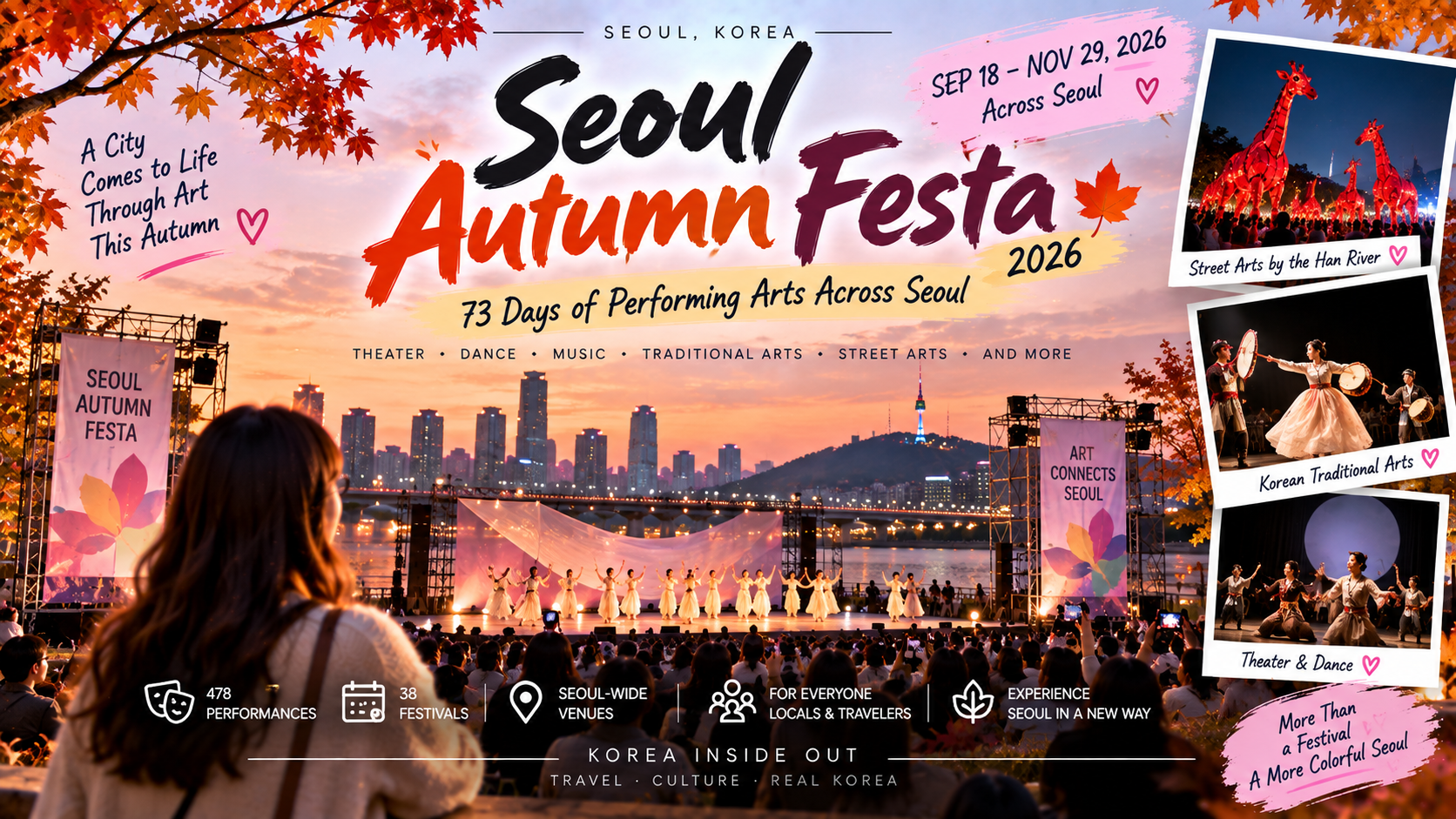
The 2026 Seoul Autumn Festa runs from September 18 to November 29, 2026, bringing theater, dance, music, traditional Korean performance, street arts, festivals, and experimental performances to venues across the city.
Rather than being one festival at one location, Seoul Autumn Festa connects performances and festivals happening throughout Seoul under one autumn program.
That means you can see a performance beside the Han River, explore the theater district around Daehak-ro, discover Korean traditional music, or simply add a performance to a sightseeing day.
And for international visitors, there is a particularly interesting selection of performances introducing Korean traditional and contemporary arts.
Seoul Autumn Festa 2026 at a Glance
| Details | |
|---|---|
| Dates | September 18 – November 29, 2026 |
| Duration | 73 days |
| Location | Seoul-wide |
| Main areas | Daehak-ro, Han River parks, Seoul Forest, cultural venues and theaters across Seoul |
| Genres | Theater, dance, music, traditional arts, street arts and more |
| Admission | Varies by program |
| Best for | Culture lovers, couples, families, solo travelers and repeat visitors to Seoul |
| Opening event | September 18, 7:30 PM |
| Opening venue | Ttukseom Hangang Park Waterfront Stage |
The festival includes 38 festivals, 478 performances, 245 participating works and 558 individual programs, covering theater, dance, music, traditional arts and street performance.
So rather than trying to see everything, the better strategy is to choose a performance based on your interests and travel schedule.
What Is Seoul Autumn Festa?
Seoul Autumn Festa is Seoul’s major autumn performing-arts festival.
The idea is simple: instead of keeping performances inside a small number of theaters, the festival connects performances and festivals taking place throughout the city.
The result is less like a traditional festival and more like a citywide cultural season.
During the 73-day period, Seoul’s theaters, parks, public spaces and cultural venues become places to experience performances.
The Seoul Foundation for Arts and Culture describes the festival as a way of connecting private and public performing arts programs throughout Seoul and making them easier for audiences to discover.
For travelers, this is useful because you don’t have to dedicate an entire day to the festival.
You can simply add one performance to an existing Seoul itinerary.
The Festival Begins by the Han River
The best place to start is the opening night on September 18.
Seoul, Dancing on the Han River
September 18, 2026 — 7:30 PM
Ttukseom Hangang Park Waterfront Stage
The opening performance, titled “Seoul, Dancing on the Han River,” brings together dancers and performers to tell the story of Seoul through movement.
The performance is directed by choreographer Lee Ruda and features artists including the Seoul Metropolitan Dance Theatre, Melancholy Dance Company, K-Arts dance performers, Black Toe Dance Company and other leading Korean artists.
The setting is part of the attraction.
Instead of opening inside a conventional theater, the festival begins beside the Han River.
The city skyline, river and evening atmosphere become part of the experience.
According to the festival’s organizers, around 10,000 spectators are expected to gather for the opening event.
Our tip: If you are visiting Seoul that weekend, combine this with an evening at Ttukseom Hangang Park rather than treating it as a standalone performance.
September 19–20: A Weekend of Street Performances
The opening weekend continues with the Seoul Street Arts Festival 2026 on September 19–20.
The festival takes over Ttukseom Hangang Park and Seoul Forest, with circus, parades, mobile performances and audience-participation programs.
One of the highlights is the giant giraffe performance, featuring enormous red giraffes moving through the riverside landscape.
This is also where the festival introduces the idea of Artrekking — following performances on foot rather than sitting in a fixed theater seat.
In other words, you can walk through Seoul while following the art.
We have a separate guide to the event here:
Seoul Street Arts Festival 2026: Giant Giraffes, Circus & Free Performances by the Han River
Note: Once the Seoul Street Arts Festival article is published, this should be replaced with its exact URL.
The combination makes the opening weekend particularly attractive to travelers.
Friday: Han River opening performance
Saturday–Sunday: Street performances, circus and giant giraffes
Evening: Seoul Forest and Seongsu
Discover Korean Culture Through the K-Arts Selection
If this is your first trip to Korea and you want to experience something that feels distinctly Korean, look for the festival’s K-Arts Curated Selection.
This collection brings together traditional Korean music and contemporary Korean performing arts.
One example is Mugang II, performed at Donhwamun Traditional Theater on September 20.
The performance brings together the Korean gayageum and the Taiwanese pipa, creating a meeting point between traditional musical cultures.
Another highlight comes later in the festival.
Resonance
October 8 — LG Arts Center Seoul
The Korean world-music group Gong Myoung combines traditional instruments with contemporary musical ideas.
It is a good option if you want to experience Korean traditional sounds without attending a strictly traditional concert.
Neo-Tradition
October 23–24 — Namsangol Hanok Village
Liquid Sound brings together young traditional artists from Korea, China and Japan.
The performances reinterpret traditional Asian arts through a contemporary perspective.
For travelers, this is one of the most interesting parts of Seoul Autumn Festa because it goes beyond the usual tourist experience of watching a traditional performance in a palace.
You get to see how traditional culture is being reinvented by younger artists.
Spend an Evening in Daehak-ro
If you enjoy theater, make Daehak-ro one of your main destinations during the festival.
Daehak-ro is Seoul’s best-known theater district, and Seoul Autumn Festa brings dozens of programs to the area.
During the festival, more than 70 programs are connected with Daehak-ro and surrounding cultural venues.
You can turn a theater visit into a full evening:
Late afternoon: Explore Daehak-ro
↓
Dinner: Eat around Hyehwa
↓
Evening: Watch a play or musical
↓
After the show: Explore the neighborhood
The festival also connects theater with programs such as After Theater, where audiences can continue conversations and discussions after performances.
There is even a local market program, Daengno Market, allowing visitors to experience the neighborhood beyond the theater itself.
What If You Don’t Speak Korean?
This is an important question for international visitors.
Not every performance at Seoul Autumn Festa is designed specifically for non-Korean speakers.
However, the festival includes several options that are more accessible to international audiences.
Physical theater, dance, circus and music can often be enjoyed without understanding every line of dialogue.
There is also a particularly useful program at Daehak-ro Theater Q, where the performance series “Questions of Theater: Evolving Texts” provides real-time translated subtitles through smart glasses for international audiences.
That makes it one of the more interesting options if you want to experience Korean theater but are concerned about the language barrier.
Our tip: When choosing a performance, check whether English subtitles, translated materials or non-verbal performance formats are available before booking.
Find a Performance That Matches Your Taste
The biggest challenge with Seoul Autumn Festa is not finding something to do.
It is deciding what to choose.
There are hundreds of programs.
The festival itself recommends approaching the program according to your interests rather than trying to see as much as possible.
Here is a simple way to choose.
If you love Korean culture
Look for:
- Traditional music
- Gayageum performances
- Pansori
- Korean traditional performance
- Neo-traditional productions
If you prefer contemporary art
Try:
- Contemporary dance
- Experimental theater
- New Korean creators
- International collaborations
- Multimedia performances
If you are traveling with children
Look for family-oriented performances and programs connected with Performance Spring, including productions such as The Long Long Night and A Carmen Journey with Percussion.
If you don’t speak Korean
Prioritize:
- Dance
- Circus
- Street arts
- Music
- Non-verbal performances
- Shows with English subtitles
If you want something easy
Choose an outdoor performance.
You can enjoy the atmosphere without committing to a long theater evening.
A Great Choice for Repeat Visitors to Seoul
If this is your first trip to Seoul, you will probably spend plenty of time visiting palaces, markets, shopping districts and famous neighborhoods.
But if you have already seen the major sights, Seoul Autumn Festa offers another way to experience the city.
Instead of asking:
“What tourist attraction should I visit today?”
you can ask:
“What is happening in Seoul tonight?”
You might find a dance performance near the Han River.
Or a play in Daehak-ro.
Or traditional music at a historic venue.
Or contemporary art in a cultural center.
The festival is essentially an invitation to explore Seoul through its performing arts.
How to Plan Seoul Autumn Festa Into Your Trip
You don’t need to plan your entire vacation around the festival.
Instead, choose one or two events.
One-day culture itinerary
Morning — Gyeongbokgung Palace
Start with Seoul’s traditional side.
Lunch — Jongno
Try Korean food around Jongno or Insadong.
Afternoon — Insadong or Bukchon
Explore traditional streets and shops.
Evening — Performance
Head to Daehak-ro, a theater, or one of the festival’s evening venues.
Night — Cheonggyecheon
Finish the evening with a walk through central Seoul.
If you are still deciding how much time to spend in Seoul, our guide to 3, 5 or 7 days in Seoul can help you fit cultural experiences into your itinerary.
A Weekend at the Han River
For September 18–20, you can create an especially interesting Seoul weekend.
Friday, September 18
Seoul Autumn Festa opening
Ttukseom Hangang Park
7:30 PM
Watch the opening performance beside the Han River.
Saturday, September 19
Seoul Street Arts Festival
Explore Ttukseom Hangang Park and Seoul Forest.
Watch street performances and circus acts, then head to Seongsu for dinner and cafés.
Sunday, September 20
Choose another performance from Seoul Autumn Festa or explore one of the traditional Korean programs.
This weekend is a particularly good option if you want to experience a side of Seoul beyond the standard tourist attractions.
Where to Find the Festival
Because Seoul Autumn Festa is spread across the city, there is no single festival entrance.
The best starting point for information is the festival’s integrated information platform.
A dedicated information center operates at the Seoul Foundation for Arts and Culture Daehak-ro Center, where visitors can search performances by interest and connect to booking information using kiosks and QR codes.
The center is particularly useful if you are overwhelmed by the number of choices.
Instead of searching through hundreds of individual performances, you can use the festival’s recommendations to find something suitable for your interests and schedule.
How Much Does Seoul Autumn Festa Cost?
There is no single festival admission fee.
Because Seoul Autumn Festa connects many different performances and festivals, prices depend on the individual event.
Some performances are free, while others require tickets.
Outdoor city programs can be especially attractive to travelers because you can experience the atmosphere of the festival without necessarily buying an expensive theater ticket.
Always check the individual performance information before visiting.
Seoul Autumn Festa 2026: Practical Tips
1. Don’t try to see everything
There are hundreds of programs.
Choose two or three experiences that actually interest you.
2. Check the language information
If you are not comfortable watching a Korean-language performance, look for English subtitles, translated materials, dance, music or non-verbal performances.
3. Book popular performances early
Some theater performances have limited seating and require advance reservations.
4. Use the Han River programs as your easy entry point
Outdoor performances are often the easiest way for visitors to experience the festival without worrying about language or formal theater etiquette.
5. Explore Daehak-ro
Even if you don’t attend a performance, the theater district is worth visiting during the festival.
6. Check the weather
Some of the most interesting autumn programs take place outdoors.
September and October can be beautiful in Seoul, but evening temperatures can change quickly.
7. Combine performances with sightseeing
The festival is spread throughout Seoul, so choose performances that fit naturally into your daily itinerary rather than crossing the city several times.
Is Seoul Autumn Festa Worth Adding to Your Trip?
Absolutely — especially if you want to experience modern Seoul rather than only its historic attractions.
The biggest strength of Seoul Autumn Festa is its scale.
For 73 days, Seoul doesn’t have one single festival location.
The city becomes the festival.
A riverside park can become a stage.
A theater district can become an evening destination.
A traditional music venue can introduce you to Korean culture.
A contemporary dance performance can show you a completely different side of the country.
And because the festival continues from September 18 through November 29, you have plenty of opportunities to find something that fits your trip.
For visitors coming to Seoul in September, the opening weekend is particularly attractive because it combines the Han River opening performance with the Seoul Street Arts Festival.
For travelers visiting in October or November, there are still weeks of performances to discover.
Seoul Autumn Festa 2026: Quick Summary
Dates: September 18 – November 29, 2026
Where: Across Seoul
What: Theater, dance, music, traditional Korean arts, street performance and festivals
Opening: Seoul, Dancing on the Han River — September 18, 7:30 PM
Best area for theater: Daehak-ro
Best for outdoor performances: Han River parks and Seoul Forest
Best for Korean traditional arts: K-Arts curated programs
Best for international visitors: Dance, music, street arts, non-verbal performances and selected shows with English translation
Admission: Varies by program
Final Thoughts
Autumn is one of the best times to experience Seoul.
The weather becomes more comfortable, the parks turn colorful, and the city begins to move outdoors again.
The 2026 Seoul Autumn Festa adds another reason to stay out a little longer.
Instead of simply visiting Seoul’s attractions, you can watch the city perform.
And perhaps that is the best way to experience Seoul in autumn:
walk through the city, find a performance, and let Seoul become your stage.
Official Information
- Seoul Autumn Festa – Official Seoul Foundation for Arts and Culture
- 2026 Seoul Autumn Festa – Seoul Culture Portal
- 2026 Seoul Autumn Festa – Visit Seoul
September 18 – November 29, 2026 | Seoul, South Korea
Leave a Reply