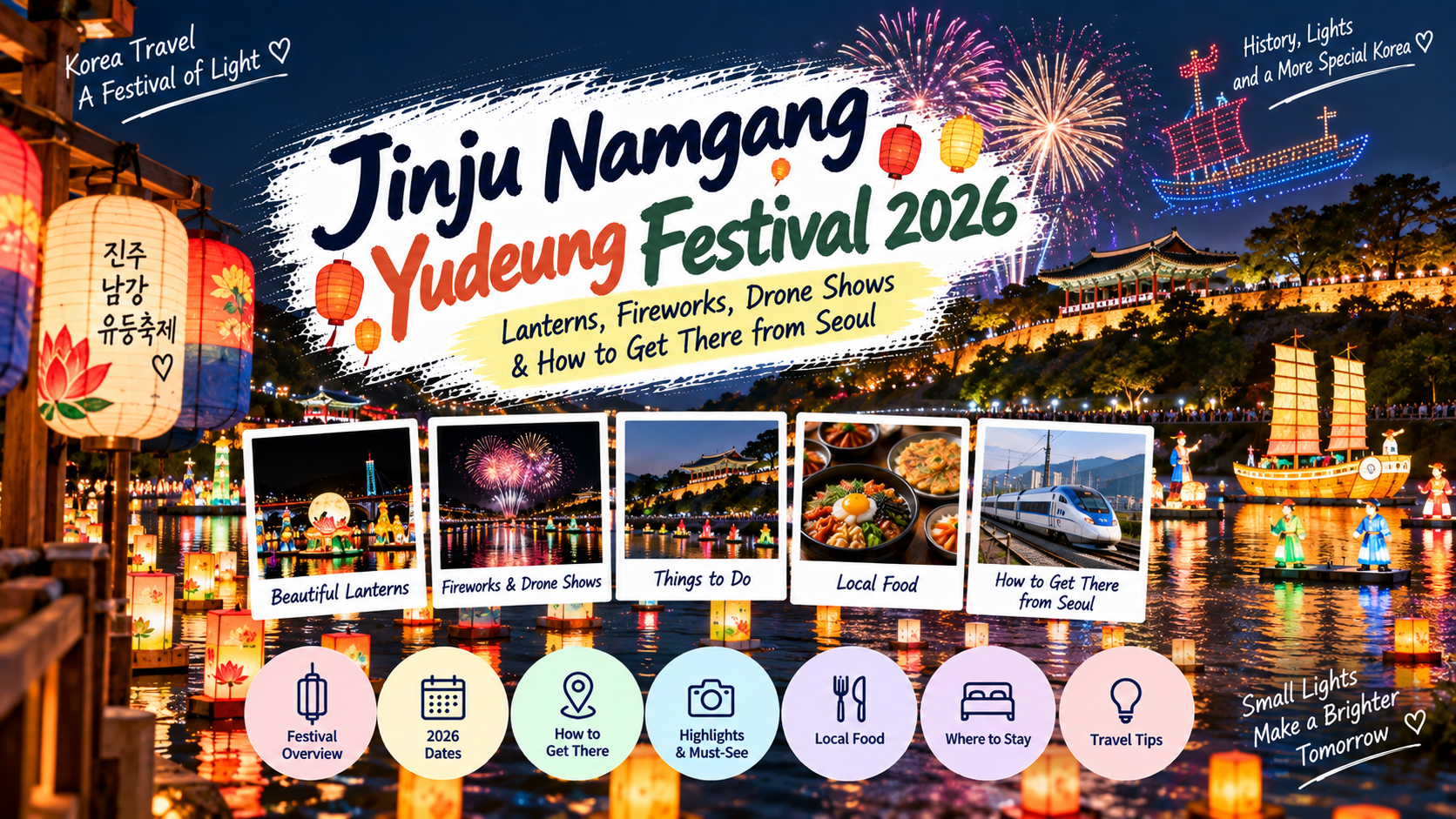
If you are visiting Korea in October 2026 and want to experience one autumn festival outside Seoul, Jinju Namgang Yudeung Festival deserves serious consideration.
From October 3 to October 18, 2026, the riverside city of Jinju in South Gyeongsang Province turns the Namgang River, Jinjuseong Fortress and surrounding streets into a huge nighttime landscape of illuminated lanterns.
This is not a small display that you can finish in twenty minutes.
The official 2026 program includes 22 lantern exhibition zones, nighttime performances, food areas, hands-on activities, drone light shows and fireworks over the river. Lanterns are illuminated every night from 6 PM to midnight, while festival booths and pontoon-bridge areas operate from 1 PM to 11 PM.
If you have already seen Seoul’s palaces, Busan’s beaches and Korea’s major city attractions, Jinju gives you something very different: a regional Korean festival where history, river scenery and large-scale light installations all come together.
You can check the changing schedule through the official Jinju Namgang Yudeung Festival program before traveling.
Jinju Namgang Yudeung Festival 2026 at a Glance
Dates: October 3–18, 2026
Main area: Namgang River, Jinjuseong Fortress and nearby riverfront districts
Lantern lighting: 6 PM–12 AM
Booths and pontoon-bridge operating hours: 1 PM–11 PM
Korean name: 진주남강유등축제
Best for: night photography, Korean history, couples, families and autumn regional travel
The most important thing to understand is that this is primarily an evening festival.
You can arrive during the afternoon and explore Jinju, but the main visual experience begins after 6 PM.
Why Does Jinju Have a Lantern Festival?
The lanterns are not simply decorative.
According to the festival’s official history, their origin is connected to the Battles of Jinjuseong during the Imjin War in the 1590s.
During the 1592 battle, defenders used lanterns on the Namgang River both as a military tactic to watch for enemy forces attempting to cross the river and as a way to communicate with family members outside the fortress.
After the devastating second battle in 1593, local residents continued floating lanterns on the river to honor those who died.
That tradition eventually developed into today’s festival.
Knowing that history changes the experience.
Jinjuseong Fortress is not just a convenient backdrop for an Instagram event. The river, fortress and lanterns are historically connected.
What Is New and Special in 2026?
The 2026 festival spreads its lantern displays across 22 themed zones around the Namgang, Jinjuseong and surrounding districts.
Several themes are particularly interesting for international visitors.
The Future City Jinju Space Zone reflects Jinju’s identity as an aerospace hub.
The Our Language, Our Heart zone uses King Sejong and Hangul as a visual theme.
Around Jinjuseong, visitors can find installations inspired by traditional Korean culture, while the Typo Art in Hangul Zone combines modern graphic design with Korean letters.
There is also a Space Theme Park Zone on the Sinan riverbank and a K-culture-focused area at Jinju Railway Culture Park.
This mix is important because the festival is not only historical.
You will see references to Joseon culture and Jinju’s wartime history, but also Korean popular culture, futuristic design and playful family-oriented installations.
The Best Nights for Fireworks
The official 2026 schedule lists fireworks on three nights:
October 3, October 9 and October 17 at 8 PM.
The fireworks take place over the Namgang River between Jinju Bridge and Cheonsu Bridge.
These are likely to be among the busiest festival nights.
If fireworks are a major reason for your trip, that may be worth the crowds.
If you mainly want to photograph the lanterns and walk around comfortably, another evening could be a better choice.
Drone Light Show Dates
The festival also has three scheduled drone-light-show nights.
On October 3 and October 17, the drone show is scheduled for 7:50 PM.
On October 10, it is scheduled for 8 PM.
October 3 and October 17 therefore combine both a drone show and 8 PM fireworks.
Those nights offer the most spectacle, but they will also require the most careful planning.
Do not expect to arrive at the river at 7:55 PM and casually find the perfect viewing spot.
Which Date Should You Choose?
For the full opening-night experience, choose October 3.
The opening program begins with a memorial ceremony at Jinjuseong at 6 PM, followed by a symbolic lantern parade at 6:30 PM and the first official lighting ceremony at 7:30 PM. The drone show follows at 7:50 PM and fireworks at 8 PM.
If you want fireworks but would rather avoid opening night, October 9 is another option.
If the drone show is more important, October 10 gives you a scheduled drone event without the same fireworks program.
For the final major weekend spectacle, choose October 17, when both the drone show and fireworks return.
If none of these special events matter to you, consider a weekday.
The lantern displays themselves run every evening throughout the festival.
Do Not Arrive Only at Night
It may sound strange to recommend arriving early for a night festival, but Jinju is worth seeing before sunset.
Start with Jinjuseong Fortress.
Walk the fortress grounds while you can still clearly see the architecture and the Namgang River.
Then have an early dinner.
By the time the lanterns switch on at 6 PM, you will already understand how the festival area is laid out.
You can then focus on enjoying the lights instead of trying to navigate an unfamiliar city in the dark.
A Good Festival-Day Itinerary
A practical day could begin around mid-afternoon at Jinjuseong.
Spend one to two hours walking the fortress and riverfront. Do not rush through the historical area simply because the lanterns are the headline attraction.
Around 5 PM, eat dinner before the biggest evening crowds arrive.
At 6 PM, start with the lantern zones along the Namgang.
As darkness settles, cross between the riverfront sections and Jinjuseong depending on the current crowd flow.
If you are visiting on a fireworks or drone-show night, move toward your preferred viewing area well before 8 PM.
After the major show, do not immediately leave.
The lanterns remain illuminated until midnight, so the period after the fireworks can actually be one of the nicest times to continue walking.
Don’t Try to See All 22 Zones
This is an easy mistake.
The official program lists 22 exhibition zones, but turning the evening into a completion challenge is not necessary.
For a first visit, prioritize three areas:
the Namgang River,
Jinjuseong,
and one additional themed area that interests you.
If you are traveling with children, the more playful character or space-themed zones may be worth adding.
If photography is your priority, spend more time around the river.
If Korean history is the reason you came, give Jinjuseong more time.
Food at the Festival
The official 2026 festival site confirms food zones, food trucks and a night-market area along the festival grounds.
That makes it possible to eat inside the festival area, but I still recommend having your main meal relatively early.
On high-traffic nights, popular food areas become part of the crowd.
Eating at 5 PM and buying snacks later is usually more comfortable than becoming hungry at exactly 8 PM when everyone is waiting for the fireworks.
Is There an Entrance Fee?
The current official festival overview does not present one single all-inclusive admission ticket for the entire festival area.
Much of the event is spread through public riverside and fortress areas, while certain activities, experiences or special facilities may carry separate charges.
Because individual programs can change, check the official festival program and reservation information for the specific activity you want rather than relying on an old blog’s price from a previous year.
How to Get There from Seoul
Jinju is much farther from Seoul than Suwon or Incheon, so I would treat this as a proper regional trip rather than a casual suburban day trip.
By Train
Check Korail services from Seoul Station to Jinju Station for your date.
Direct or connecting schedules can vary, so look at your actual travel day rather than building the trip around an old timetable.
Once you reach Jinju Station, use a local bus or taxi toward Jinjuseong (진주성) or the Namgang festival area.
For navigation in Korea, search the Korean destination name in NAVER Map.
By Bus
Long-distance buses also connect Seoul with Jinju.
The exact Seoul departure terminal and schedule depend on the service you choose, so check the terminal carefully before traveling.
If you are deciding between train and bus, compare the entire trip — hotel to festival — rather than only the time spent on the vehicle.
Should You Return to Seoul the Same Night?
It can be possible depending on that day’s train or bus schedule.
But for a festival built around nighttime illumination, an overnight stay is much more relaxed.
This is particularly true on fireworks nights.
Before leaving Seoul, check the last realistic return connection.
Do not wait until 10 PM in Jinju to discover that your preferred service has already finished.
Where Should You Stay in Jinju?
For a one-night festival trip, convenience matters more than finding the city’s most luxurious hotel.
Look for accommodation with easy access to:
Jinjuseong, the Namgang riverfront or central Jinju.
That lets you enjoy the lanterns without worrying about a long late-night journey after the festival.
If accommodation near the core festival area becomes expensive on special-event weekends, compare locations based on taxi or local-bus access.
Driving to the Festival
Driving gives you flexibility, but the busiest festival evenings can create exactly the type of traffic that makes a car inconvenient.
The official 2026 transport plan includes temporary parking areas and shuttle buses on October 3–5, October 9–11 and October 16–18.
If you are driving, use the official transport guidance rather than trying to park immediately beside Jinjuseong.
On fireworks nights, follow temporary traffic instructions and allow extra time.
What to Wear in Jinju in October
October is one of Korea’s best walking months, but the temperature can change significantly after sunset.
Bring a light jacket or layer even if the afternoon feels warm.
Wear comfortable shoes.
This festival involves much more walking than simply standing beside the river and watching a show.
If rain is in the forecast, check the official festival notices before traveling because outdoor performances can be affected by weather.
Is This Good for Families?
Yes.
The combination of illuminated installations, character displays, river scenery and activity areas makes the festival relatively easy to enjoy with children.
The main challenge is timing.
For younger children, arriving around 4–5 PM and staying through the first few hours of illumination may work better than trying to remain until midnight.
On fireworks nights, expect more noise and much denser crowds.
Is It Good for Couples?
Very much so.
The Namgang after dark is one of the reasons this festival photographs so well.
Rather than rushing between every installation, choose a slower route along the river, stop for food and spend time around the waterfront.
October 3 and 17 are the most dramatic nights, but a quieter weekday can actually be better for a relaxed evening.
Is It Worth Visiting If You Have Only One Week in Korea?
That depends on your itinerary.
If this is your first Korea trip and you only have five or six days split between Seoul and Busan, I would not force Jinju into the middle.
If you have a longer trip, are already traveling through the southern part of Korea, or specifically enjoy seasonal festivals, it becomes much more attractive.
For broader autumn planning, our Autumn in Korea guide compares foliage areas and other October festivals around the country.
Jinju works especially well when your trip already includes Busan, Gyeongju or another southern destination.
Useful Korean Search Terms
Save these in your phone:
진주남강유등축제 — Jinju Namgang Yudeung Festival
진주성 — Jinjuseong Fortress
진주역 — Jinju Station
진주남강 — Jinju Namgang River
유등 — floating lantern / lantern light
불꽃놀이 — fireworks
드론 라이트 쇼 — drone light show
축제 셔틀버스 — festival shuttle bus
임시주차장 — temporary parking lot
These are useful in NAVER Map and Korean local search results.
FAQ
When is the Jinju Lantern Festival in 2026?
The 2026 Jinju Namgang Yudeung Festival runs from October 3 through October 18. Lanterns are scheduled to be illuminated from 6 PM until midnight each night.
When are the fireworks?
The official 2026 schedule lists fireworks at 8 PM on October 3, October 9 and October 17.
When are the drone shows?
Drone shows are scheduled for October 3 and 17 at 7:50 PM, and October 10 at 8 PM.
Is Jinju a day trip from Seoul?
It can be done depending on transport schedules, but because the main festival experience happens after dark, an overnight stay is more comfortable.
What time should I arrive?
For a first visit, I would arrive during the afternoon, see Jinjuseong before sunset, eat early and be ready for the lanterns from 6 PM.
Is it only a lantern display?
No. The 2026 program includes 22 lantern zones, cultural performances, food areas, activity programs, drone shows and fireworks on selected dates.
Final Thoughts
Korea has many autumn festivals, but Jinju stands out because the lights belong to the landscape.
The fortress is there.
The river is there.
And the history behind the lantern tradition is tied directly to both.
That makes the festival feel very different from a temporary light installation built solely for tourism.
Come before sunset.
Walk Jinjuseong while there is still daylight.
Eat before the peak evening crowds.
Then watch the river change when thousands of lights turn on at 6 PM.
If your schedule allows, stay overnight instead of racing back to Seoul.
The best part of the Jinju Namgang Yudeung Festival is not checking every lantern zone off a map.
It is simply spending an autumn night beside the Namgang when the entire river is glowing.
Leave a Reply