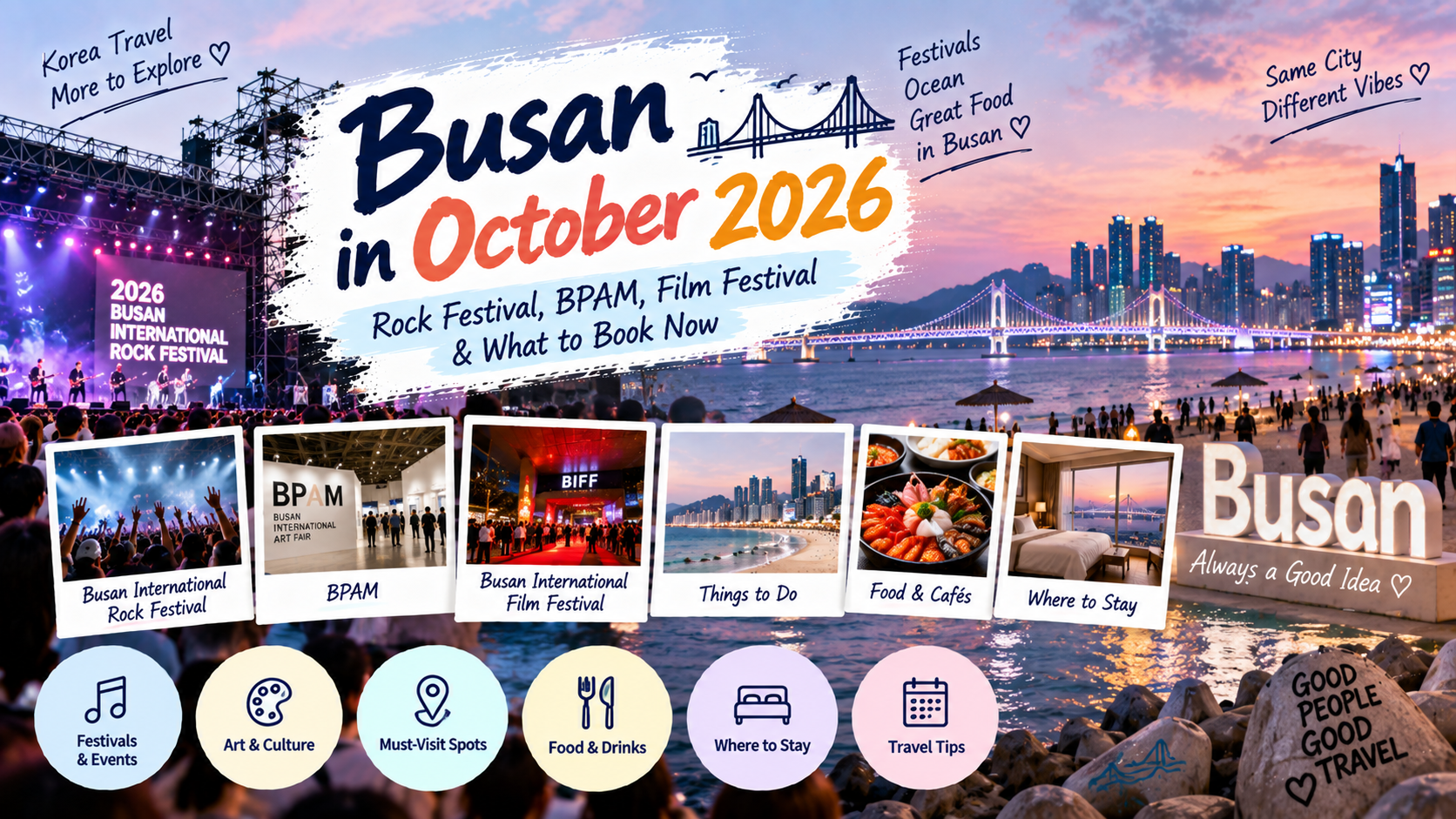
October is one of the easiest months to recommend for a trip to Busan.
The intense summer heat is fading, evenings are more comfortable for walking along the coast, and the city’s autumn cultural calendar is packed with events.
For travelers visiting in October 2026, that means you can build a trip around live music, performing arts, film culture, night markets and Busan’s famous beaches — without making the entire itinerary dependent on one festival.
The trick is knowing which events are worth planning around, which experiences can stay flexible, and how much time you actually need in a city that is much larger than many first-time visitors expect.
Before your trip, check the official Visit Busan events calendar for last-minute additions and schedule changes.
Why Visit Busan in October?
Busan in October works particularly well for travelers who want to spend a lot of time outdoors.
Summer in Korea can be hot and humid. By October, walking-heavy itineraries generally become much easier.
That matters in Busan because many of the city’s best experiences involve being outside:
Gwangalli Beach at night,
Haeundae and Dongbaekseom,
coastal walks,
Gamcheon Culture Village,
traditional markets,
and neighborhoods that are more enjoyable when you can simply wander.
October is also one of Busan’s strongest cultural months.
Busan International Rock Festival — October 2–4
One of the biggest early-October events is the Busan International Rock Festival, scheduled for October 2–4, 2026.
If live music is one of the reasons you’re coming to Busan, treat the festival as the main event of the day rather than trying to squeeze it between five tourist attractions.
A better festival day looks like this:
slow breakfast,
one nearby attraction,
early lunch,
festival,
late dinner if you still have energy.
Trying to visit Gamcheon, Jagalchi, Haeundae and Gwangalli before a full music festival is a good way to spend most of your day in transit.
Always confirm the latest lineup, ticket conditions and venue information through official festival channels shortly before your visit.
BPAM — Busan International Performing Arts Market
The Busan International Performing Arts Market, or BPAM, also takes place in early October.
Despite the word “market,” this is not a food market or shopping event.
It is connected to performing arts and brings together performances and arts-industry programs.
For international visitors interested in Korean culture beyond K-pop, palaces and food, October can therefore be a good time to encounter contemporary theater, dance and other performing arts in Busan.
Check individual performances before planning around them because accessibility for non-Korean speakers will vary.
Visual performance and dance may be easier to enjoy without Korean than dialogue-heavy theater.
Busan’s Film Culture
Busan and cinema are closely connected.
Even outside a specific screening, the Busan Cinema Center is an important part of the city’s contemporary cultural identity.
In Korean, search:
영화의전당
If film is one of the main reasons for your October trip, choose your accommodation after checking where your actual screenings and events are located.
Busan is not compact enough to assume that any hotel described as “central” will be convenient for every venue.
Starry Sea Busan Night Market — Until October 18
Another useful October option is the Starry Sea Busan Night Market, which runs from September 26 through October 18, 2026.
It takes place at Hwamyeong Ecological Park and combines Korean traditional alcohol, food, picnic areas and hands-on activities.
The market gives you a very different Busan evening from Gwangalli or Haeundae.
Instead of ocean views and dense tourist neighborhoods, the setting is around the Nakdong River and ecological park area.
If you’re staying in Busan for three or more nights, this is exactly the type of experience that can make the trip feel less repetitive.
See the latest details through Visit Busan’s official event information.
Gwangalli Is Still Worth a Night Without a Festival
Not every evening needs a ticketed event.
Gwangalli is one of the simplest places to spend an autumn evening.
Arrive before sunset.
Find a café.
Walk along the beach.
Have dinner.
Then return to the waterfront after dark to see Gwangan Bridge illuminated across the water.
This is a good reminder when planning an event-heavy trip: temporary festivals should improve your itinerary, not take it over completely.
Haeundae After Summer
Haeundae has a different atmosphere once the peak summer beach season is over.
You can still enjoy the waterfront, but October is better suited to walking and exploring nearby areas rather than treating the beach purely as a swimming destination.
A Haeundae day can include:
Haeundae Beach,
Dongbaekseom,
The Bay 101 area,
Cheongsapo,
or coastal areas toward Songjeong.
Don’t automatically combine all of them.
Choose based on the weather and how much walking you actually want to do.
Gamcheon and Nampo-dong
For first-time visitors, the older downtown side of Busan is still worth a day.
You can combine:
Gamcheon Culture Village
with
Jagalchi Market
and
Nampo-dong / BIFF Square
much more naturally than trying to add Haeundae in the middle of the same route.
This is one of the most useful Busan planning principles:
group attractions geographically.
A map may make Busan look manageable.
Repeatedly crossing the city makes it feel much bigger.
How Many Days Do You Need in Busan?
For a first trip, I would recommend at least two nights.
Three nights is better if you’re attending an October event.
2 Nights
Day 1: Arrive → Gwangalli
Day 2: Haeundae or Nampo/Gamcheon
Day 3: Morning sightseeing → departure
3 Nights
Day 1: Arrival + Gwangalli
Day 2: Major festival or event
Day 3: Classic Busan sightseeing
Day 4: Relaxed breakfast → departure
That extra night prevents the trip from becoming a race.
Where to Stay in Busan
Your best neighborhood depends on the itinerary.
Haeundae
Choose Haeundae if beaches, coastal attractions and eastern Busan are the priority.
Gwangalli
Good for travelers who want cafés, restaurants and one of Korea’s best urban night views.
Seomyeon
A practical urban base with useful transportation connections.
Nampo
Good for Jagalchi, BIFF Square and the older downtown area.
Do not choose a hotel simply because an online list says it is in the “best area.”
Choose the area that reduces your travel time.
How to Get to Busan from Seoul
For many international travelers, the KTX from Seoul Station to Busan Station is the easiest option.
The train makes a Seoul + Busan itinerary very practical.
But book earlier around:
weekends,
major festivals,
and Korean public holidays.
Also remember that arriving at Busan Station does not mean you’ve arrived at Haeundae.
Busan Station is in the older central part of the city, while many famous beach attractions are farther east.
Allow for the final local journey.
Should You Fly Instead?
Sometimes.
A domestic flight can make sense depending on your itinerary.
If you’re coming from Jeju, for example, flying to Gimhae International Airport is much more logical than returning to Seoul first.
If you’re already in central Seoul, however, KTX can be extremely convenient because you avoid airport check-in and airport transfers.
Compare the door-to-door time, not just the advertised flight time.
Sample 3-Day October Itinerary
Day 1 — Gwangalli
Arrive in Busan.
Check in.
Head to Gwangalli in the afternoon.
Walk the beach.
Have dinner nearby.
Stay for the bridge lights.
Day 2 — Event Day
Keep the morning intentionally light.
Visit one attraction close to your event venue.
Eat early.
Attend the festival, performance or screening.
Leave the rest of the evening flexible.
Day 3 — Choose One Side of Busan
Option A:
Gamcheon Culture Village
Jagalchi
Nampo-dong
Option B:
Haeundae
Dongbaekseom
Cheongsapo or another eastern coastal area
Both are good.
Doing both in a rushed half-day is not.
What Is Busan Weather Like in October?
October is generally a transitional autumn month.
Daytime can still feel pleasantly mild, while evenings near the sea may feel cooler.
Bring layers.
A light jacket is useful after sunset, particularly around Gwangalli and Haeundae.
Comfortable shoes matter more than you might expect.
Busan includes hills, large subway stations and coastal walking routes.
Rainy-Day Backup Plans
Do not assume every October day will be clear.
Useful indoor or mixed-weather options include:
museums,
shopping complexes,
cafés,
Busan Cinema Center programming,
and indoor attractions around major commercial districts.
Build one or two alternatives into your itinerary instead of forcing a coastal walk during bad weather.
What Should You Book First?
If you’re traveling for a major October event, use this order:
1. Seoul–Busan transportation
2. Hotel
3. Festival/event tickets
4. Special experiences
5. Restaurants
Why transportation first?
Because a perfect concert ticket is much less useful if your preferred KTX is sold out.
Don’t Trust Last Year’s Event Article
This is especially important in October.
A 2025 festival article can still appear high in Google.
Always check the year.
Verify:
dates,
venue,
ticket conditions,
opening hours,
transportation notices,
and weather-related changes
against the official 2026 information.
Korean Search Terms
부산 10월 축제 — Busan October festivals
부산국제록페스티벌 — Busan International Rock Festival
부산 공연 — Busan performances
영화의전당 — Busan Cinema Center
광안리 — Gwangalli
해운대 — Haeundae
부산 야시장 — Busan night market
부산 가볼만한 곳 — things to do in Busan
Is October Better Than Summer?
It depends on why you’re visiting.
If you want peak beach season and swimming, summer has obvious advantages.
But if you care more about:
walking,
festivals,
food,
neighborhoods,
cafés,
coastal views,
and evenings outside,
October can be easier and more enjoyable.
Final Thoughts
Busan deserves more than being treated as “the second city after Seoul.”
October makes that especially obvious.
You can watch live music, explore contemporary Korean performance, spend a night beside Gwangan Bridge, eat at a riverside night market and still have enough permanent attractions to fill several days.
The best approach is not to schedule every festival you find.
Choose one or two temporary experiences, then build the rest of your trip around Busan itself.
That way, even if the weather changes or an event schedule shifts, the trip still works.
Leave a Reply