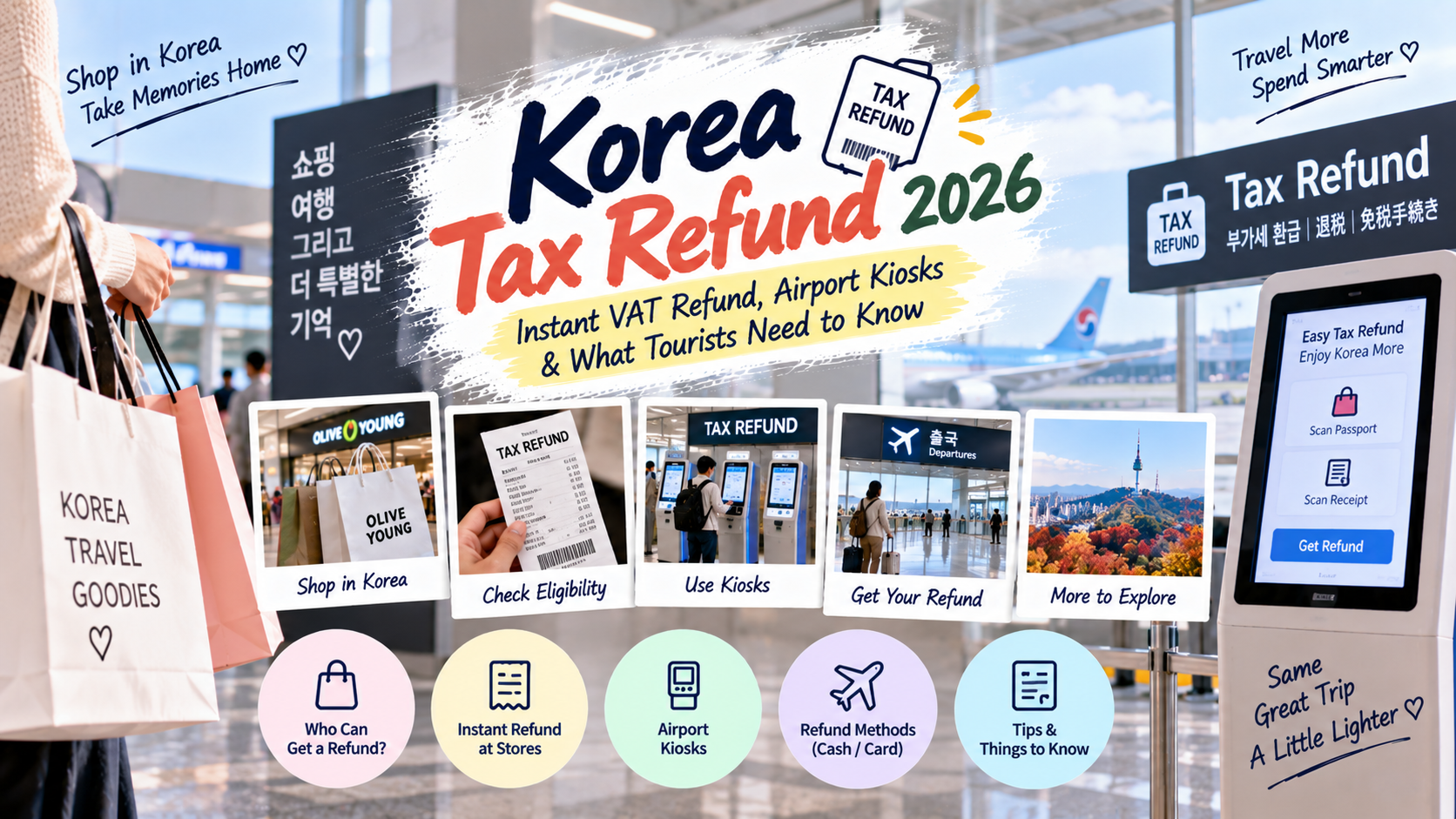
Shopping in Korea is easy.
Understanding the tax refund can be less obvious.
You buy skincare in Myeongdong.
The cashier asks for your passport.
One store deducts the tax immediately.
Another gives you a refund slip.
A department store tells you to use a kiosk.
Then someone online says you have to do everything again at Incheon Airport.
So which version is correct?
Potentially all of them.
Korea uses several tourist tax-refund methods, and what happens depends on the shop, purchase amount and refund operator.
The good news is that the system is much easier once you understand the three main options:
immediate tax refund at the store, downtown refund, or refund after customs confirmation when you depart Korea.
Here is the practical 2026 version.
The Most Important Number: KRW 15,000
Visit Seoul’s current tax-refund guide lists a minimum purchase of KRW 15,000 for eligible foreign tourists, while Incheon Airport’s current departure guide instructs travelers making refund-eligible purchases over KRW 15,000 to request the receipt and refund documents at the store.
For trip planning, think of ₩15,000 as the current official threshold to know, while letting the store’s tax-refund system determine whether your particular transaction qualifies.
This is important because you may still find older Korea travel pages online using higher purchase thresholds.
Use current official information, not a screenshot from several years ago.
Who Is Eligible?
According to Visit Seoul’s current guidance, a foreign tourist generally qualifies when they have stayed in Korea for less than six months and purchase eligible goods within three months of departure.
The refund applies to eligible purchases at participating tax-refund stores.
That last part matters.
A receipt from a random business does not automatically become tax refundable simply because you are a tourist.
Look for tax-refund participation before paying.
Tax Refund Is Not the Same as Duty-Free
This causes a lot of confusion.
A duty-free shop — such as the duty-free shopping areas travelers associate with airports or designated downtown duty-free stores — operates under a different system.
A tourist tax-refund store sells ordinary goods including domestic tax, then processes or documents the refund for eligible foreign visitors.
You may see signs such as:
TAX FREE
TAX REFUND
Global Blue
Global Tax Free
or other refund-company branding.
Do not rely only on the words “tax free.”
Ask what procedure applies to your purchase.
Option 1: Immediate Tax Refund
This is the easiest version.
At participating stores, the tax is deducted during payment, so you do not have to wait until the airport to receive that refund.
Visit Seoul’s current rules state that an immediate-refund purchase must be under KRW 1,000,000, while the total amount of purchases processed under this system must remain under KRW 5,000,000 during one trip.
You will normally need to prove tourist eligibility, so having your passport information available matters.
If the cashier can process an immediate refund, it is usually the most convenient choice.
You pay the reduced amount and continue your trip.
Does Every Store Offer Immediate Refund?
No.
A store can participate in tourist tax refunds without necessarily processing every purchase as an instant deduction at the register.
Different stores use different refund operators and systems.
Some have self-service kiosks.
Some issue a document for later refund.
Some larger retailers integrate the process into checkout.
And some stores do not participate at all.
So before a large purchase, ask.
A simple Korean phrase is:
택스 리펀드 돼요?
“Can I get a tax refund?”
Or simply show the phrase Tax Refund on your phone.
Option 2: Downtown Tax Refund
Korea also has systems that let eligible travelers receive the refund before reaching the airport.
Visit Seoul describes this as a downtown tax refund, where the refund can be processed at a booth or kiosk before final customs clearance.
The important part is that receiving the money downtown does not necessarily mean your departure obligations disappear.
You still have to complete any required customs/export confirmation when leaving Korea.
Think of this as:
get the refund first, prove export when departing.
Not:
get refund, forget everything else.
Keep your paperwork.
Option 3: Refund When Leaving Korea
This is the traditional process and the one many travelers still encounter.
You buy from a participating shop.
You request the tax-refund receipt or documentation.
You keep the goods and documents.
Then you complete the departure process and receive the refund according to the refund operator’s instructions.
The current Visit Seoul tax-refund guide explains the general sequence as purchase → customs export approval → refund.
Always Ask for the Refund Documents at Purchase
Do not wait until your final day and assume an ordinary receipt can magically be converted into a tax-refund form.
Incheon Airport’s official guide specifically warns that travelers should request the purchase receipt and tax-refund documents when buying eligible goods and must keep them until departure. It also notes that a refund can be refused when the required documents were not requested or were completed incorrectly.
That means your airport strategy actually starts inside the shop.
Before leaving the counter, check that you received what you need.
Do You Need Your Passport When Shopping?
For tax-refund processing, passport information matters.
Incheon Airport’s current guidance explicitly states passport required when requesting refund documentation for eligible purchases.
Some systems may be able to use passport information electronically.
But if tax refund is important to you, do not assume a photograph of your passport is accepted everywhere.
The lowest-risk approach is to have the required identity document available when making major purchases.
What About Cosmetics?
Cosmetics are one of the most common reasons international visitors encounter Korea’s tax-refund system.
The rule is not “all cosmetics are automatically tax free.”
The store must participate, and the transaction must meet the relevant conditions.
Large beauty chains and tourist-heavy shopping districts often make the process very visible.
Smaller independent stores may not.
Check before paying if the refund matters to your purchase decision.
Clothing, Fashion and Department Stores
The same logic applies.
Many major department stores and visitor-oriented retailers offer tax-refund support.
But the exact refund counter, floor, kiosk or checkout method depends on the business.
If you are spending a significant amount in one department store, ask the information desk:
Where is the tax refund counter?
It can save you from returning to the same floor later.
Why You Should Keep the Goods Accessible
Tax refund is based on the idea that eligible goods are being exported from Korea.
Customs can require inspection.
Incheon Airport’s current instructions say that when inspection is requested, travelers must show their passport, purchased goods and purchase confirmation; the airport specifically describes inspected goods as unopened and unused.
Do not bury every refund purchase under a suitcase full of clothes and then discover customs wants to see it.
This becomes especially important for checked baggage.
The Big Checked-Baggage Mistake
Imagine this:
You bought several hundred thousand won of skincare.
You put everything in your checked suitcase.
At the airline counter, you hand over the bag.
It disappears onto the baggage belt.
Then you go to the tax-refund process and customs asks to see the products.
Now you have a problem.
Incheon Airport gives a specific procedure for this.
If refund-eligible goods are going into checked baggage, tell the airline staff before the bag is sent away.
The airport instructs travelers to have the baggage tagged, reclaim it for the refund/customs process when required, and then place the customs-cleared bag on the large-baggage conveyor beside the customs desk.
This is one of the most useful details to know before departure.
If You Carry the Goods On Board
The process is easier.
Incheon Airport says travelers keeping refund items with them should receive their boarding pass, keep the eligible goods and documentation out of checked baggage, and use the departure-hall kiosk.
If the system requests customs inspection, present your passport, goods and purchase confirmation at the customs desk.
Again, leave enough airport time.
Do not begin this process when your gate is already boarding.
Incheon Airport Terminal 1 Refund Counter
As of the current 2026 airport guide, the staffed domestic tax-refund desk in Terminal 1 operates from:
7:00 AM to 10:00 PM
It is located in the duty-free area on the third floor near Gate 28.
These details can change, so check the official Incheon Airport tax-refund page if your trip is months away.
Incheon Airport Terminal 2 Refund Counter
The current Terminal 2 staffed desk operates from:
7:00 AM to 9:30 PM
It is near Gate 253, across from Gate 250, on the third floor in the duty-free zone.
Know your terminal before you leave Seoul.
Tax-refund instructions at Terminal 1 do not help if your airline departs from Terminal 2.
What If Your Flight Is Very Early?
This is where the automated kiosks matter.
Incheon Airport currently lists tax-refund kiosks in the duty-free zones of both Terminal 1 and Terminal 2 as operating 24 hours.
The airport says travelers can scan their passport and receive the approved refund according to the recorded transaction. It also notes that refunds can be credited to the traveler’s own credit card when the amount is large or cash is not preferred.
That makes early-morning and late-night departures much more manageable.
Cash or Credit Card Refund?
The available method depends on the refund operator, approval and kiosk/counter system.
At Incheon, the official guide explicitly provides credit-card refund as an option in certain cases.
If you are leaving Korea and do not need more Korean won, a card refund can also be more useful than receiving cash shortly before boarding.
But processing time to the card account can vary.
Do You Get Exactly 10% Back?
Do not build your shopping budget around the assumption:
₩100,000 purchase = exactly ₩10,000 cash back.
Korea’s standard VAT rate may lead travelers to make that calculation, but the actual tourist refund displayed by the refund system can differ based on the taxable amount and refund structure.
The practical rule is simpler:
Use the refund amount shown by the shop or refund operator.
Treat that as your actual benefit.
Are All Purchases Combined?
Not necessarily in the way travelers expect.
The ₩15,000 eligibility threshold applies to the qualifying purchase under the relevant refund process, while immediate-refund limits also apply to individual purchases and the cumulative trip total.
Do not assume you can collect ten tiny receipts from unrelated shops and combine them yourself into one qualifying transaction.
Let the participating retailer or refund system determine the eligibility.
What Does “Within Three Months of Departure” Mean?
Visit Seoul states that eligible goods should be purchased within three months of departure from Korea.
For an ordinary one- or two-week vacation, this is not something you need to worry about.
It matters more to long-stay visitors.
Shopping in Myeongdong
Myeongdong is one of the easiest places to encounter tax-refund systems because it serves so many international shoppers.
If shopping is an important part of your trip:
bring your passport,
ask about immediate refund before paying,
keep refund documents together,
and do not throw away receipts while cleaning out your bag.
A small envelope or zip pouch for tax-refund documents can save you a lot of confusion on departure day.
Shopping in Seongsu or Hongdae
Trendy neighborhoods have a mix of major brands, pop-ups and independent stores.
Do not assume that every fashionable shop has the same tourist-refund system as a department store.
Ask.
This is especially important at temporary pop-ups where payment and refund procedures may be different from a brand’s permanent retail store.
Traditional Markets
A traditional market purchase is not automatically part of the tourist VAT-refund system.
Some individual businesses may participate.
Many will not.
If you are buying food, small souvenirs or low-cost goods at a market, the tax refund should not be the center of your decision.
For payment planning more generally, our Do You Need Cash in Korea? guide explains cards, ATMs and when Korean won is useful.
Departing From an Airport Other Than Incheon
Do not copy Incheon Airport’s Gate 28 or Gate 253 instructions if you are flying from Gimpo, Gimhae, Jeju or another airport.
The general tax-refund logic is similar.
The counter and kiosk locations are not.
Check your actual departure airport’s current information.
This is especially relevant for travelers who enter through Incheon but fly to Japan from Gimpo or Busan.
What If You Leave Korea by Ferry?
Again, the concept is the same but the departure procedure differs.
Use the refund operator and port information for your actual exit point.
An “airport tax refund guide” should never be treated as universal customs instructions for every Korean border point.
Seven Common Tax-Refund Mistakes
1. Shopping at a non-participating store.
Being a foreign tourist does not make every purchase refundable.
2. Forgetting to request the tax-refund document.
An ordinary receipt may not be enough later.
3. Throwing away paperwork.
Keep it until you have completed the process.
4. Checking the suitcase too early.
If customs may need to inspect goods, follow the baggage procedure first.
5. Using or opening goods that may require inspection.
Incheon Airport’s current customs process refers to inspected refund items as unopened and unused.
6. Arriving at the airport too late.
Tax refund is an additional departure task, not a reason airport security will hold the plane.
7. Confusing immediate refund with “nothing else can ever be required.”
Follow the instructions attached to your actual transaction.
My Practical Tax-Refund Routine
If I were helping a first-time visitor, I would keep it this simple.
At a participating store:
ask whether immediate tax refund is available.
If yes, use it.
If not:
get the proper tax-refund document.
Keep all refund receipts in one place.
On the final night:
separate refund items that may need inspection.
At the airport:
do not send checked refund goods away before understanding whether customs needs them.
Then follow the kiosk/customs/refund sequence shown at your terminal.
That is much easier than trying to learn the entire system while standing beside your suitcase at Incheon Airport.
Korean Terms to Save
택스 리펀드 — tax refund
사후면세 — tourist VAT refund / post-purchase tax exemption system
즉시환급 — immediate refund
환급창구 — refund counter
환급 키오스크 — refund kiosk
세관 — customs
출국장 — departure hall
여권 — passport
영수증 — receipt
면세점 — tax-free / duty-free store depending on context
FAQ
What is the minimum purchase for a Korea tax refund in 2026?
Visit Seoul currently lists a KRW 15,000 minimum purchase, while Incheon Airport tells travelers buying eligible goods over ₩15,000 to request the refund receipt and documentation.
Who can get a tax refund?
Visit Seoul currently lists foreign tourists who have stayed in Korea for less than six months and meet the purchase/export conditions.
Can I get the tax refund immediately in the store?
At participating immediate-refund stores, yes. Current Visit Seoul rules say each purchase must be below ₩1,000,000 and total immediate-refund purchases during one trip must be below ₩5,000,000.
Do I need my passport?
Passport information is required for the refund process. Incheon Airport’s official shopping instructions explicitly say passport required when requesting refund documents.
Can I put tax-refund items in checked luggage?
Yes, but if customs verification is required, follow the airport’s special checked-baggage procedure before sending the suitcase away. At Incheon, tell the airline staff first and keep the goods available for customs inspection.
Are the tax-refund kiosks at Incheon Airport open 24 hours?
The current airport guide lists automated refund kiosks in Terminal 1 and Terminal 2 as 24-hour services.
Is the staffed refund counter open 24 hours?
No. Current listed hours are 7 AM–10 PM in Terminal 1 and 7 AM–9:30 PM in Terminal 2.
Is duty-free shopping the same as a tourist tax refund?
No. Duty-free purchasing and a VAT refund from an ordinary participating retailer are different systems.
Final Thoughts
Korea’s tax-refund system sounds complicated when you read five different versions of it online.
At the shopping counter, it is usually much simpler.
Ask whether the store participates.
Use immediate refund when available.
Keep the correct documents when it is not.
Keep potentially inspectable goods accessible.
And give yourself enough time at the airport.
The most important 2026 numbers to remember are:
₩15,000 — current official minimum-purchase reference
under ₩1,000,000 — immediate-refund single-purchase limit
under ₩5,000,000 — immediate-refund cumulative trip limit.
If you are departing through Incheon, check the official Incheon Airport tax-refund instructions again shortly before your flight.
And if you are still planning the airport side of your trip, our Incheon Airport to Seoul guide covers AREX, airport buses and taxis.
Tax refund should save you money.
It should not be the most stressful part of your final day in Korea.
Leave a Reply