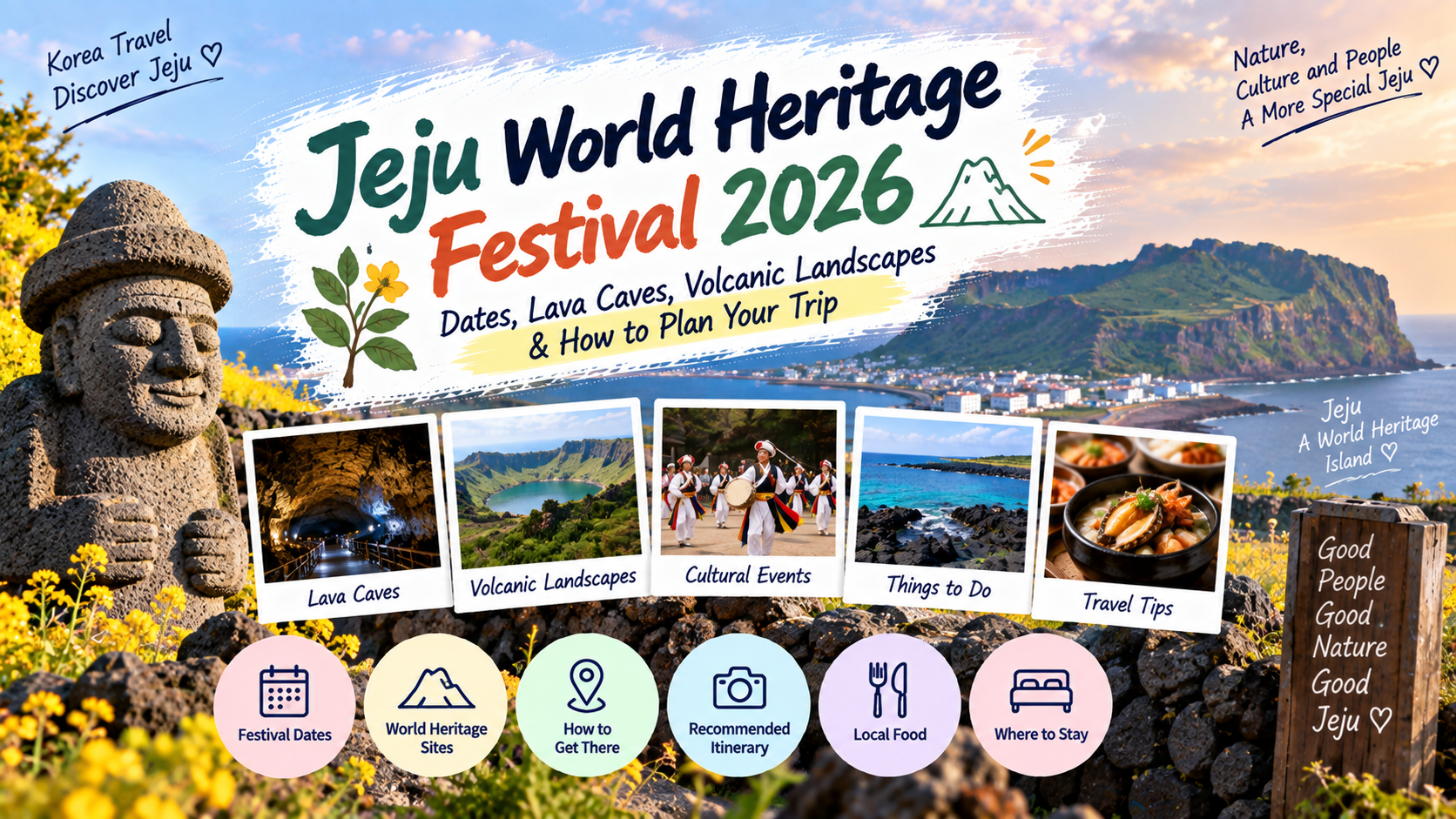
Jeju is famous for beaches, waterfalls and cafés, but some of the island’s most important landscapes exist for a much bigger reason.
Jeju Volcanic Island and Lava Tubes is a UNESCO World Heritage property, created by the volcanic processes that shaped the island itself.
And from October 3 to October 18, 2026, Jeju is putting that heritage at the center of a major autumn event: the 2026 World Heritage Festival – Jeju Volcanic Island and Lava Caves.
The official Visit Jeju tourism portal currently lists the festival for October 3–18 as one of the island’s major October events.
For international travelers, this is interesting because it offers a way to understand Jeju beyond its Instagram scenery.
You are not simply looking at a mountain or a cave.
You are looking at the geological story that created the island.
Jeju World Heritage Festival 2026 at a Glance
Dates: October 3–18, 2026
Destination: Jeju Island
Theme: Jeju’s volcanic World Heritage landscapes and their inheritance
Best for: Nature lovers, hikers, geology fans, photographers, repeat Jeju visitors and travelers who want more than cafés and beaches
The exact individual program schedule should be checked close to your visit because heritage walks, performances and special access programs may have different dates and reservation conditions.
Visit Jeju specifically notes that festival schedules can change and recommends checking its current Festivals & Events listings before visiting.
Why Is Jeju a UNESCO World Heritage Site?
Jeju is a volcanic island.
That sounds obvious until you start noticing how much of the landscape was actually created by volcanic activity.
Oreums — the small volcanic cones scattered around the island — appear everywhere.
Dark volcanic stone walls divide fields.
Lava formed underground cave systems.
Hallasan rises from the center of the island.
And Seongsan Ilchulbong stands dramatically on the eastern coast.
The UNESCO designation brings several of these geological elements together as one connected natural story.
That is why a World Heritage Festival makes more sense here than a conventional festival stage with food stalls and music.
The landscape itself is the main attraction.
Seongsan Ilchulbong
For most first-time international visitors, Seongsan Ilchulbong is the easiest World Heritage landscape to add to a normal Jeju itinerary.
Korean:
성산일출봉
The volcanic tuff cone rises directly beside the sea in eastern Jeju.
It is particularly famous for sunrise, which explains the English nickname “Sunrise Peak.”
But you don’t have to arrive before dawn.
If you’re not a morning person, visit during normal daylight and combine it with other eastern Jeju attractions.
The important thing is to understand what you’re looking at rather than simply climbing for a photograph.
Hallasan
Hallasan dominates the center of Jeju.
Korean:
한라산
It is South Korea’s highest mountain and one of the defining features of the island.
A serious Hallasan hike is not something to casually insert between a café and a museum.
Routes take time.
Weather changes.
And depending on the route and current management rules, reservation or access conditions can apply.
Check the current official mountain information before hiking rather than relying on an old travel blog.
If hiking Hallasan is a priority, build the entire day around it.
Jeju’s Lava-Tube Landscape
The lava-tube system is another essential part of Jeju’s World Heritage story.
However, this is an area where travelers should be particularly careful with old information.
Individual caves or sections can close for conservation, safety, restoration or research.
Never assume that a cave mentioned in a five-year-old itinerary is currently open to ordinary visitors.
The World Heritage Festival may also provide special interpretation or programs that are not available during a normal visit.
Check the official festival and heritage-site notices for your exact dates.
Don’t Try to See Every Heritage Site in One Day
Jeju looks small on a map.
That creates bad itineraries.
A visitor sees:
Hallasan,
Seongsan Ilchulbong,
a lava cave,
a waterfall,
a beach,
and a café
and thinks they can simply connect the dots.
In reality, driving time adds up quickly.
For a three-day trip, divide Jeju geographically.
A Better 3-Day World Heritage Itinerary
Day 1 — Eastern Jeju
Start with Seongsan Ilchulbong.
Have lunch in the eastern part of the island.
Add one nearby attraction rather than driving across Jeju.
If a World Heritage Festival program is operating nearby, make that your afternoon activity.
Day 2 — Hallasan or Mid-Mountain Jeju
Choose a hiking day if conditions are suitable.
If you don’t want a major hike, explore one or two easier volcanic or forest landscapes instead.
Do not schedule an important evening reservation after an exhausting mountain day.
Day 3 — Flexible Jeju
Use your final day for whichever part of the island you have not explored.
This also protects the itinerary against bad weather.
If Day 2 is rainy, swap it with Day 3.
How to Get to Jeju from Seoul
For most international travelers, the practical route is a domestic flight.
Flights operate between the Seoul area and Jeju International Airport.
There is no KTX train to Jeju.
Once on the island, transportation becomes the bigger planning question.
A rental car gives you the most flexibility for rural heritage locations.
If you don’t drive, buses and taxis can work, but you need to plan routes more carefully.
Before committing to an itinerary, enter each destination into Naver Map and check the actual travel time.
Should You Rent a Car?
For a heritage-focused itinerary, I would strongly consider it if you are comfortable driving in Korea.
The main advantage is not speed.
It is flexibility.
If rain moves in over one side of the island, you can change plans.
If you find an interesting coastal road, you can stop.
If a heritage program finishes later than expected, you aren’t immediately worried about a complicated bus connection.
That said, don’t rent a car simply because every Jeju blog says you must.
If you plan to stay mainly around Jeju City or one concentrated area, public transportation and taxis may be enough.
October Weather and What to Wear
October is one of the most attractive times for outdoor Jeju travel, but the island is exposed to wind and weather can vary.
Bring layers.
For heritage walks or volcanic landscapes:
wear proper walking shoes,
carry water,
bring a light outer layer,
and check weather conditions before leaving.
Conditions on Hallasan can be very different from the coast.
Combine the Festival With Jeju’s Other October Events
October 2026 is unusually busy on Jeju.
Visit Jeju currently lists the 65th Tamna Cultural Festival for October 17–21 and the 32nd Seogwipo Chilsimni Festival for October 23–25, in addition to the World Heritage Festival.
That creates a useful progression:
Oct 3–18: World Heritage Festival
Oct 17–21: Tamna Cultural Festival
Oct 23–25: Seogwipo Chilsimni Festival
If your trip falls in the second half of October, you may be able to combine natural heritage with traditional culture.
Useful Korean Search Terms
세계유산축전 제주 — Jeju World Heritage Festival
제주 화산섬과 용암동굴 — Jeju Volcanic Island and Lava Tubes
성산일출봉 — Seongsan Ilchulbong
한라산 — Hallasan
제주 10월 축제 — Jeju October festivals
제주 가볼만한 곳 — things to do in Jeju
Is It Worth Planning a Trip Around?
If you’re already interested in Jeju’s landscapes, yes.
But I wouldn’t think of this as a festival where you arrive at one gate and spend the entire day inside.
The more interesting approach is to let the festival change how you see Jeju.
A volcanic cone becomes more than a photo spot.
A stone wall becomes evidence of the island’s geology.
A mountain becomes part of the same volcanic system that created caves beneath the ground.
That’s the real reason to visit.
Jeju is beautiful even if you know nothing about geology.
Understanding how the island was created makes it considerably more interesting.
Leave a Reply