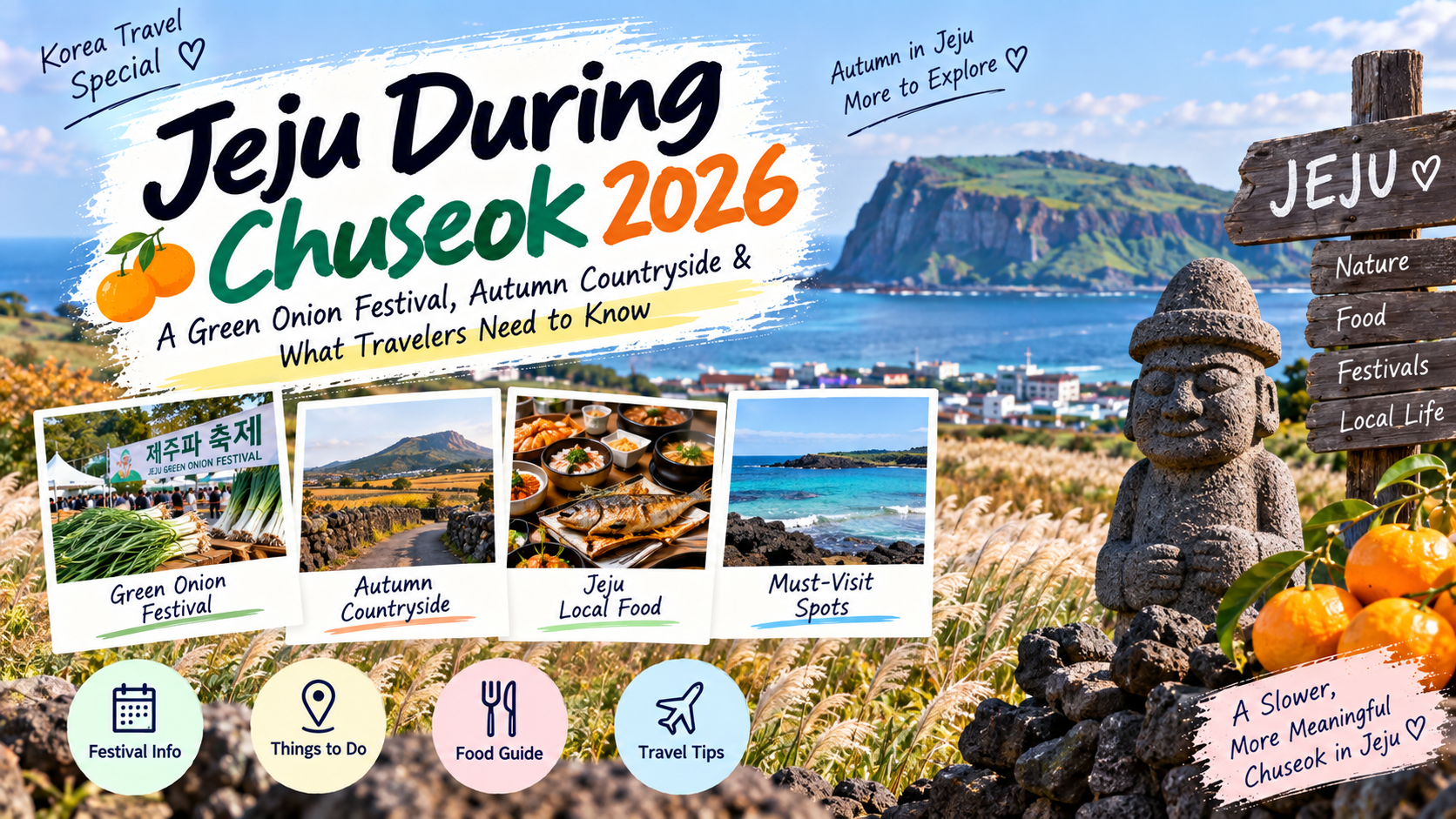
Jeju during Chuseok doesn’t have to mean crowded beaches and closed restaurants.
If you’re visiting the island over Korea’s biggest autumn holiday in 2026, there is a surprisingly local experience starting on September 24: a festival where visitors can walk through Jeju farmland, harvest green onions and taste them fresh.
Yes, green onions.
It may sound much less glamorous than a drone show in Busan or a major festival in Seoul.
But that is exactly why the 2026 Boromwat Green Onion Festival is interesting.
It offers something travelers don’t usually get from Korea’s major tourist attractions: a glimpse of Jeju’s agricultural landscape and a hands-on rural experience during Chuseok.
The official Visit Jeju festival listing describes the event as a festival where visitors can harvest and taste fresh green onions themselves, surrounded by open fields and Jeju’s volcanic landscape.
Here is how to decide whether it belongs in your Jeju itinerary.
2026 Boromwat Green Onion Festival at a Glance
Starts: September 24, 2026
End date: Until the available green onions are exhausted
Location: Boromwat, Pyoseon-myeon, Seogwipo
Address: 2350-104 Beonyeong-ro, Pyoseon-myeon, Seogwipo-si, Jeju
Korean name: 보롬왓
The festival begins just as the Chuseok holiday period gets underway.
One unusual detail is that there is no fixed closing date.
Visit Jeju states that the festival continues until the green onions allocated for the event are exhausted.
That means this is not an event where I would rely on an old itinerary several weeks later.
If the festival is the main reason for your visit, check the latest Boromwat information before you drive across the island.
What Exactly Is Boromwat?
Boromwat is in the countryside of eastern Jeju, in the Pyoseon area of Seogwipo.
This is not central Jeju City and it isn’t the dense tourist strip around Jungmun.
That’s part of the appeal.
Jeju’s image overseas is usually built around beaches, volcanic peaks, waterfalls and cafés.
But agriculture is also an important part of the island’s landscape.
Drive outside the main towns and you quickly encounter fields bordered by Jeju’s distinctive dark volcanic stone walls.
Boromwat turns that rural setting into a visitor experience.
Why Visit a Green Onion Festival?
If you’ve traveled all the way to Korea, harvesting green onions may not be the first activity on your bucket list.
But consider what most first-time Jeju itineraries look like:
Seongsan Ilchulbong.
A waterfall.
A beach.
A café.
Another café.
Maybe a museum.
All of those can be worthwhile.
But after a few days, a hands-on rural experience can become one of the more memorable parts of the trip precisely because it doesn’t feel like another conventional attraction.
Visit Jeju describes the 2026 festival around three simple elements: harvesting, tasting and the surrounding fields.
For families, that simplicity can work particularly well.
Why Chuseok Makes the Timing Interesting
Chuseok is one of Korea’s most important traditional holidays.
Food, harvest and family are central to the season.
A farm experience therefore feels unusually appropriate during this particular week.
That doesn’t mean the festival itself should be treated as a traditional Chuseok ritual. It is a contemporary visitor event.
But it does offer a more grounded connection to the harvest season than spending the entire holiday inside shopping malls.
Combine It With Eastern Jeju
The biggest mistake would be driving a long distance solely for one short activity and then driving back.
Instead, treat Boromwat as part of an eastern Jeju day.
A practical itinerary could look like this:
Morning — Seongsan Ilchulbong
Start early at one of Jeju’s best-known volcanic landmarks.
Late morning or lunch — Eastern Jeju
Eat in the Seongsan or Pyoseon area rather than returning toward Jeju City.
Afternoon — Boromwat
Visit the fields and festival.
Late afternoon — Pyoseon
Continue toward the coast or a nearby café.
Sunset
Choose your sunset location according to the weather rather than trying to cross the entire island.
This approach matters in Jeju.
Distances may look short on a map, but driving between attractions takes time.
Do You Need a Car?
For this particular type of Jeju itinerary, a rental car is the easiest option.
Jeju has public buses, but rural attractions are much easier to combine when you can control your own schedule.
If you don’t drive, check the route in Naver Map before committing to the itinerary.
Search:
보롬왓
rather than relying only on an English transliteration.
For taxi travel, save the Korean address as well.
How to Get There From Seoul
You cannot take a train from Seoul to Jeju.
For most travelers, the practical route is a domestic flight from the Seoul area to Jeju International Airport.
Once you land, you still need to travel across the island toward Pyoseon.
This is why I would not recommend Jeju as a spontaneous one-day side trip from Seoul during Chuseok.
Give the island proper time.
At least two nights makes far more sense than flying in, racing around and flying back.
Chuseok Transportation Warning
Holiday travel in Korea requires more planning than an ordinary September weekend.
Domestic flights, trains and intercity transportation can become much busier as Koreans travel to see family.
If your itinerary includes both Seoul and Jeju, secure the long-distance part of the trip before building your detailed sightseeing schedule.
The same principle applies to rental cars.
Don’t design a car-dependent Jeju itinerary and only afterward discover that the vehicle category you wanted is unavailable.
What Else Is Happening in Jeju?
One advantage of using Jeju’s official tourism portal is that it maintains a dedicated festivals and events section rather than requiring travelers to rely on old travel blogs.
The official Visit Jeju portal is the first place I would check shortly before your trip.
Event schedules in Korea can change, and smaller local festivals are especially likely to publish updates close to the date.
What to Wear
Late September is a transitional season.
For a farm visit, practical shoes matter more than fashionable ones.
If the ground is damp, white sneakers may not be your best idea.
I would bring:
comfortable closed shoes,
a light outer layer,
sun protection,
and something that can handle a little dirt.
This is a field experience, not an indoor exhibition.
What About Rain?
Outdoor agricultural events are obviously more weather-sensitive than museums or shopping malls.
Check the weather the morning of your visit.
If conditions are poor, keep a flexible backup plan.
Jeju has enough museums, cafés and indoor attractions that you don’t need to force an outdoor itinerary in bad weather.
Is It Worth It for International Travelers?
I wouldn’t fly to Jeju solely for this festival.
But if you’re already visiting Jeju over Chuseok, I think it can be a very good addition.
It works best for:
families with children,
repeat visitors to Jeju,
travelers interested in local food,
people who prefer rural scenery,
and anyone who wants something different from the standard checklist.
If this is your first and only day in Jeju, prioritize the island’s major landscapes.
If you have three or four days, this is exactly the sort of smaller local experience that can make the itinerary feel less generic.
Useful Korean Search Terms
보롬왓 — Boromwat
보롬왓 쪽파축제 — Boromwat Green Onion Festival
제주 추석 행사 — Jeju Chuseok events
표선 가볼만한 곳 — things to do in Pyoseon
제주 동쪽 여행 — eastern Jeju travel
Saving Korean search terms makes it easier to find recent local information in Naver Map.
A Better Way to Think About Jeju
Jeju is often marketed as Korea’s tropical-looking escape.
That description isn’t wrong, but it is incomplete.
The island is also farms, villages, stone walls, seasonal produce and landscapes shaped by volcanic soil.
A green onion festival is unlikely to become the most famous attraction on your Korea itinerary.
It doesn’t need to.
If you’re already on Jeju during Chuseok, spending part of a day in a field, harvesting something grown on the island and then continuing through eastern Jeju may tell you more about the place than another hour in a souvenir shop.
And that is exactly the kind of travel experience worth making room for.
Leave a Reply